
‘Onipa‘a 2013 Celebrates Queen Lili‘uokalani’s 175th Birthday
Check out the many upcoming activities put on this year by the Hawaii Ponoi Coalition in honor of the Queen’s 175th birthday at http://www.hawaiiponoi.info/!!
‘Onipa‘a 2013 Celebrates Queen Lili‘uokalani’s 175th Birthday
Check out the many upcoming activities put on this year by the Hawaii Ponoi Coalition in honor of the Queen’s 175th birthday at http://www.hawaiiponoi.info/!!

It seems that the Library of Congress websites (including Chronicling America) are undergoing maintenance, but they should be back up by 6 a.m. Eastern Time, on Monday the 19th. In the meantime, the Hawaiian-Language Newspaper websites are still up and running!!
While leaving Kapaa at 2:30 Wednesday the James Makee was blown ashore. The W. G. Hall went to her assistance and, after lightering, the vessel was taken off three hours later. Part of the keel was torn off; two knees and one beam split; part of the anchor stock stuck through the vessel three feel below water. The Mikahala escorted the Makee to port.
[It is good to at least be aware that many times, Hawaiians called things (boat, for instance) a different name from what it was called in English. Here you see the W. G. Hall mentioned. It might sound more familiar to you as the Malulani.
Spelling is also varied in Hawaiian on occasion. You would expect in the Hawaiian-Language Newspapers, the James Makee to be written Kimo Maki (which it is at times), but it is also seen as Kimo Makee, James Maki, and James Makee as well! On a somewhat related note, Ena Road in Waikiki is not pronounced like “ena” as is so often heard today from the youngsters, but it is pronounced like “ina” and refers to the old-time Ing Family. So you will see in the Hawaiian-Language Newspapers, John Ena, John Ina, Keoni Ena, Keoni Ina…
I would like to see an easy online reference done for English/Hawaiian name variants done!]
(Hawaiian Star, 1/2/1897, p. 2)
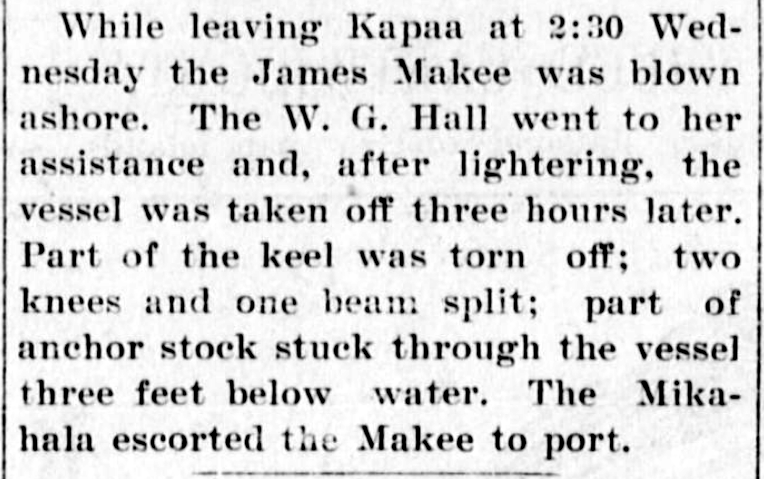
The Hawaiian Star, Volume III, Number 1160, Page 2. January 2, 1897.
I just received an email from the Library of Congress saying that Chronicling America has been updated to included 600,000 more pages of newspapers, including some from Hawaii nei!
I am excited that we can now search the Polynesian (5/18/1844 to 4/25/1863) as well as the Pacific Commercial Advertiser (7/2/1856 to 12/29/1883)!
And don’t forget that you can find Hawaii related news not only in Hawaii newspapers… Hawaiians travelled everywhere, and Hawaii got news coverage across the globe.
I will be going on a little break because I found a short-term exciting job (for pay!)… Will be back in a week or two? If you need your daily newspaper fix, maybe look back at the old posts… Or better yet, check out:
OR
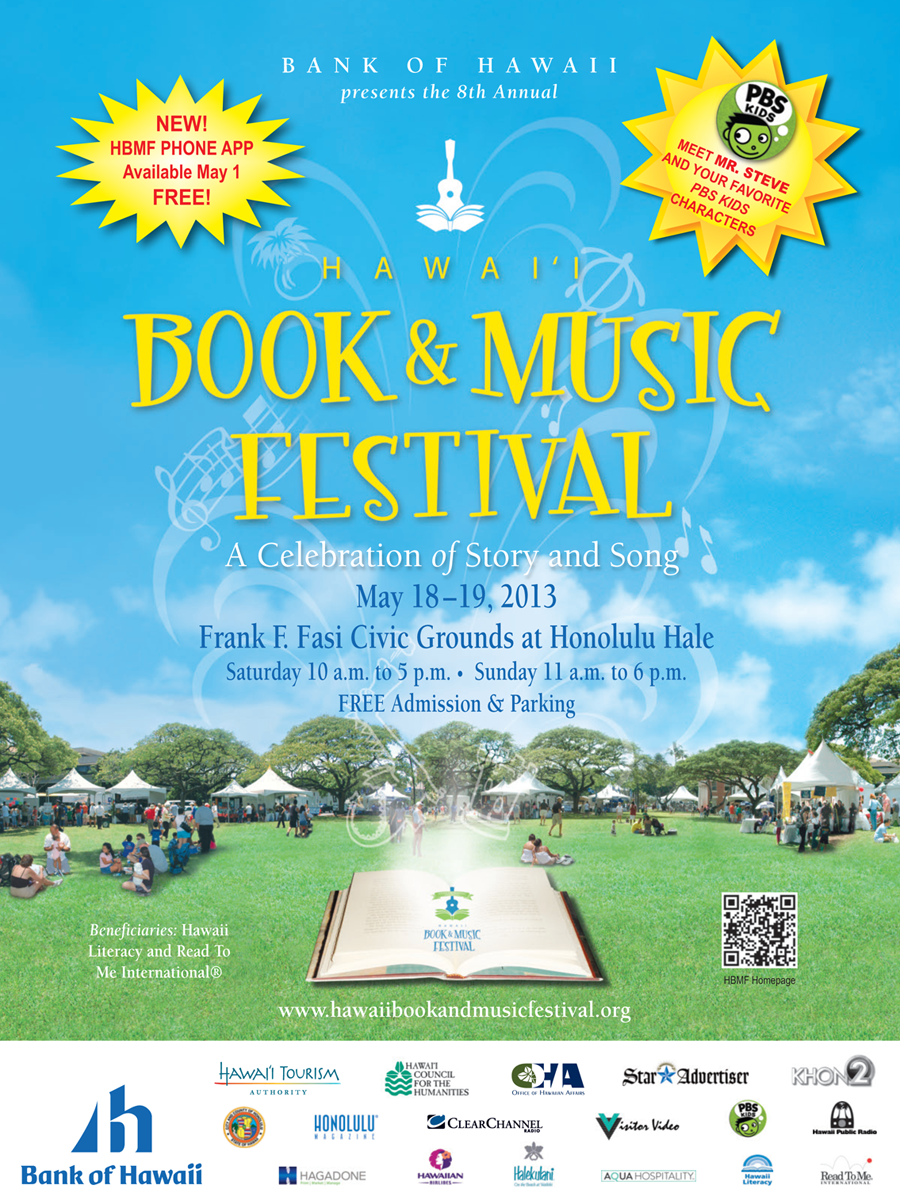
Hawaii Book and Music Festival 2013
Police Court Judge Frank Andrade this morning felt that he sat on the edge of an active volcano, for through the window over his starboard shoulder, up from the pit at the bottom of which in a cell grovelled Sweet Emalia, came discordant beseechments for a renovation of the universe and the making of a new world.
It was difficult to size up the merits between a man with an attacking hoe and a gentleman with a damaged cow when such sounds soared benchward.
“Has not the doctor been sent for to examine Sweet Emalia?” inquired His Honor.
Chief of Detectives Kalakiela stated that he had been summoned.
Then Emalia took up singing, having torn her garments to shreds, and this was less upsetting that her howling and cursing.
Emalia was taken to the station about breakfast time today from the parish of Kalihi. Neighbors rang in, calling loudly for Thwing or Parkhurst, declaring that a large lady who had forgotten her wardrobe was roaming the streets. The patrol wagon hurried out and Emalia was found without covering, making morning calls on the neighbors.
When she sighted the hurry-up she hastened to her home and donned a garment in which she was taken to the police station. There having the covering of a cell, she found the clothing superfluous and straightway made fricasee of them. She is alleged to be insane.
A lolo or stupid boy received the court’s attention. He was charged with vagrancy, sleeping in sawdust in the back parlor of a planing mill. He was open-mouthed and stare-eyed and committed to be examined with Sweet Emalia by Dr. Moore, Dr. Emerson taking a vacation.
…..
[After coming across this article from 1908 showing Sweet Emalia out in Honolulu, I am now thinking that the Emily Kaihumua sent to Kalawao in 1906 and being examined there in 1909 by Dr. Goodhue might not be the same person…
Hopefully one day soon, all the Hawaiian-Language Newspapers will be rescanned clearly so that if there is ever enough money to do once again an OCR project, or a hand transcription project, it can be done accurately so that hopefully we can find each and every available article that could clarify what became of Emalia, or any other person or event in Hawaiian history for that matter!!]
(Hawaiian Star, 8/13/1908, p. 5)
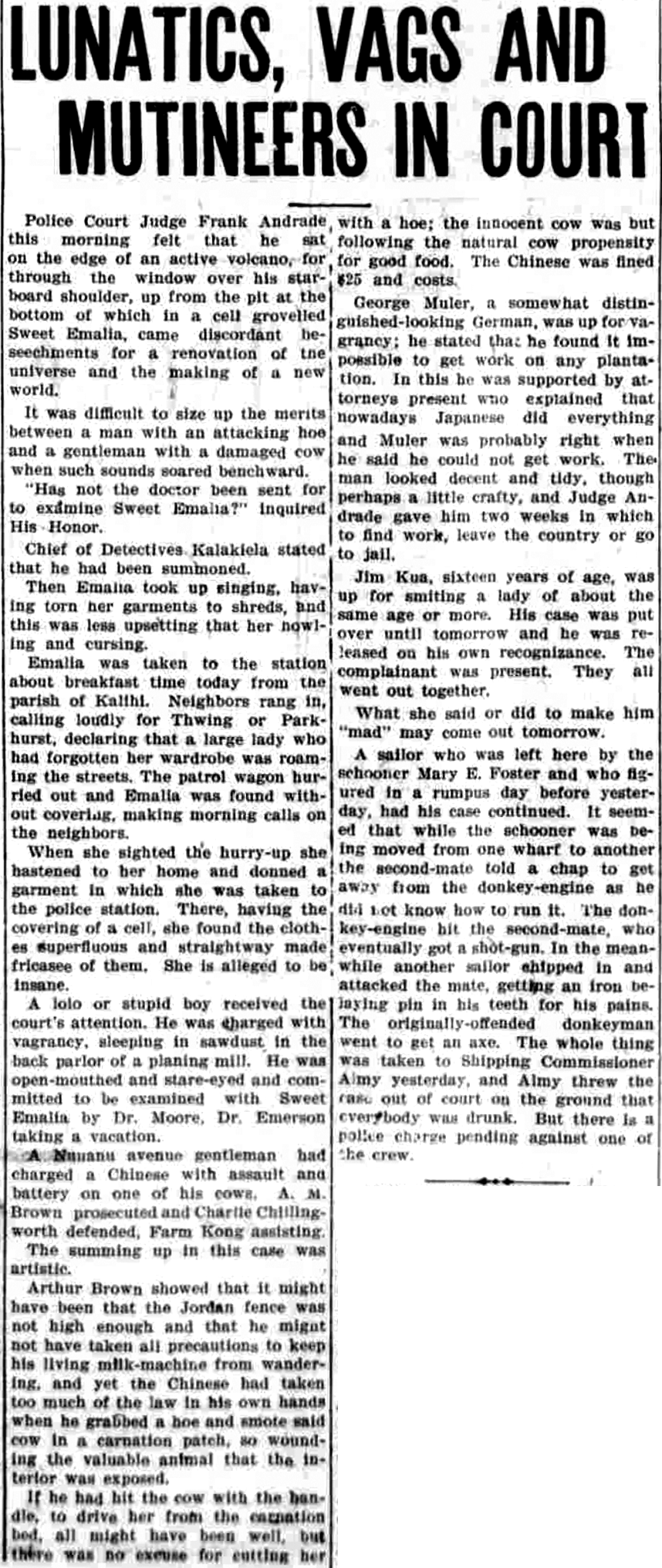
The Hawaiian Star, Volume XVI, Number 5708, Page 5. August 13, 1908.
…For all of the rare-in-the-world success that Hawaiian language revitalization has achieved in four decades, only a fraction of it has been paid for by public funds. For every dollar that’s ever been spent on teacher salaries, school rooms or curriculum, 10 times that has been expended from the pockets or personal schedules of people who dedicated their lives to making sure Hawaiian wasn’t erased by the sweep and force of English dominance. The kupuna who gave all of their golden years to learners and the teachers who create lessons from scratch are the tip of the iceberg. Unlike other places where government support of indigenous efforts is now the norm, most of the investment in Hawaiian language and culture always has been a people’s project. Hawaiian is the foundation of Hawai’i’s unique identity and knowledge base, not a useless adornment to a place with nice geography. That mind-set loses everything that makes these Islands so special. Money spent on keeping Hawai’i connected to its past and present isn’t hush money to assuage and entertain the natives, it’s an investment in Hawai’i’s continuity.
[Click here for the rest of this response to Bob Jones’ article (MidWeek 4/24/2013) which we put up in the previous post, written by Puakea Nogelmeier in the current issue of MidWeek.
What do you all think?]
Somebody surely will ask: Why are we spending $28 million in state money for the College of Hawaiian Language building at UH Hilo?
Why put all that public money into Hawaiian language when we need funds for command of the English language and delving into American political history and contemporary culture issues?
[Click here to read the rest of this piece of work penned by Bob Jones which appeared the other week in the MidWeek!]

