More on the first opening of “Pacific Hall” and the Kamehameha School for Girls, 1894.

SPECIAL DAY FOR KAMEHAMEHA SCHOOL.

Remembrance of the Birthday of the Founding Lady.

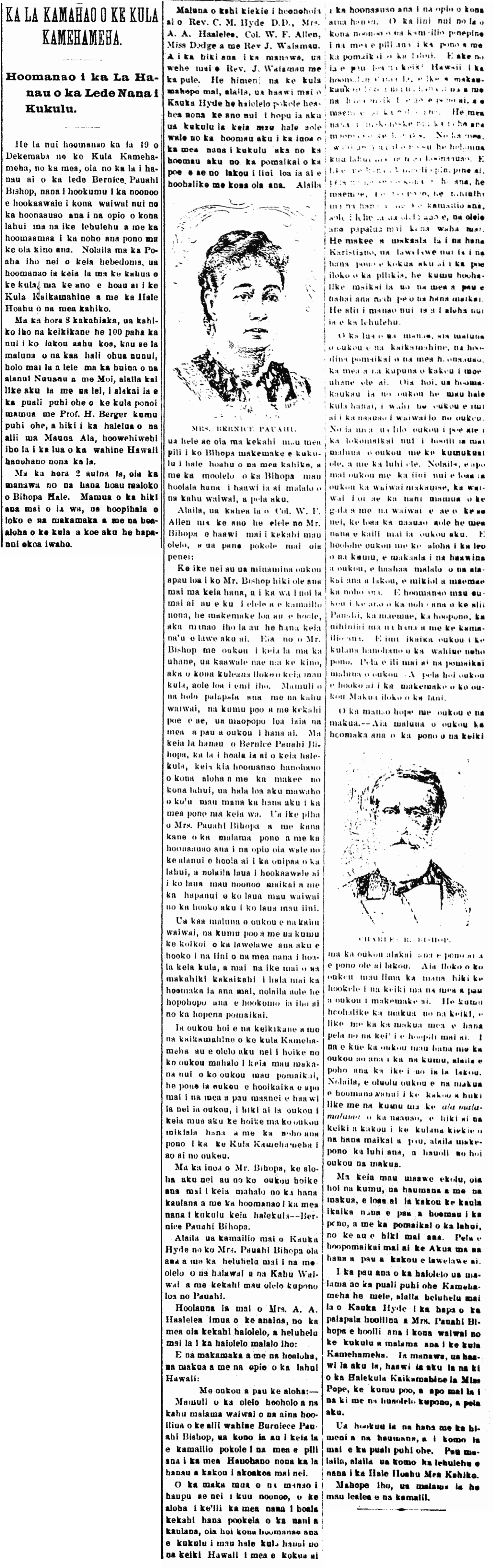
The 19th of December is a much celebrated day for Kamehameha School, for it is the day of birth of the lady, Bernice Pauahi Bishop, the one who came up with the idea to set aside her great estate for the educating of the youth of her people in the many fields of knowledge and in living healthily. Therefore on the past Thursday, the day was commemorated on the grounds of the school, by dedicating the Girls’ School and the Museum.

At 8 o’clock in the morning, perhaps 100 boys were dressed in military uniform and put aboard and rode trolleys [kaa hali ohua nunui], getting off at the corner of Nuuanu and King Streets, and from there they marched with lei, led by the school’s band in front, with Prof. H. Berger as the conductor, until the crypt of the alii at Mauna Ala, where they decorated the grave of the honorable Hawaiian woman for whom the day was for.

2 o’clock in the afternoon was the time for the dedication in Bishop Hall [Bihopa Hale]. Before the hour, the room was filled with intimates and friends of the school with a majority outside.

Rev. C. M. Hyde, D. D.; Mrs. A. A. Haalelea; Col. W. F. Allen; Miss Dodge; and Rev. J. Waiamau were sitting in a raised area. And when the time came, Rev. J. Waiamau began with a prayer. After that was a hymn by the school, and then Doctor Hyde gave a short speech of welcome of which the gist was that these structures were built not just to memorialize the name of the founder, but for the continued benefit of those who it is hoped will emulate her life. Thereafter…

MRS. BERNICE PAUAHI.

he moved on to matters dealing with Bishop’s desire to build a museum, and the story of Bishop’s planning given under the board of trustees, and so forth.

Then Col. W. F. Allen was called up as a representative for Mr. Bishop to give some words, and he spoke shortly in this manner:

I know that you all regret the absence of Mr. Bishop on this occasion, and when asked to represent and speak for him I should much rather have declined but felt it a duty to accept. That Mr. Bishop is with you today in spirit you all know, and though absent in person, he interest in these schools never wanes. By correspondence with the trustees, principals, and others, he has kept well posted in all the progress you have made. On this the natal day of Bernice Pauahi Bishop, the founders day of this Institution, such a grand monument to her love and care for her people, it is beyond my powers to do justice to the occasion or theme. Both Mrs. Bishop and her husband fully realized that the proper care and teaching of the young was the only way to insure the stability of the people, and so they have devoted their best thought, and much of their property to carry out these ideas.

To you, trustees, principals and teachers the responsibility of carrying out the wishes of the founders of this institution belongs, and from the experience of the few years since the opening, no fears are entertained of the ultimate result.

To you, boys and girls of Kamehameha School, I would say that to show your appreciation of the great gifts of your benefactors, you should ever strive to take advantage of all that is here offered you, so that in the future you can show by your industrious and virtuous lives what the Kamehameha School has done for you.

On behalf of Mr. Bishop, I thank you all for showing such an appreciation for the grand work and memory of the founder of this institution—Bernice Pauahi Bishop. [English for W. F. Allen’s speech taken from Hawaiian Star, 12/19/1894, p. 3.]

Then Dr. Hyde spoke about Mrs. Pauahi Bishop’s life, and read the minutes of meetings of the Board of Trustees as well as some appropriate words about Pauahi.

Mrs. A. A. Haalelea was introduced before the assembly because she was one of the speakers, and she read the following speech below:

O Associates and Friends, Parents and Youth of the Hawaiian People:

With all of you is my aloha:—

Because of the decision of the trustees of the estate of Bernice Pauahi Bishop, I was invited on this day to speak a bit about the Honorable one for whose birthday we are gathered.

The first thing to come to mind, is that it was the aloha of this alii which initiated this greatest work of beauty and fame, that is her idea to build boarding schools for the Hawaiian children to help educate the youth of her homeland. That was her great desire and spoke often things pertaining to the good and benefit of the lahui. [Image is unclear for a number of lines.] She was devout and vigilant in her Christian duties; she undertook many worthy causes to help those in need, and she is a fine example for all to follow after in good deeds. She was an alii who was thought much of and well loved by the people.

The second point: upon you, O Girls, is the inheritance of education, something our kupuna did not dream of. That being for you is prepared some boarding schools where you can find knowledge that will be truly valuable for you. So you will be indebted for the great kindness given upon you at no expense or trouble. Therefore, strive with great effort to acquire this precious treasure, a treasure more beautiful than gold or any of the other riches of this world; should you gain an education, there is no one that can take it away from you. Listen with aloha to the teachings of your instructors, pay attention to the lessons, be humble to their instruction, and be neat and clean in your daily life. Constantly recall the character of the alii Pauahi: her purity, righteousness, and decorum in actions and words. Always strive for the honorable standing of a woman who lives properly. In that way, you will be blessed. And in that way you will be carrying out the desire of your Father in heaven.

The last thought goes to you, O Parents.—Upon you lie the beginnings of the good character of your children…

CHARLES R. BISHOP.

…by your guidance will your children be upright or not so. Within your hands is the power to steer the children towards all that you desire. The parents are examples for the children; for instance, how a parent acts is what a child will follow. Should your actions and your instructions contradict those of the teachers’, then what is taught to them will be wasted. Therefore, O Parents, please strive to support and cooperate with the teachers on the pathway to knowledge, so that our children may reach a high level in all fine occupations, an this will make the effort worthwhile, and you, O Parents, will rejoice.

With these three plies, that being the teachers, the students, and the parents, we can get a strong cord which will hold fast and push forward the righteousness and blessings of the lahui for the coming age. In that way will God bless us in all our endeavors.

At the end of her speech, the Kamehameha band played a song, then Dr. Hyde read the portion of the will of Mrs. Pauahi Bishop giving her wealth for the building and caring for the Kamehameha School. This is when the keys of the Girls’ School handed over to Miss Pope, the principal, and she took the keys with some appropriate words, and so forth.

The activities were let out with the singing of the students, along with the band. When that was done, the crowd went in to see the Museum.

After that, some fun activities for the children were held.

[Much of the text on the top of the column on the right is hard to read. It is time that these Hawaiian-Language Newspapers were rescanned as cleanly as possible! If you can’t read the information, is it really information?]

(Kuokoa 12/22/1894, p. 2)
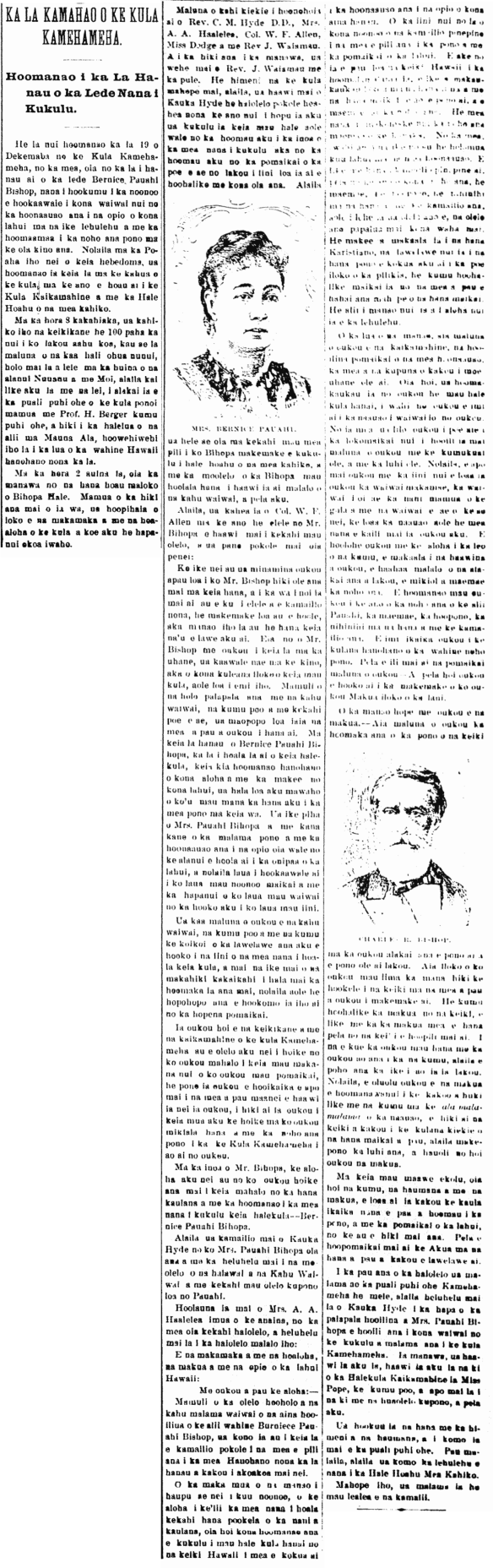
KA LA KAMAHAO O KE KULA KAMEHAMEHA.

Ka Nupepa Kuokoa, Buke 33, Helu 51, Aoao 2. Dekemaba 22, 1894.

Ben Hur translation, 1913.

FINE STORY
OF

BEN HUR

THE JEWISH BOY

A STORY FROM THE TIME
OF

CHRIST

(Translated and provided for the benefit of the readers of the Hoku.)

INTRODUCTION

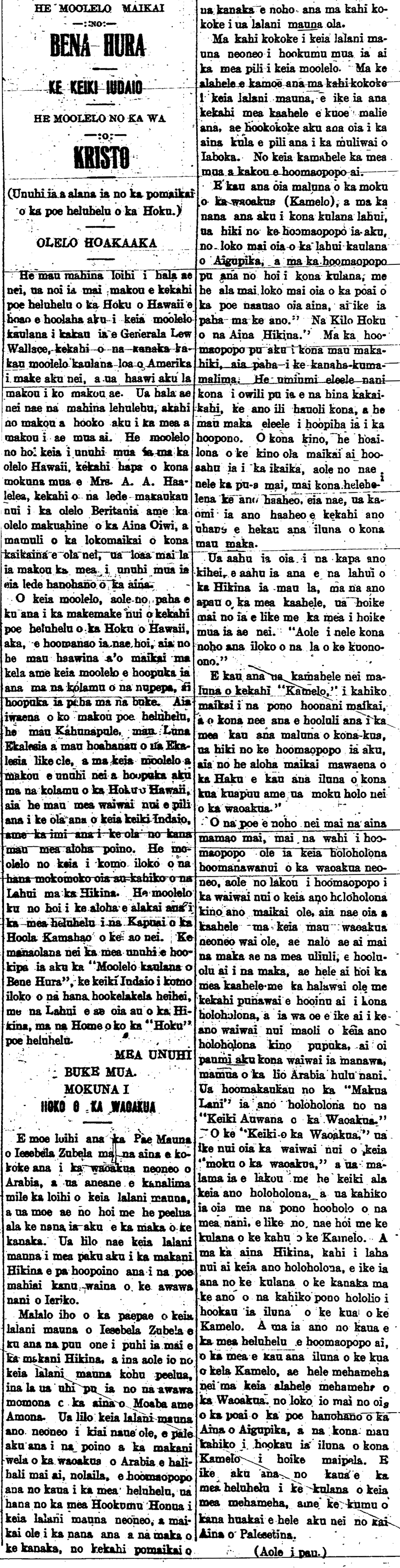
Some months past, we were asked by some of the readers of the Hoku o Hawaii if we could try printing the famous story written by General Lew Wallace, one of the very famous authors of America who just died, and we agreed. Many months have gone by and we have only now come through with what we first agreed to do. This is a moolelo which a portion of the beginning chapters were first translated into Hawaiian by Mrs. A. A. Haalelea, one of the ladies who was very adept at English and the mother tongue of the Native Land, and due to the kindness of her younger surviving sister, we have acquired what was translated earlier by this honored lady of this land.

This moolelo will perhaps not be greatly liked by some of the readers of the Hoku o Hawaii, however, let it be considered that there are valuable lessons in every moolelo published in the columns of the newspapers as well as books. Amongst our readers are Pastors, Church Leaders, and brethren of the many Churches, and within this moolelo which we are translating and publishing in the columns of Hoku o Hawaii, there are many very valuable things dealing with the life of this Jewish boy, along with his searching to find a life for his loved ones in distress. This story is one dealing with combat of that ancient times of the People in the East. This moolelo is one of aloha, pointing out to the reader the Steps of the  Wonderful Redeemer of the world. The translator hopes that the “Famous Story of Ben Hur,” the Jewish boy who took part in the glorious races with the other Nations of the time in the East, will be welcomed into the Homes of readers of the Hoku.

FIRST BOOK.
CHAPTER I
IN THE DESERT

E moe loihi ana ka Pae Mauna o Iesebela Zubela ma na aina e kokoke ana i ka waoakua neoneo o Arabia, a ua aneane e kanalima mile ka loihi o keia lalani mauna, a ua moe ae no hoi me he peelua ala ke nana ia aku e ka maka o ke kanaka. Ua lilo nae keia lalani mauna i mea paku aku i ka makani Hikina e pa hoopoino ana i na poe mahiai kanu waina o ke awawa nani o Ieriko.

Malalo iho o ka paepae o keia lalani mauna o Iesebela Zubela e ku ana na puu one i puhi ia mai e ka makani Hikina, a ina aole io no keia lalani mauna kohu peelua, ina la ua uhi pu ia no na awawa momona o ka aina o Moaba ame Amona. Ua lilo keia lalani mauna ano neoneo i kiai naue ole, e pale aku ana i na poino a ka makani wela o ka waoakua o Arabia e halihali mai ai, nolaila, e hoomaopopo ana no kaua i ka mea heluhelu, na hana no ka mea Hookumu Honua i keia lalani mauna neoneo, a maikai ole i ka nana ana a na maka o ke kanaka, no kekahi pomaikai o na kanaka e noho ana ma kahi kokoke i ua lalani mauna ola…

[Lew Wallace’s “Ben-Hur: A Tale of Christ” was translated by MEA UNUHI MOOLELO, “Translator of Stories,” in Hoku o Hawaii from 2/20/1913 to 7/4/1918. Unfortunately, the issues from the beginning (1913) until the early months of 1917 of the Hoku o Hawaii are still not available online.]

(Hoku o Hawaii, 2/20/1913, p. 1)

HE MOOLELO MAIKAI NO BENA HURA

Hoku o Hawaii, Buke 7, Helu 38, Aoao 1. Feberuari 20, 1913.

Ivanhoe! 1871.

A MOOLELO
OF
IVANHOE!

CHAPTER 1.

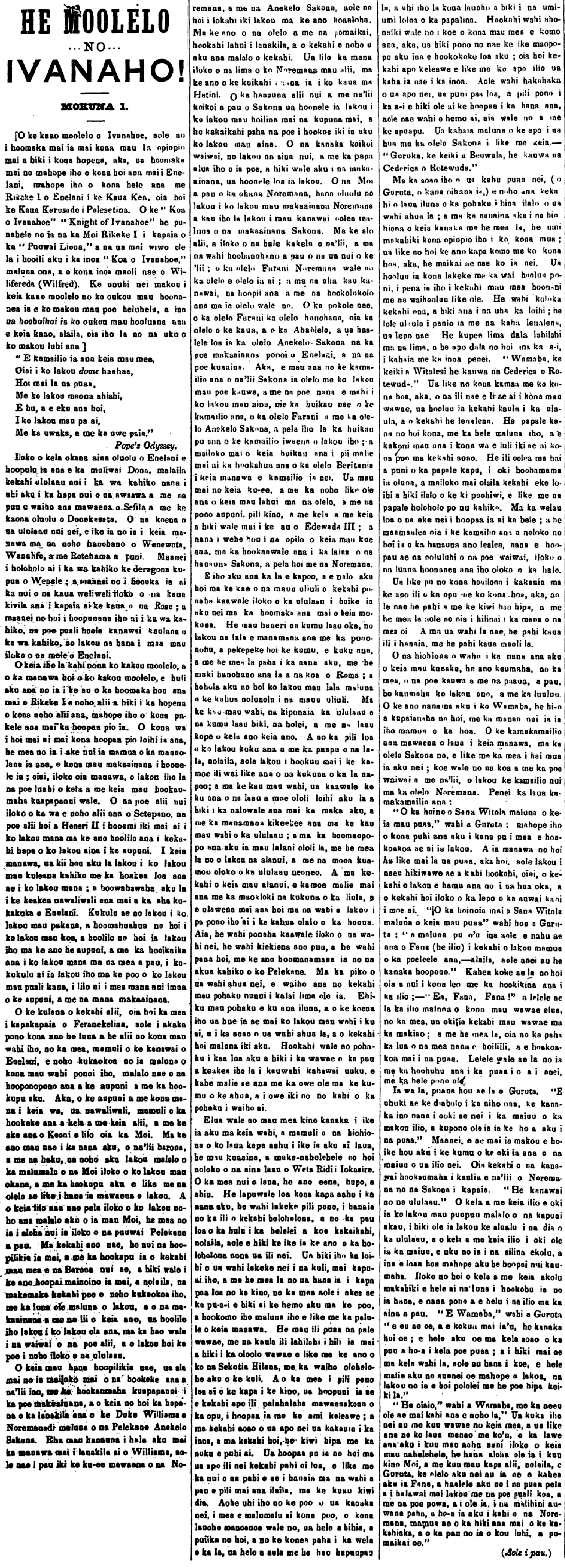
The kaao moolelo of Ivanhoe does not begin from his youth until the end, but it begins after his return to England right after he goes with Richard I of England on the Crusades “War of the Cross,” that being the Crusades in Palestine. The Knight of Ivanhoe was a favorite of King Richard I, called the “Lion Hearted,” and it was that fearless king who gave him the name “Knight of Ivanhoe,” but his real name was Wilfred. We are translating this kaao moolelo for your entertainment, our readers, and should your association with this story be made enjoyable, then that is payment for our labors.]

“E kamailio ia ana keia mau mea,
Oiai i ko lakou dome haahaa,
Hoi mai la na puaa,
Me ko lakou maona ahiahi,
E hu, a e eku ana hoi,
I ko lakou mau pa ai,
Me ka uwaka, a me ka uwe paia.”

Pope’s Odyssey.

Iloko o kela okana aina oluolu o Enelani e hoopulu ia ana e ka muliwai Dona, malaila kekahi ululaau nui i ka wa kahiko nana i uhi aku i ka hapa nui o na awaawa a me na puu e waiho ana mawaena o Sefila a me ke kaona oluolu o Donekesata. O na koena o ua ululaau nui nei, e ike ia no ia i keia manawa ma na noho hanohano o Wenewota, Wanalife, a me Rotehama a puni. Maanei i holoholo ai i ka wa kahiko ke deragona kupua o Wenale; a maanei no i hoouka ia ai ka nui o na kaua weliweli iloko o na kaua kivila ana i kapaia ai ke kaua o na Rose; a maanei no hoi i hoopunana iho ai i ka wa kahiko, na poe puali hoole kanawai kaulana o ka wa kahiko, no lakou na hana i maa mau iloko o na mele o Enelani…

[“Ivanhoe” by Sir Walter Scott is found in Au Okoa from 2/9/1871 until 8/29/1872.  The story is almost completed. Unfortunately, the issue that the last section of the story would have appeared in (9/5/1871) is missing the last two pages! The Ivanaho translation usually appeared on the fourth page of each issue. There are many missing pages and issues and volumes of Hawaiian-Language Newspapers, hopefully someday they will be found, if not in Hawaii, then somewhere across the ocean. Hawaiians lived all over the world, and they had the papers sent to them so that they would not lose touch with the sands of their birth…]

(Au Okoa, 2/9/1871, 4)

HE MOOLELO NO IVANAHO!

Ke Au Okoa, Buke VI, Helu 43, Aoao 4. Feberuari 9, 1871.

“Puss in Boots” in Hawaiian, 1862.

[Translated for the Kuokoa.]

POPOKI
ILOKO O NA KAMAA BUTI.

E NOHO ANA KEKAHI KANAKA me na keiki ana ekolu; a i kona wa i make ai, kaahele oia i kona waiwai e like me keia malalo: O ka Wili ana, i ka mua, o ke Kekake i ka hope, a o ka Popoki i ka hope loa. O ua poe keiki nei, lawe i ko lakou mau waiwai, me ke kokua ole mai o kekahi Loio, ka mea nana e hoolilo i ko lakou wahi waiwai uuku i mea ole i na lilo o ke Kanawai.

O ua wahi keiki opiopio nei nana ka Popoki, olelo iho la ua hana inoia ia: “E o’u mau kaikuaana,” wahi ana, “ma ka hoohui ana i ko laua waiwai, loaa ko laua pomaikai ma keia honua, a owau ka hoi, i kuu wa e ai ai a pau kuu Popoki; alaila, make koke paha au i ka pololi!” O ua Popoki nei, e hoolohe mai ana ia i na manawa a pau loa; a hoomaka mai la ia e hele, a olelo mai e like me keia: “Mai hookaumaha oe i kou manao pela, e kuu haku maikai; hookahi wale no au hana o ka haawi mai ia’u i eke, a me ona mau Kamaa Puki no’u, i hiki ai ia’u ke hele maloko o ka lepo, a me ka nahelehele; alaila ike oe, aole oe e poino loa, e like me kau mea e manao nei.”…

[Here is J. W. again, this time translating Charles Perrault’s “Puss in Boots.” Notice how bad the digital image is. Hopefully pages like this can be rescanned clearly soon! If you can’t read the information, is it really information?]

(Kuokoa, 5/31/1862, p. 1)

POPOKI ILOKO O NA KAMAA BUTI.

Ka Nupepa Kuokoa, Buke I, Helu 27, Aoao 1. Mei 31, 1862.

More on Liliu’s 73rd birthday celebration, 1911.

BIRTHDAY OF LILIUOKALANI

Honolulu, Sept. 2—The commemoration of Queen Liliuokalani’s birthday was held today, and according to what the Queen said to some of her friends:

“This is my seventy-third birthday, and i am in good health; i have left behind the disturbing things of this world in which we live, and have surrounded myself with many friends.”

The Queen’s health is fine indeed, and in the morning, the Band of the County [? Royal Hawaiian Band] arrived to play while she dined on breakfast until 10 a. m. Several associations arrived to giver their congratulations to the Alii; and at 11 o’clock, the procession of haole friends to see the Alii began, and this perhaps is the grandest royal audiences of haole giving their congratulations to the Queen.

The Queen was attired in a beautiful garments fitting of her stature, and attended by the Princess Kalanianaole and Mrs. Irene Holloway and Mrs. C. P. Iaukea. The place where the Queen sat was surrounded by many different kahili, and it was her steward, the Honorable C. P. Iaukea who introduced the many strangers. The Alii, the Queen, met each one who came to visit her and she placed a kind smile upon her Royal visage. When the writer for the Hoku [this newspaper, Hoku o Hawaii] appeared before the Alii, she immediately asked, “How are the famous lehua of the land, the lehua of Hilo; are the famous blossoms of the land still beautiful?”

The Queen wore a white lehua [lehua puakea] lei from Hilo, and on her Royal countenance was happiness. On that morning of her birthday, she presented the water leaping land of Waikahalulu as a Park for the public, and it will be administered for the benefit of the people.

The Hoku o Hawaii prays for the long life of the beloved Queen of Hawaii, and although she has no throne upon to rule, hers is the throne of aloha within the hearts of her loving people. May the Queen live in God.

[Unfortunately the issues of Hoku o Hawaii from 1906 to the early part of 1917 (including this article) are not available online! The more people talk about the importance of the information in the Hawaiian-Language Newspapers and the need to rescan those newspapers clearly and make them accurately searchable, the more chance there will be funding for it!]

(Hoku o Hawaii, 9/7/1911, p. 2)

LA HANAU O LILIUOKALANI.

Ka Hoku o Hawaii, Buke 6, Helu 18, Aoao 2. Sept. 7, 1911.

Don’t forget! The Queen’s 175th Birthday! 2013.

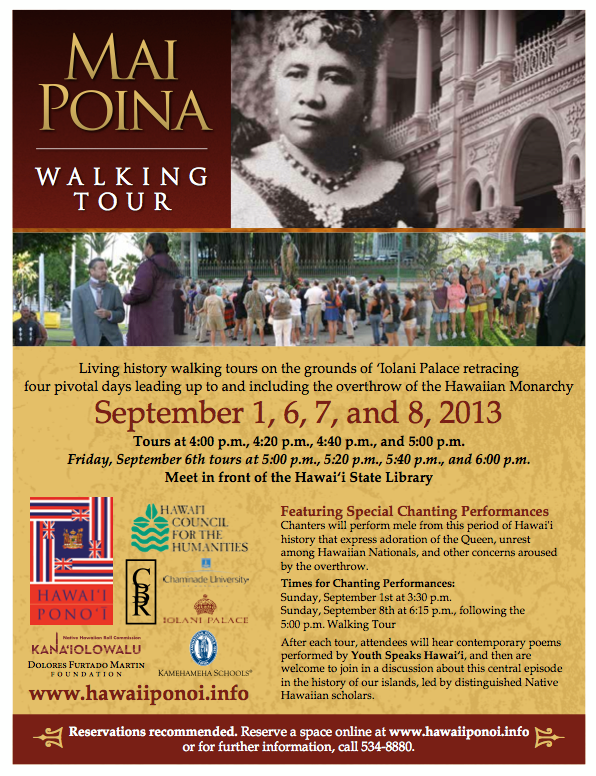
MAI POINA WALKING TOURS 2013!

Don’t Forget, if you are on Oahu nei, there are many events coming up to celebrate the memory of Queen Liliuokalani, like the Onipaa Celebration happening on the grounds of Iolani Palace on Sunday, September 1, from 10:00 a. m. to 3:00 p. m. Also there are the Mai Poina Walking Tours on the 1st, 6th, 7th, and 8th!

What about the rest of the islands? What are all of you up to?

Mai Poina 2013

Patriotic mele in English, 1893.

As Israel in ancient times sat weeping by the waters of Babylon listening to the plaintive songs which arose from their singers, so sits Hawaii in grief and mourning to-day and to Her our bard sings:

I had a dream, I saw a vision pass before me,
Long ages past arose in swift array,
Adown the stream of time my fleeting fancy bore me
From age to age unto the present day,
Far o’er the southern sea I saw brave ships a-sailing
From isle to isle, till at Hawaii’s shore
They touched, and soon with joy the natives came, them hailing
With pious awe, incarnate Gods of yore,
From all the land they flocked with speed to see the stranger,
Adoring gave their gifts both rich and rare,
But time brought fuller knowledge, knowledge brought its dangers
And Captain Cook’s life paid the forfeit there.
And down the stream still visions came a-floating;
Vancouver came unto this race so brave;
Restored the friendship Cook had lost; while noting
That Britain ne’er would hold them as her slave.
Still swept the vision on with flight so speedy;
One ship alone this time comes into view—
America’s gift unto these islands needy,
Peace, love, goodwill—and Christianity too.
Right lovingly was welcomed each new teacher,
The people flocked to hear good news so true,
That more and more it seemed to every preacher,
The harvest plenteous, but the laborers few.
And time flew by on wings. The isles grew fair, and fairer;
One Briton thought to seize them for his land,
But Britain’s Admiral, our independence bearer,
Restored the flag midst praise from every hand,
The years passed by. Through all the land there rose the steeple—
The preacher controlled all with kindly hand;
Give land and constitution to your people!
(O King! Give heed!) and God will bless your land.
Year followed year. Changed Kings and constitution.
The stranger increased: took mortgages on land:
Kept Hawaii’s daughters, sisters, wives in prostitution:
Spread poverty and vice around on ev’ry hand.
Still years rolled on. With sugar now grown wealthy,
The foreign Christians lifts his eye around,
And says: “For me no doubt the climate is most healthy,
“Tho’ poor and dying Hawaii’s native sons are found.
“Some seventy years ago we gave this land the Bible
“And tried to teach them then its use,
“(To say we’ve showed them poor examples is no libel)
“And fair exchange ‘t will be to cook their goose.
“Their cries for right and justice soon we’ll stifle:
“Take for ourselves this Paradise on earth.
“If they object, we’ll each one tap our rifle,
“And call for help upon our land of birth.
“Unfit to rule with all these years of training—
“(We’ll spread the lie around on every hand,)
“You’ll see they’ll let us do it, uncomplaining,
“For they have got our Bible, and so we’ll take their land.”
At this a noise awoke me, and in wonder
I saw the very instance of my dream.
Hawaii’s Queen and Natives were put under
To bolster up their money-getting scheme
And now forth from them goes across the waters
One last appeal for Justice and for Right.
Preserving peace, Hawaii’s gen’rous sons and daughters,
Before God’s throne on high, in prayer unite:
“Great God! the Judge of All! The records thou art keeping!
“Look down in mercy on our sad estate!
“Be kind unto us! Hear our voice of weeping!
“Till thou restore, grant us in peace to wait.
“And thou, great nation! home of truth and bravery!
“Freedom’s defender! we pray thee us O, hear!
“Restore our Queen and us; now, as in slavery,
“Held by usurper’s armed fear.
“Restore our rights and help us to maintain them!
“O let our prayer be crowned with success!
“Our conduct and your friendship will retain them,
“The God of nations will for ever bless.”

[This mele was probably composed by Kahikina Kelekona, J. G. M. Sheldon.

The image taken from the microfilm is hard to make out at the bottom. Hopefully there will be funding found to have the Hawaiian-Language Newspapers be unbound and rescanned clearly. How can you get to all the pearls stored in the newspapers if you can’t make out the words?]

(Hawaii Holomua, puka pule, 1/28/1893, p. 4)

As Israel in ancient times...

Hawaii Holomua (Puka Pule), Buke III, Helu 5, Aoao 4. Ianuari 28, 1893.