Molokai correspondent, Ruby Apiki Bright, 1939.

NEWS ITEMS FROM MOLOKAI

INTRODUCTION

We, the managers of the newspaper Hoku o Hawaii, are blessed through receiving some news items from the Homestead lands of Molokai, the land which the Alii Kuhio put much effort into for the Hawaiians. This is received through the correspondence of the mother, Mrs. Ruby Apiki Bright.

Lot 2, Hoolehua

Sept. 5, 1839

To my dear patient Hoku:

Here is some baggage for the deck of our pride, should it be kindly allowed some free space. On this past 26th of August, the Catholics of Kaunakakai held a silver jubilee in commemoration of the building of their church, St. Sophia, and there was a fair, and the activities that day went well. They gave the name of that well-to-do mother of the Island of Hina [Molokai] to their church, that being Mrs. Sophie Judd Cooke—the open-hearted mother who spread forth her helping hands for its furnishing and building in the year 1914.

The Calvinists held a Bazaar for their benefit, selling all sorts of things on this past 2nd of this month. Everything was lovely.

……..

[Ruby Apiki Bright started her regular column reporting on news from Molokai on this day, September, 20, 1939, in Hoku o Hawaii. I hope some day soon, these papers will be rescanned again clearly so they are easily read!]

(Hoku o Hawaii, 9/20/1939, p. 1)

HUNAHUNA MEA HOU O MOLOKAI

Ka Hoku o Hawaii, Volume XXXIV, Number 21, Page 1. Sepatemaba 20, 1939.
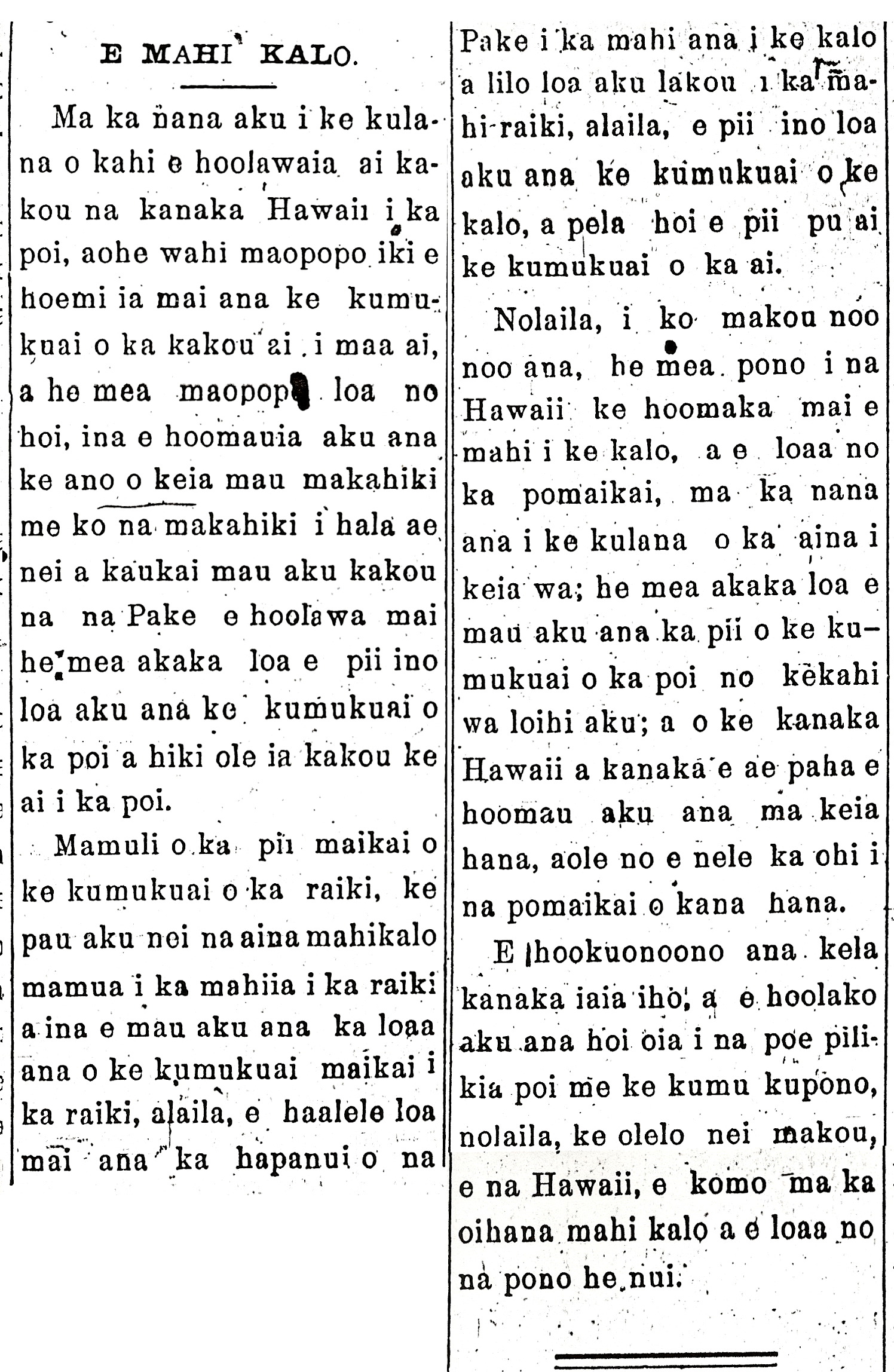
On kalo, poi, and life, 1901.

FARMING KALO.

When considering how we Hawaiians are being supplied with poi, there is not the slightest indication that the cost of our staple food will decrease, and it is also very clear that if what has happened in the past years continues on into the upcoming years, and we continue relying on the Chinese for our supply, it is obvious that the price of poi will shoot up, and we will not be able to eat poi.

As a result of the increase in the price of rice, the former taro lands are being planted with rice, and should the rice market continue to be favorable, then a majority of the Chinese will abandon taro and become rice farmers, then, the cost of kalo will skyrocket, and as a result, so too will the price of poi.

Therefore, in our opinion, Hawaiians should start farming kalo, and obtain its benefits; looking at the land situation these days, it is very clear that the price of poi will continue to rise for long into the future; and the Hawaiians or others perhaps who continue this occupation will not fail to reap its benefits.

That man will make himself prosper and he will supply those who are lacking poi at a fair price, and so we say, O Hawaiian people, go into the occupation of kalo farming, and there shall be many blessings.

[While rice is no longer being planted here, perhaps in its place are being planted buildings. What is there to be done today?]

(Lahui Hawaii, 6/22/1901, p. 4)

E MAHI KALO.

Ka Lahui Hawaii, Buke III, Helu 25, Aoao 4. Iune 22, 1901.


Vital Statistics, 2013.

MARRIAGES.

??????

BIRTHS.

?????

DEATHS.

??????

[Unfortunately, the Vital Statistics column for this date appeared on the bottom, left column seen below. This is just another example of a bad digital image taken from a badly shot microfilm. On the microfilm, you can make out three (3) marriages, eight (8) births, and seven (7) deaths. You can make out a portion of the names and dates using the microfilm, like Keola, Villa, Koana?, Kapena, Apela, Miner, Naluai… But a lot of it is just a blur.

Now is time to rescan, as clear as possible, the original newspapers, so you have a better chance of finding what your ohana left behind in the newspapers: whether it be in a vital statistics column, or a mele, or a commentary about the government, or in any other priceless words and pictures…]

(Kuokoa, 6/20/1913, p. 3)

NA MARE. / NA HANAU. / NA MAKE.

Ka Nupepa Kuokoa, Buke LI, Helu 24, Aoao 3. Iune 20, 1913.

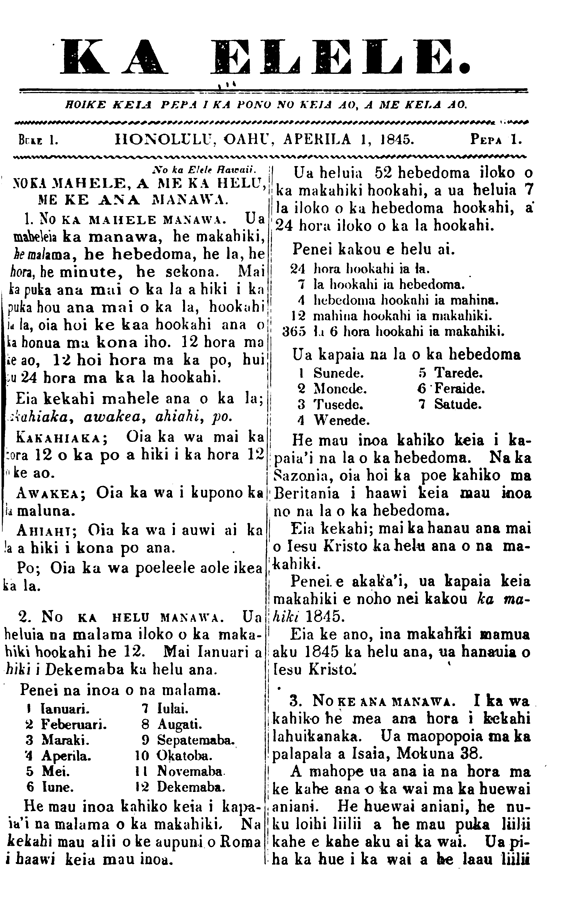
Ka Elele, 1845–1848.

THE MESSENGER.

THIS PAPER SHOWS WHAT IS RIGHT FOR THIS WORLD AND THE WORLD TO COME.

[“Ka Elele” (1845–1848) is not available yet on either nupepa.org or papakilodatabase.com. It is however available on Google Books at http://books.google.com/books?id=TmNFAAAAYAAJ&dq=elele&pg=PR6#v=onepage&q=elele&f=false! The images were again taken from a tightly bound book, so once again, the text in the margins are hard to read. See the very first page below. The left side is distorted and the words almost cannot be made out. The pages need to be unbound and then scanned if we are to get clear, legible images of the entire newspaper!]

(Elele, 4/1/1845, p. 1)

KA ELELE.

Ka Elele, Buke 1, Pepa 1, Aoao 1. Aperila 1, 1845.

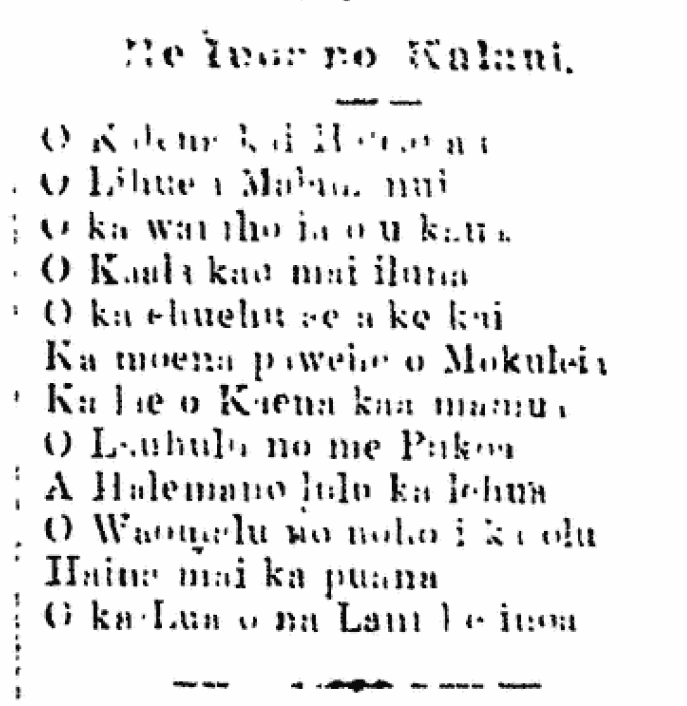
More hidden mele: a name song for Kamehameha II, 1893.

He Inoa no Kalani.

O Kalena kai Haleauau
O Lihue i Malamanui
O ka wai iho ia olu kaua
O Kaala kau mai iluna
O ka ehuehu ae a ke kai
Ka moena pawehe o Mokuleia
Ka lae o Kaena kaa mamua
O Lauhulu no me Pukoa
A Halemano lulu ka lehua
O Waomalu no noho i ka olu
Haina mai ka puana
O ka Lua o na Lani he inoa

[This mele, a name song for Kamehameha II, is still popular today, and is more commonly known as “Kalena Kai.” It was not “hidden” within a separate moolelo, but the reason that it was and is hard to find is that the digital images of this newspaper, Lei Momi, are terrible. I hope one day soon this and all the other Hawaiian-Language Newspapers will be rescanned as clearly as possible before they disintigrate…]

(Lei Momi, 7/8/1893, p. 4)

He Inoa no Kalani.

Ka Lei Momi, Buke 1, Helu 14, Aoao 4. Iulai 8, 1893.

Vital Statistics, 1913.

MARRIAGES.

Edward Harbottle Boyd to Miss Anabelle Mundon, Jun 19.
Frank Kaimi to Rebecca Kua, June 21.

BIRTHS.

To James L. Akana and Georgina, a daughter, June 10.
To Samuel Apela and Maryann Kualii, a son, June 1.
To Earl L. Bodine and Annie Antone, a son, June 13.
To David Hakuole and Annie Kawai, a daughter, June 16.
To George Kanekoa and Sarah Wong Kong, a son, June 19.
To Manuel Vincent and Kamakini, a son, June 22.

DEATHS.

John Iwa ????????

[There appears to be six deaths listed, but the digital image is totally blacked out, and the microfilm image is not much better. Hopefully one day in the near future, the Hawaiian-Language Newspapers will be rescanned clearly, so each and every name, and each and every word can be read easily!]

(Kuokoa, 6/27/1913, p. 4)

NA MARE. / NA HANAU. / NA MAKE.

Ka Nupepa Kuokoa, Buke LI, Helu 25, Aoao 4. Iune 27, 1913.

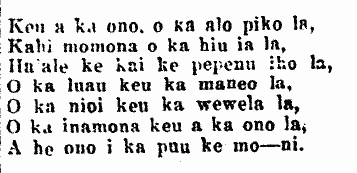
Mele found everywhere in the Hawaiian-Language Newspapers, 1912.

[From: “KA LA NUI O NA LIMAHANA MA KEAUHOU, HAWAII.”]

Keu a ka ono, o ka alo piko la,
Kahi momona o ka hiu ia la,
Ha’ale ke kai ke pepenu iho la,
O ka luau keu ka maneo la,
O ka nioi keu ka wewela la,
O ka ina mona keu a ka ono la,
A he ono i ka puu ke mo—ni.

[This mele excerpt is included in an article on a Labor Day celebration which took place in Keauhou, Kona, Hawaii. The writer of the article, Harry Haanio, says that it is a famous song composed by his older brother, who lives in Koloa, Hawaii Island, famous for the iliili hanau, the rocks that give birth.

Would this be what inspired Bina Mossman to compose her famous mele, “He Ono”? There are many, many old oli and mele which get altered and added to in later years. There are countless beautiful poetic pieces in the Hawaiian-Language Newspapers. Composers of today might consider looking within its pages for their own inspiration!]

(Kuokoa, 9/13/1912, p. 5)

Keu a ka ono, o ka alo piko la...

Ka Nupepa Kuokoa, Buke XLVIII, Helu 37, Aoao 5. Sepatemaba 13, 1912.