Sweet Emalia in Puuhale, 1894.

[Just as an aside, here is a notice for unclaimed mail put out by the postmaster general (Luna Leta Nui), J. M. Oat. These were the days when you had to pick up your mail at the closest post office. Notice that Emalia Kaihumua is listed in the section for Kalihi and Puuhale.]

Na Leta e waiho nei iloko o ka Hale Leta a hiki i ka la 31 o Augate 1894.

Ka Nupepa Kuokoa, Buke XXXIII, Helu 36, Aoao 3. Sepatemaba 8, 1894.

Vital Statistics, 1913.

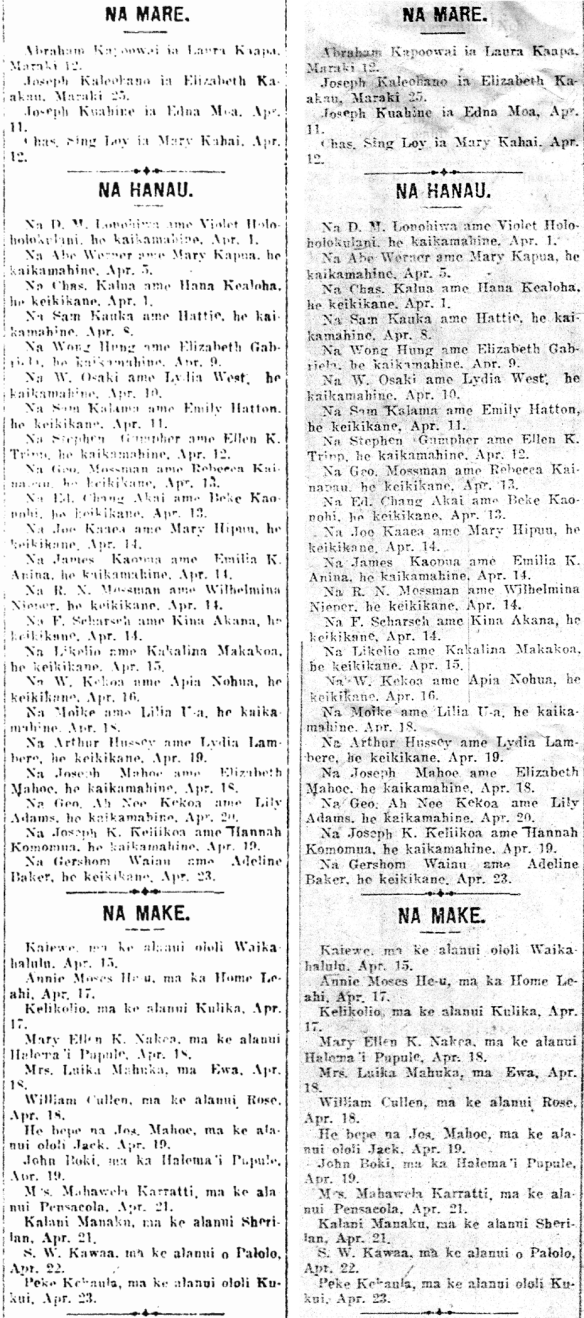
MARRIAGES.

Abraham Kapoowai to Laura Kaapa, March 12.
Joseph Kaleohano to Elizabeth Kaakau, March 25.
Joseph Kuahine to Edna Moa, Apr. 11.
Charles Sing Loy to Mary Kahai, Apr. 12.

BIRTHS.

To D. M. Lonohiwa and Violet Holoholokulani, a daughter, Apr. 1.
To Abe Werner and Mary Kapua, a daughter, Apr. 5.
To Charles Kalua and Hana Kealoha, a son, Apr. 1.
To Sam Kauka and Hattie, a daughter, Apr. 8.
To Wong Hung and Elizabeth Gabriela, a daughter, Apr. 9.
To W. Osaki and Lydia West, a daughter, Apr. 10.
To Sam Kalama and Emily Hatton, a son, Apr. 11.
To Stephen Gumpher and Ellen K. Tripp, a daughter, Apr. 12.
To George Mossman and Rebecca Kainapau, a son, Apr. 13.
To Ed. Chang Akai and Beke Kaonohi, a son, Apr. 13.
To Joe Kaaea and Mary Hipuu, a son, Apr. 14.
To James Kaopua and Emilia K. Anina, a daughter, Apr. 14.
To R. N. Mossman and Wilhelmina Nieper, a son, Apr. 14.
To F. Scharsch and Kina Akana, a son, Apr. 14.
To Likelio and Kakalina Makakoa, a son, Apr. 15.
To W. Kekoa and Apia Nohua, a son, Apr. 16.
To Moike and Lilia U-a, a daughter, Apr. 18.
To Arthur Hussey and Lydia Lambere, a son, Apr. 19.
To Joseph Mahoe and Elizabeth Mahoe, a daughter, Apr. 18.
To George Ah Nee Kekoa and Lily Adams, a daughter, Apr. 20.
To Joseph K. Keliikoa and Hannah Komomua, a daughter, Apr. 19.
To Gershom Waiau and Adeline Baker, a son, Apr. 23.

DEATHS.

Kaiewe, on Waikahalulu Lane, Apr. 15.
Annie Moses He-u, at Leahi Home, Apr. 17.
Kelikolio, on Gulick Street, Apr. 17.
Mary Ellen K. Nakea, on Insane Asylum Road, Apr. 18.
Mrs. Luika Mahuka, at Ewa, Apr. 18.
William Cullen, on Rose Street, Apr. 18.
A baby of Joseph Mahoe, on Jack Lane, Apr. 19.
John Boki, at the Insane Asylum, Apr. 19.
Mrs. Mahawela Karratti, on Pensacola Street, Apr. 21.
Kalani Manaku, on Sheridan Street, Apr. 21.
S. W. Kawaa, on Palolo Street, Apr. 22.
Peke Kekaula, on Kukui Lane, Apr. 23.

[The image below on the left is taken from the digital images online. As you have heard me say many a time, the current digital images are often not legible. While this column is not bad overall, there were a number of names that I could not make out for sure. The image on the right is from the microfilms. The microfilm images are always clearer than the digital images. And luckily,  I was able to figure out the remaining information here.

The microfilms for now are the next clearest thing to the originals, and should not be dismissed or overlooked when doing research just because we have easily accessed digital images. If you cannot make out words from the online digital images, go to the microfilms always. Only if the microfilms are also illegible and you really need the information, only then would I suggest checking the originals.

My ultimate hope is that the originals will be rescanned clearly someday soon so that we will no longer need to handle them and they can be preserved for the future. The more they are flipped through and handled, the more damaged they get…]

(Kuokoa, 4/25/1913, p. 4)
NA MARE. / NA HANAU. / NA MAKE.

Ka Nupepa Kuokoa, Buke LI, Helu 16, Aoao 4. Aperila 25, 1913.
Oamaru, New Zealand graves searchable online, 2013.

Cemetery database makes family searches easier

A new Oamaru cemeteries database has the potential to provide insight into the past, a supporter of the initiative says.

The database is available through the Waitaki District Council website and allows users to search for people buried in the Oamaru Old and Lawn Cemeteries by surname and/or first name, and shows information such as the age of the deceased and what block and plot they are buried in.

North Otago Museum archives curator Eva Garbutt says tracing family history is becoming a popular pastime, with more people than ever wanting to unearth their roots.

“In the past year the demand for putting our cemetery database online has increased as more and more people are getting into doing their family history.

“Now people will be able to search for their ancestors buried in the Oamaru cemeteries thanks to the wonderful

efforts of our volunteers, who have spent many hours putting the information from the original burial registers into a digital and searchable format.”

Waitaki District councillor and historian Helen Stead is a huge supporter of the database and says she is delighted it is up and running.

“I think it places us in the research and genealogical world, because people can look at the database that relates to Oamaru from anywhere in the world.”

Mrs Stead also believes the database could unlock dozens of stories about Oamaru’s past that have been lost with time.

[For the entire article from The Timaru Herald, click the link below:

Cemetery database makes family searches easier]

Comments, Questions, and Corrections, 2013.

Aloha all.

I would like to state again that all comments, questions, and corrections are greatly welcomed, but it would be most helpful if they are appended under the corresponding posts here at http://nupepa-hawaii.com.

This would allow for an open dialogue among readers (and potential future readers?). Hopefully, one day, this page (and others like it) will take on a life of its own and I will no longer feel the need to put up anymore posts myself!

Mahalo a nui!!

Ninipo Hoonipo Song, a follow up, 1999.

There was a question by MA Kaiulani Milham about a translation of an earlier post about the mele “Ninipo Hoonipo Song,” by Queen Liliuokalani. There is a very nice book of many of the Queen’s songs put out by Hui Hanai in 1999, “The Queen’s Songbook.” The lyrics are in there along with the music, a translation, and a short writeup!

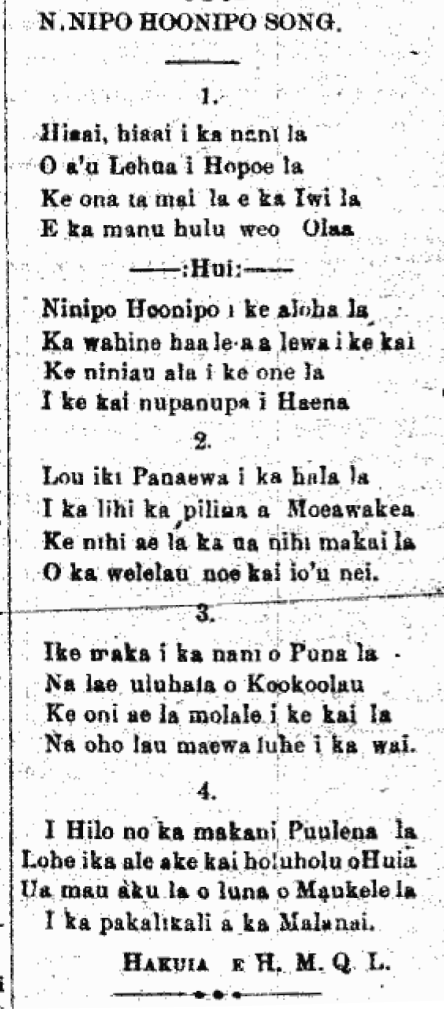
A mele by Her Majesty Queen Liliuokalani, 1894.

NINIPO HOONIPO SONG.

1.

Hiaai, hiaai i ka nani la
O a’u Lehua i Hopoe la
Ke ona ia mai la e ka Iwi la
E ka manu hulu weo Olaa

——: Hui :——

Ninipo Hoonipo i ke aloha la
Ka wahine haa le-a a lewa i ke kai
Ka niniau ala i ke one la
I ke kai nupanupa i Haena

2.

Lou iki Panaewa i ka hala la
I ka lihi ka pilina a Moeawakea
Ke nihi ae la ka ua nihi makai la
O ka welelau noe kai io’u nei.

3.

Ike maka i ka nani o Puna la
Na lae uluhala o Kookoolau
Ke oni ae la molale i ke kai la
Na oho lau maewa luhe i ka wai.

4.

I Hilo no ka makani Puulena la
Lohe i ka ale a ke kai holuholu o Huia
Ua mau aku la o luna o Maukele la
I ka pakalikali a ka Malanai.

Composed by H. M. Q. L.

[The newspaper “Ka Oiaio” begins in 1889, but there are only a few issues found for that year, and for 1890, 1891, 1892, and 1893, there are none! Hopefully someone is holding on to copies of these years, because they can open up a whole new picture to that period in history!!

Talk about the Hawaiian-Language Newspapers to others. The more people talk, the more likely it will be that these lost issues might once again be found.]

(Oiaio, 8/10/1894, p. 4)

NINIPO HOONIPO SONG.

Ka Oiaio, Buke VI, Helu 32, Aoao 4. Augate 10, 1894.

Beginning of line-by-line commentary of “Aia i Honolulu kuu pohaku,” 1929.

EXPLANATION OF THE FIRST LINE.

1. Aia i Honolulu kuu pohaku

Kapanookalani’s thoughts:—This land Honolulu, it is close to Nanawale, Puna, by the sea. It is a ku, a small land in between large lands.

The stone [pohaku] is Lord [Haku] of the chiefess and in this word, the important idea is chiefess [‘lii wahine].

Kahapula’s thoughts:—Honolulu is on Oahu, where King Kamehameha V dwelt and those who opposed him is the Honolulu in this first line of the mele. It was here his enemies schemed and carried out all their defiant acts against him. While they knew the wish of the King to marry the chiefess Pauahi, her teacher, Amos Cooke secretly agreed to  Bishop for him to meet with Pauahi without the knowledge of her parents. That is how Pauahi became Bishop’s, and this is how Bishop and his relative Lee [? William Little Lee] became dignitaries of the land.

Kupihea’s thoughts:—Honolulu is a fish stone called a Kuula, and was brought here to this Honolulu [on Oahu] from the Honolulu of Puna [on Hawaii]. This Kuula was placed in the tiny land of Honolulu where an Alii called Honolulu lived, who was related to the chiefess Peleula, whose younger sister was the beautiful Waikiki. This place is mauka of the old Rawlin’s Estate. There is a bank of coral where Honolulu is; the fishing altar [Kuula] for the fish ponds [loko i’a] is on the Waikiki side of Liliha Street and between Vineyard and King Streets.

The stone is related to chiefs from times immemorial [mai ka po mai]. It is a manifestation made by God.

Iokepa’s thoughts:—Honolulu is a small land and a canoe landing makai of Nanawale, Puna, between two sand dunes, one on the Hilo side and one on the Puna side, called Puu Waawaa. From this Honolulu is called the Honolulu here [on Oahu] which used to be called Kou before, and after it was called Honolulu until this day.

This is the meaning for the word Honolulu:—The wind is very calm [lulu] an the sea is serene; it is very fine and peaceful. Bay [? Hono] of calm sea; Hono that is peaceful.

Kuluwaimaka’s thoughts:—The stone is related to Kamehameha V. Honolulu in Puna is a lowland next to the sea. Its width is perhaps half a mile long between Na Puu o Pele and Waiakahiula on the Hilo side. Honolulu is a place where you pick opihi [ku’i opihi] and pick limu [hana limu]. There is a fine spring [punawai] there and there is a foot path there.

[And to think that this is but the very beginning of Kelsey’s detailed account of the explanation of the six loea of the mele “Aia i Honolulu kuu pohaku.” This is just the first line! It continues in the following issues!!

One more (huge) reason that Hawaiian-Language Newspapers are priceless!!!]

(Alakai o Hawaii, 12/5/1929, p. 2)

NA MANAO WEHEWEHE MALUNA O KA LAINA EKAHI.

Ke Alakai o Hawaii, Buke 1, Helu 32, Aoao 2. Dekemapa 5, 1929.

More on “Aia i Honolulu kuu pohaku”! 1929.

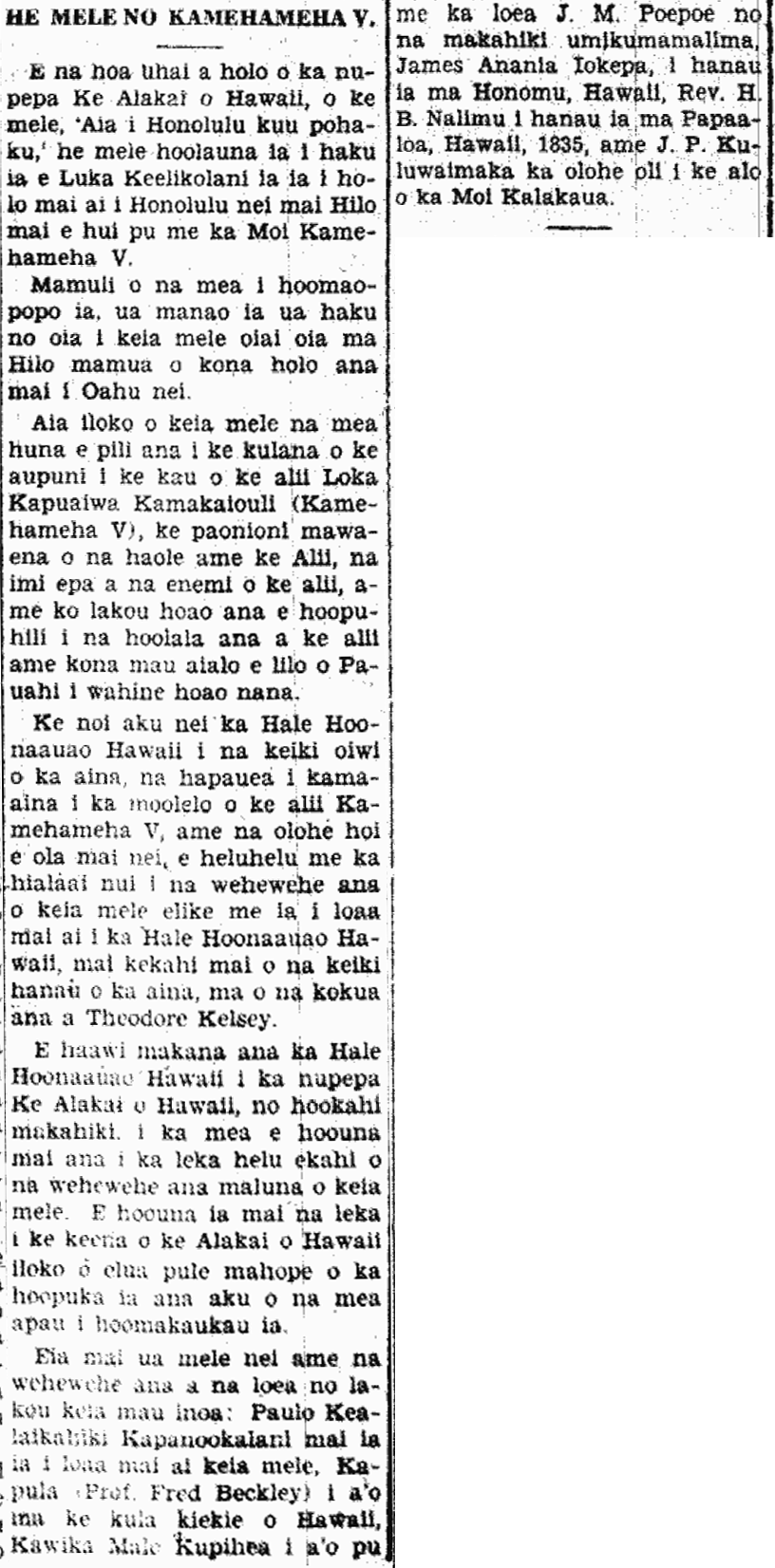
A MELE FOR KAMEHAMEHA V.

O Friends who chase after Ke Alakai o Hawaii, the mele, “Aia i Honolulu kuu pohaku,” is a mele of familiarity [mele hoolauna] composed by Luka Keelikolani when she was coming to here in Honolulu from Hilo to meet with King Kamehameha V.

From what is understood, it is believed that she composed this mele while she was in Hilo before her travelling to Oahu nei.

In this mele are hidden things dealing with the nation in the time of the alii Loka Kapuaiwa Kamakaiouli (Kamehameha V); the contention between the haole and the King, the deceit of the enemies of the King and their attempt to thwart the plans by the King and his court to make Pauahi his wife.

The Hale Hoonaauao Hawaii asks the native ones of the land, the old ones familiar with the history of King Kamehameha V, and the experts still living, to read with much pleasure the explanations of this mele as per what was obtained by the Hale Hoonaauao Hawaii from those native born of the land through the assistance of Theodore Kelsey.

The Hale Hoonaauao Hawaii will award a one-year subscription of the newspaper Ke Alakai o Hawaii to the one who sends the best letter with explanations on this mele. Send the letters to the office of Ke Alakai o Hawaii withing two weeks of the completion of the publishing of all that has been compiled.

Here is the mele and the explanations of the experts [loea] whose names are: Paulo Kealaikahiki Kapanookalani from whom we received this mele, Kahapula (Prof. Fred Beckley) who teaches at the University of Hawaii, Kawika Malo Kupihea who studied with the loea J. M. Poepoe for fifteen years. James Anania Iokepa who was born in Honomu, Hawaii, Rev. H. B. Nalimu who was born in Papaaloa, Hawaii in 1835, and J. P. Kuluwaimaka the skilled chanter [olohe oli] in the court of King Kalakaua.

[“Aia i Honolulu kuu pohaku” is perhaps the most widely studied mele i have seen, with line-by-line interpretations by experts of the day. It continues on for a number of issues of Alakai o Hawaii.

Does anyone have any details on the organization called Hale Hoonaauao Hawaii, or Hale Hoonaauao o Hawaii?]

(Alakai o Hawaii, 12/5/1929, p. 2)

HE MELE NO KAMEHAMEHA V.

Ke Alakai o Hawaii, Buke 1, Helu 32, Aoao 2. Dekemapa 5, 1929.

Kaulilua… Mele inoa for Kamehameha IV, 1864.

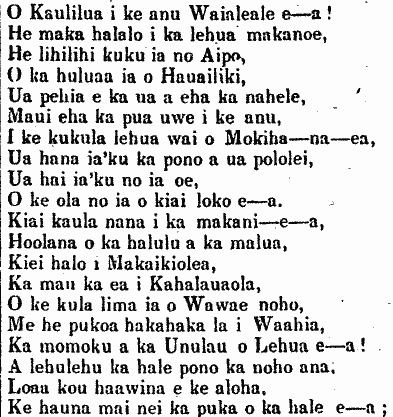
[Excerpt found under: “A DIRGE FOR KING Alexander Kalanikualiholiho, Maka o Iouli, Kunuiakea o Kukailimoku, KAMEHAMEHA IV!”]

O Kaulilua i ke anu Waialeale e—a!
He maka halalo i ka lehua makanoe,
He lihilihi kuku ia no Aipo,
O ka huluaa ia o Hauailiki,
Ua pehia e ka ua a eha ka nahele,
Maui eha ka pua uwe i ke anu,
I ke kukula lehua wai o Mokiha—na—ea,
Ua hana ia’ku ka pono a ua pololei,
Ua hai ia’ku no ia oe,
O ke ola no ia o kiai loko e—a.
Kiai kaula nana i ka makani—e—a,
Hoolana o ka halulu a ka malua,
Kiei halo i Makaikiolea,
Ka mau ka ea i Kahalauaola,
O ke kula lima ia o Wawae noho,
Me he pukoa hakahaka la i Waahia,
Ka momoku a ka Unulau o Lehua e—a!
A lehulehu ka hale pono ka noho ana,
Loaa kou haawina e ke aloha,
Ke hauna mai nei ka puka o ka hale e—a;

[So many interesting things about this. The first and foremost perhaps is that this appears as part of an unusual kanikau for Alexander Liholiho Kamehameha IV in the form of a conversation between Kamehameha III (K III.) and himself (K IV.). Another is that if you hula, you probably learned this as a mele inoa for Kalakaua and not as one for Kamehameha IV. Does anyone know who it is that is labeled as (M.) in the conversation? Click here for a PDF of the issue with the rest of the piece on page 4.]

(Kuokoa, 1/23/1864, p. 4)

O Kaulilua i ke anu Waialeale e—a!

Ka Nupepa Kuokoa, Buke III, Helu 4, Aoao 4. Ianuari 23, 1864.