Mele about Na Pali Mahoe, 1888.

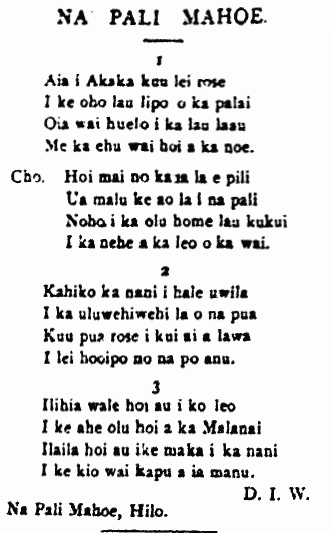
NA PALI MAHOE.

1

Aia i Akaka kuu lei rose
I ke oho lau lipo o ka palai
Oia wai huelo i ka lau laau
Me ka ehu wai hoi a ka noe.

Cho. Hoi mai no ka ia la e pili
Ua malu ke ao la i na pali
Noho i ka olu home lau kukui
I ka nehe a ka leo o ka wai.

2

Kahiko ka nani i hale uwila
I ka uluwehiwehi la o na pua
Kuu pua rose i kui ai a lawa
I lei hooipo no na po anu.

3

Ilihia wale hoi au i ko leo
I ke ahe olu hoi a ka Malanai
Ilaila hoi au ike maka i ka nani
I ke kio wai kapu a ia manu.

D. I. W.

Na Pali Mahoe, Hilo.

[There are so many beautiful songs held in the pages of the Hawaiian-Language Newspapers! Here is one written by someone living in the Na Pali Mahoe spoken of in the previous post. It would benefit modern composers greatly to look back at and to study these as they turn forward and compose their own mele.]

(Kuokoa, 5/5/1888, p. 1)

NA PALI MAHOE.

Ka Nupepa Kuokoa, Buke XXVII, Helu 18, Aoao 1. Mei 5, 1888.

Another promising brown bag from UHM Center for Biographical Research, 2013.

If you are free at noon this Thursday (4/4/2013), this sounds like an interesting brown bag. Hokulani K. Aikau talks about her new publication on Mormonism and Hawaiians. See below for more:

“A Chosen People, A Promised Land:

Mormonism and Race in Hawai‘i.”

Prince Kuhio’s 17th birthday celebration redux—a little clearer, but still… 1888.

[Found under: “This and That.”]

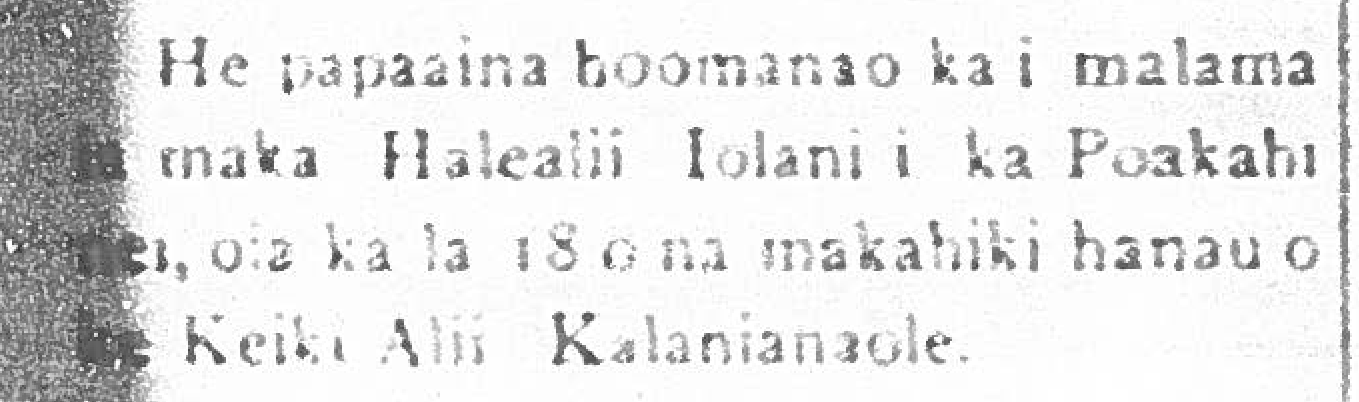
A celebratory feast was held at Iolani Palace this past Monday; that was the 18th¹ birthday of Prince Kalanianaole.

[Compare this to the previous post. This  image was taken directly from the microfilm. At least the text, although barely, is legible. Many times even the microfilms are unclear. The Hawaiian-Language Newspapers deserve to be reshot clearly—the countless people who wrote in the Hawaiian-Language Newspapers deserve to have their words read and heard as they intended.]

The black to the left of the article is a shadow that was caused because the newspaper is bound tightly like a book, and when that page is shot, the left of the page curves down and falls in a valley. That is why although the binding of the issues allowed them to survive intact to today, it is not good for shooting images. The papers need to be first unbound and laid out flat so we can get as clear an image as possible.]

¹If Kuhio was born on March 26, 1871, he would have been 17 years old then.

(Kuokoa, 3/31/1888, p. 3)

He papaaina hoomanao ka i malama...

Ka Nupepa Kuokoa, Buke XXVIII, Helu 13, Aoao 3. Maraki 31, 1888.

Statistics galore and useful information, 1875–1947.

If you haven’t heard of Thrum’s Hawaiian Almanac and Annual, check this out! And if you didn’t know that it is available online, here it is. This long running yearly publication contains a wide range of general information all in one place, and it can come in handy. Mahalo to the good folks at Hamilton Library’s Hawaiian Collection (5th floor) for putting up this helpful page!

About Thrum’s and About This Guide

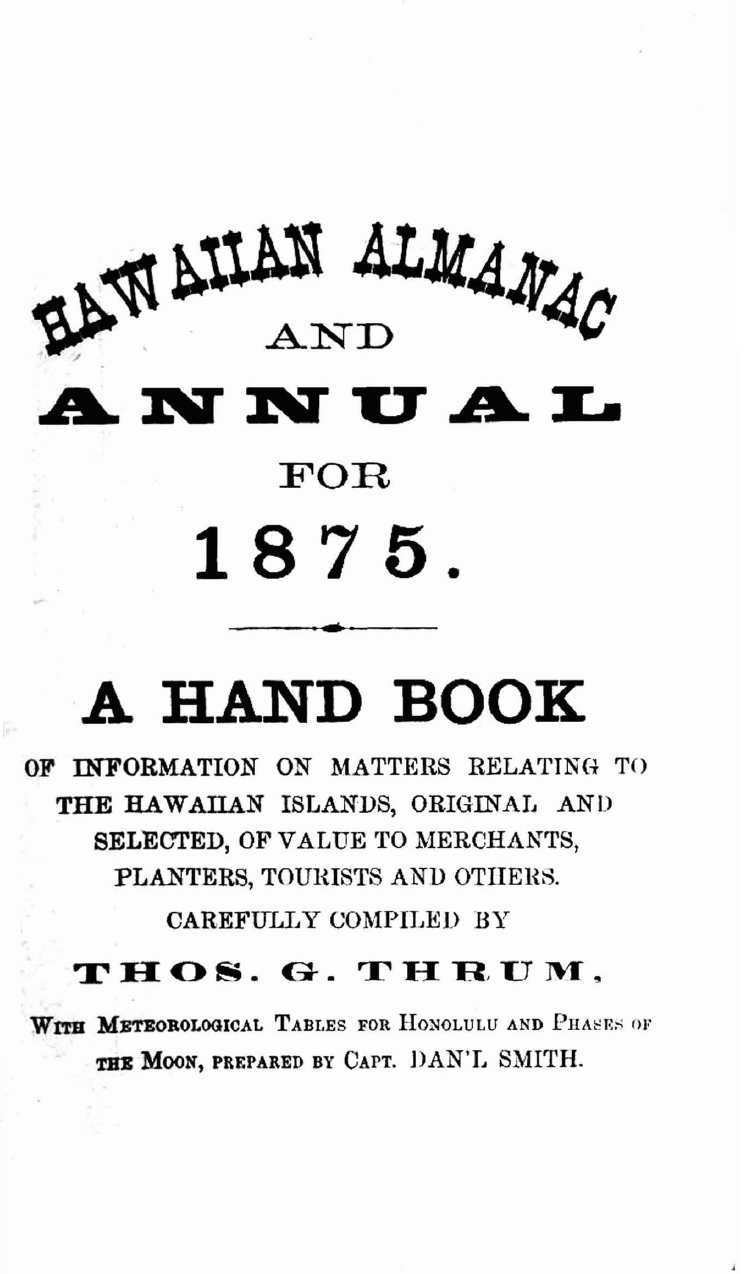
HAWAIIAN ALMANAC AND ANNUAL FOR 1875.

First page of the first “Hawaiian Almanac and Annual”.

A “fishing” accident, 1913.

MAIMED FROM AN EXPLOSION OF GIANT POWDER

How reckless are the lawless, those who fish by setting off giant powder [kiana pauda] without fear resulting from the many people whose hands were maimed and without stopping this activity; because this past Sunday, a Korean was brought to the Queen’s Hospital with his hand blown off and a side of his face falling victim to the giant powder.

It was only because of the quick action taken by Deputy Sheriff [Hope Makai Nui] Davis of Koolaupoko and Dr. Tuttle that that Korean was saved by stopping the heavy bleeding from his injuries earlier in proper time.

That Korean went that Sunday to blast fish with giant power and his body was found by Deputy Sheriff Davis of Koolaupoko, he was lying on the sand on the side of Kaneohe Bay near Mokapu.

The first thing Deputy Sheriff Davis did was to bring that Korean to Kaneohe, and called for Dr. Tuttle; he hurried in answering to the call, and that is how the Korean’s life was spared; he was would have been in trouble because of the tremendous amount of bleeding.

According to what is understood about how that Korean received his injuries: he went with a friend that day to fish, and because he was not accustomed to and very inept at handling giant powder, that is how this senseless tragedy befell him.

A twist of giant powder was thrown after lighting the fuse, and because it did not go off, that Korean went to grab it and check it out, and while he was handling it, it exploded, and his had flew off, and almost his whole face was burnt by the powder.

When the government man found the Korean, found also was a twist of giant powder ready to ignite and throw into the ocean.

[Notice how the dash in the first word of the title, “pa-huia” signifies that the syllable after the dash is lengthened, and also how the passive “ia” is as usual, not set off—today therefore it would be written “pahū ʻia”

(Kuokoa, 3/21/1913, p. 1)
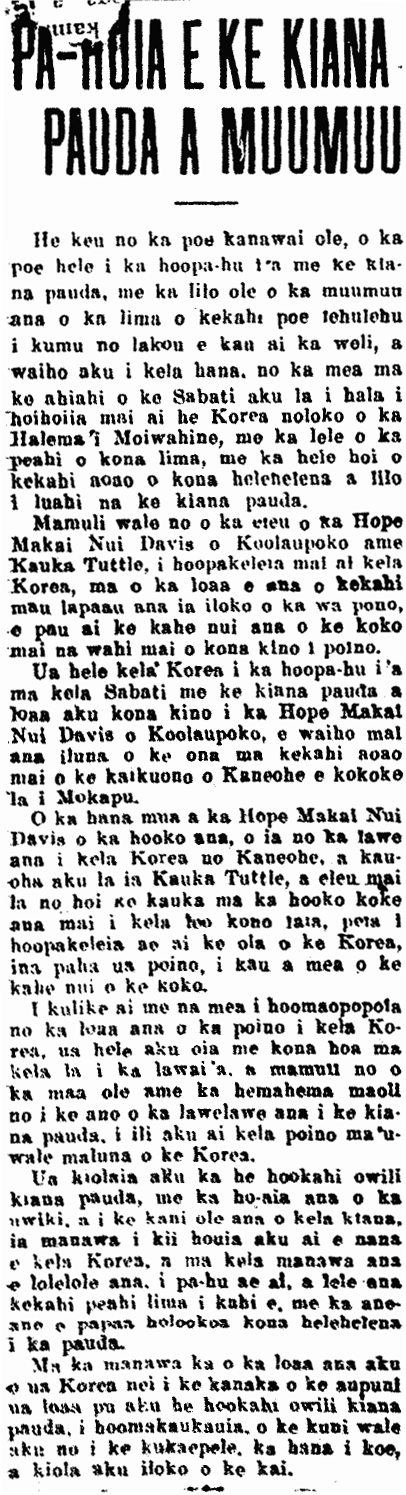
PA-HUIA E KE KIANA PAUDA A MUUMUU

Ka Nupepa Kuokoa, Buke VL, Helu 12, Aoao 1. Maraki 21, 1913.
800,000 more word-searchable pages added to Chronicling America, 2013.

Chronicling America Update: 800,000 added pages, including newspapers from North Dakota and Indiana

March 20, 2013

On March 18, the Library of Congress updated the Chronicling America Web site to add more than 800,000 newspaper pages, published from 1836 to 1922 in the U.S. In addition to the 25 states and the District of Columbia already represented on the site, this update adds newspapers from Indiana and North Dakota as well as additional French and Spanish newspapers from Arizona, Louisiana, New Mexico, and Texas. Other updates include improved use on iOS devices, added navigation features, and updated US Newspaper Directory information.

[Reposted from Chronicling America, Program News.]

Hawaiian Music and Musicians, Revised and Updated, 2013.

If you are free at 12:00 noon tomorrow, the Center for Biographical Research’s Brown Bag tomorrow is on the updated classic, “Hawaiian Music and Musicians”!

“Hawaiian Music and Musicians, Revised and Updated.”
by John Berger, Author and Editor
Thursday, March 14th
12 noon to 1:15 pm
Kuykendall 410

For more information, please contact biograph@hawaii.edu, 956-3774, or www.facebook.com/CBRHawaii

George S. Kanahele published his monumental Hawaiian Music and Musicians: An Illustrated History in 1979. Compiled with the assistance of a hundred contributors and the research of many more, it was immediately recognized as the most ambitious book ever written about Hawaiian music.

The book is arranged alphabetically, with entries on Hawaiian music from its roots in ancient chants to the flowering of the musical renaissance in Hawai’i. It describes leading personalities and groups, organizations, songs and publications, and discusses the extraordinary popularity of Hawaiian music round the world. There are biographies of musicians from every period of Hawaiian musical history—from Henry Berger, David Kālakaua, Queen Lili‘uokalani, and others of their time, to the great names of the 20th century.

In 2000 Dr. Kanahele asked veteran music critic John Berger to work with him on a second edition; Dr. Kanahele passed away a few months later. It took John Berger another dozen years to complete this Revised and Updated Hawaiian Music and Musicians: An Encyclopedic History (Mutual Publishing, 2012). The book is now more than doubled in length, with almost every entry revised and updated, and with almost 100 new entries. In this talk, John Berger will be discussing the process of revising and editing this immense musical history.

Speaker Bio:

John Berger has covered entertainment in Honolulu for 40 years. He has been writing about music, theatre and social events of all kinds for the Honolulu Star-Advertiser (formerly the Honolulu Star-Bulletin) since 1988.

[From University of Hawaii’s Center for Biographical Research Facebook page: https://www.facebook.com/events/423747624386459/ ]

Martha Poepoe Hohu and three Hilo women honored, 1929.

THREE HILO STUDENTS HONORED

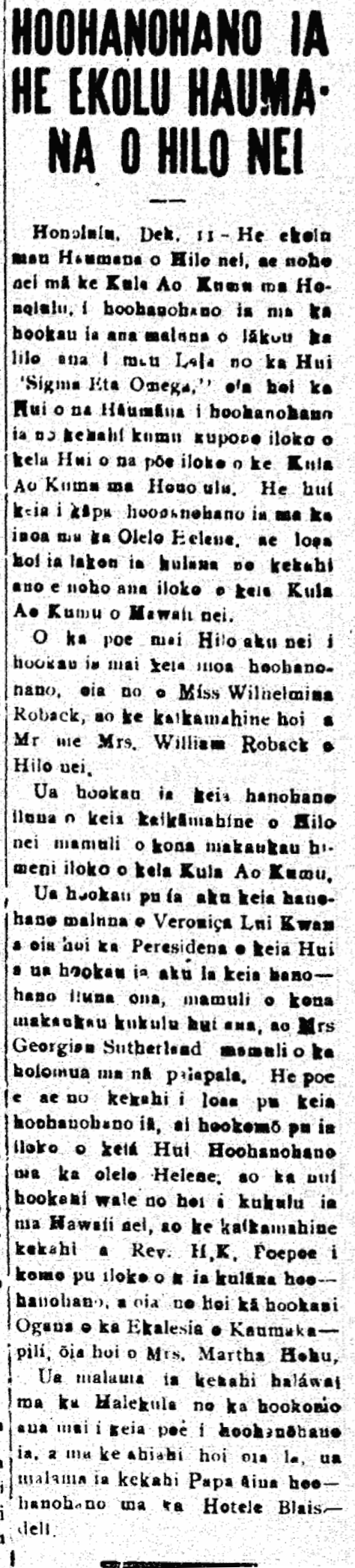
Honolulu, Dec. 11—Three Students from here in Hilo, who are boarding at the Teachers’ School in Honolulu, were honored by being initiated as members of the Society of “Sigma Eta Omega,” which is the Association of the Students who were honored for doing good works among that Association of those in the Teachers College [Kula Ao Kumu] in Honolulu. This Association is honorably named in Greek, and they are bestowed this position because of their standing in this Teachers College of Hawaii.

The ones from Hilo upon whom were bestowed this honored name, were Miss Wilhelmina Roback, the daughter of Mr. and Mrs. William Roback of Hilo nei.

This honor was conferred upon this girl from Hilo because of her singing abilities at that Teachers College.

This honor was also conferred upon Veronica Lui Kwan, the President of this Association, and this honor was bestowed upon her because of her skill in organizing the association; and to Mrs. Georgian Sutherland for her progress in studies. There were others as well receiving this honor and were initiated into this Greek Honors Society, the only society established in Hawaii nei; the daughter of Rev. H. K. Poepoe was also one included in this honored position, that being the Organist of Kaumakapili Church, Mrs. Martha Hohu.

A gathering was held at the College to initiate those who were honored, and on the evening of that day a celebratory party was held at the Blaisdell Hotel.

[Hoku o Hawaii, the last of the historic Hawaiian-Language Newspapers and one of the longest running (1906–1948) was printed in Hilo. For some reason, there seems to be at this time no issues online from before 5/31/1917. Eleven years of this paper is available on microfilm, but are not online as of yet. Hopefully, this newspaper can get reshot in entirety soon, because much of the available images are hard to read.]

(Hoku o Hawaii, 12/17/1929, p. 1)

HOOHANOHANO IA HE EKOLU HAUMANA O HILO NEI

Ka Hoku o Hawaii, Buke XXIII, Helu 27, Aoao 1. Dekemaba 17, 1929.

A couple of more days… 2013.

I will be away for a couple of more days. But in the meantime, click here to check out TROVE, the National Library of Australia website!

I am impressed by the wide range of capabilities. See what you all think.

Here for example you can see all the newspaper articles including the name Liliuokalani:

http://trove.nla.gov.au/newspaper/result?q=Liliuokalani&sortby=dateAsc