Mary Mahiai passes away, 1913.

AGED HAWAIIAN PASSES BEYOND

Believed by many of the Hawaiians to be at least 110 years old, and having figured in a history which has been recounted from the Atlantic coast to the far east, Mary Mahiai died at her home on Vineyard street last Monday night, and was buried yesterday afternoon in the cemetery back of the asylum.

The aged Hawaiian was born on the island of Kauai during the period the reign of Kamehameha the Great, long before the first missionaries from New England arrived here, and at the age of seven years went out in a canoe with her uncle and five other men for the island of Molokai. A storm came up and the canoe was driven out of sight of land, and for ten days they drifted at the mercy of the elements without food or water. When nearly dead from hunger and thirst, a sail was sighted, and two boats appeared, the larger of which sent a boat out to take the occupants of the canoe aboard. They were treated kindly by the captain and soon learned that the vessel was bound for China. The little Hawaiian girl was given the task of caring for the captain’s daughter and the men put to work on the vessel. At one of the islands of the Ladrones the five men of the little party were put ashore at their request, and it was afterward earned that they were devoured by cannibals who were known to infest those islands. Mary Mahiai, with her uncle, remained on the vessel and were taken to China, where they were turned over to missionaries there. They remained there several years, during which time Mary’s uncle died. Mary was made nurse to one of the missionary’s children and soon after traveled to New York with her mistress. At the time of the gold rush to California Mary was in the employ of a missionary family named Bates, and in 1848 they set sail for the gold fields, via Cape Horn. They were many months reaching their destination on account of the fierce storms which swept that coast, finally reaching Monterey.

The party sailed for the Hawaiian islands a few years later, arriving in Honolulu in 1850, and Mary at once sent a letter to her friends, who had many years previous mourned her death, thinking that she had been drowned or eaten by sharks. Her friends came to Honolulu and her return was celebrated with a luau which lasted many days. Mary did not accompany her relatives back to Kauai, but remained in the employ of the Bates family, to whom she had become very much attached. Later, she married, her husband dying a few months later. Her second husband died of the smallpox and her third lived only a year after their marriage. She married for the fourth time and she and her husband lived happily for twenty years, he dying in the early part of the present century.

The interesting story of her life was told by her when she appeared before the United States senatorial commission on its visit to Honolulu in 1902. As she became old, Mary Mahiai lapsed into the easy Hawaiian life in her humble home on Vineyard street, where she would be often seen barefooted and clad in a holoku.

(Star-Bulletin, 1/8/1913, p. 4)

AGED HAWAIIAN PASSES BEYOND

Honolulu Star-Bulletin, Volume XX, Number 6479, Page 4. January 8, 1913.
Mary Mahiai, what a story! 1901.

MARY MAHIAI.

The picture above is of Mary Mahiai, a Hawaiian woman who is ninety years old or more. Last week, she was called to court over land that is being fought over. Here, her story was heard. Because of her good story and her long life, one of our writers went once again to ask her about her history. And this is it:

I don’t know when I was born, but I was born before the arrival of the missionaries. I was very small at that time, and maybe I was this tall. One day, we boarded a canoe, her Uncle and five others; they wanted to visit Molokai. They were caught up in a storm in the middle of the ocean, and blown outward; they did not eat for ten days and nights. Because I was so young, I cried a lot. I wanted to eat, and I was thirsty. We had nothing to eat, and had no water left. Water came in the waa, and some of us drank the bilge water. We were near crazy with hunger and thirst. We lost hope that we would live. One day we spotted a ship. We tried to get noticed. We were fetched and taken aboard the ship. My duty aboard the ship was to care for the children. The captain and his wife were kind. We landed at Lardone [??]. Five of them got off with the intent of living there. We heard that they were eaten after that by the people this place. My uncle and I went all the way to China. I cared for the baby some missionaries, Mr. and Mrs. Brown. Thereafter, my uncle died and I was left alone with those haole. I was the caretaker of the baby. I lived for perhaps six whole years in China. I travelled around many places. Later, Mrs. Brown died. I lived with Mr. and Mrs. Bates. After that he wanted to go to California to prospect for gold. We accompanied him on a boat, and saw Cape Horn [Kepahoni], that place famous for rough seas. I saw many lands. I lived for three months in the gold fields. I wanted very much to return to Hawaii. Afterwards, these haole agreed and we all left for Hawaii nei. When we arrived, I immediately wrote to my parents and younger siblings. They came to Honolulu at once. They believed that I had died earlier. My father died without me knowing him.

Continue reading

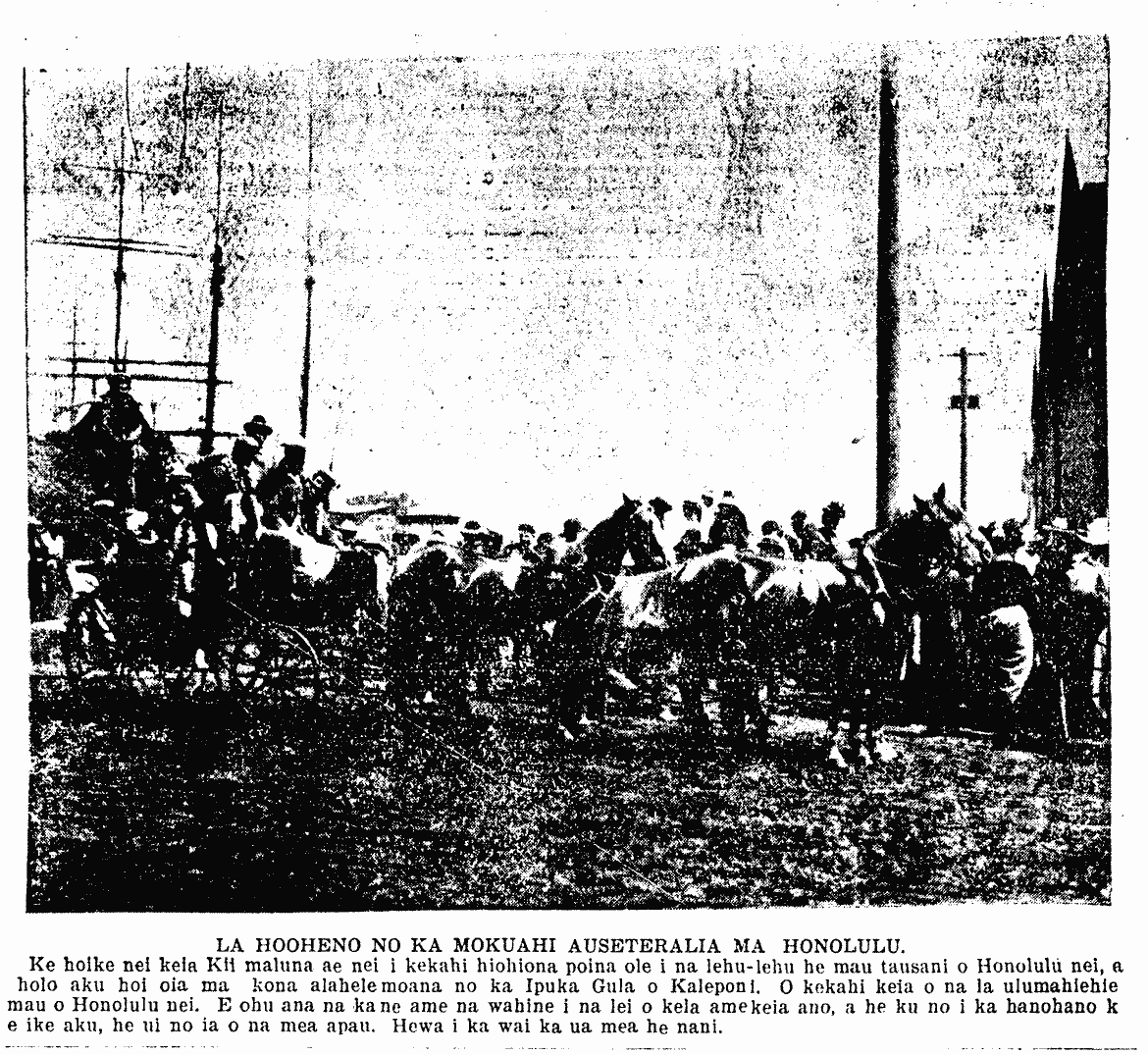
The Steamship Australia, 1900.

A DAY OF CELEBRATION FOR THE STEAMSHIP AUSTRALIA IN HONOLULU.

The picture above illustrates the scene that cannot be forgotten by the crowd of thousands of Honolulu nei, as it goes on its ocean path to the Golden Gate of San Francisco. This is a regular festivity here in Honolulu. The men and women are decorated with lei of this and that variety, and it is glorious to see, the beauty of everyone. It is so very beautiful.

[The Australia was one of the many ships that took Hawaiians to and from this Archipelago. One of her famous passengers was Sweet Emalia, Emalia Kaihumua, the composer of “He Aloha Moku o Keawe,” which is a song composed in far away San Francisco during a time of great turbulence, where the writer yearns for her homeland.

Don’t forget to tune in tonight to the 94th annual Kamehameha Schools’ Song Contest! Its theme this year is Songs of World Travel!!]

(Kuokoa, 3/23/1900, p. 1)

LA HOOHENO NO KA MOKUAHI AUSETERALIA

Ka Nupepa Kuokoa, Buke XXXVIII, Helu 12, Aoao 1. Maraki 23, 1900.

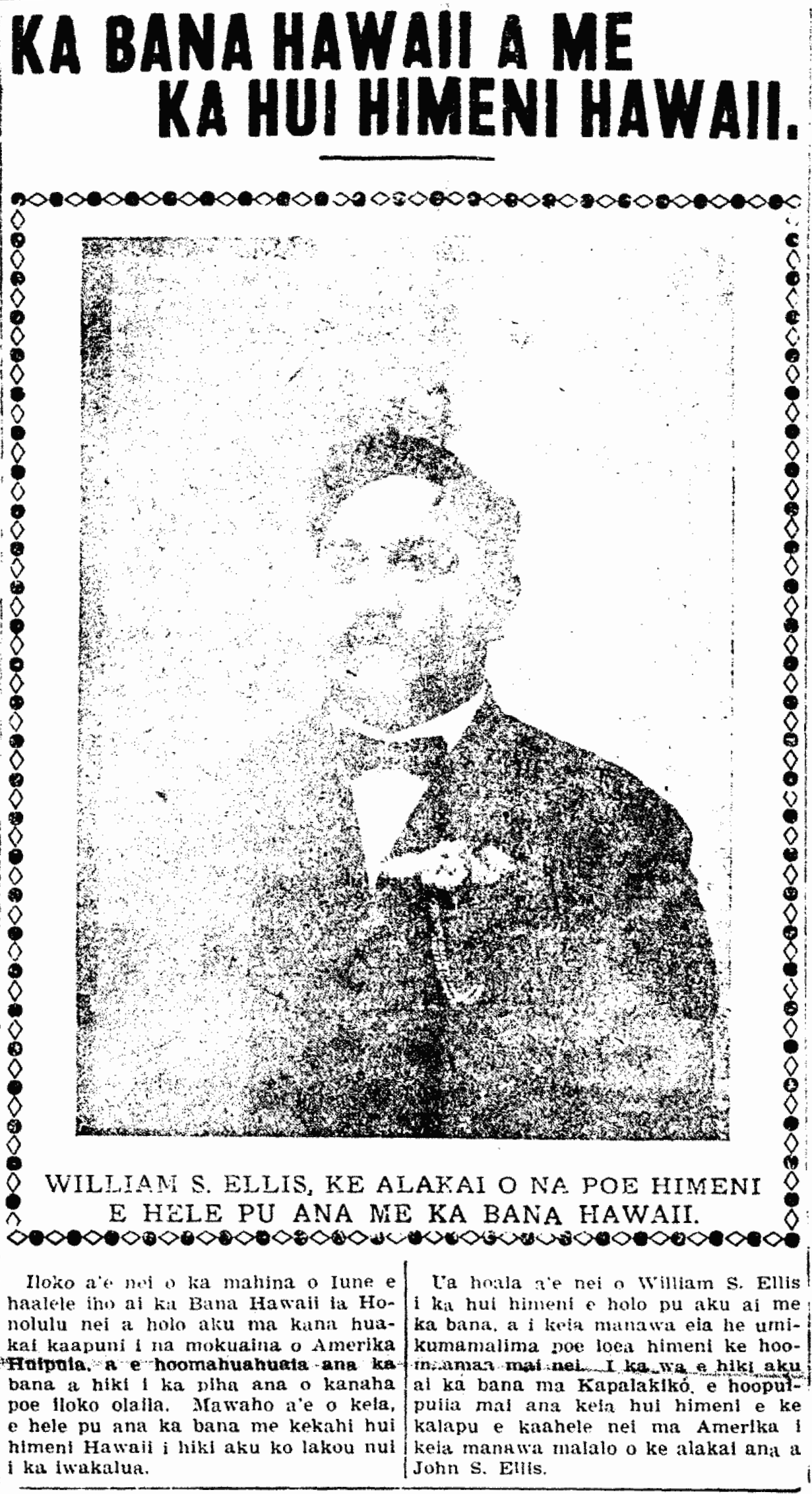
William S. Ellis, leader of the glee club accompanying the Royal Hawaiian Band on tour, 1906.

THE ROYAL HAWAIIAN BAND AND THE HAWAIIAN GLEE CLUB.

WILLIAM S. ELLIS, THE LEADER OF THE SINGERS THAT ARE TRAVELLING WITH THE ROYAL HAWAIIAN BAND.

In the month of June, the Royal Hawaiian Band is leaving Honolulu and going on their tour of the states of the United States of America, and their number will increase until it includes forty people. Other than that, the band will go with a Hawaiian glee club that is made up of twenty people.

William S. Ellis formed the glee club going along with the band, and currently there are fifteen skilled singers who are practicing. When the band arrives in San Francisco, this glee club will be increased by the club that is touring America under the leadership of John S. Ellis.

(Kuokoa, 3/9/1906, p. 1)

KA BANA HAWAII A ME KA HUI HIMENI HAWAII.

Ka Nupepa Kuokoa, Buke XLIV, Helu 10, Aoao 1. Maraki 9, 1906.

Stopping by at Washington, D. C. on the way to see the Queen, 1887.

KING KALAKAUA’S WIFE.

QUEEN KAPIOLANI ARRIVES AT OUR NATIONAL CAPITAL.

Arrangements Made for the Queen to Call on the President and Mrs. Cleveland—A Benevolent Creature on Her Way to Visit Victoria—Queen Emma.

QUEEN KAPIOLANI.

Washington, May 4.—Queen Kapiolani, of the Hawaiian Islands, who arrived in San Francisco on April 20, arrived in Washington to-day and immediately went to the Arlington Hotel. Arrangements have been made for the queen to call on the president and Mrs. Cleveland at noon on Wednesday. The queen and suite will arrive here early Tuesday evening and go at once to the Arlington. A time will be appointed by the queen during her stay here for the diplomatic corps to call on her, and she will also probably receive calls from the naval officers who have been stationed at Honolulu, all of whom have met her majesty, and many of whom have danced with her.

After spending a few days here sight-seeing she will go to New York. From there she goes to England to be present at the Queen’s jubilee. She has never been out of her own country before, and is quite anxious to see the “greatest woman on the face of the earth,” as she calls Queen Victoria. Queen Kapiolani is not of what is known as royal blood in Honolulu. Strictly speaking neither is King Kalakaua of royal blood, as he was elected to the throne and did not inherit it. Continue reading

Royal Hawaiian Band on major tour, 1906.

THE HAWAIIAN BAND HAS LEFT

Miss Annie Leilehua Brown is the Kahuli¹ that has Left.

Madame Nane [Nani] Alapai Pulled Out Over Some Issues—The Places They Will Visit.

MISS ANNIE LEILEHUA BROWN, THE KAHULI OF THE HAWAIIAN BAND WHO HAS LEFT.

On the evening of this past Wednesday, the Royal Hawaiian Band gave their aloha to the communities of their beloved land, and travelled across the wide ocean to the Golden Gate [Ipuka Gula] of San Francisco, and from there they will travel the major cities of the Father Land. They made the deck of the Steamer Korea adorned with them.

There were sixty people on there of the band and glee club, and the majority are Hawaiian, with a few Portuguese; and some people are waiting in San Francisco to join up with the band there. All of them are under the management of Mr. J. C. Cohen, the haole who took the band earlier to Portland [Pokolana].

There is one sad thing, and that is the dropping of the sweet-voiced singer of the band, Madame Nane [Nani] Alapai. Due to a differences between her and J. C. Cohen about her husband, Mrs. Alapai has left the band, and returned to the bosom of her beloved husband; this is a noble example of the power of aloha that is triply bound betwixt a man and his wife; and she will abandon the prestige and power of money.

Hawaii however does not lack in all sorts of singers, so that band is not missing a singer being that they were accompanied by Miss Annie Leilehua Brown, the bird that enlivens the nights of Niolopa. Upon this Hawaiian girl lies the hopes of J. C. Cohen that Hawaii will be lauded with much praise, and that before the band returns home, this girl will become something big.

There are men in that band with beautiful voices, and they will be made to sing solos. There is Jack Ellis, one of Hawaii’s fine tenors; Beni Jones, the bull of the Kawaihau Glee Club; William Ellis and Solomon Hiram, the baritones. When they are all singing together, it is just so beautiful!

These below are all of the people in this tour of the band:

Executive Staff—J. C. Cohen, general manager [lunanui]; A. A. Lotto, business representative [lunahana]; W. Prestidge, master of properties [malama waiwai]; W. Schwartz, assistant master of properties [hope malama waiwai] and librarian [malama pepa].

THE BAND.

Captain H. Berger, Director.

Clarinets—D. K. Naone, C. Palikapu, F. Santanna, L. Salamanco, P. K. Kakalia, S. Opeka, J. M. Gomes, A. H. Elona, P. Kanoho, A. Baker, G. K. Gilman, D. Nape, S. Santanna.

Saxophones—W. S. Ellis, L. Nunes.

Oboes—K. Peters, D. Kaiwi.

Drums—J. Naone, J. C. Freitas, J. Colburn.

The Brass Section.

Cornets—J. Amasiu, Charles Krueter, L. Waiamau, R. W. Aylett, W. Anahu, M. Moniz, W. Sea.

Baritone Horn—M. Mendoza.

Tubas—R. H. Baker, J. Kanoho, J. Kaaua, J. McCabe.

Alto Horns—M. Garcia, R. S. Kapua, G. Wela, H. Keawe.

Trombones—H. Heanu, J. Punua, J. Pa, S. Hiram.

GLEE CLUB.

Directors—Sonny Cunha and W. S. Ellis.

Double bass—R. H. Baker; Violinists—J. Colburn, C. Palikapu; flutists, D. Kaiwi, D. Nape; Piano, Sonny Cunha.

Singers—John S. Ellis, tenor, soloist; Ben Jones, bass, soloist; W. S. Ellis, baritone, soloist; Solomon Hiram, J. Harrison, P. H. Kakalia, W. Sea, H. Heanu, H. K. Clark, K. Peters, J. Kamakani, L. Waiamau, J. Edwards, R. W. Aylett, Joe Pa, J. Akana, H. Keawe, J. K. Kaaa, R. S. Kapua, J. Punua.

Female singer—Miss Lei Lehua [Leilehua]

THE PLACES THEY WILL TRAVEL.

May 28 to June 4, 1906, Oakland, California.
June 5, Stockton, Yosemite Theater.
June 6, Sacramento, Clumie Theater.
June 7, on the road.
June 8, 9, Portland, Oregon, Hellig Theater.
June 10, 11, 12, Seattle, Washington, Grand Music House.
June 13, Victoria, British Columbia, Victoria Theater.
June 14, Vancouver, B. C., Vancouver Music House.
June 15, Watcom, Washington, Beck Theater.
June 16, Everett, Washington, Everett Theater.
June 17, Tacoma, Washington, Music House.
June 18, Aberdeen, Washington, Music House.
June 19, Yakima, Washington, Yakima Theater.
June 20, 21, Spokane, Washington, Spokane Theater.
June 22, Missoula, Montana, Music House.
June 23, Helena, Montana, Helena Theater.
June 24, Great Falls, Montana, Music House.

¹Kahuli are the famous singing land shells which are often used to describe sweet-voiced singers.

(Kuokoa, 5/25/1906, p. 1)

UA HOLO AKU LA KA BANA HAWAII

Ka Nupepa Kuokoa, Buke XLIV, Helu 21, Aoao 1. Mei 25, 1906.

June 25, Anaconda, Montana, Margaret Theater.
June 26, Butte, Montana, Broadway Theater.
June 28, Pocatello, Idaho, Auditorium.
June 29, Logan, Utah, Thatcher Music House.
June 30, July 1, Ogden, Utah, Music House.
July 2, 3, 4, Salt Lake City, Salt Lake Theater.
July 5, Salida, Colorado, Music House.
July 6, Pueblo, Colorado, Music House.
July 7, Colorado Springs, Music House.
July 8, 9, 10, 11, 12, 13, 14, Denver, Colorado, Tabor Grand Theater.

(Kuokoa, 5/25/1906, p. 8)

HOLO AKU KA BANA HAWAII.

Ka Nupepa Kuokoa, Buke XLIV, Helu 21, Aoao 8. Mei 25, 1906.

Hawaiian boy in the military writes home to his mom, 1921.

A LETTER FROM A BOY TO HIS MOM.

JOHNSON KEALOHA

February 23, 1921.

To My beloved Mama:—I received your letter, and with much aloha for you and papa, I am writing this letter. I was pleased to find out that you guys received the check that I sent, that check that you sent to me and that I sent back.

Mama, I had a very happy experience here in Balboa; we had a swimming meet, competing with the swimming team of the Balboa Club. I won the 50 yard meet, and the competitor for the Balboa Club lost. Older brother Kalei was with me, he is now the captain of the Yeoman of the warship Wyoming. Kaehu won the 200 yard meet, this was a race where you swam face up. We lost the relay race [heihei paku’i], however some of us were right behind the winner. We will race once again on the 24th of this month with that same club. I believe that by the time you receive this letter, we will soon reach San Pedro in a couple of days.

I am in good health, and I hope that so too are you two and everyone as well at home. O Mama, one more thing I wanted to tell you, of which I am happy about, and that is this, I received my gold medals a few days ago, from the Mayor of New York. I will send the medals to you, when he returns to the states.

In a shooting practice amongst the Pacific and the Atlantic fleets, the Pacific won in a competition held in the sea of Panama. I will stop here, because I am returning to catch a skiff to go back on board the battleship New York, so much aloha for you and papa and all of the family.

March 15, 1921.

My dear Mama:—I am sending the two of you this dipoloma [palapala homaikai] given for crossing over the Mediterranean Sea [Kaiwaena] with a American battleship. I was going to send you this with the other things I sent you,  but I forgot because I was very rushed, so I will send you this “diploma” now, and I hope that you will get it.

Mama, I want you to frame this diploma in a big wooden frame so that it doesn’t get damaged, and I also hope that it will be something nice for the family to look at always. Both older brother Kalei and I crossed over the Mediterranean Sea. Write me if you get this diploma.

I am in good health, and so too is older brother, Kalei. I hope that there will be a swim meet between us and the club of South California this coming month; our superior is organizing a meet between the club of the warships of the Pacific and that of California.

I am stopping here and will write again to you mama. Give my aloha to papa and all the family at home. From you loving child,

JOHNSON KEALOHA.

(Kuokoa, 4/8/1921, p. 2)

HE LEKA NA KE KEIKI I KONA MAMA.

Ka Nupepa Kuokoa, Buke LIX, Helu 14, Aoao 2. Aperila 8, 1921.

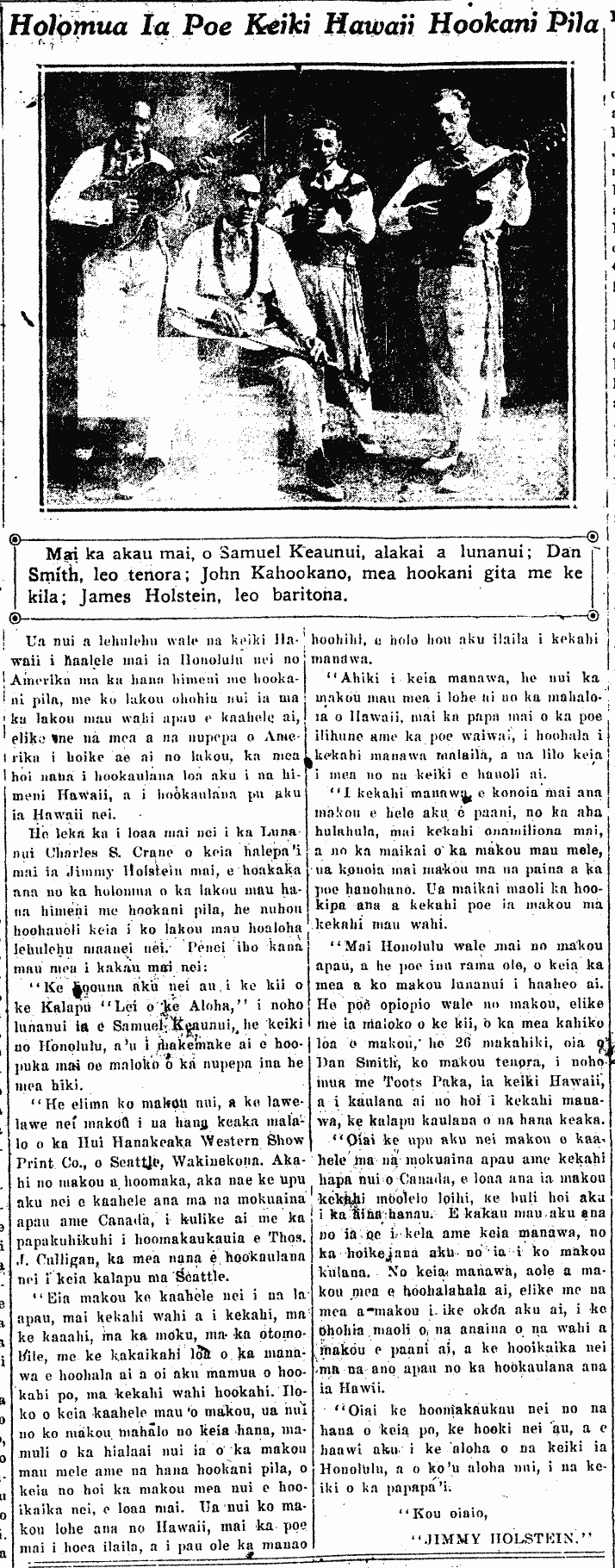
“Lei o ke Aloha” band making music abroad, 1919.

Hawaiian Musician Boys Making Progress

From the right, Samuel Keaunui, leader and manager; Dan Smith, tenor; John Kahookano, guitarist and steel guitarist; James Holstein, baritone.

There are a great and many Hawaiian youths that have left Honolulu to go to America to sing and play music, with much acclaim everywhere they have travelled, like what has been reported about them in newspapers in America, which makes Hawaiian music famous, and makes Hawaii nei famous as well.

There has been a letter received by the Editor of this press, Charles S. Crane, from Jimmy Holstein, explaining the progress made in their singing and music; this is happy news for their many friends here. Here is what he had to say:

“I am sending a picture of the Club “Lei o ke Aloha,” managed by Samuel Keaunui, a boy from Honolulu, that I want you to print in the newspaper if possible.

“We are comprised of five members, and are acting under the Acting Company, Western Show Print Co., of Seattle, Washington. We have just began, but we hope that we will travel all the states as well as Canada, as per the itinerary prepared by Thomas J. Culligan, the one making this club famous in Seattle.

“Currently we are moving from one place to another everyday, aboard trains, ships, automobiles, hardly ever spending more than a night in one place. While constantly travelling, we have much appreciation for this work because of the great delight received from our singing and music; and this is what we strive to attain. We hear much of Hawaii from those who went there and whose desire never ends to go there once again.

“Until now, we hear much of the admiration for Hawaii from the fathers of the poor and the rich, who spent some time there, and this has become something that the Hawaiian boys enjoy.

“Once we were invited to play for a ball, by a millionaire, and because of our find singing, we were invited to parties of prestigious people. The hospitality we received from various people in certain places has been great.

“We are all from Honolulu, and are not drinkers, and this is something which our leader is proud of. We are but youngsters, as seen in the picture; the oldest of us is 26, that being Dan Smith, our tenor, who was with Toots Paka before, that Hawaiian boy that was famous for some time; the club famous for acting.

“Being that we hope to travel through all the states and some of Canada, we will have a long story when we return to our land of birth. I will write to you all the time to tell you how we are doing. For now, there is nothing  we have to complain about, like what we have seen, or the true enthusiasm of the audiences wherever we’ve played at, and we are working in every way to bring fame to Hawaii.

“Since we are getting ready for tonight’s gig, I will stop here; give the boys’ aloha to Honolulu, and my great aloha to the boys of the press.

“Yours sincerely,

“JIMMY HOLSTEIN.”

(Kuokoa, 8/15/1919, p. 2)

Holomua Ia Poe Keiki Hawaii Hookani Pila

Ka Nupepa Kuokoa, Buke LVII, Helu 33, Aoao 2. Augate 15, 1919.

Diamond Kekona writes home, 1908.

A LETTER FROM FOREIGN LANDS.

This past week, Mr. D. K. Kekona received a letter from his child Dimond Kekona [Diamond Kekona], written in the city of Philadelphia, United States of America, telling of how they are doing and their progress of their work in the foreign lands.

These are Hawaiian boys who left the beloved shores of Hawaii nei and sailed to other lands in search of fortunes through singing and playing music with their various instruments. According to what he reported, their work is going well; they receive around $1,425 every week.

They are under the direction of a haole that shows movies named Mr. Lubin, and on the first night that showed the movies in the city of Philadelphia, along with their singing of Hawaiian songs, they received a huge sum of money, and on that night in their estimation, there was about ten-thousand people or more gathered there to see the performance of the Hawaiian boys which they heard about.

In their band is seven actual Hawaiian boys; each of their names are: Dimond Kekona [Diamond Kekona], Charles Kalahila, E. Davis, Frank Forest [Frank Forrest], Harry Parker, Sam and Willie Jones. There are many other Hawaiian bands in America and they travel all over the place.

Here is the gist of the letter:

To My Dear Papa,

Mr. D. K. Kekona, Aloha to you and all the family:—I have found the perfect time to write to you this letter to tell you how we are and how our work is here.

We opened a show in the city of Philadelphia before a large group of people that numbered about ten thousand. Mr. Lubin is our leader, and he shows movies with our assistance in our singing Hawaiian songs along with playing instruments. Hawaiian songs are very popular. The audience was filled with delight and were pleased until the time when the program let out for the night. The money we make is about $1,425 a week and we earn very good wages for the week. We will be touring other places with our singing.

There are just seven of us Hawaii boys. We are all doing good and are in good health. It is very cold here.

(Kuokoa, 11/20/1908, p. 4)

HE LEKA MAI NA AINA E MAI.

Ka Nupepa Kuokoa, Buke XLIII, Helu 47, Aoao 4. Novemaba 20, 1908.