Beginnings of the Anglican Church in Hawaii, 1862.

Pertaining to the 28th of November¹

This day known to everyone, the day of the return of independence to the Islands and the day chosen by the Monarchs as a day for the two of them to join the new faith which has recently arrived.

On the morning of that day, at the hour of 10½, the Alii arrived at the Church and the National troops [koa o ke Aupuni], the Honolulu Rifles [koa Rifles?], the Hawaii Kiai [?], and the Cavalry [Puali Kaua Lio] were all lined up.

When the Alii arrived and passed through the entrance, the Bishop came and layed his hand and blessed them. They then entered within and sat down; following them was a procession, and they entered while chanting one of the psalms. After this was done, the laying on of hands began, and they were confirmed as brethren of the new church.

The beauty that is imbued in all creatures of the earth is what left all of their subjects who went there awe-stricken. Some wept, some fled [hoonaholoholopoo?], some were downcast, and some shuddered in awe, appearing as if the spirit from the heavens was accepted in the Monarchs joining into the circle of eternal life.

Present was Her Highness Princess V. K. Kaahumanu, the Honorable M. Kekuanaoa, the Honorable R. C. Wyllie, the Honorable Chief Justice E. H. Allen, the Honorable C. R. Bishop and his wife, the Honorable C. Kapaakea, the Honorable Colonel D. Kalakaua, Colonel McKibbin Jr., Colonel W. C. Lunalilo, Major Hasslocher, Kekaaniau, the Dowager Queen K. Hakaleleponi, Mrs. Haalelea, the wives of the Supreme Court Judges, and the Honorable Ii. There also was W. W. F. Synge and his wife, along with the Consuls of Foreign Nations.

The building was filled with those wanting to witness the joining of the Monarchs as brethren, and everyone felt much appreciation for the beauty of the Royals, the Alii, and the ceremony performed. God save the King.

¹La Kuokoa [Hawaiian Independence Day]

(Hoku o ka Pakipika, 12/4/1862, p. 2)

No ka la 28 o Novemaba.

Ka Hoku o ka Pakipika, Buke 2, Helu 8, Aoao 2. Dekemaba 4, 1862.

And more yet from Lei Day in Hilo, 1928.

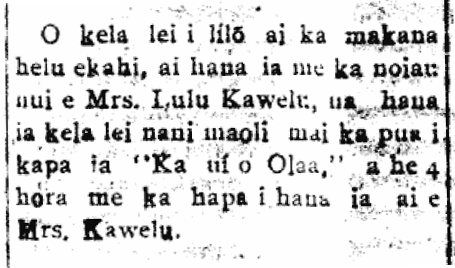
The lei that took first prize and made with great skill by Mrs. Lulu Kawelu—that truly beautiful lei was made from the flowers called “Ka ui o Olaa”¹ [Olaa Beauty], and it was made in 4 hours and a half by Mrs. Kawelu.

¹This plant is also known as “Nani o Olaa”.

(Hoku o Hawaii, 5/8/1928, p. 2)

O kela lei i lilo ai ka makana helu ekahi...

Ka Hoku o Hawaii, Buke XXI, Helu 48, Aoao 2. Mei 8, 1928.

More Lei Day in Hilo, 1928.

DAY TO CELEBRATE LEI IN HILO

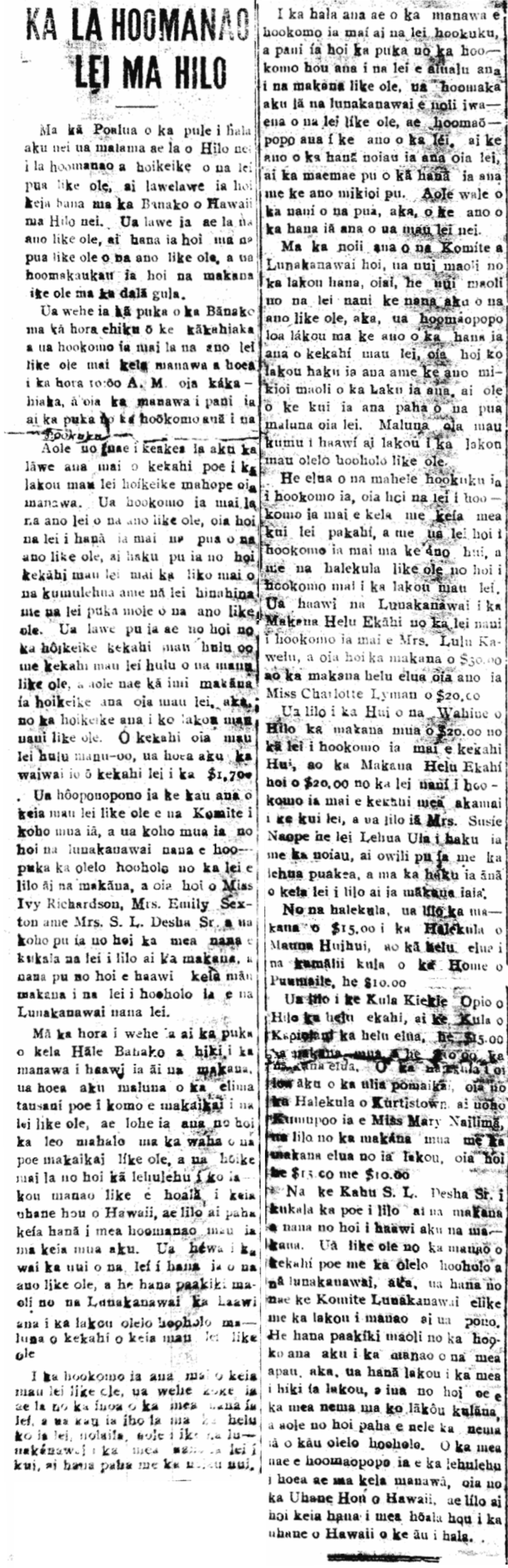
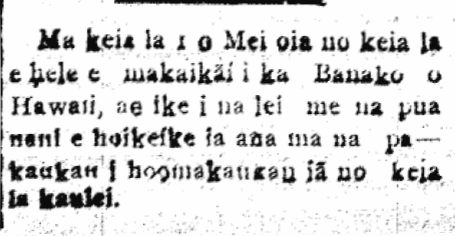
On Tuesday last week, Hilo held a celebration and display of flower lei of all sorts, and this was done at the Bank of Hawaii in Hilo. All types of lei were brought down and they were made will all kinds of flowers of all types, and prizes of all kinds were prepared of gold coins [dala gula].

The doors of the Bank were opened at seven in the morning, and lei of all types were brought in from then on until 10:00 A. M. of that morning, and then the doors were closed to bring in the judges.

However the bringing in of lei to put on display by others after that was not barred. Entered were all types of lei of all sorts; for instance, lei made of various flowers, and some lei were woven with the buds of the lehua, and lei hinahina, and lei pukamole of all sorts. Also brought for display were some oo bird feathers, and feather lei of various birds, but they were not there for judging, they were just there to show the many beautiful kinds. Some of those lei of oo bird feathers are valued at $1,700 for one.

The placing of the various lei were organized by the Committee chosen earlier, and also chosen before were the judges who would decide which lei won the prizes, and they were Miss Ivy Richardson, Mrs. Emily Sexton, and Mrs. S. L. Desha, Sr. Also selected was the one who would announce the winning lei and he would also hand out the prizes decided upon by the lei judges.

From the time when the Bank was opened until the time when the awards were given, there was approximately five-thousand visitors who entered to look at the many lei, and voices of appreciation were heard from the mouths of many attendees, and the crowd expressed their joint feelings to rouse this new Hawaiian spirit, and that this event will be commemorated always from now on. There were countless [hewa i ka wai] lei that were crafted of all sorts, and it was truly a difficult task for the Judges to give their decision on some of these lei.

When the many lei were brought in, the name of the maker was immediately announced, and a number was given to the lei, so therefore the judges did not know who strung the lei, or crafted them with great skill.

When the period for the competition lei to be entered was over and the doors were closed to the entry of lei competing for the various prizes, the judges began to examine each lei, paying attention to make up of the lei, and how it was crafted, and how cleanly it was made and how neat they were as well. [They were judged] not on just how pretty the flowers were, but on how the lei were made.

In the examination by the Judging Committee, their job was tremendous, being that there were just so many beautiful-looking lei of all sorts, but some were distinguished by how they were made, in that they were woven with true craftsmanship, or by how the flowers were sewn into the lei. By those qualities did they hand down each of their judgements.

There were two competition divisions that were entered, those being lei entered by individual lei makers, and lei entered by a group, and many different schools entered their lei. The Judges awarded the First Place Prize to the beautiful lei entered by Mrs. Lulu Kawelu, and that was a prize of $30.00 and the second place prize went to Miss Charlotte Lyman, $20.00.

To the Women’s Association of Hilo went the first prize of $20.00, for the lei entered by a group; and the First Place Prize of $20.00 for the beautiful lei entered by a skilled maker of lei—to Mrs. Susie Naope with a lei of Red Lehua skillfully woven  and wound with white lehua, and by weaving this lei, that prize went to her.

As for the schools, the prize of $15.00 went to the Mauna Huihui School, and the second place to the school children of Puumaile Home, a prize of $10.00.

To Hilo Junior High School went the first place, and to Kapiolani School the second place; $15.00 was the first prize and $10.00 was the second prize. The school that was the luckiest was the Kurtistown School, whose principal is Miss Mary Nailima—to them went the first prize and second prize, $15.00 and $10.00.

Kahu S. L. Desha, Sr. announced the winners of the prizes and it was he who presented the prizes. Some people had all sorts of ideas regarding the decisions of the judges, but the Judging Committee did as they thought was right. It is difficult indeed to please everyone, but they did what they could, and should you, O Fault Finders, be in their place, there mostly surely would be those faulting your decisions. The thing sensed by the crowd there at that time was the new Hawaiian spirit; and this event will become something that reawakens the spirit of Hawaii of times past.

(Hoku o Hawaii, 5/8/1928, p. 2)

KA LA HOOMANAO LEI MA HILO

Ka Hoku o Hawaii, Buke XXI, Helu 48, Aoao 2. Mei 8, 1928.

More Lei Day in Honolulu, 1928.

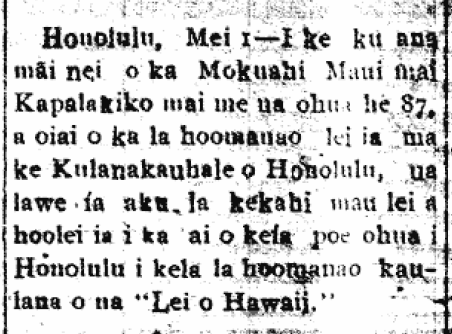
Honolulu, May 1—When the Steamer Maui from San Francisco docked with 87 passengers, and being that it was the day to celebrate lei in the City of Honolulu, lei were brought and the necks of the passengers in Honolulu were adorned with lei, on this famous day to celebrate the Lei of Hawaii.

(Hoku o Hawaii, 5/8/1928, p. 2)

Honolulu, Mei 1...

Ka Hoku o Hawaii, Buke XXI, Helu 48, Aoao 2. Mei 8, 1928.

Lei Day in Honolulu, 1928.

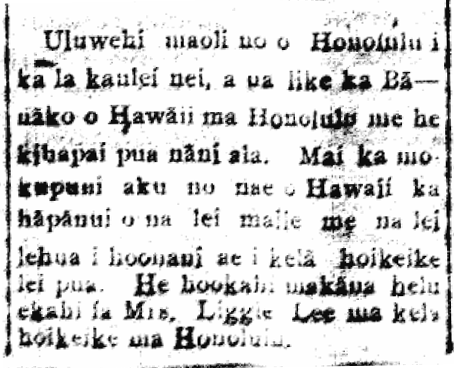
Honolulu was truly festive on this day to wear lei, and so too was the Bank of Hawaii in Honolulu, which was like a lovely flower garden. Most of the maile lei and lehua lei which decorated that display of flower lei were however from Hawaii Island. The single first prize went to Mrs. Liggie [Liggle?] Lee at that show in Honolulu.

(Hoku o Hawaii, 5/8/1928, p. 2)

Uluwehi maoli no o Honolulu...

Ka Hoku o Hawaii, Buke XXI, Helu 48, Aoao 2. Mei 8, 1928.

Kamehameha III, Kauikeaouli’s birthday, a little late. 1907.

Day of Remembrance

of the

King Kauikeaouli

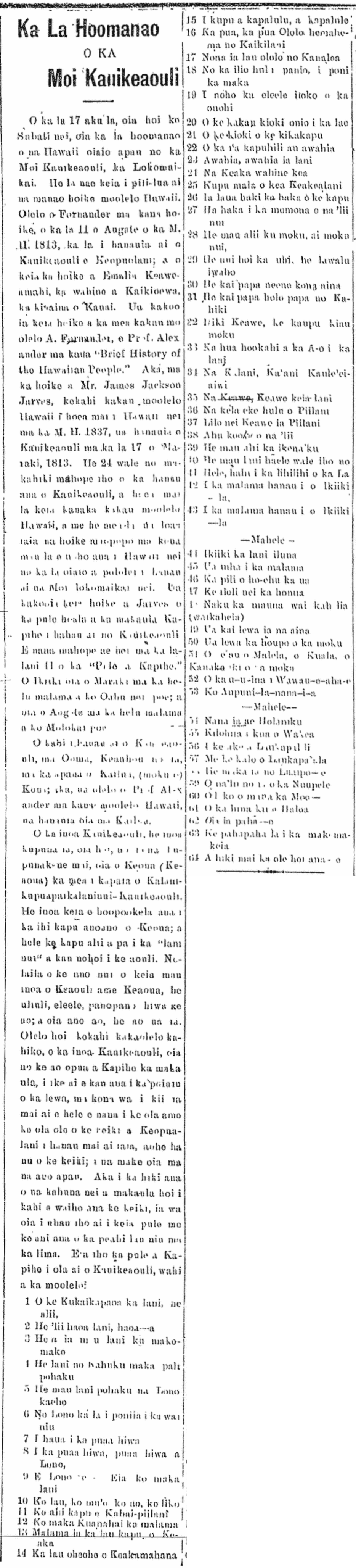
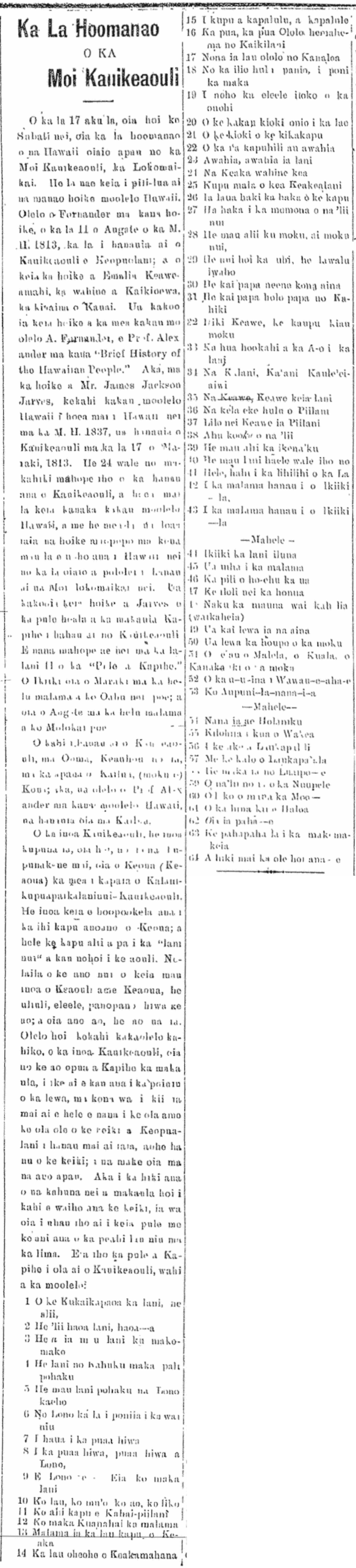
This past 17th, Sunday, was the day of remembrance for all true Hawaiians, of the King Kauikeaouli, the Benevolent one. There are two different historical accounts of this day. Fornander states in his account that Kauikeaouli was born of Keopuolani on 11 August 1813, and that this information was from Emalia Keaweamahi, the wahine of Kaikioewa, the governor of Kauai. This date of A. Fornander is supported by Prof. Alexander in his “Brief History of the Hawaiian People.” However, in the account of Mr. James Jackson Jarves, a scholar of Hawaiian history who arrived here in Hawaii nei in 1837, Kauikeaouli was born on 17 March 1813. This historian arrived here but 24 years after the birth of Kauikeaouli, and it would seem that he obtained clear information about the true birth date of the Benevolent King, while he was living here. This statement by Jarves is supported by the reviving prayer that Kapihe offered for Kauikeaouli. Look below at line 11 [42?] in the “Pule a Kapihe.” Ikiiki is the month of March according to the reckoning of Oahu people, and according to Molokai people it is August.

Kauikeaouli was born at Ooma, Keauhou, in Kailua, in the moku of Kona. However, Prof. Alexander, in his history of Hawaii, says Kauikeaouli was born in Kailua.

The name Kauikeaouli is a name from his ancestors, that being the name of his grandfather, Keoua (Keaoua), the one called Kalanikupuapaikalaninui Kauikeaouli. This name puts on high the sacred kapu of Keoua–his chiefly kapu extends above and touches the great heavens, and rests upon the dark clouds. So therefore, the importance of the names Keaouli and Keaoua, is the dark, black, thick, esteemed cloud. This cloud is a rain cloud. A Orator of the old times said that the name Kauikeaouli is the bank of clouds that Kapihe, the prophet, saw spread high in the heavens when he was called to go to see if the child that Keopualani gave birth to was alive or not alive. He was not breathing and was totally lifeless. However, when this kahuna and prophet arrived to where the child was placed, he offered this prayer while waving a coconut frond in his hand. This is the prayer by which Kapihe made Kauikeaouli live, according to the story:

1 O ke Kukaikapaoa ka lani, ae alii,

2 He ‘lii haoa lani, haoa—a

3 He a ia m u lani ku makomako

4 He lani no Kahuku maka pali pohaku

5 He mau lani pohaku na Lono kaeho

6 No Lono ka la i poniia i ka wai niu

7 I haua i ka puaa hiwa

8 I ka puaa hiwa, puaa hiwa a Lono,

9 E Lono—e. Eia ko maka lani

10 Ko lau, ko mu’o, ko ao, ko liko

11 Ko alii kapu e Kahai-piilani

12 Ko maka Kuanahai ka malama

13 Malama ia ka lau kapu o Keaka

14 Ka lau oheohe o Keakamahana

15 I kupu a kapalulu, a kapalule

16 Ka pua, ka pua Ololo hemahema no Kaikilani

17 Nona ia lau ololo no Kanaloa

18 No ka ilio hulu panio, i poni ka maka

19 I noho ka eleele iloko o ka onohi

20 O ke kakau kioki onio i ka lae

21 O ke kioki o ke kikakapu

22 O ka i’a kapuhili au awahia

23 Awahia, awahia ia lani

24 Na Keaka wahine kea

25 Kupu mala o kea Keakealani

26 Ia laua haki ka haka o ke kapu

27 He haka i ka momona o na ‘lii nui

28 He mau alii ku moku, ai moku nui,

29 He nui hoi ka uhi, ka lawalu iwaho

30 He kai papa neenekona aina

31 He kai papa holo papa no Kahiki

32 I iki Keawe, ke kaupu kiau moku

33 Ka hua hookahi a ka A-o i ka lani

34 Na Kalani Ka’ani Kauleleiaiwi

35 Na Keawe, Keawe keia lani

36 Na kela eke hulu o Piilani

37 Lilo nei Keawe ia Piilani

38 Ahu kooka o na ‘lii

39 He mau alii ka ikena ‘ku

40 He mau lani haele wale iho no

41 Hele, hahi i ka lihilihi o ka La

42 I ka malama hanau i o Ikiiki—la

43 I ka malama hanau i o Ikiiki—la

—Mahele—

44 Ikiiki ka lani iluna

45 Ua uiha i ka malama

46 Ka pili o ho-ehu ka ua

47 Ke iloli nei ka honua

48 Naku ka mauna wai kali lia (waikaheia)

49 Ua kai lewa ia na aina

50 Ua lewa ka houpo o ka moku

51 O e au o Malela, o Kuala, o Kanaka ki o a moku

52 O ka u-u-ina i Wawau-e-aha-o

53 Ko Aupuni-la-nana-i-a

—Mahele—

54 Nana ia ae Holaniku

55 Kilohiia i kua o Wakea

56 I ke ake a Laukapalili

57 Me ke kalo o Laukapalala

58 He maka ia no Luaipo—e

59 O na ‘lii no ia o ka Nuupele

60 O I ko o maua ka Moo—

61 O ka hina kai o Haloa

62 Oia ia paha—e

63 Ke pahapaha la i ka makemakeia

64 A hiki mai ka ole hoi ana—e

[Amazingly, this is the only issue of this entire year that seems to have survived! If this newspaper could be reshot nicely, we could get a clear/clearer reading of this important mele!

And I put up the mele as is (although the image is not clear in some areas, so there are some questionable lines), so that words and phrases will be searchable on this blog or on google right now, instead of having to wait for some time in the future…]

(Kuokoa Home Rula, 3/22/1907, p. 4)
Ka La Hoomanao O KA Moi Kauikeaouli

Kuokoa Home Rula, Buke V, Helu 12, Aoao 4. Maraki 22, 1907.

May Day Queen, 1941.

Became Queen

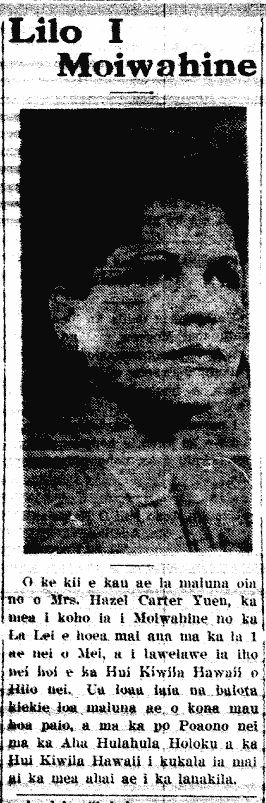
The picture above is of Mrs. Hazel Carter Yuen, the one chosen as Queen for the upcoming Lei Day, the 1st of May, held by the Hawaiian Civic Association [Hui Kiwila Hawaii] of Hilo. She received the most ballots from amongst her running mates, and on the night of this past Saturday at the Holoku Ball of the Hawaiian Civic Association the one who took the win was announced.

(Hoku o Hawaii, 4/9/1941, p. 1)

Lilo i Moiwahine

Ka Hoku o Hawaii, Buke XXXV, Helu 50, Aoao 1. Aperila 9, 1941.

Mothers’ Day should be everyday, but… 1912.

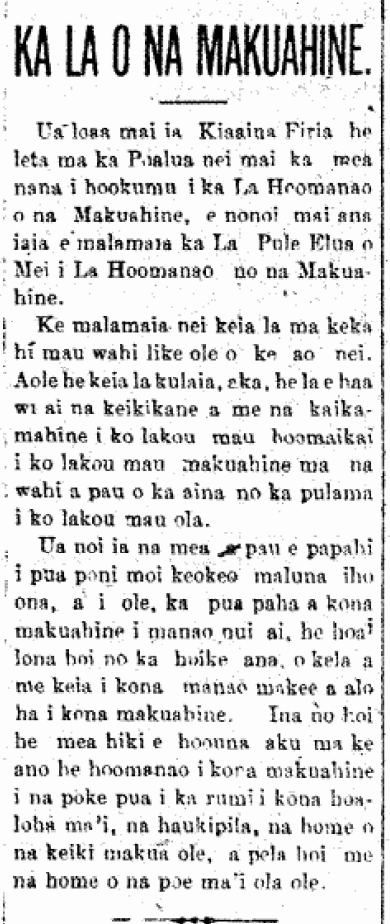
DAY FOR MOTHERS.

Governor Frear received a letter this past Tuesday from the person who started Mothers’ Day [Julia Ward Howe?], asking him to make the second Sunday of May a Day to Remember Mothers.

This day is celebrated in places all over the world. This is not a holiday, but it is a day where boys and girls all over the land give their thanks to their mothers and cherish their lives.

Everyone is asked to adorn themselves with a white carnation, or a flower which their mother is fond of, which will be a show from each and everyone of their affection and love for their mother. If possible, send in remembrance of a mother a bouquet of flowers to the room of a sick friend, or the hospital, or the orphanage home, and also to the home for the incurable.

(Aloha Aina, 3/9/1912, p. 4)

KA LA O NA MAKUAHINE.

Ke Aloha Aina, Buke XVI, Helu 10, Aoao 4. Maraki 9, 1912.