Paʻiʻai Supply for Kalaupapa, 1898.

BITS OF NEWS FROM THE PATIENT SETTLEMENT

Mr. Editor,

Aloha oe:

Please insert this in an empty space of our beloved [newspaper], and it will whip about all the borders of the land so that the many friends will know who live from Kumukahi where the sun appears to the setting of the sun at surface of the sea at Lehua.

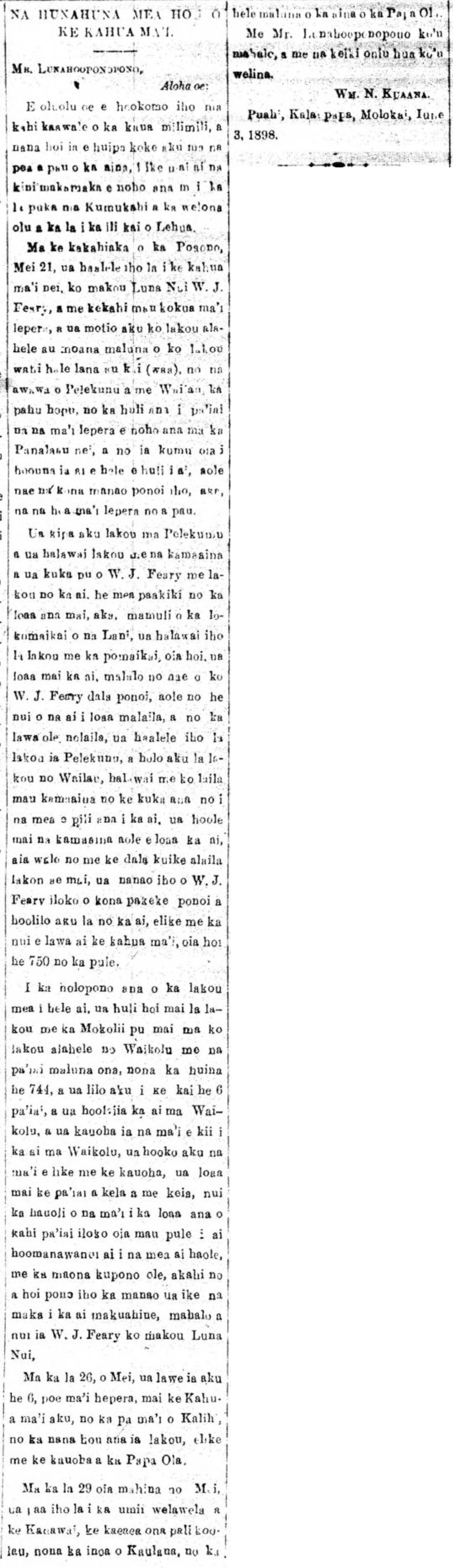
In the morning of Saturday, May 21, our Superintendent W. J. Feary along with a number of leprosy patient assistants left the Settlement. The end of their ocean path aboard their arc (canoe) were the valleys of Pelekunu and Wailau, in search of paʻiʻai for the patients living here in the Colony. It was for that reason that he was sent on this search; it was not his own idea, but because of all of the patients.

They visited Pelekunu and met with the kamaaina, and W. J. Feary talked with them about ʻai, and that it was difficult acquiring, but due to the grace of the Heavens, they met with good fortune, in that they received some ʻai, but by using W. J. Feary’s own money. They did not receive a lot there, so they left Pelekunu and sailed on for Wailau. They met with the kamaaina there to discuss ʻai. The kamaaina denied them. They would not receive ʻai, unless they paid in cash. W. J. Feary thrust his hand in his pocket and and paid for the ʻai that would be enough for the colony, that being 750 per week.

With the success of their mission, they turned back along with the Mokolii on their path to Waikolu with the paʻiʻai on board numbering 744, while 6 paʻiʻai was lost at sea, The ʻai was flung ashore at Waikolu. The patients were told to fetch them from Waikolu, and they did as they were told, and each received paʻiʻai. The patients were overjoyed at receiving paʻiʻai. Those weeks when they patiently ate haole food, without being satiated. Only now has their minds returned after their eyes saw their staple food. Much sthanks to W. J. Feary, our Superintendent.

On the 26th of May, 6 patients were taken from the Colony to the Kalihi Receiving Station for reexamination per the order of the Board of Health.

On the 29th of that month of May, caught in the burning grip of the law was the champion of the Koolau cliffs, the one whose name is famous, for going on Board of Health lands.

My appreciation goes to the Editor, and with the typesetting boys my salutations.

William N. Kuaana,
Puahi, Kalaupapa, Molokai, June 3, 1898.

(Aloha Aina 6/11/1898, p. 6)
Ke Aloha Aina, Buke IV, Helu 24, Aoao 6. Iune 11, 1898.

Back from rice to kalo, 1892.

[Found under: “NUHOU KULOKO.”]

The Chinese of Waikiki are starting to turn some rice paddy lands into taro fields, and there will be a lot of poi this next year.

(Hawaii Holomua, 12/12/1892, p. 3)

Hawaii Holomua, Buke III, Helu 117, Aoao 3. Dekemaba 12, 1892.

Kahahawai wins? 1892.

[Found under: “NU HOU HAWAII.”]

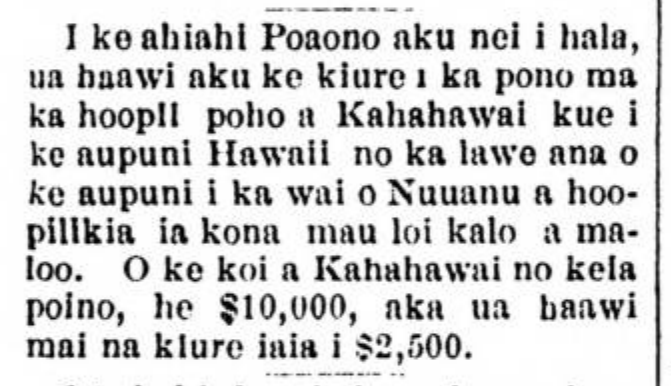
On this past Saturday evening, the jury decided in favor of Kahahawai’s suit for damages against the Hawaiian government for the government taking the water of Nuuanu and causing trouble for his irrigated taro terraces and drying them up. Kahahawai claim for the damages was $10,000, but the jury gave him $2,500.

(Kuokoa, 7/23/1892, p. 3)

Ka Nupepa Kuokoa, Buke XXXi, Helu 30, Aoao 3. Iulai 23, 1892.

Huli Kalo of all varieties! 1913.

Taro Tops! Taro Tops!!

You can obtain Huli Kao of all varieties at the Hilo Boarding School. $2.50 for a thousand.

Inquire of the Principal of the Hilo Boarding School [Kula Hanai o Hilo].

Levi C. Lyman [L. C. Laimana]
Principal.

(Hoku o Hawaii, 1/2/1913, p. 3)

Ka Hoku o Hawaii, Buke 7, Helu 31, Aoao 3. Ianuari 2, 1913.

Jonah Kumalae begins selling poi, 1920.

Ready to Produce Poi

I recently built a Poi Factory for Myself, and am ready and am steaming taro. My poi is six pounds for a quarter. Those people who want to pick up poi however should bring a bag to put the poi in.

My taro comes from Pauoa, a land of delicious poi. All those who want poi are invited to leave their poi orders on the day prior to when they want it so that I know how much taro I need to cook so that there is enough for the desired poi.

Continue reading

On huli and planting and the ebook coming out from Bishop Museum Press, 1857/2020.

[Found under: “NO KA MAHIAI.”]

Not all kinds of huli are suitable for planting in wet patches. If the corm has been too closely cut off from the bottom of the huli and the huli itself is too small, it is not good for planting. If the taro has rotted and only a third remains good, Continue reading

Kalo planting and an ebook from Bishop Museum Press, 1922/2020.

[Found under: “KE ANO O KE KALAIAINA.”]

On  making loʻi if it was not done previously. I learned to make wet patches for four years at Lahainaluna. If it was desirable to convert a piece of dry land into a wet patch, they looked to see how water could be brought to it, because water was important. . . . If the patch was 20 fathoms long and 10 fathoms [anana, arm span] wide, we made them with shovels and the few pickaxes that we had. The soil near the banks was tossed up on them. The banks were made well, they were solid and thick. In digging with the shovel from the upper to the lower end and from one side to the other there was no part of the patch that was not dug. It looked level and even. Then the water was run into it and then the uneven places were seen, some deep, some high. The deep places were filled in. When it was seen that it was level then water was allowed to run in. We brought the oxen, that pulled the carts over the plains, and put them into the newly made patch and the oxen trampled on the earth up and down, to-and-fro. If we wanted some fun like the oxen, we increased the water in which to play. . . . Continue reading

A Hawaiian Co-Op, 1918.

KA “HUI LOKAHI O NA HAWAII” KAUPALENAIA.

These passing day, Hawaiians like Mayor Joseph J. Fern, David Kalauokalani, Samuel C. Dwight, James L. Holt, Hon. William P. Jarrett, Hon. C. P. Iaukea and a number of other Hawaiians are joining together to establish a company that will deal in the sale of poi, beef, salmon, dried fish, and so forth; with the intent to help Hawaiians in all ways that will lessen their household expenses; because it is very clear these days that because the poi factory of Kalihi is not making poi now, the current poi manufacturers are greatly raising the price of poi to five cents per pound; this is a price not seen in the past ten years or more; so too with the price of beef; the Chinese are buying very fine beef from the company of C. J. Waller [Wala], but the Chinese are charging Hawaiians 35 cents per p0und; it is an exorbitant price which has never been seen before; and it is heard from the talk of the Chinese that they will raise the price of poi once again to 6 cents a pound; it was this that encouraged the Hawaiians to establish a company that could hold back the severe increasing of the prices of our foods, O Hawaiians, by the Chinese.

The establishing of a company amongst Hawaiians is important and crucial; but if we Hawaiians do not implement an endeavor that will help ourselves, there will  be no one else who will help us.

If we turn back and look at the history of Hawaii nei, we will see that the dissension amongst us Hawaiians was what wrenched away small businesses from us Hawaiians as well as all the other endeavors. Continue reading