Donations for the commission carrying the anti-annexation petitions to America, 1898.

OLIVE LEAVES OF ALOHA

FOR THE REPRESENTATIVES

FROM BALDWIN HOME

We are the Aloha Aina boys whose hearts are full of true aloha from deep within.

We are donating our few cents for the well-being of the Representatives with unified hearts and to attest to this, we affix our names.

MOLOKAI.

B. Lapilio, 50 cents

Nakeu, 50 ”

Halekauhola, 50 ”

E. D. T. Sing, 50 ”

John Lono, 50 ”

Moluhi, 50 ”

John Hao, 50 ”

Kukaukama, 50 ”

Kaomea Kaui, 50 ”

J. Namaielua, 50 ”

Jeo Kahilahila, 50 ”

Kalua, 50 ”

Mahi Kaio, 50 ”

S. Pilipo, 50 ”

Kauluwehiwehi, 50 ”

Hanaole, 50 ”

Micah Kaui, 50 ”

Kalauahea, 50 ”

Pohano, 50 ”

Kaukua, 50 ”

Kihauna, 50 ”

Ake, 50 ”

Hoopii, 50 ”

Moses Holi, 50 ”

S. Kauhahaa, 50 ”

Pihana, 50 ”

Isaia Wai, 50 ”

Pali, 50 ”

Hukia, 25 ”

Kanakahoa, 25 ”

Lai Kilauea, 25 ”

John Papu, 10 ”

Hakau, 10 ”

Kaonohiliilii, 10 ”

Kahikina, 1.00 ”

John Haloi, 1.00 ”

J. K. Laanui, 1.95 ”

D. W. J. Kaopuiki, 1.00 ”

Total: $20.00

D. W. J. Kaopuiki

Committee.

The boys of Baldwin Home are speedy.

[The newspaper Ka Loea Kalaiaina (and many other Hawaiian-Language Newspapers) are for some reason still not available online in searchable text form or even in image form. This is unfortunate, for although most people are familiar with the anti-annexation petitions (“Kū‘ē Petitions”), many have not seen the many lists of donations collected from all over the islands for the expenses of the commission carrying the petition to Washington D. C.

This particular list of donors and donations are from Kalawao! These patients were forced to live isolated from mainstream society, and yet they remained staunch patriots!!

This image is difficult to read, and I hope that clear images of these pages will be made, so if they are typed out to be word-searchable online, people will be able to find their kupuna—it will be near impossible to find a name if there is an “@” somewhere within it…]

(Loea Kalaiaina, 3/14/1898, p. 3)
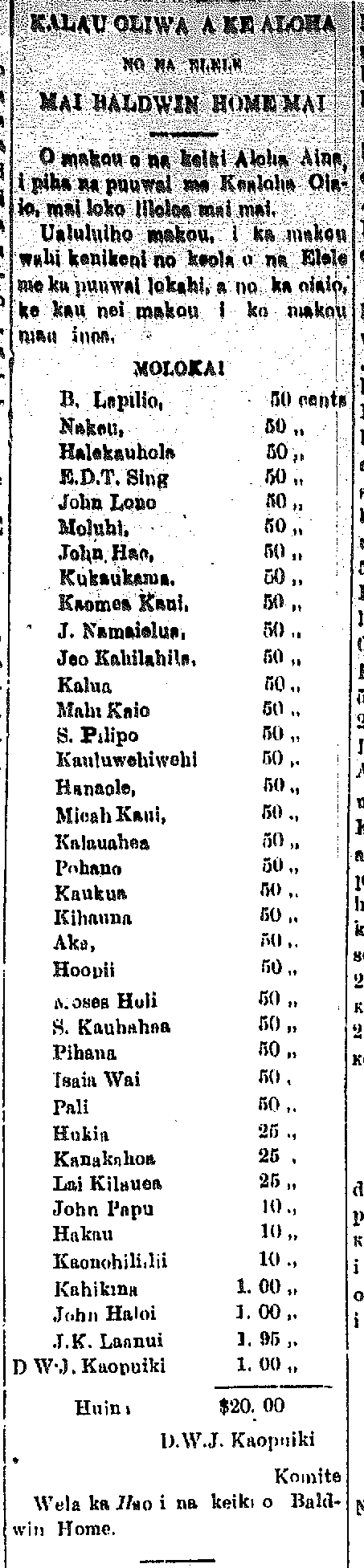
KALAU OLIWA A KE ALOHA

Ka Loea Kalaiaina, Buke II, Helu 11, Aoao 3. Maraki 14, 1898.

Kalaupapa a hundred years ago, 1912.

NEWS FROM KALAUPAPA, MOLOKAI.

The S. S. Mikahala arrived yesterday, and turned around full of cargo for this port, and at Kaunakakai it put ashore the pai ai [pa‘i ‘ai], and most of the items will perhaps arrive the following week. The kokua went upside to Kaunakakai with the donkeys to fetch the pai ai yesterday evening, and last night the provision donkeys arrived, and this morning they left again for the remaining pai ai. The reason that that S. S. Mikahala could not land her cargo was because of the rough seas surrounding us; there was no harbor, only ocean, and the waves spreading across shore were towering, but an amazing thing was the request by the Vice Superintendent and Doctor W. J. Goodhue for the children and their skiff of the H. H. K. L. [?] and this request was granted.

Dr. W. J. Goodhue got on, along with the stout boys of the H. H. K. L. and they rowed out to try and get the Mikahala to throw over the pai ai to them; the amazing thing I spoke of was when the skiff came into view and before them was a huge wave, and that was when everyone held their breath, because it was as if the boat and the brave ones aboard would be pulled down, however with the blink of an eye, the skiff arrived triumphantly outside without harm, and Dr. W. J. Goodhue was seen waving his handkerchief to the people on land. And to Mr. Paahao, the helmsman went the people’s appreciation, because it was his steering that they faced the powerful waves and came out like a man-eating shark speeding atop the sparkling [hulala?] billows of the sea; and admiration also went to the boys who rowed, being that it was their strength which helped the helmsman greatly. This is just some news.

I understand that you sent the Calendars and they came, but there they go back again, and maybe we will get them next week.

There is a much Rain and strong Kona winds blowing, from last week until today, and it is this wind that caused the rough seas, and the rough seas are bringing up great rocks [aa?] and depositing them upland.

William Notley
Kalaupapa, Molokai, Feb. 2, 1912.

(Kuokoa Home Rula, 2/9/1912, p. 1)

NA MEA HOU O KALAUPAPA MOLOKAI.

Kuokoa Home Rula, Buke X, Helu 6, Aoao 1. Feberuari 9, 1912.

Added suffering in Kalaupapa, 1912.

[Found under: “Local News”]

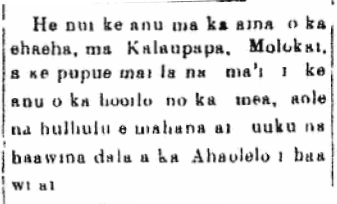
The land of suffering is terribly cold, at Kalaupapa, Molokai, and the patients are crouching up in the cold of the winter because they don’t have blankets to warm themselves being that little money was granted by the Legislature.

(Kuokoa Home Rula, 1/19/1912, p. 2)

He nui ke anu ma ka aina o ka ehaeha...

Kuokoa Home Rula, Buke X, Helu 3, Aoao 2. Ianuari 19, 1912.

More from Kalaupapa, 1912.

GOOD CARE IS GIVEN.

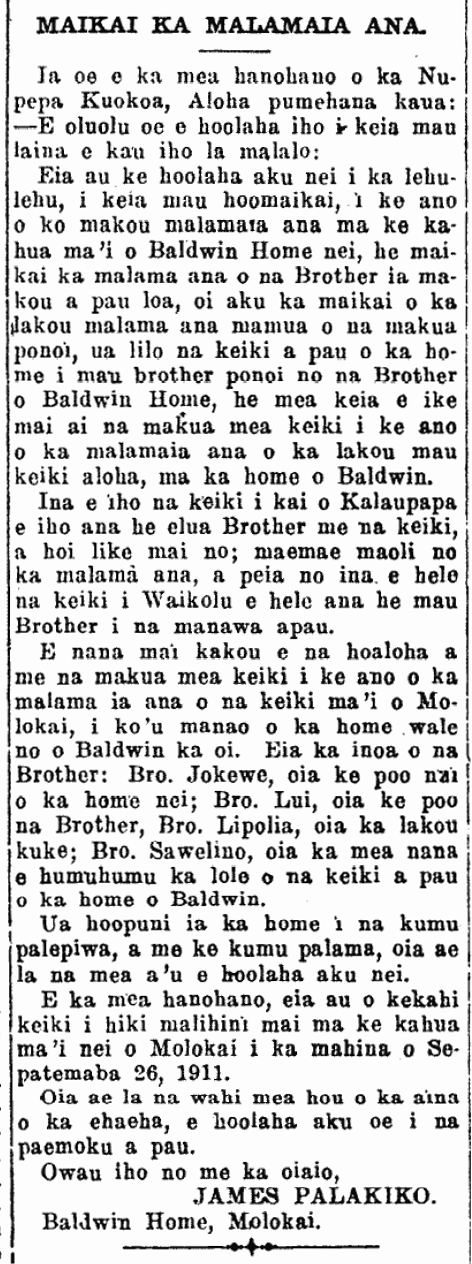
To you, the distinguished one, O Nupepa Kuokoa, warm Aloha between us:—Please print these lines below:

Here I am spreading amongst the public, appreciation for the way we are being cared for at Baldwin Home here at the leprosy colony; the Brothers take good care of all of us and their care is better than true parents, all of the boys of the home have become true brothers to the Brothers of Baldwin Home; and this [letter] is to let the parents know of how their beloved children are being cared for at Baldwin Home.

If the children go down to the ocean of Kalaupapa, two Brothers will go down with them and come back with them; they take care of the children very morally; also, if the children go to Waikolu, some of the Brothers will accompany them all the time.

Let us look, O Friends and Parents, at the manner in which the sick children of Molokai are taken care of; in my opinion, Baldwin Home is the best. These are the names of the Brothers: Bro. Jokewe [Joseph Dutton] is the head of this Home, Bro. Lui [?] is the head of the Brothers, Bro. Lipolina [?] is their cook, Bro. Sawelino [?] is the one who sews the clothes of all of the children of Baldwin Home.

The Home is surrounded by eucalyptus trees and plum trees; those things above are what I have to inform you of.

O Distinguished One, I am one of the children who came to this foreign land, her to the leprosy colony of Molokai in the month of September 26, 1911.

That is the news from the land of suffering; please spread it to the entire archipelago.

Sincerely yours,
James Palakiko.
Baldwin Home, Molokai.

(Kuokoa, 1/12/1912, p. 6)

MAIKAI KA MALAMAIA ANA.

Ka Nupepa Kuokoa, Buke XLVIII, Helu 2, Aoao 6. Ianuari 12, 1912.

Patients released from Kalaupapa, 1917.

NEWS FROM THE LAND OF SUFFERING, KALAUPAPA, MOLOKAI.

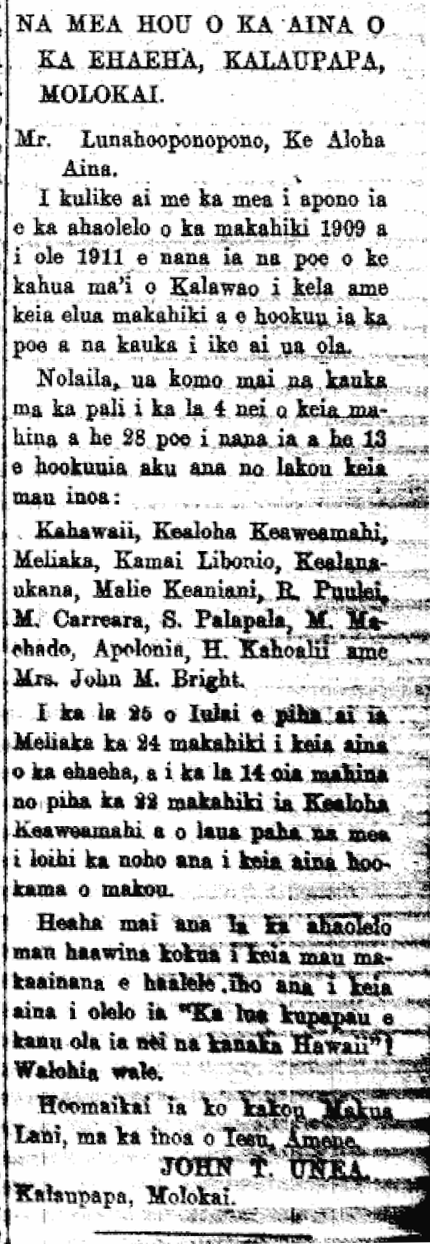
Mr. Editor, Ke Aloha Aina.

In accordance with what was approved of by the legislature of 1909 or 1911, the people of the patient colony of Kalawao will be examined every two years and the people who are determined by the doctor to be cured will be released.

Therefore, the doctors entered the pali on the 4th of this month, and 28 people were examined and 13 will be released, whose names are:

Kahawaii, Kealoha Keaweamahi, Meliaka, Kamai Libonio, Kealanaukana, Malie Keaniani, R. Puulei, M. Carreara, S. Palapala, M. Machado, Apolonia, H. Kahoalii and Mrs. John M. Bright.

On the 25th of July, Meliaka will have spent 24 years in this land of suffering, and on the 14th of that very month, Kealoha Keaweamahi will have spent 22 years, and the two of them are perhaps the ones who have lived the longest in this land which we adopt.

How will the legislature assist these citizens who will leave this land called, “The grave where Hawaiians are being buried alive”? How heart wrenching.

Blessed be our Heavenly Father, in the name of Jesus, Amen.

JOHN T. UNEA.

Kalaupapa, Molokai.

(Aloha Aina, 4/13/1917, p. 1)

NA MEA HOU O KA AINA O KA EHAEHA, KALAUPAPA, MOLOKAI.

Ke Aloha Aina, Buke XXII, Helu 15, Aoao 1. Aperila 13, 1917.

Deaths from Kalawao, Molokai, 1887.

[Found under: “Correspondences from Friends”]

Kalawao, Molokai.

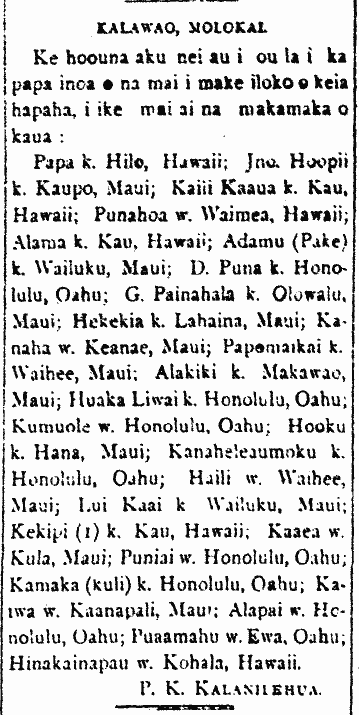
I am sending to you the list of names of the patients who died in this quarter, so that our friends may know:

Papa m. Hilo, Hawaii; Jno. Hoopii m. Kaupo, Maui; Kaiii Kaaua m. Kau, Hawaii; Punahoa f. Waimea, Hawaii; Alama m. Kau, Hawaii; Adamu (Chinese) m. Wailuku, Maui; D. Puna m. Honolulu, Oahu; G. Painahala m. Olowalu, Maui; Hekekia m. Lahaina, Maui; Kanaha f. Keanae, Maui; Paomaikai m. Waihee, Maui; Alakiki m. Makawao, Maui; Huaka Liwai m. Honolulu, Oahu; Kumuole f. Honolulu, Oahu; Hooku m. Hana, Maui; Kanaheleaumoku m. Honolulu, Oahu; Haili f. Waihee, Maui; Lui Kaai m. Wailuku, Maui; Kekipi (1) m. Kau, Hawaii; Kaaea f. Kula, Maui; Puniai f. Honolulu, Oahu; Kamaka (deaf) m. Honolulu, Oahu; Kaiwa f. Kaanapali, Maui; Alapai f. Honolulu, Oahu; Puaamahu f. Ewa, Oahu; Hinakainapau f. Kohala, Hawaii.

P. K. KALANILEHUA.

[This is one of the better lists, giving not only name, but whether male or female, and also where they were from (although the death date is not given)! Many times, there is just a list of names given…]

(Kuokoa, 11/5/1887, p. 4)

KALAWAO, MOLOKAI.

Ka Nupepa Kuokoa, Buke XXVI, Helu 45, Aoao 4. Novemaba 5, 1887.

Kalaupapa, almost twenty-five years later, 1891.

[found under “Letters from Our Friends.”]

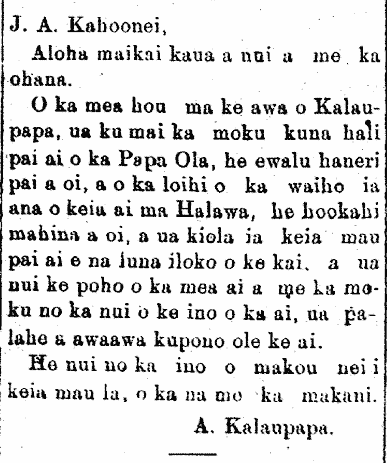
J. A. Kahoonei [of the newspaper “Nupepa Elele”],

Much aloha between us and the family.

The news from the port of Kalaupapa is that the rations-bearing schooner of the Board of Health arrived; there was eight-hundred pa‘i ‘ai or more which were left at Halawa for a whole month or more and then dumped into the ocean by the luna; a lot was wasted, being thrown into the sea [a me ka moku?] because of the great spoilage—it was rotten and too sour to eat.

It has been very stormy these past days with rain and wind.

A. Kalaupapa

(Nupepa Elele, 2/28/1891, p. 4)

J. A. Kahoonei, Aloha Maikai kaua a nui...

Nupepa Elele, Buke XII, Helu 29, Aoao 4. Feberuari 28, 1891.

More from Kalaupapa—the early years of the leprosy settlement, 1867.

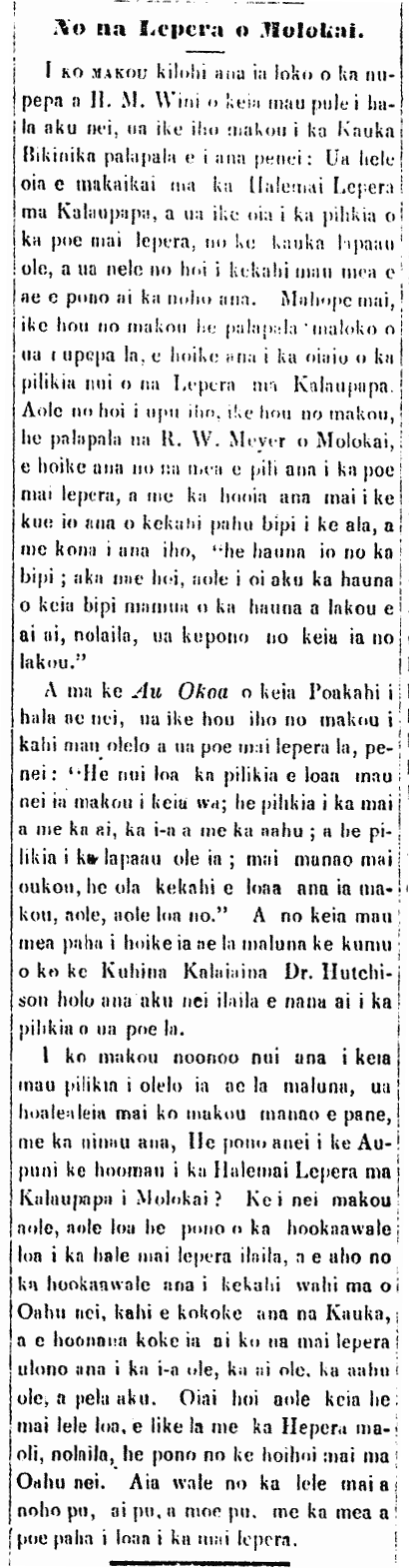
About the Leprosy Patients of Molokai.

Looking through H. M. Whitney’s newspaper [Pacific Commercial Advertiser? Nupepa Kuokoa?], of these past weeks, we came upon Dr. Bikinika [?]’s letter stating that he went to tour the Leprosy Hospital in Kalaupapa, and witnessed the plight of the leprosy patients—the lack of doctors and the lack of other living necessities. Later, we saw another letter in the same paper confirming the many difficulties of the patients in Kalaupapa. We did not imagine we’d see another letter, by R. W. Meyer of Molokai, speaking about things relating to the patients, and saying that there indeed was a crate of beef on the street, adding, “The beef was spoiled, but it was no more spoiled than what they eat, so it is fine for them.”

And in the Au Okoa of this past Monday, we again saw talk of the leprosy patients, as follows: “We are always facing many difficulties these days; there are problems with sickness, food (‘ai and i‘a), and clothing; we are troubled because we have no medical care—do not imagine that there is a life for us, for that is not at all the case, not at all.” And it is perhaps because of this statement above that the Minister of the Interior, Dr. Hutchison went there to see the difficulties of those people.

After much consideration of these problems shown above, we are stirred to respond with the question, “Is is right for the Government to continue the Leprosy Hospital in Kalaupapa, Molokai?” We say, “No, it is definitely not right to totally separate the leprosy housing there, and instead, to set aside a place here on Oahu, someplace close to Doctors; and the cries of the patients for lack of food, clothing, and so forth, can be immediately looked at. Being that this is not an extremely contagious disease like smallpox, they should be returned to Oahu. It can only be spread by living together, eating together, sleeping together with one or more of the people who have leprosy.

(Kuokoa, 2/23/1867, p. 2)

No na Lepera o Molokai

Nupepa Kuokoa, Buke VI, Helu 8, Aoao 2. Feberuari 23, 1867.