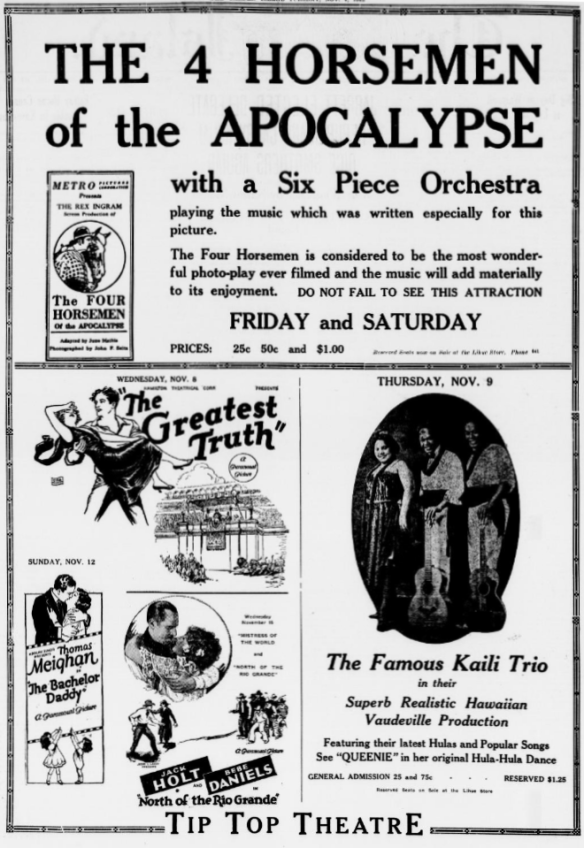
Kaili Trio performing at Kauai’s Tip Top Theatre, 1922.

THE 4 HORSEMEN of the APOCALYPSE

with a Six Piece Orchestra

playing the music which was written especially for this picture.

The Four Horsemen is considered to be the most wonderful photo-play ever filmed and the music will add materially to its enjoyment. DO NOT FAIL TO SEE THIS ATTRACTION

FRIDAY and SATURDAY

PRICES: 25c 50c and $1.00 Reserved Seats now on Sale at the Lihue Store, Phone 641

WEDNESDAY, NOV. 8

HAMILTON THEATRICAL CORP. PRESENTS

“The Greatest Truth”

A Paramount Picture

SUNDAY, NOV. 12

ADOLPH ZUKOR PRESENTS

Thomas Meighan in “The Bachelor Daddy”

A Paramount Picture

Wednesday

November 15

“MISTRESS OF THE WORLD

and

“NORTH OF THE RIO GRANDE”

JACK HOLT AND BEBE DANIELS

in

“North of the Rio Grande”

THURSDAY, NOV. 9

The Famous Kaili Trio

in their

Superb Realistic Hawaiian
Vaudeville Production

Featuring their latest Hulas and Popular Songs
See “QUEENIE” in her original Hula-Hula Dance

GENERAL ADMISSION 25 and 75c – – – RESERVED $1.25

Reserved Seats on Sale at the Lihue Store

TIP TOP THEATRE

(Garden Island, 11/7/1922, p. 2)
GardenIsland_11_7_1922_2.png

The Garden Island, Volume 18, Number 45, Page 2. November 7, 1922.

Ernest Kaai’s Hawaiian Troubadours in New Zealand, 1925.

AMUSEMENTS.

“NIGHT IN HONOLULU.”

The ukulele, the hula-hula, and the steel guitar, as entertaining products of Hawaii, are known all over the civilised world that comes under the influence of vaudeville circuits, but such segregated examples as have hitherto been shown in Auckland are mere museum specimens compared with the living actuality of the performance given in His Majesty’s Theatre on Saturday night by Ernest Kaai’s Hawaiian troubadours. These minstrels exhibited ukulele and guitar with all the sweet setting of their native haunts, the strains of the strings enriched by vocal harmonising in which the Hawaiian exccels, and the harmonising enhanced by quaint falsetto and yodelling effects that thoroughly delighted a house packed to the doors.

The curtain rose on a pretty palm-fringed beach scene, when it could be seen, for the house was in darkness when a harmonious chorus of Hawaiian voices, with stringed instrument accompaniment, was lifted in song to welcome the doming dawn. It was a native harmonising chorus set to music by Queen Liliuokalani, and entitled “Aloha Oe,” which swells to a paean of joy as the rising sun lights up the expectant world—in this case quite an effective stage scene. A similar characteristic effort of voice, strings, and light, symbolising twilight, with the stage fading melodiously into darkness, marked the ending of the first part of the programme, while in between dawn and twilight came a series of novel, interesting and thoroughly entertaining items. An Island folk-song by eddie Kniley, a ballad by Frank Luiz, hula dances by Gertila Byrnes and Layley Leywood, and a steel  guitar selection by Thelma Kaai were given with effective voice and string accompaniments. It was the part-singing in trios, however that most captivated the audience. One such number by David Kaili, Thelma Kaai and Eddie Kinley was emphatically encored, but when Queenie and David Kaili and Thelma Kaai appeared in whimsical part songs in which Queenie appeared as a soubrette of talent with a quaint gift for vocal ornamentation, the house was so vastly entertained and amused that the party were recalled four or five times. Continue reading

Hawaiian music in Aotearoa, 1925.

NEW ZEALAND IS JOYFUL WITH HAWAIIAN MUSIC.

A news item published in the newspaper Auckland Star on the 20th of April past described the enthusiasm of the people of New Zealand for Hawaiian songs, given at the concert held by Ernest Kaai and his band which is going around New Zealand.

When one of the concerts opened in the theater, the interior of the theater was decorated with greenery, and the theater was darkened, and when the music began, accompanied by the voices of the singers, it was as if the scene then was the coming of light at the break of dawn; and the audience held their breath when Aloha Oe was sung, as the instruments played along. Continue reading

More mele, because they can easily be found throughout the newspapers! 1929.

HE WAHI LEO MELE HAWAII

Ua pau kou mana e ka makua,
Ua hiki au i ka hoounauna,
I kuu wa liilii iluna kuu alo,
I mai oe ia’u hupekole,
A nui ae au a wahine ui,
Alaila oe la hooheno mai.
Ua hiki no au ke kuupau
I ka laki kikala o ka oiwi,
He iwi keia i hana a kani
He awihi maka no kau loaa
I loaa oe ia’u i ka la nui
I ka huikaulu o ka kaona
Onaona na maka o ka huapala,
Ua pulu i ka wai lohi o Maleka
Haina ia mai ana ka puana,
Ke aloha o ka ipo, mea pau ole.

Owau iho no me ka oiaio

Wahia Ii

[Cheeky!]

(Alakai o Hawaii, 2/7/1929, p. 4)

AlakaioHawaii_2_7_1929_4.png

Ke Alakai o Hawaii, Buke 1, Helu 41, Aoao 4. Pepeluali 7, 1929.

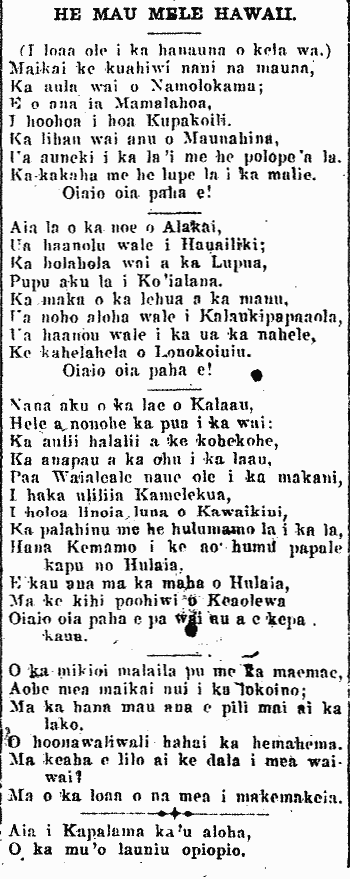
More old mele, 1919.

HAWAIIAN MELE

(That are not known to the generation of this time.)

Maikai ke kuahiwi nani na mauna,
Ka aula wai o Namolokama;
E o ana ia Mamalahoa,
I hoohoa i hoa Kupakoili.
Ka lihau wai anu o Maunahina,
Ua auneki i ka la’i me he polope’a la,
Ka-kakaha me he lupe la i ka malie.
Oiaio oia paha !

_____

Aia la o ka noe o Alakai,
Ua haanolu wale i Hauailiki;
Ka holahola wai a ka Lupua,
Pupu aku la i Ko’ialana.
Ka maka o ka lehua a ka manu,
Ua noho aloha wale i Kalaukipapaaola,
Ua haanou wale i ka ua ka nahele,
Ke kahelahela o Lonokoiuiu.
Oiaio oia paha e!

_____

Nana aku o ka lae o Kalaau,
Hele a nonohe ka pua i ka wai;
Ka aulii halalii a ke kohekohe,
Ka anapau a ka ohu i ka laau,
Paa Waialeale naue ole i ka makani,
I haka uliliia Kamelekula,
I holoa linoia luna o Kawaikini,
Ka palahinu me he hulumamo la i ka la,
Hana Kemamo i ke ao humu papale kapu no Hulaia,
Ma ke kihi poohiwi o Keaolewa
Oiaio oia paha e pa wai au a e kepa kaua.

_____

O ka mikioi malaila pu me ka maemae,
Aohe mea maikai nui i ka lokoino;
Ma ka hana mau ana e pili mai ai ka lako.
O hoonawaliwali hahai ka hemahema.
Ma keaha e lilo ai ke dala i mea waiwai?
Ma o ka loaa o na mea i makemakeia.

_____

Aia i Kapalama ka’u aloha,
O ka mu’o launiu opiopio.

(Kuokoa, 6/13/1919, p. 2)

Kuokoa_6_13_1919_2

Ka Nupepa Kuokoa, Buke LVII, Helu 24, Aoao 2. Iune 13, 1919.

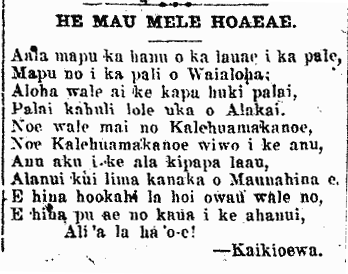
A mele by Kaikioewa, 1919.

A MELE HOAEAE.

Aala mapu ka hanu o ka lauae i ka pale [pali],
Mapu no i ka pali o Waialoha;
Aloha wale ai ke kapa huki palai,
Palai kahuli lole uka o Alakai.
Noe wale mai no Kalehuamakanoe,
Noe Kalehuamakanoe wiwo i ke anu,
Anu aku i ke ala kipapa laau,
Alanui kui lima kanaka o Maunahina e.
E hina hookahi la hoi owau wale no,
E hina pu ae no kaua i ke ahanui,
Ali’a la ha’o-e!

—Kaikioewa.

(Kuokoa, 6/13/1919, p. 2)

Kuokoa_6_13_1919_2

Ka Nupepa Kuokoa, Buke LVII, Helu 24, Aoao 2. Iune 13, 1919.

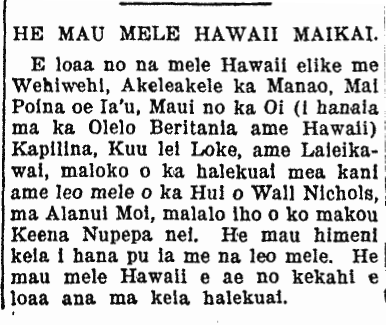
Sheet music at Wall Nichols Co., 1900.

SOME FINE HAWAIIAN SONGS.

You can find Hawaiian music like Wehiwehi, Akelekele ka Manao, Mai Poina oe Ia’u, Maui no ka Oi (in English and Hawaiian), Kapilina, Kuu lei Loke, and Laieikawai, at the musical instrument and music store of Wall Nichols Company on King Street under our Newspaper Office. These are songs done with the music. There are other Hawaiian songs available at this store.

[This sounds like Johnny Noble’s “Aloha: Souvenir Collection of Rare Old Hawaiian Songs.”]

(Kuokoa, 1/26/1900, p. 2)

Kuokoa_1_26_1900_2

Ka Nupepa Kuokoa, Buke XXXVIII, Helu 4, Aoao 2. Ianuari 26, 1900.

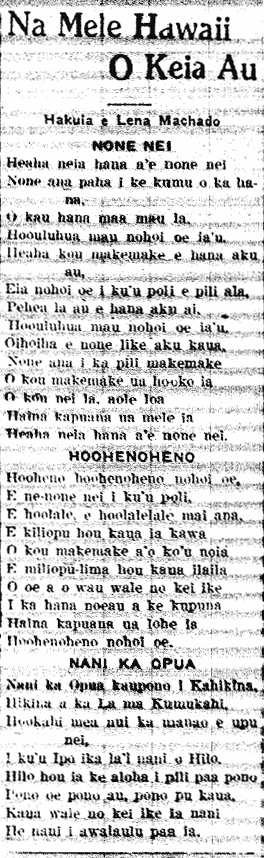
Three Lena Machado mele! 1939.

Hawaiian Songs of This Age

Composed by Lena Machado

NONE NEI

Heaha neia hana a’e none nei
None ana paha i ke kumu o ka hana,
O kau hana maa mau ia,
Hoouluhua mau nohoi oe ia’u.
Heaha kou makemake e hana aku au,
Eia nohoi oe i ku’u poli e pili ala,
Pehea la au e hana aku ai,
Hoouluhua mau nohoi oe ia’u.
Oihoiha e none like aku kaua,
None ana i ka pili makemake
O kou makemake ua hooko ia
O ko’u nei la, aole loa
Haina kapuana ua mele ia
Heaha neia hana a’e none nei.

HOOHENOHENO

Hooheno hoohenoheno nohoi oe,
E ne-none nei i ku’u poli,
E hoolale, e hoolalelale mai ana,
E kiliopu hou kaua ia kawa
O kou makemake a’o ko’u noia
E miliopu-lima hou kaua ilaila
O oe a o wau wale no kei ike
I ka hana noeau a ke kupuna
Haina kapuana ua lohe ia
Hoohenoheno nohoi oe.

NANI KA OPUA

Nani ka Opua kaupono i Kahikina,
Hikina a ka La ma Kumukahi,
Hookahi mea nui ka manao e upu nei,
I ku’u Ipo ika la’i nani o Hilo.
Hilo hou ia ke aloha i pili paa pono
Pono oe pono au, pono pu kaua,
Kaua wale no kei ike ia nani
He nani i awaiaulu paa ia.

(Hoku o Hawaii, 6/28/1939, p. 1)

HokuoHawaii_6_28_1939_1

Ka Hoku o Hawaii, Volume XXXIV, Number 9, Aoao 1. Iune 28, 1939.

Selection from Homer’s Iliad, 1868.

WRITING.

Greetings to you [E weli aku ana ia oe] O Maaa wind of my beloved land moistened by the light showers of Winter, and the fragrance-carrying Puulena wind of Mahamoku: O Honele Ihuanu of Albion,¹ aloha to you. It was many years ago when I was overcome by a sudden desire for the poems of the Iliad, the book of Homer of the Greeks, along with the Aeneid of Virgil of the Romans, as I assumed that these mele books were the greatest compositions of the world. I had a great desire to read wisely the lines which brought delight to my mind—however, I was held back by a great cliff from which I was not able to leap and dive to the other side where my mind desired, being that it was written in a superior foreign language reaching the very core of the tongue, which these lips could not mouth; the classical language of those poems. And because I saw these mele in English, translated by someone skilled in those classical languages, that is the reason I thought to bring it into our own language so that you as well may see some of those poems; and perhaps there will be some of you who will hold the past in high regard just as I do. The nature of this mele composed below is a conversation between Hector (a fearless Warrior of Troy) and his wife, Andromache, when they were being warred upon by Greece: The composition of this mele is near factual; and it is truly beautiful. Thus:

“A! e ke alii wiwo ole, i hea la oe e holo aku ai?
A hoopoina loa hoi i kau wahine a me kau keiki.
Aole anei ou manao i ka nui o ko maua pilikia?
Ia’u, he wahine kane ole, a me iala hoi he keiki makua ole? Continue reading

Aiu, the Kauai boy comes home from war, 1920.

KAUAI BOY SONG.

He mele he inoa no Aiu,
Kuu pua o Kina hapa Hawaii,
He opua hookahi a i kuu alo,
Kuu lei miulana poina ole;
Kau he hiki aku i ka moana,
Na ale nupanupa o ka Pakipika,
Ike oe i ke anu o Kaleponi,
I ohu halii paa ka moana.
Kau aku ka manao nou e Palani,
Ke kahua hoolulu a o na koa,
O ke kikowaena a o ke kaua,
Ua huliamahi na aupuni hui,
Ike pono i ka hana a Kelemania,
Lahui puuwai ole o ke ao nei,
Ilaila hu ae ke aloha a i ka  makua.
Haalele ana i ka puuwai,
Ua paa ko kino i ka aelike,
Me na ‘liikoa Amerika.
Hookahi makahiki i ka aina malihini,
Huli ho i ka home kulaiwi,
Hoomaikaiia ka Makua Lani,
E ole kuu kokua Mana Lani,
Hoi kino mai au me ka lanakila.
Haina ia mai ana ka puana,
Kuu pua o Kina hapa Hawaii.

Owau iho no,

MRS KILA KAILI.

[Might anyone know which Aiu this song is composed for by Mrs. Kila Kaili?]

(Kuokoa, 1/2/1920, p. 2)

Kuokoa_1_2_1920_2.png

Ka Nupepa Kuokoa, Buke LVIII, Helu 1, Aoao 2. Ianuari 2, 1920.