Mele Inoa for Kauikeaouli, Kamehameha III. 1862.

HE INOA NO KAUIKEAOULI.

Auhea wale ana oe, kapua hau o Maleka,
Ke au nei ka manao, Pehea o Niagala,
Kela wai kamahao, wai halulu o ka moano,
Nene i na moku, lohe aku nei Lukini,
Ua ana ia Kuleke, aohe i hopo Ladana,
I ka nui o Asia, hue a ke kaona nui,
Laki ka moana Iniana, ehuehu Enelani,
Ke kowa o Sekotia, aita oe e palau,
No’u o Ainahau, a ka wai o Nolewai,
Pau mai ko’u palena, ilaila a’u la oki,
Lawe u’a linohau, a ai ka manu iluna,
I kilohi iho kuu hana, he nani o Hudesona,
Kaikuono Papine, mea ua ae ia,
Me oe a ke aloha iwini o ke aumoa,
Auhea wale ana oe, e ka uneune puuwai,
E ke kaukini ma-lo, nana i ue laholio,
Hoomaloe i kuu kino, hooueue i ka moe,
Lana koi kahi manao, halanalana i ka leo,
O ua mea ino nei, he hoouluulu ia,
Keehi pono i ko haka, i luhi lai ko kahu,
A ao luau ai, pau ko aumakua pi kai a kaua,
I ka lihi kai o lalo, eia la he manao,
Kai hiki mai ia nei, e kali iki iho oe,
A hala ae Welehu, ka malama ino ke kau,
Hiki ae la ia Nana, pe oi kahi manao,
Olu ka noho na o ka lani me oe a ke aloha,
Iwini o ke aumoe, i mai nei o Piuta,
Ua hala kou palena, aohe koina oonei,
O kou la luu loli, a lae hao au lohe,
Ilaila ka wahine Ia, nana i nai ka moana,
He ukali aina ahi, i ka lae o Kepohoni,
Aia iho o Palema, ke noho la i ka hema,
Nana e kuhikuhi mai, ka lonitu akau,
Ike ia na degere, na kuea o ka honua,
Alo mai Kapena Kuke, ka noe i Nouaiki,
Ikiiki wale hoi au, i ka lohe pepeiao,
E ake ko’u manao, ka ike ia Panama,
I pau kuu kuhihewa, i ke kai o Inia,
Nopia o Iapana, ke hui me Ualana,
Me oe a ke aloha, iwini o ke aumoe.

Ii.

Honolulu, Aperila 14, 1862.

[This is a mele known as a mele inoa for Kamamalu, but here it is submitted by Ioane Ii as a mele inoa for Kauikeaouli.]

(Hoku o ka Pakipika, 5/8/1862, p. 4)

HE INOA NO KAUIKEAOULI.

Ka Hoku o ka Pakipika, Buke I, Helu 33, Aoao 4. Mei 8, 1862.

A Kanikau for Mrs. Fidelia Church Coan, done in Hawaiian and English! 1872.

[Translation.]

A Dirge for Mrs. Coan,

Composed by request for the Church and friends at Hilo.

Tune, A Mother’s Kiss,—Golden Robin.

1.

What hand is this stretched from above,
From where kind Spirits blend?
It is a hand let down in love
To bear away a friend.
A stranger friend she came to us
From homes beyond the seas,
And moved by love she staid with us
To teach us words of peace.

2.

Long she abode in our domain,
And domiciled with us;
A Mother teacher she became,
A kind and tender nurse;
A mother dear and much beloved,
A guide both safe and sure
O’er verdant fields with flowers perfumed,
By waters still and pure.

3.

Look upward, lo! what sight is this?
A shining cloud appears,
It floats, and thence an angel’s voice
Falls on our listening ears;
O friend beloved, there’s waiting nigh
An angel carr for thee;
Take passage, and ascend on high,
To the world though long’st to see.

4.

Hark! hark! what notes are these we hear?
they are deep sorrow’s wails;
They roll, and swell, and fill the air,
And echo o’er the hills—
The angel choir has borne away
From children weeping here
A mother whom they loved to obey,
A mother teacher dear.

5.

Our mournful tears are flowing fast,
And falling here and there,
For thee, our mother in days past,
Our leader kind and dear.
We bend in sorrow o’er one loved,
Our grief for thee is great—
Thou came’st, and we together moved;
But now we separate.

6.

Hark! hark! what bell is tolling thus?
It is a mournful bell:—
Gather together in God’s house—
It is the funeral knell.
We listen and together come,
Dear friends the summons heed;
And draped mourning, to the tomb
We march with sorrow’s tread.

7.

Mournful we move, and all are hush!
Angels are looking on,
And Jesus comes to walk with us,
And comfort those who mourn.
The hills and vales, and streams that flow,
Together with us mourn.
The loved one’s form is lower’d, and lo!
The clouds are dak’ning round!

8.

But look again, the clouds have flown,
And light breaks thro’ the gloom;
A voice exhorts with gentle tone,
O cease, ye friends, to mourn.
The dear and much beloved one
Lies not in this drear tomb,
She’s risen and to heaven has gone,
With Jesus she’s at home.

Hawaii.

[Unuhiia.]

He Kanikau no Mrs. Koana,

I hakuia ma ke noiia mai no ka ekalesia a me na makamaka o Hilo.

Leo, A Mother’s Kiss,—Golden Robin.

1.

He lima aha e o nei
Mai luna mai ke ao?
He lima kii e lawe ae
Kekahi hoahanau.
He hoa malihini nei
Mai kahi loa mai no,
Aloha nae a noho mai
I kumu no kakou.

2.

Ua noho a loihi no,
A kamaaina pu,
A lilo i makua ao,
A hanai ia kakou;
Makuwahine makamae,
A alakai maikai
Ma kahi kula uli e,
A ma na wai maemae.

3.

E nana, e, heaha nei?
He ao olino e,
Ke kau la, a noloko mai
He leo hea mai;
Ke hoa aloha, ke ku nei
He kaa anela nou;
E ee maluna, a pii ae,
Pii i ke ao ma o.

4.

Hamau! he lohe aha nei?
He olo pihe no;
O olo ae, a kupinai
Maluna o na puu—
Ua kai na anela aulii,
Mai na keiki ae,
I ka makua aloha e,
Makua ao maikai.

5.

Ke kahe nei a helelei
Na u waimaka e
Nou, ka makua aloha e,
Ko makou alakai—
Ke haalou nei, a hu ka uwe,
Pau mako e makou!
Hoea a noho pu maanei,
Kaawale nae ano.

6.

Hamau! he bele aha nei?
He bele kanikau—
E hui ma ka halawai
Hoolewa kupapau.
Ke hui nei na hoahanau,
Na hoaaloha pu;
Paa i ka lole kanikau,
A nauwe u kakou.

7.

Ke nauwe kanikau hamau—
Nana na anela,
Me Iesu hoi ke hele pu,
A, nana e hoona.
Na puu, na awawa a kahawai
Ke kanikau pu no.
Ka mea aloha ua nalo ae,
Pouli mai na ao!

8.

E nana hou, ua hee na ao,
Poha he lama e;
He leo paipai olu no,
E pau, e pau ka uwe—
Ka mea aloha makamae,
Aole ia maanei.
Ua lele i ke ao maikai
Me Iesu e maha’i.

Hawaii.

[I thought to post this piece because it is one of the few examples where the author/composer did both the Hawaiian and English version. It is interesting to look at the two compositions side by side. This is a kanikau written for Fidelia Church Coan who arrived in Hawaii along with her husband, Titus Coan, on June 6, 1835. They were stationed in Hilo, and she ran a boarding school there for girls.

The composer who calls himself “Hawaii,” is a prolific translator of English hymns into Hawaiian in the Kuokoa newspaper. Could this possibly be Lorenzo Lyons? Would anyone have any information on this?]

(Kuokoa, 11/2/1872, p. 7)

[Translation.] A Dirge for Mrs. Coan...

Ka Nupepa Kuokoa, Buke XI, Helu 44, Aoao 7. Novemaba 2, 1872.

More mele from Mary Jane Montano, 1927.

SOME OLD MELE OF HAWAII NEI.

Mr. Solomon Hanohano, Editor of the Kuokoa Newspaper:—Please publish the following mele from times past, when the land was filled with alii.

This is a name song [mele inoa] for the royal one Ahumanu [Kaahumanu], which was inherited by Kaumakaokane II, the mother of Kuakini (John Adams Cummins) during the youth of Kaumaka, and that royal woman [Kaahumanu] then called Kaumakaokane, by the name Papaleaiaina.

This name is the name that Kalaniahumanu [Kaahumanu] called the Royal One, Paiea Kamehameha I, and it is answered to today by the granddaughter of the Hon. J. A. Cummins, that being Matilda Papaleaiaina Walker Constable.

It would be best that these jewels of Hawaii nei be shown, for some of us will live on as teachers for the impertinent questions, as like the one who questioned in the Advertiser newspaper, about my dear brother, the Hon. J. A. Cummins, the “backbone” [iwikuamoo] of the chiefly ones who have passed into the next realm.

Kaumakaokane he inoa,
Hanau a koa he kupuna,
Eia ua aliiwahine nei,
Ke holo mai nei o ka moku,
Me ka hae o kau weloweloula,
Ku’ilua ka pu,
He aloha ia,
Aole i ike ka haole,
Wahi a Kalanikauleleiaiwi,
Iwi ka maka,
Holoholo ka onohi,
Lele ka puuwai i ka makemake,
I ka wai olu o Lanipo-e,
Nau ke ku’i haukeke ka auwae,
I hemahema i ka wa kamalii,
O ko’u wa naaupo no ia,
E laua la e,
Papaleaiaina kuu aloha e—
O kau ka haili aloha i o’u nei,
O ka welelau o kuu lima ka i pa aku,
Pa i ka lihi o Kilauea.

And here is the genealogy of the lei to adorn the neck of Ahia (Mrs. Capt. George Beckley), that being John Adams Cummins.

Liloa is the father who dwelt with Akahiakuleana, born was Umi. Umi, dwelt with Piikea, born was Aihakoko, Kumulaenuiaumi. Kumulaenui, dwelt with Kumunuipawalau, born was Kekapuhelemai; Kekapuhelemai dwelt with Piilani, born was Lonoikauakini.

Lonokauakini, dwelt with Kapukaheiau, born was Lonoikahaupo; Lonoikahaupo, dwelt with Ninauaiwi, born was Kekapalakea. Kekapalakea dwelt with Kelahuna, born was Kowali; Kolwali dwelt with Kaumaokaokane, born was Keaweaua. Keaweaua dwelt with Kaahaiku, born was Keauiaole; Keauiaole dwelt with Liloa, born was Kaumakaokane, Kameeiamoku.

Kaumakaokane (f) dwelt with Thomas Cummins, born was John Adams Cummins.

Kelahuna (f) is a descendant of Kelahunapaikua (m) and Ahia (f) and Kelahunapaikua (m) is a child of Kakuhihewa and Kolimoalani, that being Koaekea (f), the grandchild of Akahinuikameenoa (f), the woman that I placed a kapu upon.

Kelahuna (f) is the younger sister of Kamehaiku, these being female alii of Kau, Hawaii, and Kamehaiku is the woman of Keeaumoku, the father of Kaahumanu who slept with Kalanianoano and begot Kanehoa, the grandfather of Kaleianoano, Hoapili, and so forth, as well as Jesse Hakainai [Makainai ?], and so forth.

Sincerely, this is I

Ako-kuia ka hale lehua o ka manu,
Kauwewe i ka liko o ka ohia,
He uanoe he uaawa no ka mauna,
Uli ka nahele o Ookuauli,
Uli ka nahu hoomau a ka makani,
A makani a lei a lea,
Lea i na kauna ami a ka ua,
Alohi Maukele anapa i ka la e,
Okioki a hoe,
O ke aho no ia a ka ua Polohinalo,
A pikipiki ka lei,
Me he nu’a kapa la,
Popo ka lei a waiho malie,
Nana aku o kuu apana hala iuka o Panaewa,
Mamina ino no kuu kula lehua,
A’u i kawili mua ai,
Ua maka-pa ua eena ka manu,
He ena kai olohia ia no ke kanaka e—

The is the origin of my name from the heavenly one, Kauikeaouli; Kekulani is the name appended to Keoni Ana Opio [John Young, Jr.] when Kauikeaouli died and returned.

E o mai oe i kou inoa e Kekulani,
O ka lani no ka i ku,
I ka papa holu i ka makani,
A o oe no ke o mai e,

MARYJANE AHIA AHUENA KEKULANI MONTANO.

(Kuokoa, 3/31/1927, p. 1)

KEKAHI MELE KAHIKO O HAWAII NEI.

Ka Nupepa Kuokoa, Buke LXVI, Helu 13, Aoao 1. Maraki 31, 1927.

Another composition by Mary Jane Kulani Montano, 1919.

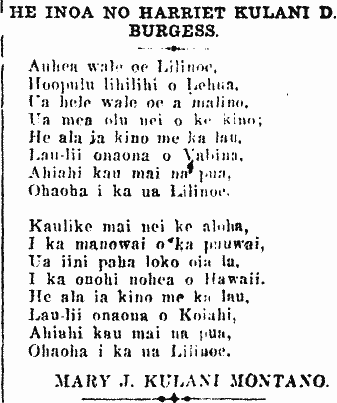
HE INOA NO HARRIET KULANI D. BURGESS.

Auhea wale oe Lilinoe,
Hoopulu lihilihi o Lehua,
Ua hele wale oe a malino,
Ua mea olu nei o ke kino;
He ala ia kino me ka lau,
Lau-lii onaona o Vabina,
Ahiahi kau mai na pua,
Ohaoha i ka ua Lilinoe.

Kaulike mai nei ke aloha,
I ka manowai o ka puuwai,
Ua iini paha loko oia la,
I ka onohi nohea o Hawaii,
He ala ia kino me ka lau,
Lau-lii onaona o Koiahi,
Ahiahi kau mai na pua,
Ohaoha i ka ua Lilinoe.

MARY J. KULANI MONTANO.

[Anyone know of the relationship between these two women?]

(Kuokoa, 2/28/1919, p. 3)

HE INOA NO HARRIET KULANI D. BURGESS.

Ka Nupepa Kuokoa, Buke LVII, Helu 9, Aoao 3. Feberuari 28, 1919.

This mele is a classic, 1887.

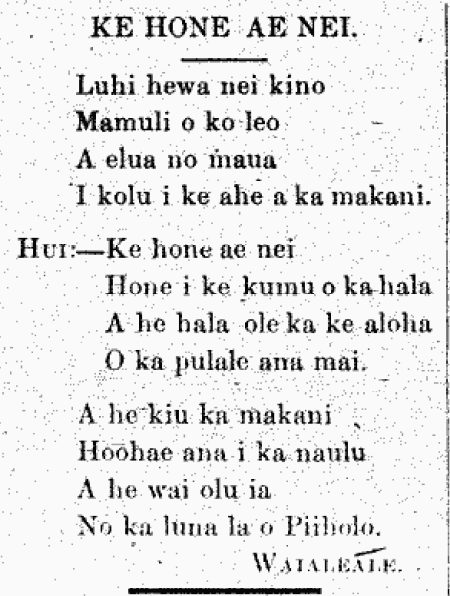
KE HONE AE NEI.

Luhi hewa nei kino
Mamuli o ko leo
A elua no maua
I kolu i ke ahe a ka makani.

Hui:—Ke hone ae nei
Hone i ke kumu o ka hala
A he hala ole ka ke aloha
O ka pulale ana mai.

A he kiu ka makani
Hoohae ana i ka naulu
A he wai olu ia
No ka luna la o Piiholo.

Waialeale.

(Makaainana, 12/17/1887, p. 1)

KE HONE AE NEI.

Ka Makaainana, Buke I, Helu 41, Aoao 1. Dekemaba 17, 1887.

Another mountain-climbing mele for Emalani, 1871.

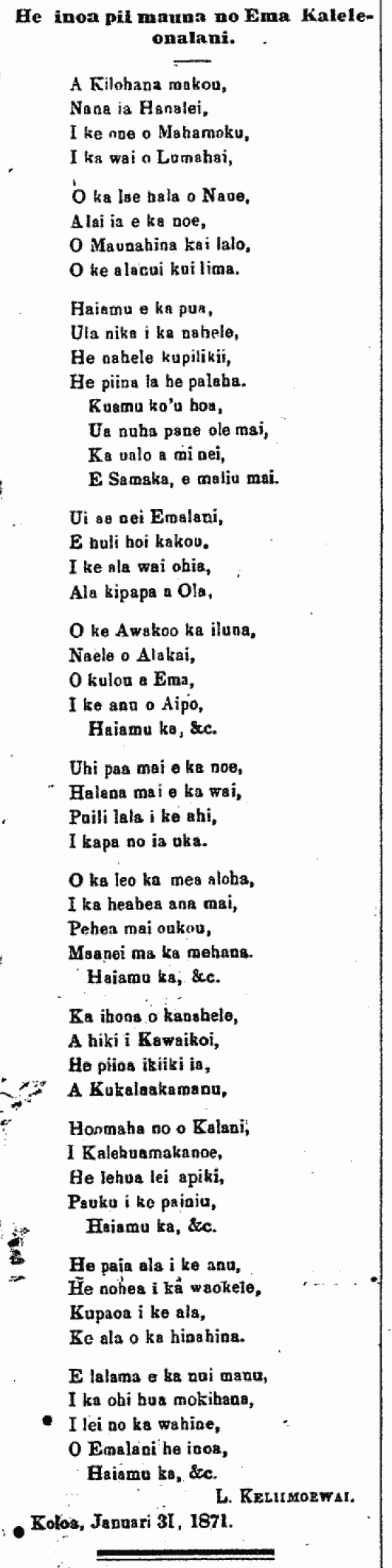
A mountain-climbing name song for Ema Kaleleonalani.

A Kilohana makou,
Nana ia Hanalei,
I ke one o Mahamoku,
I ka wai o Lumahai,

O ka lae hala o Naue,
Alai ia e ka noe,
O Maunahina kai lalo,
O ke alanui kui lima.

Haiamu e ka pua,
Ula nika i ka nahele,
He nahele kupilikii,
He piina la he palaha.
Kuamu ko’u hoa,
Ua nuha pane ole mai,
Ka ualo a mi nei,
E Samaka, e maliu mai.

Ui ae nei Emalani,
E huli hoi kakou,
O ke ala wai ohia,
Ala kipapa a Ola,

O ke Awakoo ka iluna,
Naele o Alakai,
O kulou a Ema,
I ke anu o Aipo,
Haiamu ka, &c.

Uhi paa mai e ka noe,
Halana mai e ka wai,
Puili lala i ke ahi,
I kapa no ia uka.

O ka leo ka mea aloha,
I ka heahea ana mai,
Pehea mai oukou,
Maanei ma ka mehana.
Haiamu ka, &c.

Ka ihona o kanahele,
A hiki i Kawaikoi,
He piina ikiiki ia,
A kukalaakamanu,

Hoomaha no o Kalani,
I Kalehuamakanoe,
He lehua lei apiki,
Pauku i ke painiu,
Haiamu ka, &c.

He paia ala i ke anu,
He nohea i ka waokele,
Kupaoa i ke ala,
Ke ala o ka hinahina.

E lalama e ka nui manu,
I ka ohi hua mokihana,
I lei no ka wahine,
O Emalani he inoa,
Haiamu ka, &c.

L. Keliimoewai.

Koloa, Januari 31, 1871.

[This is another mele honoring Queen Emma and her famous travels through Kauai. It seems the eight lines starting “Haiamu e ka pua” is repeated like a chorus after every two verses.

This seems to be a more “complete” version of the one printed in “He Lei no Emalani,” pp. 90–91.]

(Au Okoa, 2/9/1871, p. 1)

He inoa pii mauna no Ema Kaleleonalani.

Ke Au Okoa, Buke VI, Helu 43, Aoao 1. Feberuari 9, 1871.

Mele by Ninito Sumner and Manaiula Sumner for Victoria Kaahumanu, 1862.

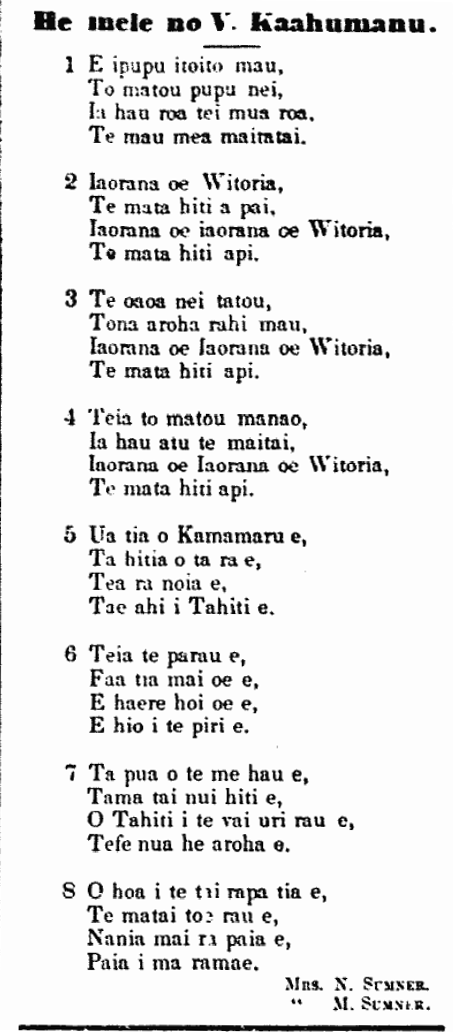
A mele for V. Kaahumanu.

1. E ipupu itoito mau,
To matou pupu nei,
Ia hau roa tei mua roa,
Te mau mea maitatai.

2. Iaorana oe Witoria,
Te mata hiti a pai,
Iaorana oe iaorana oe Witoria,
Te mata hiti api.

3. Te oaoa nei tatou,
Tona aroha rahi mau,
Iaorana oe Iaorana oe Witoria,
Te mata hiti api.

4. Teia to matou  manao,
Ia hau atu te maitai,
Iaorana oe Iaorana oe Witoria,
Te mata hiti api.

5. Ua tia o Kamamaru e,
Ta hitia o ta ra e,
Tea ra noia e,
Tae ahi i Tahiti e.

6. Teia te parau e,
Faa tia mai oe e,
E haere hoi oe e,
E hio i te piri e.

7. Ta pua o te me hau e,
Tama tai nui hiti e,
O Tahiti i te vai uri rau e,
Tefe nua he aroha e.

8. O hoa i te tai rapa tia e,
Te matai toe rau e,
Nania mai ra paia e,
Paia i ma ramae.

Mrs. N. Sumner.

” M. Sumner.

[Can anyone supply a translation for this mele?]

(Kuokoa, 1/25/1862, p. 3)

He mele no V. Kaahumanu.

Ka Nupepa Kuokoa, Buke I, Helu 9, Aoao 3. Ianuari 25, 1862.

Here is a pretty love song likening the object of one’s affection to a miulana flower, 1913.

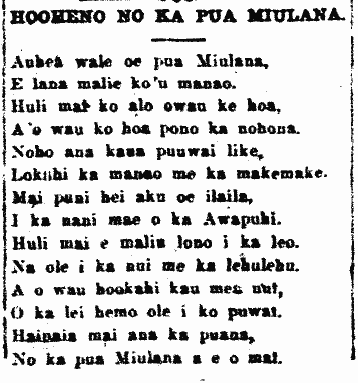
HOOHENO NO KA PUA MIULANA.

Auhea wale oe pua Miulana,
E lana malie ko’u manao.
Huli mai ko alo owau ke hoa,
A o wau ko hoa pono ka nohona.
Noho ana kaua puuwai like,
Lokahi ka manao me ka makemake.
Mai puni hei aku oe ilaila,
I ka nani mae o ka Awapuhi.
Huli mai e maliu lono i ka leo.
Na ole i ka nui me ka lehulehu.
A o wau hookahi kau mea nui,
O ka lei hemo ole i ko puuwai.
Hainaia mai ana ka puana,
No ka pua Miulana a e o mai.

[“Don’t be captivated by that over there, At the fading beauty of the Ginger blossom…”

For more on the miulana plant, check out this article by Heidi Bornhorst in the Honolulu Advertiser, 6/10/2001.]

(Kuokoa, 12/19/1913, p. 2)

HOOHENO NO KA PUA MIULANA.

Ka Nupepa Kuokoa, Buke LI, Helu 50, Aoao 2. Dekemaba 19, 1913.

Interpretation of an interesting song from across the shore, 1901.

COMPOSED FOR THE USURPERS OF LAND.

The poem below is taken by us from the newspaper, “Commoner,” of William J. Bryan, the Presidential candidate of the Democrats who lost in the last Presidential race of the United States.

Ina oe e ike ana he kapakai nani
I kaili lima nui ole ia mamua,
E waiho ana ma ke alahele o na hana kalepa
Me na kanaka e noho hemahema ana
I makaukau ole no ka hakaka
O, e komo aku oe a lawe ae no kona nani
O, e oluolu oe e ku iho a lawe ae no kona nani
E hoomaopopo ia aole no ke aloha i ke dala
E hoe aku oe ia oe iho no uka o ka aina
Me ka Baibala iloko o kou lima
E pule aku oe me ka powa pu aku iaia no kona nani
Ina oia e uwa mai, e kipu aku iaia no kona nani,
Ae, he oi loa aku ma kela wahi mamao
E olelo ae hoi kakou, ilalo o Kina
Kahi a na Karistiano e pakaha la i no poe pekana no kona nani
E puhi ahi aku oe, a e kipu aku no hoi
E hoopiha i kau eke me ka waiwai pakaha
Aka, e hoomaopopo iho oe e hana wale ana no oe no kona nani
I kou wa e pakaha ai i na Pake Buda no ko lakou mau waiwai
E lawe ana i na pohaku makamae mai ko lakou mau onohi maka laau
A i kou wa e hoonohonoho ai i na kumukuai
E haawi ae i wahi leo pule
No kou hoike ana aku e hana ana oe no ko lakou pono
A e hoomoakaka aku i ke ano o kou hahao ana iloko o kou pakeke.

[Mahalo to Chronicling America for putting up the original to this mele. See it here: “For His Good” in The Commoner, 3/1/1901, p. 8.]

(Aloha Aina, 4/27/1901, p. 2)

HAKUIA NO NA POE PAKAHA AINA.

Ke Aloha Aina, Buke VII, Helu 17, Aoao 2. Aperila 27, 1901.

A music book gifted to the Honorable Lilia K. Dominis, 1868.

[Found under: “LOCAL NEWS: Oahu”]

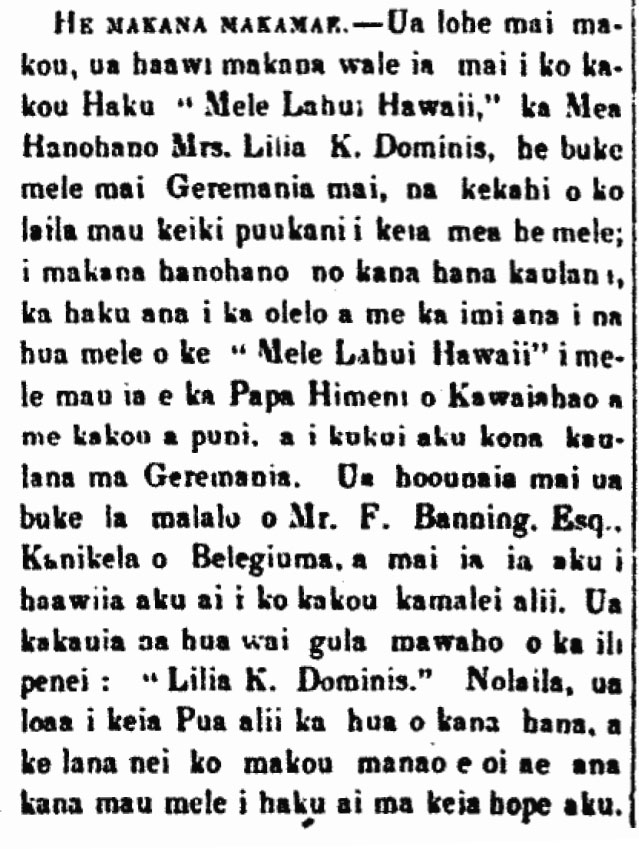
A Precious Gift.—We have heard that our Composer of “Mele Lahui Hawaii,” the Honorable Mrs. Lilia K. Dominis, was gifted a music book from Germany, by one of their singers; it was presented with honor for her famous accomplishment: the composition of the lyrics and the searching for the music of “Mele Lahui Hawaii,” which is sung all the time by the choir of Kawaiahao and by all of us everywhere and its fame has been heard of in Germany. The book was sent by way of Mr. F. Banning, Esq., Consul of Belgium, to our precious alii. Printed in gold lettering on the cover was: “Lilia K. Dominis.” This young alii has thus received the fruits of her labors, and we hope that there will be more of her compositions here after.

[Anyone know what this book is and where it is located today?]

(Kuokoa, 3/28/1868, p. 2)

He Makana Makamae.

Ka Nupepa Kuokoa, Buke VII, Helu 13, Aoao 2. Maraki 28, 1868.