Mr. George J. Fern
HAS OPENED
a Poi Shop at the Market. Go and see him and His Delicious Poi. Liliha and Kukui.
(Puuhonua o na Hawaii, 5/25/1917, p. 3)
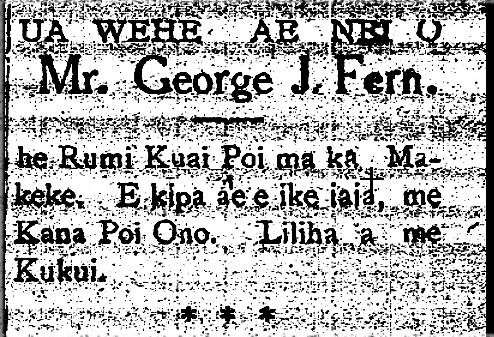
Ka Puuhonua o na Hawaii, Buke IV, Helu 21, Aoao 3. Mei 25, 1917.

HAS OPENED
a Poi Shop at the Market. Go and see him and His Delicious Poi. Liliha and Kukui.
(Puuhonua o na Hawaii, 5/25/1917, p. 3)
Ka Puuhonua o na Hawaii, Buke IV, Helu 21, Aoao 3. Mei 25, 1917.
These passing day, Hawaiians like Mayor Joseph J. Fern, David Kalauokalani, Samuel C. Dwight, James L. Holt, Hon. William P. Jarrett, Hon. C. P. Iaukea and a number of other Hawaiians are joining together to establish a company that will deal in the sale of poi, beef, salmon, dried fish, and so forth; with the intent to help Hawaiians in all ways that will lessen their household expenses; because it is very clear these days that because the poi factory of Kalihi is not making poi now, the current poi manufacturers are greatly raising the price of poi to five cents per pound; this is a price not seen in the past ten years or more; so too with the price of beef; the Chinese are buying very fine beef from the company of C. J. Waller [Wala], but the Chinese are charging Hawaiians 35 cents per p0und; it is an exorbitant price which has never been seen before; and it is heard from the talk of the Chinese that they will raise the price of poi once again to 6 cents a pound; it was this that encouraged the Hawaiians to establish a company that could hold back the severe increasing of the prices of our foods, O Hawaiians, by the Chinese.
The establishing of a company amongst Hawaiians is important and crucial; but if we Hawaiians do not implement an endeavor that will help ourselves, there will be no one else who will help us.
If we turn back and look at the history of Hawaii nei, we will see that the dissension amongst us Hawaiians was what wrenched away small businesses from us Hawaiians as well as all the other endeavors. Continue reading
To those who read this.
With aloha:—Whereas all of the shares of the Company named above has been acquired by W. C. Achi and some Hawaiians, and being that they are the only Hawaiians carrying out the growing of taro and the selling of poi, the food of our kupuna and makua; therefore, they humbly ask you, O Hawaiians, that you give them your assistance, by you buying your poi from their group.
The production of the poi at their poi factory is truly sanitary, and your orders will be filled with great haste.
Hasn’t the time come that Hawaiians try to help in the economic endeavors of their own people? Continue reading
Orders for poi from all over the Territory will be filled. The cost is reasonable and the production is hygienic. Isn’t it right that Hawaiians should assist in the efforts of Hawaiians?
Send in your Orders.
Telephone Number 1586
HONOLULU, T. H. 11-2716
(Aloha Aina, 4/15/1916, p. 4)
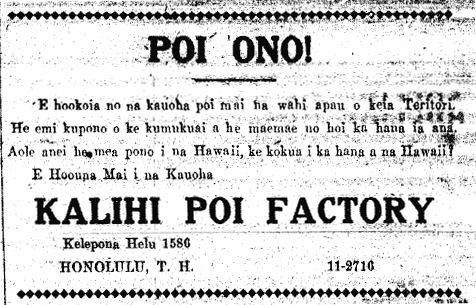
Ke Aloha Aina, Buke XXI, Helu 27, Aoao 4. Aperila 15, 1916.
Here is a very old poi board [papa ku’i poi] that is seventy-one years old, that is being cared for by Mr. Dick Kekona, and according to him, this board was carried everywhere his grandparents went.
(Kuokoa, 4/30/1915, p. 4)
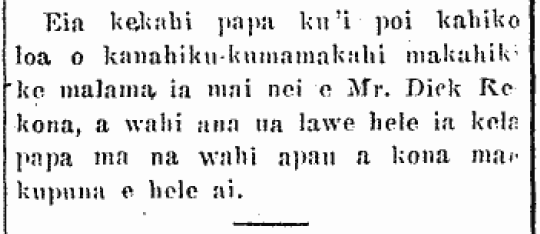
Ka Nupepa Kuokoa, Buke LIII, Helu 18, Aoao 4. Aperila 30, 1915.
Mr. Editor of Ka Hoku o Hawaii:
Aloha oe—
Please allow to include this sad parcel in some space in your newspaper to be published this week, in the issue of this new year. Our beloved mother left us, her children and family to grieve for her.
She was born in Canton, China, in 1857, in the month of April 23, and left her homeland when she was thirty-two years old and came to the Hawaiian Islands. She lived patiently with her husband in the beautiful valley of Waipio working under a poi company for several years. After this, her husband started his very own poi company. His capital was a single mule, some leased land, and a hired hand.
He did well for five years, and at that point, the two of them grew until the other poi companies dropped off. Today, it is one of the big poi factories of this beautiful valley supplying on the average 8,000 pounds of poi every week, feeding the workers of the ranches of Hawaii nei. Her husband (our father) died three years ago.
We are her children
Ernest Akioka
Edward Akioka
Herbert Akioka
(Hoku o Hawaii, 1/17/1928, p. 3)
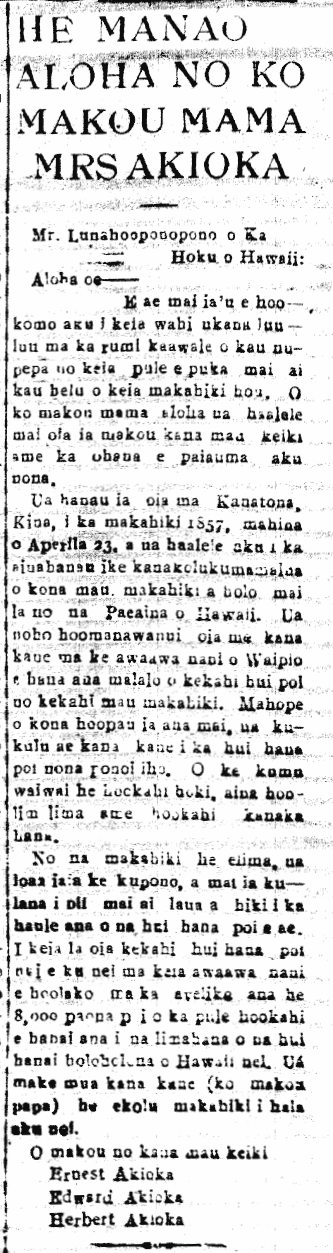
Ka Hoku o Hawaii, Buke XXI, Helu 33, Aoao 3. Ianuari 17, 1928.
MR. AKIOKA (CHINESE)
Mr. Editor of the Kuokoa Newspaper, Aloha kaua:—Please kindly allow me an open space of your newspaper, for our loved one, our father has left us, his children and his wife; he has peacefully left for that realm we must all go to.
He had a swelling sickness, and the doctor was fetched, but he did not get any relief and died.
Our father was born in the “land of flowers,” China, on the 30th of November, 1851, and he left us on the 18th of May, 1922; he was over 71 years old. Continue reading
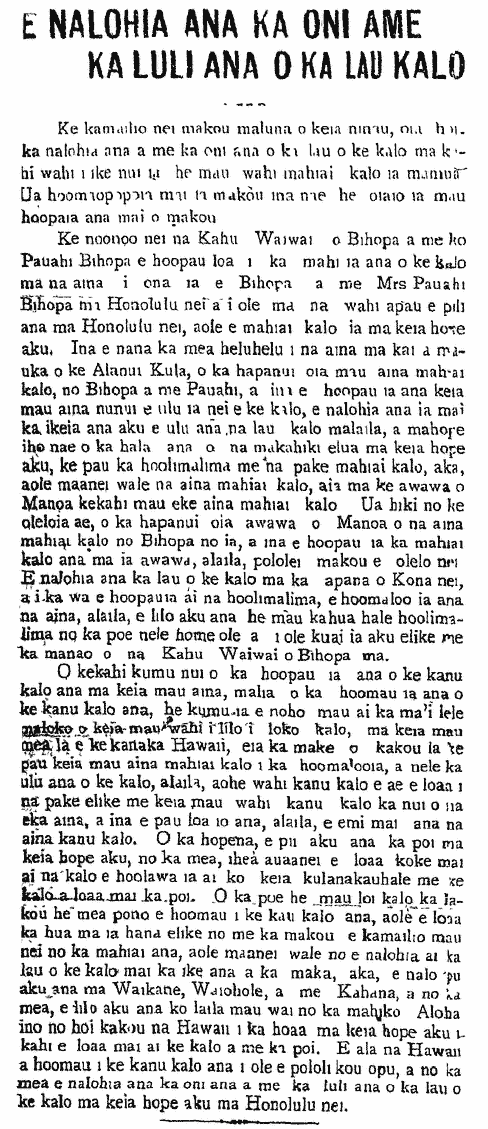
It is to you, O Hawaiians, who we strongly encourage in regard to this question about kalo here forward, for large kalo-growing lands here in Honolulu will be dried out and put an end to by those who own them. Should those lands where kalo is being grown today truly be left to dry out, by our estimation, nearly 300 acres of kalo lands will be lost here in Honolulu, or perhaps four hundred or more acres of kalo lands will not be planted anymore. Therefore, to make up for this lost acreage, it is for all of you people outside of Honolulu to plant dry-land taro in fields and small patches, or in large loi where taro can constantly be cultivated.
If you have an abundance of kalo, then feed the sows, the hens, the turkeys, the ducks, and animals from which a person who plants a lot of taro can benefit; for you can eat the kalo, and the animals can eat the stalks [haha kalo], the leaves [luau], the watery residue from poi making [kale ai]; all these things are of great help to the farmer of kalo. Therefore, O Hawaiians, don’t be weary to grow kalo, and don’t neglect this lively endeavor on the land.
(Kuokoa Home Rula, 8/18/1911, p. 2)
Kuokoa Home Rula, Buke IX, Helu 33, Aoao 2. Augate 18, 1911.
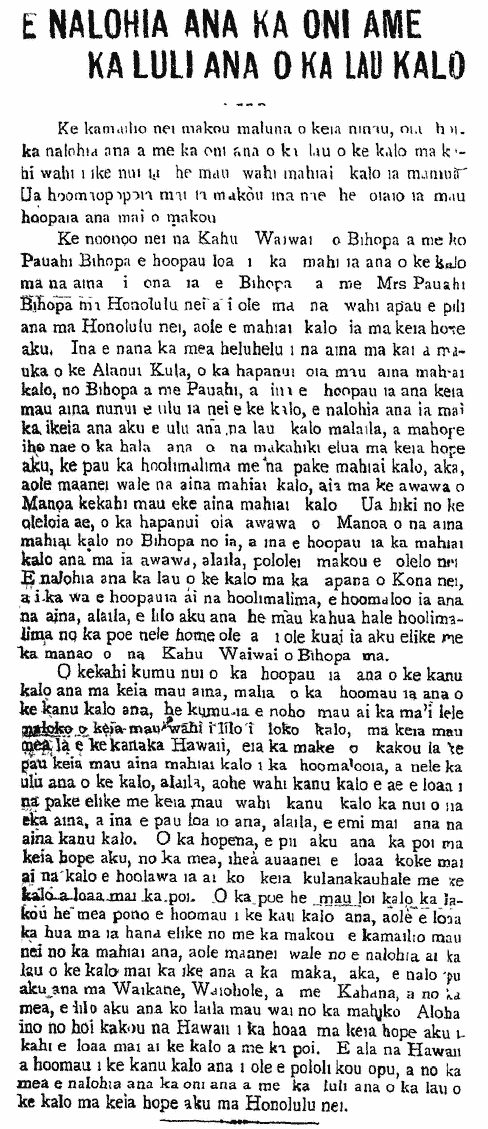
THE STIRRING AND FLUTTERING OF TARO LEAVES TO DISAPPEAR
We are discussing this problem, that being the disappearance of the fluttering taro leaves from places where kalo farming was seen often before. This is clear should our speculation be true.
The Bishop Trustees and those of Pauahi Bishop are considering putting an end for all time to the farming of kalo on lands owned by Bishop and Mrs. Pauahi Bishop here in Honolulu, or in all areas near Honolulu; there will be no more farming of kalo from now on. Should the reader take a look at the lands towards the ocean and towards the uplands of School Street, the majority of those kalo lands belong to Bishop and Pauahi, and should these large tracts of kalo-growing lands be put an end to, taro leaves growing there will no longer be seen, and two years hence, the leases with the Chinese taro farmers will come to an end; but these are not the only taro lands; in Manoa Valley, there are acres of kalo land. It can be said that most of the taro-farming lands in Manoa Valley belong to Bishop, and should the kalo farming be put to an end in that valley, then it is appropriate for us to say that taro leaves will disappear from the district of Kona, and when the leases are stopped, the lands will be dried up, and they will be made into lots to lease to those who have no homes, or they will be sold, like what is being considered by the Trustees of Bishop folks.
One of the main reasons to end the farming of kalo on these lands is perhaps because if the farming of kalo continues, these areas will be places for infectious diseases to reside; through this, O Hawaiians, our end will come; if these kalo lands are dried out and kalo is not grown, then there will be no other lands for the Chinese to lease like these tracts of lands of many acres, and should they indeed be done away with, then the places where kalo is grown will decrease. As a result, the poi prices will increase, for where will kalo be readily obtained to supply this town and to get poi? For those who have taro fields, it is important that they continue to plant taro; there will not be the profits in that work like what we always speak of when talking of farming; and it is not just here that the leaves of the taro will no longer be seen, but it will disappear from Waikane, Waiahole, and Kahana, for the water there is going to the sugarcane plantations. Alas for us Hawaiians who hereafter will be left wandering, looking for kalo and poi. Rise O Hawaiians and continue to farm kalo lest you be left hungry, being that the stirring and fluttering of kalo leaves will disappear from Honolulu nei.
[This deserves to be retranslated nicely…]
(Kuokoa Home Rula, 8/18/1911, p. 2)
Kuokoa Home Rula, Buke IX, Helu 33, Aoao 2. Augate 18, 1911.
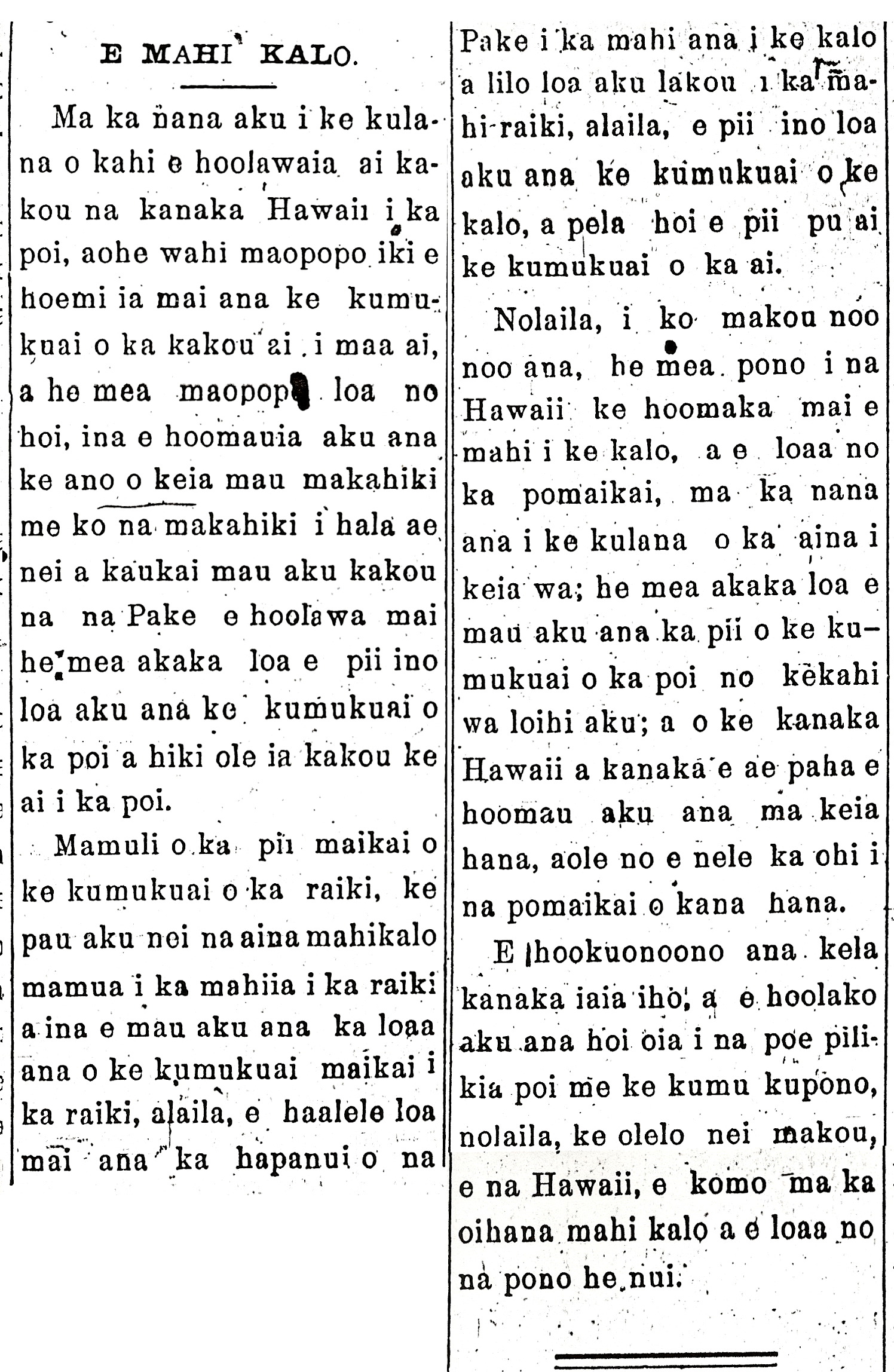
When considering how we Hawaiians are being supplied with poi, there is not the slightest indication that the cost of our staple food will decrease, and it is also very clear that if what has happened in the past years continues on into the upcoming years, and we continue relying on the Chinese for our supply, it is obvious that the price of poi will shoot up, and we will not be able to eat poi.
As a result of the increase in the price of rice, the former taro lands are being planted with rice, and should the rice market continue to be favorable, then a majority of the Chinese will abandon taro and become rice farmers, then, the cost of kalo will skyrocket, and as a result, so too will the price of poi.
Therefore, in our opinion, Hawaiians should start farming kalo, and obtain its benefits; looking at the land situation these days, it is very clear that the price of poi will continue to rise for long into the future; and the Hawaiians or others perhaps who continue this occupation will not fail to reap its benefits.
That man will make himself prosper and he will supply those who are lacking poi at a fair price, and so we say, O Hawaiian people, go into the occupation of kalo farming, and there shall be many blessings.
[While rice is no longer being planted here, perhaps in its place are being planted buildings. What is there to be done today?]
(Lahui Hawaii, 6/22/1901, p. 4)
Ka Lahui Hawaii, Buke III, Helu 25, Aoao 4. Iune 22, 1901.
 nupepa