A composition for Hawaiians boys going away to war, 1918

Mele for the Hawaiian Boys

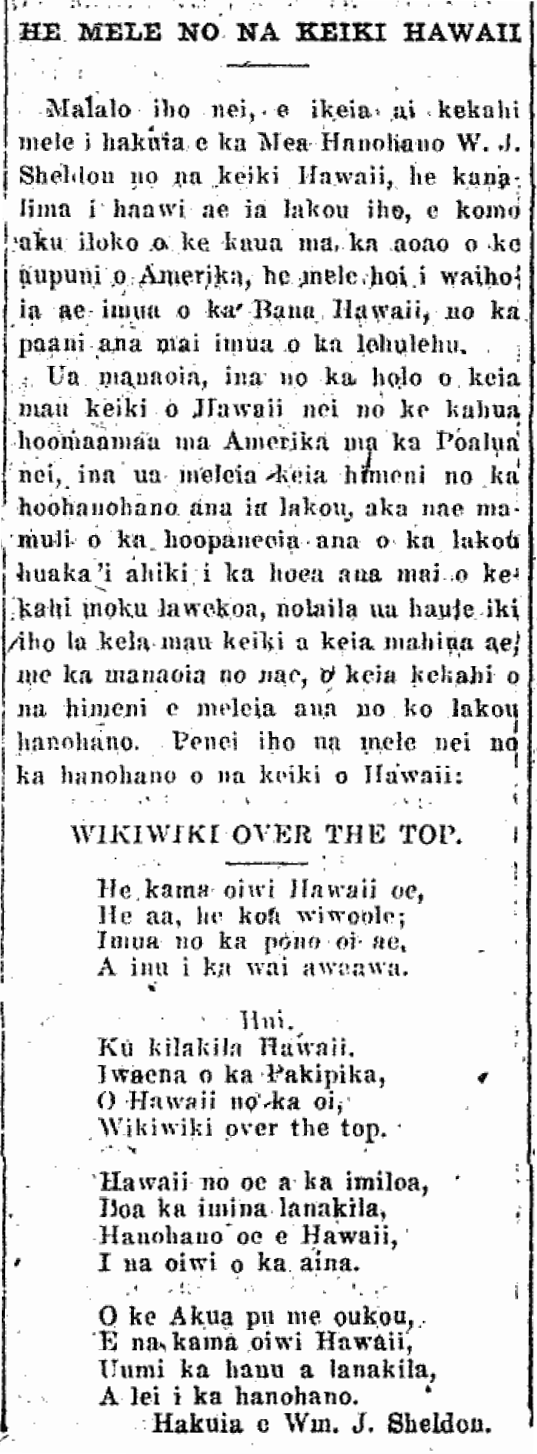
Seen below is a mele composed by the Honorable W. J. Sheldon for the fifty Hawaiian boys who gave themselves to join the war on the side of the nation of America. It is a song put before the Royal Hawaiian Band, to be played before the public.

It is believed that if these Hawaiian boys head out to the training camp in America on Tuesday, this song would have been sung for them in their honor. But as their trip is postponed until the arrival of a military ship, therefore the boys have been set back until next month. It is still believed that this will be one of the songs that will be sung to honor them. Here is this mele to glorify these Hawaiian youths:

WIKIWIKI OVER THE TOP

He kama oiwi Hawaii oe,
He aa,  he koa wiwoole;
Imua no ka pono oi ae,
A inu i ka wai awaawa.

Hui.

Ku kilakila Hawaii,
Iwaena o ka Pakipika,
O Hawaii no ka oi,
Wikiwiki over the top.

Hawaii no oe a ka imiloa,
Loa ka imina lanakila,
Hanohano oe e Hawaii,
I na oiwi o ka aina.

O ke Akua pu me oukou,
E na kama oiwi Hawaii,
Uumi ka hanu a lanakila,
A lei i ka hanohano.

Hakuia e Wm. J. Sheldon.

[Which went something like this:

QUICKLY OVER THE TOP.

You are a native son,
Daring, a fearless warrior;
Forward for the greater good,
And drink of the bitter waters.

Chorus.

Hawaii stands tall,
Amidst the Pacific,
Hawaii is the foremost,
Quickly, over the top.

You are Hawaii, of explorers,
Far reaching is your search for victory,
Proud is Hawaii,
For the oiwi of the land.

God be with you,
O Native sons of Hawaii,
Be patient until victorious,
And wear the honor like a lei.

Composed by William J. Sheldon.]

(Kuokoa, 5/17/1918, p. 3)

HE MELE NO NA KEIKI HAWAII

Ka Nupepa Kuokoa, Buke LVI, Helu 20, Aoao 3. Mei 17, 1918.

Repost: Monday, April 8th Pa‘ahao Book Drive at UH from 3-5 PM

Monday, April 8th Pa‘ahao Book Drive at UH from 3-5 PM

Posted on March 25, 2013

Several years ago, community activist Andre Perez, raised funds to send 300 books on Hawaiian culture to Saguaro prison. Since these books were not officially catalogued in Saguaro’s library, the administration considered them contraband and BURNED THESE BRAND NEW BOOKS.

Andre is now working with PSD and other entities to raise funds to buy books on Hawaiian culture that will be part of the official Saguaro library.

Please support!
Here for Flyer

paahao flyer for 4.8.13UH event

Monday, April 8th Pa‘ahao Book Drive at UH from 3-5 PM.

Hei, cat’s cradle, Hawaiian style, 1916.

Some String Figures of Hawaii

There are many people studying the history of Hawaii nei and the lifestyle of its people, like what has been done with America, Europe and Asia. And through this studying of history, there has not been a lack of new information which brings benefits by its study. However Judge [Lyle Alexander] Dickey has come up with a new path to this study, not utilized before in Hawaii nei. He is learning string figures, and is collecting the old names and the mele that go with these string figures. He now has about a hundred or more of them.

String figures is something done all over the world. And most people know one or two. From what is known, there is not much of them in Europe and Asia; there are a bit more in Africa; and there is a lot with the Indians of America and the people of the islands of the Pacific. There are two books on string figures of the islands of Britain, the Indians of the Arctic, the Indians, and a few from the islands to the south of us. There is nothing written on the hei of Hawaii nei, even if Hawaii’s figures are most wonderful for the mele which accompany them. Some are not difficult, however some are very problematic because of the many transformations, with different lines of mele going along with each change. Some are very humorous without value, while some are for wooing, while others are riddles. Knowing the way of life of the people, its tales, its history, and the lay of its lands—this is the means of understanding the meanings and kaona (underlying meanings) of these hei. Perhaps the most widely memorized figure is called Hale Kumukaaha. However to this day, Judge Dickey has not gained clarity as to the true meaning and kaona of this hei.

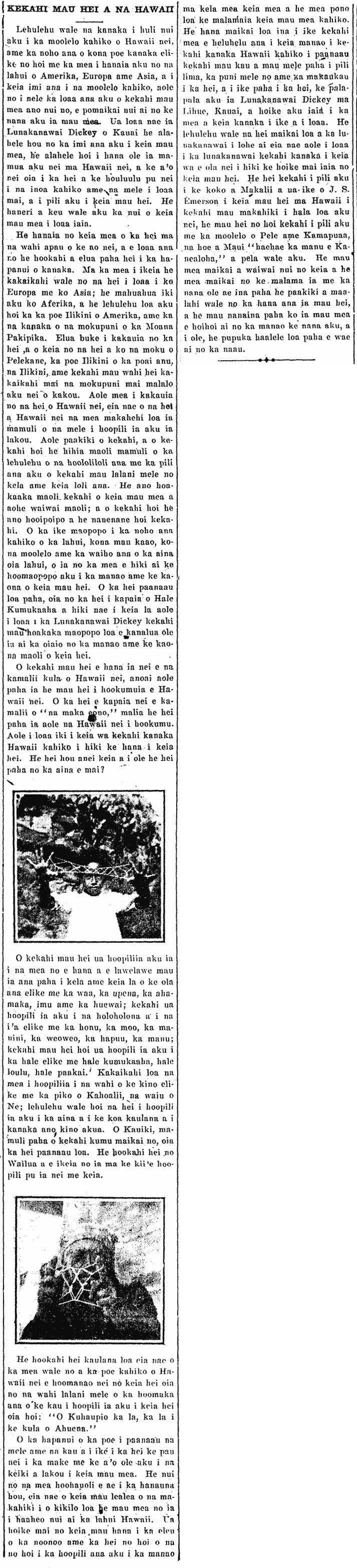
Some figures done by the school children of Hawaii are perhaps not originating in Hawaii nei. The hei called “six eyes” is probably not from here [the first image]. Not a single old Hawaiian can make this figure. Maybe it is a new figure or maybe one from outside of Hawaii.

Some of the hei are associated with daily life, like the canoe, the net, the hammock, the imu, and the water gourd. Some are associated with animals and fish, like the turtle, the mo’o, the manini, the aweoweo, the hapuu, and the bird. Some hei are associated with the house like the kumukaaha structure, the loulu structure, and the paakai structure. There are a very little hei pertaining to body parts, like the piko of Kahoalii and the breasts of Ne. There are many dealing with land and famous fishing shrines as well as men with god-like bodies. Kauiki, for probably a good reason is the most widely known figure. One hei is for Wailua and it is seen in the attached illustration.

There is one famous hei, but it is only known by the oldsters of Hawaii nei, of which is accompanied by the chant starting with: “O Kuhaupio ka la, ka la i ke kula o Ahuena.”

A majority of the people who have the song or chant memorized along with the figures, have died without teaching them to their children. There are so many other things that entertain the new generation, but this entertainment of times long ago is something that the Hawaiian people are proud of. This skill shows intelligence in making the figures and associating it to this thing or that, and it is important that this ancient knowledge be kept. It would be good if someone reading this knows of some old Hawaiian who has a chant or mele memorized close at hand, one who is fond of mele and versed in string figures, or one who knows string figures, that he should Judge Dickey in Lihue, Kauai and tell him of what this person knows. There are many different hei of which the judge has heard, however, he has not found someone now living who can show them to him. There is one that is associated with the net of Makalii that J. S. Emerson saw in Hawaii many years ago; there are also some associated with the story of Pele and Kamapuaa, the paddle o Maui, “haehae ka manu e Kanealoha,” and so forth. These are great and very valuable, and it is important that they be preserved without regard to its simplicity or difficulty. And it is perhaps something that will bring joy when witnessing it being done, or perhaps something exceedingly appalling to consider.

(Kuokoa, 6/9/1916, p. 3)

KEKAHI MAU HEI A NA HAWAII

Ka Nupepa Kuokoa, Buke LIV, Helu 23, Aoao 3. Iune 9, 1913.

Nice follow up on Louis [Lui] Thompson Keouli.

In response to an earlier post “More Hawaiians playing music afar, 1908,” from March 1, 2012.

https://nupepa-hawaii.com/2012/03/01/more-hawaiians-playing-music-afar-1908/#comment-2266

Keith James says:

I wrote a Wikipedia article on Lu Thompson Keouli (aka as Louis Keouli Thompson), who was my great-grandfather. He graduated from Kamehameha, class of 1900. (http://en.wikipedia.org/wiki/Louis_Keouli_Thompson)

Be a part of history today. 2013.

Kākoʻo i ka Pila S.B. 1235! #oleloHI

ʻŌiwi TV February 12, 2013

E nā hoa kākoʻo mau i kēia kiʻina hoʻōla ʻōlelo a moʻomeheu Hawaiʻi ma o ka pāpaho “Na Ka Hawaiʻi, No Ka Hawaiʻi”, e alu mai i ka hāpai i kēia i mua ma ka hoʻouna i manaʻo kākoʻo i ka pila SB1235.

To all those who continue to support our efforts to use the power of the media for the benefit of our ʻōlelo and moʻomeheu Hawaiʻi, please join us in supporting SB1235.

Draft Testimony Template: SB1235.Support.Leka

Submit Testimony via e-mail: CPNtestimony@capitol.hawaii.gov

Submit Testimony Online: http://www.capitol.hawaii.gov/submittestimony.aspx?billtype=SB&billnumber=1235

Submitting testimony online is as simple as entering your name, email, and clicking “support”

Measure Status Pagehttp://www.capitol.hawaii.gov/measure_indiv.aspx?billtype=SB&billnumber=1235&year=2013

S.B. 1235: http://www.capitol.hawaii.gov/session2013/bills/SB1235_.pdf

GOAL:

The goal is to acquire long-term, cyclical, and diversified funding for the production and distribution of Hawaiian language video content to support an independent Native Hawaiian television service that is a prime vehicle in the mass revitalization of Hawaiian language and culture.

SB 1235:

The purpose of this bill is to require the Department of Commerce and Consumer Affairs to allocate revenues derived from any collected franchise fees to specific entities for specific purposes. One of the new designees for allocation of funds would be Makauila, Inc., a non-profit educational organization with the purpose of revitalizing Hawaiian language and culture via media.

ARGUMENT:

The Constitution of the State of Hawaii, Article XV, Section 4 states “English and Hawaiian shall be the official languages of Hawaii,[…]” If the Hawaiian language is to reach an equal status with that of the English language in everyday use, the production and distribution of Hawaiian language broadcast media must be supported. Language revitalization research supports this assertion (Fishman).

The cable franchise fee is a 4.6% fee assessed to cable television customers in Hawaiʻi and these funds are currently allocated to support initiatives such as public, education, and government television but with no specific requirements to support the Hawaiian language. We believe that an independent Native Hawaiian television service focusing on the revitalization of language is a worthy recipient of these funds proven by the viewership and demand for this programming by Makauila and its distribution partners ʻŌiwi TV and Hawaiʻi News Now. For more information on the cable franchise fees:  http://hawaii.gov/dcca/catv/peg_plan_information/catv_final_peg_plan.pdf

Makauila, in partnership with a collective of other Hawaiian-serving organizations and funding sources, has built the foundation for a Native Hawaiian television industry through Hawaiian-focused content production, workforce training programs, and equipment investments. Partners include  ʻŌiwi TV, ʻAha Pūnana Leo, the Kamehameha Schools, the Office of Hawaiian Affairs,  and Oceanic Time Warner Cable. This collective has pursued a long-term strategy to effectively and systematically scale up the capacity to leverage diversified funding sources as content production and viewership increases.

Highlights of the collective since 2008:

Launched ʻŌiwiTV, Oceanic 326 and http://www.oiwi.tv. First Hawaiian language and cultural television station Produced ʻĀhaʻi ʻŌlelo Ola, the first native language news program on network television (KGMB/HNN)
1,200 video segments totaling 165 hours of Hawaiian-focused content, including 85 hours of all Hawaiian language content Produced the Hawaiian language greetings at Hawaiʻi airports
8.7 million views locally on KGMB/HNN, ʻŌiwi TV and web Produced the Hawaiian language video greeting for in-bound flights to Hawaiʻi
Developed and operationalized the Native Hawaiian Broadcast Media Training Program, providing 12 full-time jobs to graduates Acquired over $3million in funding from Federal, State, and private grants and contracts


MAKAUILA BIO:

Makauila, Inc. formed in April 2010 from a need for on-going funding for ʻĀhaʻi ʻŌlelo Ola, the pioneering Hawaiian language news show produced by the ʻAha Pūnana Leo for air on KGMB/Hawaii News Now and ʻŌiwi TV. Looking beyond a news segment, the core group of Native Hawaiian media professionals and their partners saw the need for this new nonprofit to acquire funding to produce high quality digital multimedia content that would expand the presence of a Hawaiian perspective in television and contemporary society.

The mission of Makauila is to utilize digital media as the means to enrich the educational and cultural experiences for Native Hawaiians in the modern context.

The purpose of Makauila is to develop and produce educational multimedia content through Hawaiian language, culture and perspective for television and digital distribution. Advances in digital technology have opened new avenues of interactive communication that offer tremendous opportunity to educate from a Native Hawaiian perspective. Makauila formed to take advantage of these opportunities and to serve as the catalyst for community building through education and language revitalization.

The long-term goal of Makauila is to leverage collective experience, relationships and knowledge to be the pre-eminent producer and distributor of relevant multimedia content from the Hawaiian perspective to support an independent Native Hawaiian television service.

As part of this strategy, Makauila partnered with ʻŌiwi TV as its primary distribution venue because of the clear alignment in vision and commitment to a high standard for ʻōlelo and moʻomeheu Hawaiʻi. Since 2010, Makauila and ʻŌiwi TV have collaborated on numerous content production projects that are providing the Hawaiian community with high-quality Hawaiian language, cultural, and educational television programming. The content and subject matter of the programming being produced through this collaboration includes news and other timely information that makes it relevant and meaningful to the audience, adding more value to the experience audience. This programming is also filling a long-underserved need by allowing Hawaiian language speakers and learners the opportunity to use their language in their homes and outside of a classroom environment. This opportunity to expand the areas in which Hawaiian language is commonplace is an important step in the revitalization of the Hawaiian language. Furthermore, using digital distribution through television and the Internet allows for Hawaiian language content to be delivered to and consumed by its audience through a modern and forward-thinking strategy.

More images from the past, 1903.

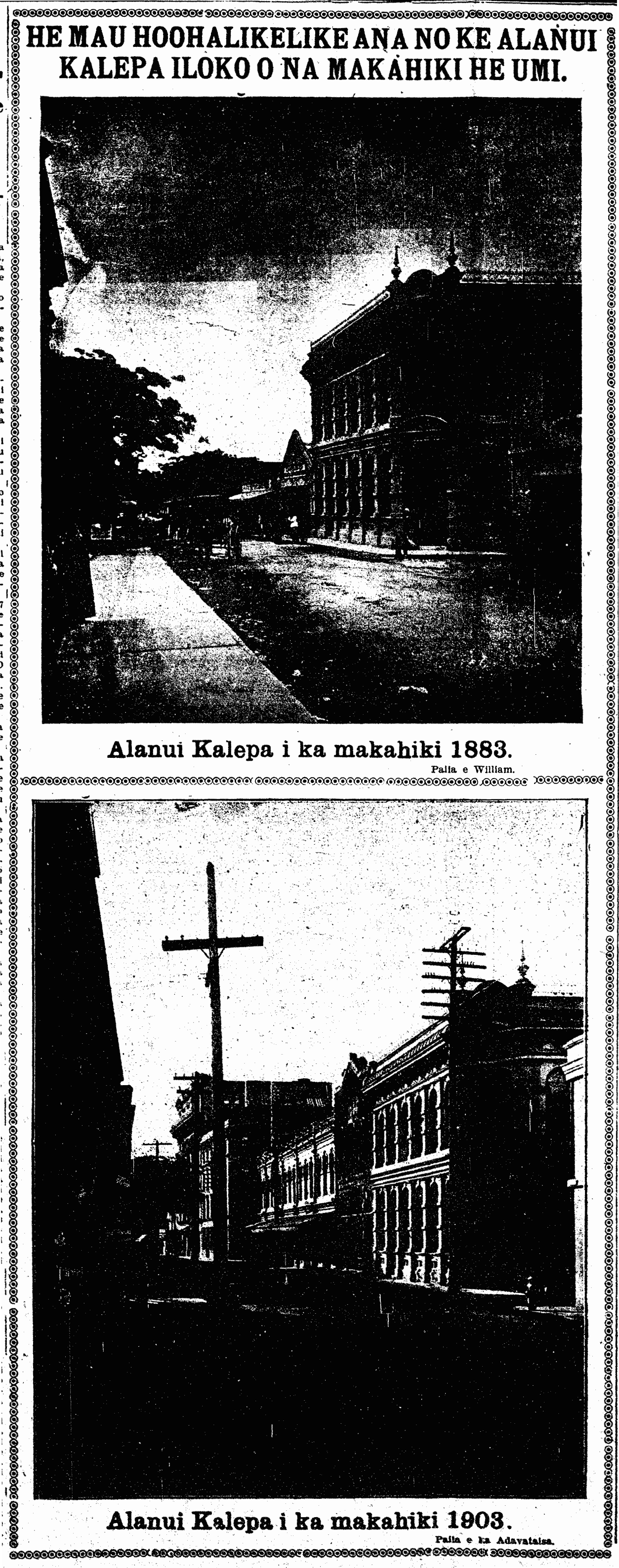
A COMPARISON OF MERCHANT STREET BETWEEN TEN YEARS.

Merchant Street in 1883.

Photographed by Williams.

Merchant Street in 1903.

Photographed by the Advertiser [Adavataisa].

[I’m not sure if they meant to say “twenty years”, or if one of the pictures is mislabeled ten years off…]

(Kuokoa, 1/30/1903, p. 1)

HE MAU HOOHALIKELIKE ANA NO KE ALANUI KALEPA ILOKO O NA MAKAHIKI HE UMI.

Ka Nupepa Kuokoa, Buke XLI, Helu 5, Aoao 1. Ianuari 30, 1903.

Pictures into the past, 1903.

THE DAYS OF YORE OF HONOLULU

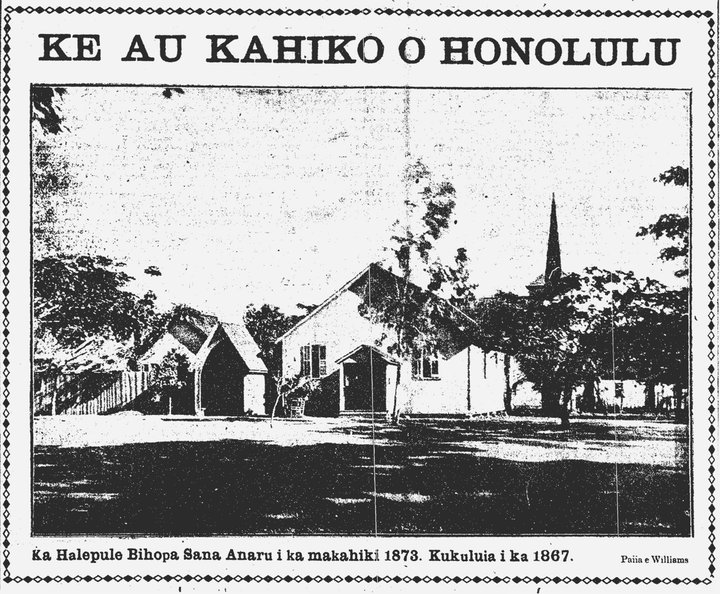
The Anglican Church Saint Andrew’s [Sana Anaru] in the year 1873. Built in 1867.

Photograph by Williams.

[This is part of a series of pictures of old Honolulu that ran on the first page of the Kuokoa. From about 1900, pictures become an added feature of the papers. Paging through the papers, you never know what or who you will come across! (…even after the all of the pages become word searchable, until they find a way to indicate that there is an image of this or of that).

(Kuokoa, 3/6/1903, p. 1)

KE AU KAHIKO O HONOLULU

Ka Nupepa Kuokoa, Buke XLI, Helu 10, Aoao 1. Maraki 6, 1903.

Queen Liliuokalani and the Red Cross, 1917.

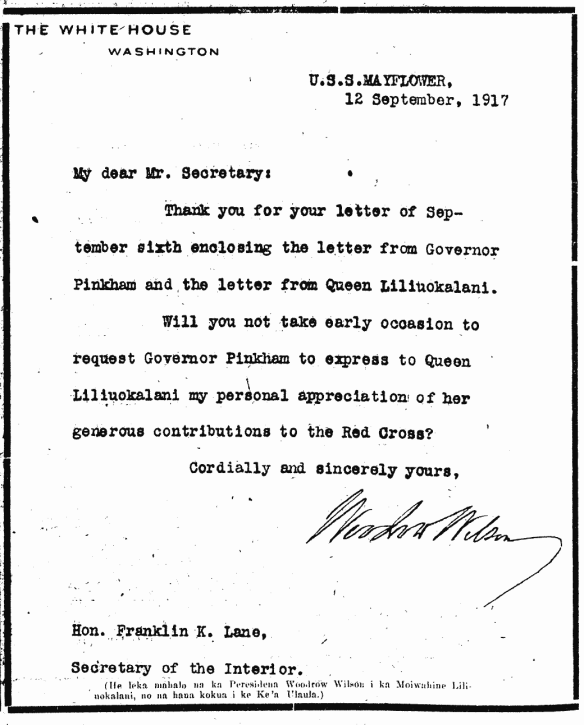
THE WHITE HOUSE

WASHINGTON

U. S. S. MAYFLOWER

12 September, 1917

My dear Mr. Secretary:

Thank you for your letter of September sixth enclosing the letter from Governor Pinkham and the letter from Queen Liliuokalani.

Will you not take early occasion to request Governor Pinkham to express to Queen Liliuokalani my personal appreciation of her generous contributions to the Red Cross?

Cordially and sincerely yours,

[signed] Woodrow Wilson

Hon. Franklin K. Lane,

Secretary of the Interior.

(A letter of appreciation from President Woodrow Wilson to Queen Liliuokalani, for her assistance to the Red Cross.)

[The Queen dies just two months later on November 11th…]

(Kuokoa, 9/28/1917, p. 2)

THE WHITE HOUSE

Ka Nupepa Kuokoa, Buke LV, Helu 39, Aoao 2. Sepatemaba 28, 1917.

Kaumakapili Church member, 1910.

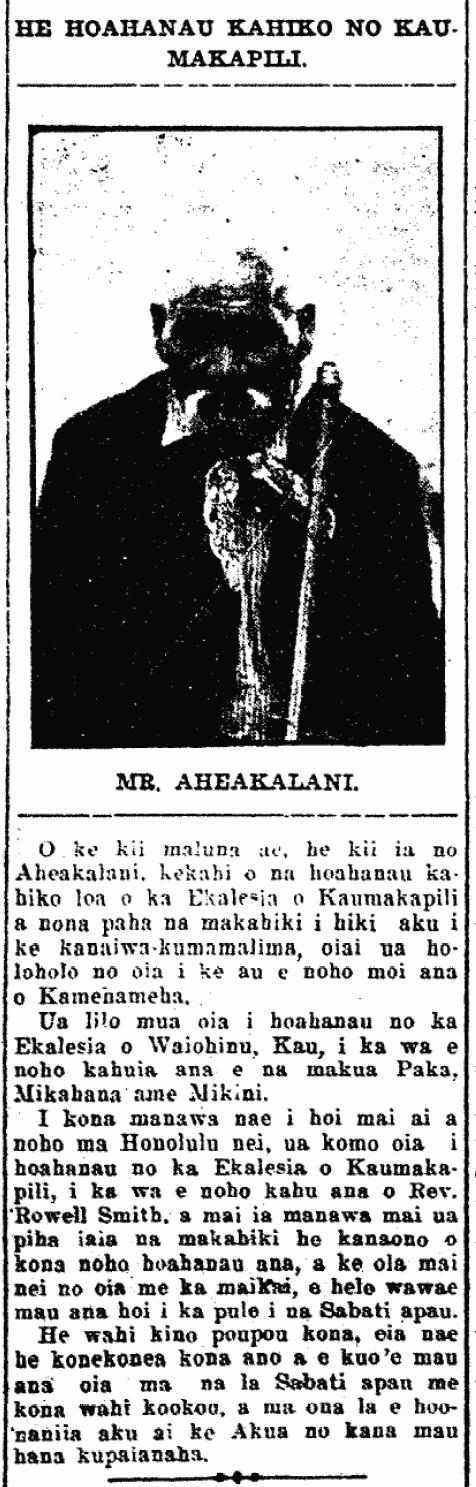
Old Member of Kaumakapili.

Mr. Aheakalani.

The picture above is one of Aheakalani, one of the very old members of Kaumakapili Church, and he has perhaps reached the age of ninety-five, being that he was going about about during the time Kamehameha was king.
He was first in the congregation of the church of Waiohinu, Kau, when the kahu were Parker, Mikahana and Mikini.

However, when he returned to Honolulu to live, he became a member of Kaumakapili Church, when Rev. Rowell Smith was kahu. And from that time, he has been one of the congregation there for sixty years. He is in good health and walks to prayer ever Sunday.
He is stout, but he is in recovery, and walks every Sunday with his cane, and through him, God is glorified for his amazing works.
(Kuokoa, 5/27/1910, p. 5)
HE HOAHANAU KAHIKO NO KAUMAKAPILI.

Ka Nupepa Kuokoa, Buke XLVII, Helu 21, Aoao 5. Mei 27, 1910.