ka luʻuluʻu,
ke kaumaha,
ka minamina,
ka menemene,
ka lihaliha,
ka paumākō,
ke kūmākena.
aloha nō.
ka luʻuluʻu,
ke kaumaha,
ka minamina,
ka menemene,
ka lihaliha,
ka paumākō,
ke kūmākena.
aloha nō.
[Found under: “NUHOU KULOKO.”]
The Chinese of Waikiki are starting to turn some rice paddy lands into taro fields, and there will be a lot of poi this next year.
(Hawaii Holomua, 12/12/1892, p. 3)

STOP FOSTER THE OLD WAYS AND THE KAHUNA RITES
This is a voice of instruction before true Hawaiian pertaining to the fostering of the old ways of the kūpuna who passed on, as well as the rites of the kahuna of those old days, and teaches Hawaiians of this progressive era as well to put an end to their activities of the kahuna of the old days, and teaches also that the fostering of those things are not according to what God wants.
Every true Hawaiian family of this progressive era should thank the Almighty God, from whom comes life and the strength of us all as well as all things of this worldly life.
There are many Hawaiians who live in the darkness, carrying out activities of the old times into this progressive era. Stop in earnest those kinds of things, for the body will be the victim, for the Holy Book says, “I am JEHOVAH your God,” and “keep My commandments.”
Stop! Stop in earnest the superstitions of the ignorant age, and turn to the truth of the Holy book; within there is life and keeper of life of body and soul.
(Kuokoa, 10/16/1924, p. 6)

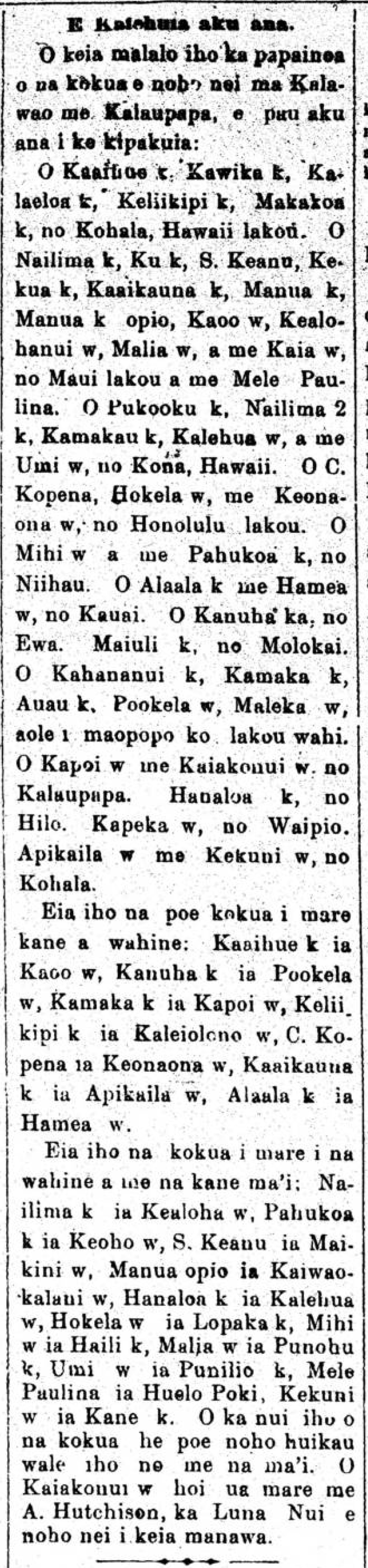
To be Discharged.
Below is the list of names of the kokua who live in Kalawao and Kalaupapa who will be kicked out.
Kaaihue (m), Kawika (m), Kalaeloa (m), Keliikipi (m), Makakoa (m)–they are from Kohala, Hawaii. Nailima (m), Ku (m), S. Keanu, Kekua (m), Kaaikauna (m), Manua (m), Manua (m) Jr., Kaoo (f), Kealohanui (f), Malia (f), and Kaia (f)–they are from Maui and Mele Paulina. Pukooku (m), Nailima 2 (m), Kamakau (m), Kalehua (f), and Umi (f)–from Kona, Hawaii. C. Kopena, Hokela (f), and Keonaona (f)–they are from Honolulu. Mihi (f), and Pahukoa (m)–from Niihau. Alaala (m) and Hamea (f)–from Kauai. Kanuha (m)–from Ewa. Maiuli (m)–from Molokai. Kahananui (m), Kamaka (m), Auau (m), Pookela (f), Maleka (f)–it is not known where they are from. Kapoi (f) and Kaiakonui (f)–from Kalaupapa. Hanaloa (m)–from Hilo. Kapeka (f)–from Waipio. Apikaila (f) and Kekuni (f)–from Kohala.
These are the kokua who are married, man and [afflicted] woman: Kaaihue (m) to Kaoo (f), Kanuka (m) to Pookela (f), Kamaka (m) to Kapoi (f), Keliikipi (m) to Kaleiolono (f), C. Kopena to Konaona (f), Kaaikauna (m) to Apikaila (f), Alaala (m) to Hamea (f).
These are the kokua who are married, woman and afflicted man: Nailima (m) to Kealoha (f), Pahukoa (m) to Keoho (f), S Keanu to Maikini (f), Manua Jr. to Kaiwaokalani (f), Hanaloa (m) to Kalehua (f), Hokela (f) to Lopaka (m), Mihi (f) to Haili (m), Malia (f) to Punohu (m), Umi (f) to Punilio (m), Mele Paulina to Huelo Poki, Kekuni (f) to Kane (k). The rest of the kokua are living mixed up with the patients. Kaiakonui (f) is married to A. Hutchison who is the current Superintendent.
(Makaainana, 2/5/1894, p. 2)
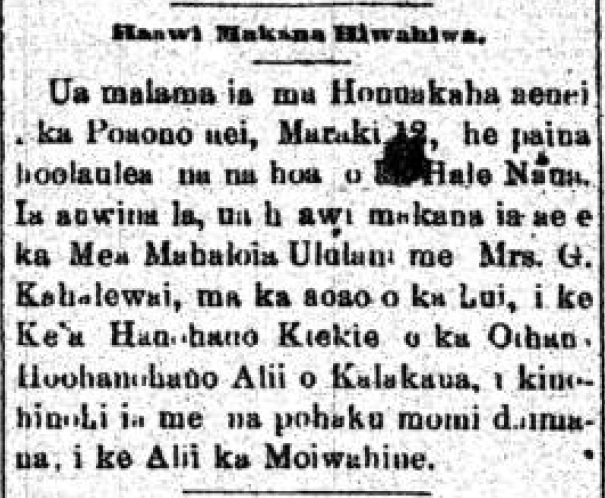
Gave a Precious Gift.
At Honuakaha on Saturday, March 12, a celebratory banquet was held by the members of the Hale Naua. That afternoon Her Excellency Ululani and Mrs. G. Kahalewai, on behalf of the organization, presented the Grand Cross of the Order of Kalakaua, set in diamonds [ke Kea Hanohano Kiekie o ka Oihana Hoohanohano Alii o Kalakaua, i kinohinohi ia me na pohaku momi daimana] to her Majesty, the Queen.
(Nupepa Elele, 3/19/1887, p. 4)
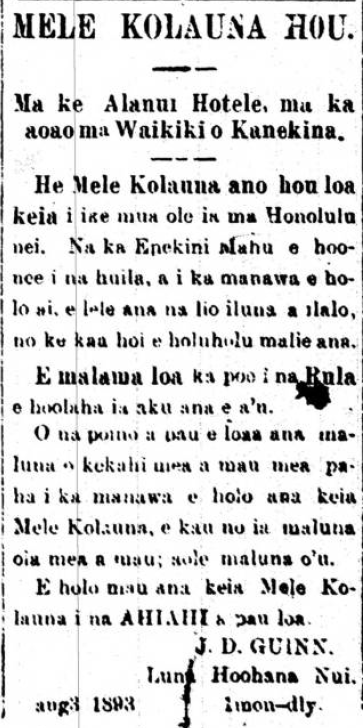
NEW MERRY-GO-ROUND.
On Hotel Street, on the Waikiki side of Kanekina.
There is the newest kind of Merry-go-Round, never seen before here in Honolulu. The wheels are run by steam engine, and when it is in motion, the horses jump up and down, and the car calmly rises and falls.
Follow closely the rules which I have advertised.
All injuries suffered by person or persons when riding this Merry-go-Round will be the responsibility of the person or persons; not mine.
This Merry-go-Round is in service every EVENING.
J. D. GUINN.
Manager.
(Leo o ka Lahui, 8/4/1893, p. 3)
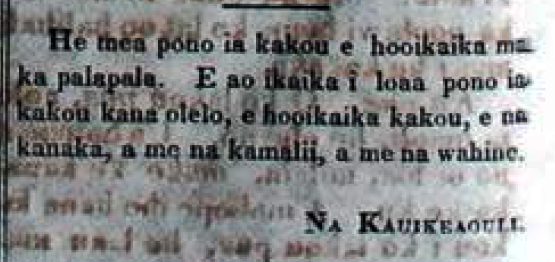
We must put effort into learning the written word. Let us study hard so that we thoroughly understand what they say, O men, children, and women.
By Kauikeaouli (Kamehameha III).
(Lama Hawaii, 5/16/1834, p. 4)
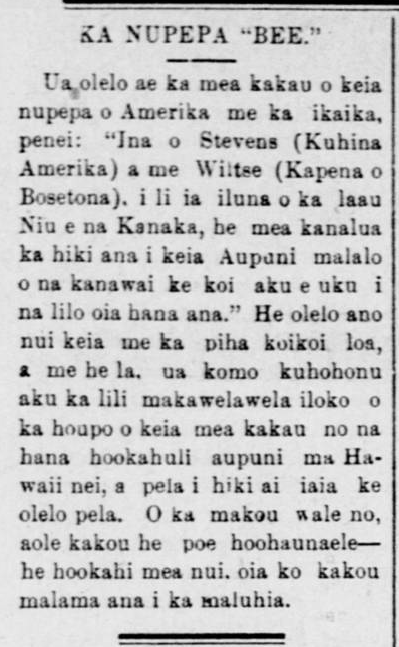
The Newspaper, “The Bee.”
The writer of this American newspaper strongly stated, “Should Stevens (American Consul) and Wiltse (Captain of the Boston), be hanged from a Coconut tree by the Hawaiians, it is not clear if this Nation can lawfully demand payment for the damages of that action.” This is a great statement full of importance, and it would appear as if extreme anger has entered deep into the heart has taken seat deep in the heart of the writer pertaining to the overthrow of the nation here in Hawaii nei, and that is the reason he is able to speak in that way. As for us, we are not a people of rioters–there is one important thing, that is our maintaining the peace.
[Has anyone seen the article being referred to here?]
(Hawaii Holomua, 2/24/1893, p. 3)
The sum of the people’s money spent to build Aliiolani Hale as well as for purchasing parcels of land for its foundation, reached $135,000! The losses from the Hawaiian Hotel and its foundation was $116,000. But if the two sums of money were added together, it would not be close to the expenses for the building of the new palace, which is known to be much greater than $300,000. We believe that there was fraud and unfair practices that went into the building of this new palace.
We would like our solon and the magi of this legislative session to properly investigate where the people’s money was spent aimlessly in this endeavor.
(Ko Hawaii Pae Aina, 5/6/1882, p. 2)

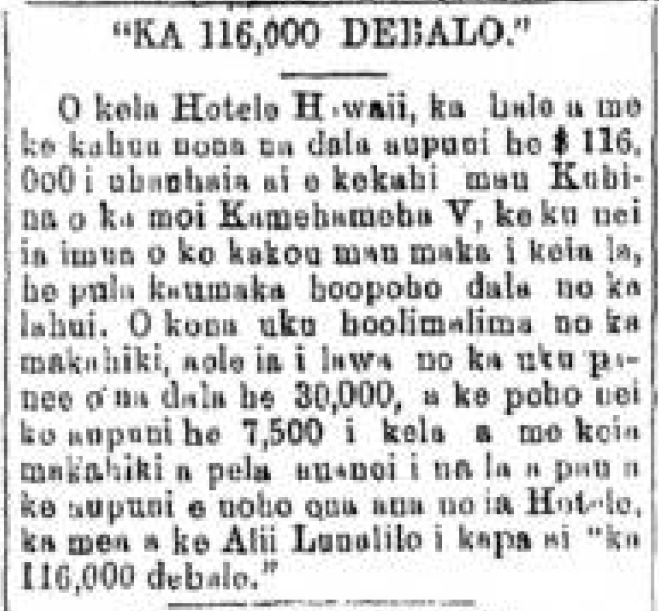
“The 116,000 Devil”
That Hawaiian Hotel, the building and grounds, which costed the government $116,000 which was squandered by a number of Ministers of King Kamehameha V. It stands in front of our eyes this day, a reminder of wasted money of the lahui. Its lease for the year is not enough to cover the interest of 30,000, and the government is losing 7,500 every year, and so forth everyday that the government remains the owner of the hotel which Chief Lunalilo has called, “the 116,000 devil.”
(Ko Hawaii Pae Aina, 5/6/1882, p. 2)
 nupepa