Thoughts for the upcoming Kamehameha Day, 1920.

THEY ARE TRUE HAWAIIANS BUT THEY CANNOT SING HAWAIIAN SONGS.

Mr. Editor of the Kuokoa Newspaper, Aloha oe:—Maybe at 3 o’clock or so in the morning of Friday, June 11, 1920, that being the birthday of the Nation Conqueror Kamehameha, there came to my home some singing boys, and this was something; it was a familiar thing where on holidays this and that person came around singing at houses lived in by Hawaiians.

Before the singers came, I got the idea that since these singers were coming to my home, I would get up and listen to the singing outside on the lanai like I was accustomed to in past years; it was not long before I heard strains of a guitar, and the singing started, but it was from my bedroom that I was listening. Continue reading

A mele ipo for Edward Abnel Keliiahonui Piikoi by King Kalakaua, 1871.

He ipo na Abenela Keliiahonui Piikoi.

Sweet Leda Lani ke Ala.

Aia la i Kemamo,
Kuu wai kihene lehua,
Wai auau a ka wahine,
No Ledalani ke ala.

Aia ilaila kuu liko,
Aia ilaila ka lehua,
Puia nae he moani,
Sweet Ledalani ke ala.

Ua like ka welona a ka la,
Ka mania i ka ili kai,
Me ka poli nahenahe o ka ipo,
O Ledalani, ke ala.

Aia ilaila kuu liko,
Aia ilaila ka halia,
Puia nae he moani,
Sweet Leda lani, ke ala. Continue reading

Opelu beaching?? 1865.

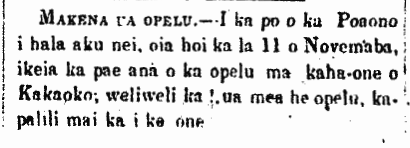
A Great Many Opelu.—At night on this past Saturday, that being the 11th of November, opelu were seen coming upon the sandy shore of Kakaako [? Kakaoko]; it was horrific! the opelu were flopping on the sand.

[I cannot recall this happening during modern times. Anyone ever see this happening?]

(Kuokoa, 11/18/1865, p. 2)

Kuokoa_11_18_1865_2.png

Ka Nupepa Kuokoa, Buke IV, Helu 46, Aoao 2. Novemaba 18, 1865.

Mele for Niihau by Mrs. Kipola Huluaulani, 1942.

Hanohano Niihau

1—Hanohano Niihau kuu aina,
Haaheo i ka maka a o kaopua.

2—He pua lei au na Kahelelani,
Milimili na ka la welo i Lehua.

3—Ilihia i ka nani o ka aina,
I ka loku a e ka ua Naulu.

4—Hoi no e pili me ke aloha,
Na makani kaulana o ka aina.

5—E ola e ka wehi o ka aina,
I ka mana kahikolu malamalama.

6—Haina kapuana i lohe ia,
Hanohano Niihau kuu aina.

(Hakuia e Mrs. Kipola Huluaulani.)

[Glorious is Niihau.

1—My dear island Niihau is glorious,
Proud in the face of the cloud banks.
2—I am a flower lei of Kahelelani,
A precious one of the sun setting at Lehua.
3—Awestruck by the beauty of the land,
In the torrents of the Naulu rain.
4—Returning to be with the beloved,
The famed winds of the land.
5—Long live the adornments of the land,
In the shining power of the trinity.
6—Let the refrain be told that it be heard,
My dear island Niihau is glorious.

(Composed by Mrs. Kipola Huluaulani.)]

(Hoku o Hawaii, 5/20/1942, p. 1)

HokuoHawaii_5_20_1942_1

Ka Hoku o Hawaii, Volume XXXVII, Number 4, Aoao 1. Mei 20, 1942.

Mother’s Day, 1940.

Ka La O Na Makuahine

This past Sunday was the day for mothers, and it was a day that children remember their mothers. People wear red and white flowers. The white flowers represent mothers who have gone to the other world, and red flowers are for mothers who are here living.

On that day we recognize, the people whose mothers are living and also those whose mothers have died. Continue reading

Conclusion of Piilani’s Story, 1917.

The Story of Piilani

(Continued from last week.)

The next day they moved up the valley and found a place where it was good to stay as there was plenty of water and lots of wild bananas. On that day they heard for the first time the cannon roar and they saw shells strike their old hiding place. They found lots of shrimps and oopu in the river and also some wild taro. During all this time Piilani stood guard half of the time. About a week later the shooting stopped. They stayed in this place about one month and then moved further makai, where there was some kalo patches, lots of fruit and more fish and opae in the river and they stayed around there for nearly two years and often saw their friends, but their friends did not see them.

Always hiding in daytime and foraging in the night, nobody knew what had become of them, some thought they had been killed or were dead from hunger, thirst and exposure.

One day as Piilani was pulling some taro she heard some noise as from a man coming. She crawled up on a high place and saw Willie Kinney coming together with Kelau and George Titcomb. She ran back to where Koolau was hidden and told him. Koolau and family went into hiding further back in the valley, but when they saw who it was they came out and shook hands with them and had a long talk with them, and when they left Kinney told Koolau that he might shoot any bipi that he needed, however, Koolau never killed any of Kinney’s cattle.

A few days after Kinney’s visit Kelau and his wife brought some more clothes for them Continue reading

Continuation of Piilani’s story, 1916.

The Story of Piilani

(Continued from last week.)

Several days later they got the news that Mr. Stolz and some policemen all armed with revolvers and guns had arrived to get the lepers and particularly to capture Koolau. When Koolau heard this he said: “It may be their idea, but the man who tries to do that will do so at the peril of his life.”

This word was brought to Stolz, and he sent the word back that Koolau would repent it if he refused to obey the orders of the authorities. Koolau took his gun, kissed it and held it to his breast and talked to the gun as if it was a friend and charged it to stand by him and shoot straight, and from that time Koolau kept guard and shortly afterwards they saw a ten being put up on the beach, and he thought it was to watch him and some of his friends went down to find out for him.

One day Koolau, Piilani and the child went makai on the path by the stream, and there they found Mr. Stolz’s raincoat with some crackers in the pocket, also a blanket, and Koolau told Piilani to take these things along with her. Shortly afterwards they met Penikala, a policeman from Waimea, and Koolau asked him, where Louis Stoltz was, and Penikala said, he did not know, but thought that Louis Stoltz had gone to Hanalei. A little later they met Peter Nowlein, a policeman from Hanalei, and Nowlein told them that Louis Stoltz had gone further up the valley to catch Koolau by surprise. Koolau and family kept going till they reached Kaumeheiwa’s house and found there a lot of their friends. Koolau told them that he was in search of Louis Stoltz and if they were afraid told them to go somewhere else. Penikila was there and Koolau upbraided him for telling a falsehood and told him he ought to be shot, but told him he would forgive him, as he was after Louis Stoltz only. The most of the people went further down towards the beach. Continue reading

Piilani, the Wife of Kaluaikoolau, 1916.

The Story of Piilani

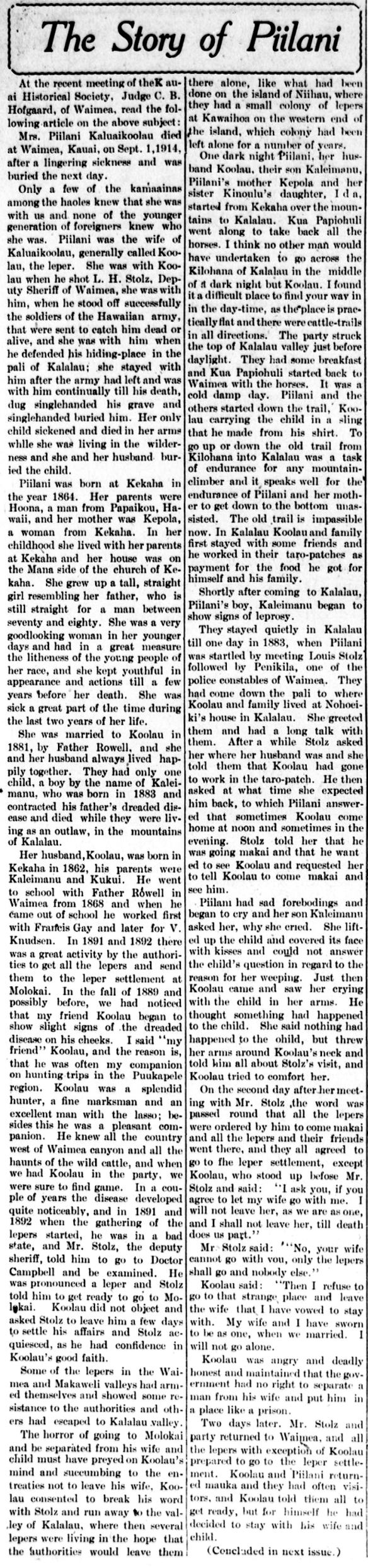
At the recent meeting of the Kauai Historical Society, Judge C. B. Hofgaard, of Waimea, read the following article on the above subject:

Mrs. Piilani Kaluaikoolau died at Waimea, Kauai, on Sept. 1, 1914, after a lingering sickness and was buried the next day.

Only a few of the kamaainas among the haoles knew that she was with us and none of the younger generation of foreigners knew who she was. Piilani was the wife of Kaluaikoolau, generally called Koolau, the leper. She was with Koolau when he shot L. H. Stolz, Deputy Sheriff of Waimea, she was with him, when he stood off successfully the soldiers of the Hawaiian army, that were sent to catch him dead or alive, and she was with him when he defended his hiding-place in the pali of Kalalau; she stayed with him after the army had left and was with him continually till his death, dug singlehanded his grave and singlehanded buried him. Her only child sickened and died in her arms while she was living in the wilderness and she and her husband buried the child.

Piilani was born at Kekaha in the year 1864. Her parents were Hoona, a man from Papaikou, Hawaii, and her mother was Kepola, a woman from Kekaha. In her childhood she lived with her parents at Kekaha and her house was on the Mana side of the church of Kekaha. She grew up a tall, straight girl resembling her father, who is still straight for a man between seventy and eighty. She was a very goodlooking woman i her younger days and had in a great measure the litheness of the young people of her race, and she kept youthful in appearance and actions till a few years before her death. She was sick a great part of the time during the last two years of her life.

She was married to Koolau in 1881, by Father Rowell, and she and her husband always lived happily together. They had only one child, a boy by the name of Kaleimanu, who was born in 1883 and contracted his father’s dreaded disease and died while they were living as an outlaw, in the mountains of Kalalau.

Her husband, Koolau, was born in Kekaha in 1862, his parents were Kaleimanu and Kukui. He went to school with Father Rowell in Waimea from 1868 and when he came out of school he worked first with Francis Gay and later for V. Knudsen. In 1891 and 1893 there was a great activity by the authorities to get all the lepers and send them to the leper settlement at Molokai. In the fall of 1889 and possibly before, we had noticed that my friend Koolau began to show slight signs of the dreaded disease on his cheeks. I said “my friend” Koolau, and the reason is, that he was often my companion on hunting trips in the Puukapele region. Koolau was a splendid hunter, a fine marksman and an excellent man with the lasso; besides this he was a pleasant companion. He knew all the country west of Waimea canyon and all the haunts of the wild cattle, and when we had Koolau in the party, we were sure to find game. In a couple of years the disease developed quite noticeably, and in 1891 and 1892 when the gathering of the lepers started, he was in a bad state, and Mr. Stolz, the deputy sheriff, told him to go to Doctor Campbell and be examined. He was pronounced a leper and Stolz told him to get ready to go to Molokai. Koolau did not object and asked Stolz to leave him a few days to settle his affairs and Stolz acquiesced, as he had confidence in Koolau’s good faith.

Some of the lepers in the Waimea and Makaweli valleys had armed themselves and showed some resistance to the authorities and others had escaped to Kalalau valley.

The horror of going to Molokai and be separated from his wife and child must have preyed on Koolau’s mind and succumbing to the entreaties not to leave his wife, Koolau consented to break his word with Sotlz and run away to the valley of Kalalau, where then several lepers were living in the hope that the authorities would leave them there alone, like what had been done on the island of Niihau, where they had a small colony of lepers at Kawaihoa on the western end of the island, which colony had been left alone for a number of years.

One dark night Piilani, her husband Koolau, their son Kaleimanu, Piilani’s mother Kepola and her sister Kinoulu’s daughter, Ida, started from Kekaha over the mountains to Kalalau. Kua Papiohuli went along to take back all the horses. I think no other man would have undertaken to go across the Kilohana of Kalalau in the middle of a dark night but Koolau. I found it a difficult place to find your way in in the day-time, as the place is practically flat and there were cattle-trails in all directions. The party struck the top of Kalalau valley just before daylight. They had some breakfast and Kua Papiohuli started back to Waimea with horses. It was a cold damp day. Piilani and the others started down the trail, Koolau carrying the child in a sling that he made from his shirt. To go up or down the old trail from Kilohana into Kalalau was a task of endurance for any mountain-climber and it speaks well for the endurance of Piilani and her mother to get down to the bottom unassisted. The old trail is impassible now. In Kalalau Koolau and family first stayed with some friends and he worked in their taro-patches as payment for the food he got for himself and his family.

Shortly after coming to Kalalau, Piilani’s boy, Kaleimanu began to show signs of leprosy.

They stayed quietly in Kalalau till one day in 1883, when Piilani was startled by meeting Louis Sotlz followed by Penikila, one of the police constables of Waimea. They had come down the pali to where Kolau and family lived at Nohoeiki’s house in Kalalau. She greeted them and had a long talk with them. After a while Stolz asked her where her husband was and she told them that Koolau had gone to work in the taro-patch. He then asked at what time she expected him back, to which Piilani answered that sometimes Koolau come home at noon and sometimes in the evening. Stolz told her that he was going makai and that he wanted to see Koolau and requested her to tell Koolau to come makai and see him.

Piilani had sad forebodings and began to cry and her son Kaleimanu asked her, why she cried. She lifted up the child and covered its face with kisses and could not answer the child’s question in regard to the reason for her weeping. Just then Koolau came and saw her crying with the child in her arms. He thought something had happened to the child. She said nothing had happened to the child, but threw her arms around Koolau’s neck and told him all about Stolz’s visit, and Koolau tried to comfort her.

On the second day after her meeting with Mr. Stolz the word was passed round that all the lepers were ordered by him to come makai and all the lepers and their friends went there, and they all agreed to go to the leper settlement, except Koolau, who stoo up before Mr. Stolz and said: “I ask you, if you agree to let my wife go with me. I will not leave her, as we are as one, and I shall not leave her, till death does us part.”

Mr. Stolz said: “No, your wife cannot go with you, only the lepers shall go  and nobody else.”

Koolau said: “Then I refuse to go to that strange place and leave the wife that I have vowed to stay with. My wife and I have sworn to be as one, when we married. I will not go alone.

Koolau was angry and deadly honest and maintained that the government had no right to separate a man from his wife and put him in a place like a prison.

Two days later, Mr. Stolz and party returned to Waimea, and all the lepers with exception of Koolau prepared to go to the leper settlement. Koolau and Piilani returned mauka and they had often visitors, and Koolau told them all to get ready, but for himself he had decided to stay with his wife and child.

(Concluded in next issue.)

(Garden Island, 12/19/1916, p. 6)

GardenIsland_12_19_1916_6.png

The Garden Island, Volume 12, Number 51, Page 6. December 19, 1916.

For you mele people, another composition by Joseph W. K. Kapololu, 1919.

HAUPU SONG.

Ka luna au i Haupu,
Akahi no a upu ka manao,
A e lawe no au a lilo,
Lawe no au a lilo oe na’u.

Mahalo aku au o ka nani,
O ka nalu ha’i mai a o Maliu,
E maliu mai oe e ke aloha,
Ka iini a ka puuwai.

Huli mai oe e pili me a’u,
Pili kaua hemo ole oe,
Ua pilipaa i ka puuwai,
I ka pana holu i ka lihilihi. Continue reading

May Day in Hilo Town, 1942.

Pertaining to Lei Day

Put on by the Hawaiian Civic Club

The main things on the schedule for Lei Day this year were explained by Wilfred K. Hussey, the president of the Hawaiian Civic Club [kalapu Kiwila Hawaii].

The schedule is being planned out by the committee selected for that work, and chaired by Clifford H. Bowman and assisted by Peter Mehau, Charles Murray, Ernest Fernandez, Johnson Kahili and Charles Auld. Continue reading