The Claudine leaves for San Francisco, 1893.

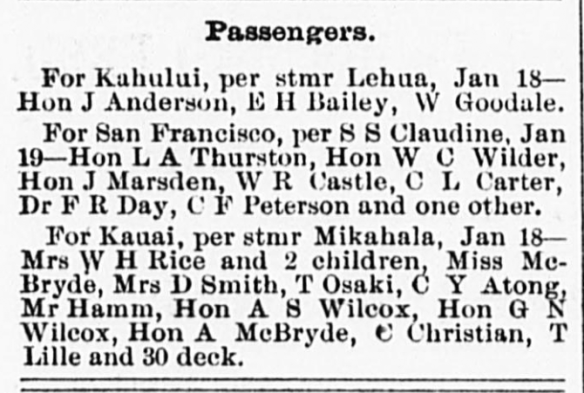
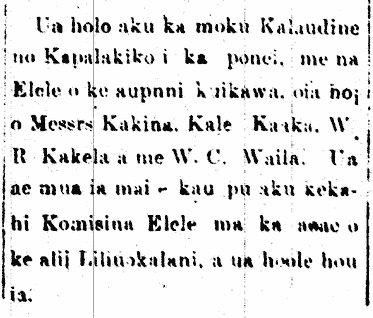
The ship Claudine [Kalaudine] left for San Francisco last night, with the Representatives of the provisional government, they being Messrs Thurston [Kakina], Charles Clark [Kale Kaaka], W. R. Castle [W. R. Kakela], and W. C. Wilder [W. C. Waila]. The Representing Commissioner for the side of the alii Liliuokalani was previously given permission to go along, but  he was denied once again.

(Leo o ka Lahui, 1/19/1893, p. 2)

LOKL_1_19_1893_2

Ka Leo o ka Lahui, Buke II, Helu 625, Aoao 2. Ianuari 19, 1893.

Hawaii Holomua, January 18, 1893.

ALOHA

Liliuokalanionamoku.

THE POWER OF THE GOVERNMENT HAS BEEN USURPED!

The Protest Proclamation of the Queen!

“My dear homeland,
It is for thee that I sing.”¹

This past Tuesday, the 17th of January, 1893, will seemingly be notorious forever in our land of birth, for it is the day that a new Nation in the form of a provisional government under thirteen haole was proclaimed.

GUARDS POSTED.

On Monday night, was when many places in town were put under the watch of armed soldiers from the American warship Boston, and on the following Tuesday morning, they were seen going around, and the members of the Honolulu Rifles began to join in and surrounded several places with their weapons, and the appearance of town was terrifying.

NEWS OF THE OVERTHROW.

In the early morning, the rumor was spread on the sides of the streets of town, saying that there is craving to overthrow the kingdom and to make a new government. This news flew on the tips of the winds and reached the countryside, and because of that, the citizens of the Queen gathered in great numbers in the streets, and the greatest number was in the groups in and outside of the Palace Grounds; and right outside Kalakaua Hale there were thousands of people standing and waiting, prepared for orders, should there be orders.

DISCUSSION

At this time, the people were in a state of astonishment, going around the sides of the streets and standing here and there in crowds, discussing and responding. This conditions continue while the peaceful state is preserved, except for the seeing of the soldiers with their guns.

GUN FIRE.

But between the hours of 2 and 3 in the afternoon, the people were shocked at the news spread that Leialoha, an government police officer, was shot and and hit by a haole, while he was carrying out his duties under the power of the law of the land. A disturbance soon started, and it was feared that there would be a riot, but as is our usual nature, we were patient, and held back our ire.

In a short time, Leialoha arrived at the Station [Halewai] held on this side and that with helping  hands, and it was realized that he had actually been shot right in front of his chest below the joint of the collarbone. Immediately he was transported to the Queen’s Hospital.

HIS CONDITION. Continue reading

More on the landing of the Boston, 1893.

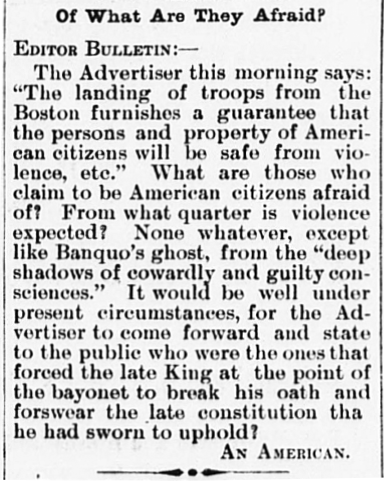
Of What Are They Afraid?

Editor Bulletin:—

The Advertiser this morning says: “The landing of the troops from the Boston furnishes a guarantee that the persons and property of American citizens will be safe from violence, etc.” What are those who claim to be American citizens afraid of? From what quarter is violence expected? None whatever, except like Banquo’s ghost,¹ from the “deep shadows of cowardly and guilty consciences.” It would be well under present circumstances, for the Advertiser to come forward and state to the public who were the ones that forced the late King at the point of the bayonet to break his oath and forswear the late constitution that he had sworn to uphold?

An American.

¹Reference to Shakespeare’s Macbeth.

(Daily Bulletin, 1/17/1893, p. 3)

DailyBulletin_1_17_1893_3

The Daily Bulletin, Volume V, Number 626, Page 3. January 17, 1893.


Invasion, 1893.

The American Troops Landed.

Without knowledge of the Government, and with agreement from the American Minister [Stevens] not to land the troops from the warship while the Government is prepared to keep peace; the American Minister nonetheless ordered the troops of the Boston to be  put in service. This would appear as if it is an attack, and should the government [provisional government] listen to the truth of these actions by its official, this will be something that it will condemn.

(Leo o ka Lahui, 1/17/1893, p. 2)

LeookaLahui_1_17_1893_2

Ka Leo o ka Lahui, Buke II, Helu 624, Aoao 2. Ianuari 17, 1893.

For all of you hula people, 1865.

[Found under: “Na mea hou o Maui Hikina.”]

The Ku-i.

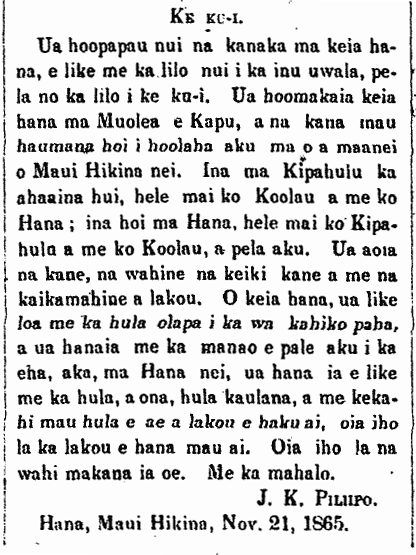
All the people are doing it, just as they are totally caught up in drinking [fermented] sweet potato, so too are they engrossed in the ku-i. This activity began at Muolea by Kapu, and it was his students who spread it all over here in East Maui. If there is a party in Kipahulu, the people from Koolau and from Hana come; if it is in Hana, people from Kipahulu and from Koolau come, and so forth. Their husbands, wives, sons and daughters are taught. This is perhaps very similar to the hula olapa in the olden days, and they are done believing it will ward off pain, but here in Hana, it is done like hula, the famous hula as well as some hula that they composed themselves, and that is what they are constantly doing. Those are my gifts to you. [That being the reporting of this story as well as the other stories that preceded it.] With thanks.

J. K. Pilipo.

Hana, East Maui, Nov. 21, 1865.

(Kuokoa, 12/9/1865, p. 3)

Kuokoa_12_9_1865_3

Ka Nupepa Kuokoa, Buke IV, Helu 49, Aoao 3. Dekemaba 9, 1865.

Duke, the true sportsman! 1916.

WIN OR LOSE KAHANAMOKU WEARS SMILE

Duke Kahanamoku, Greatest of Swimmers.

“The biggest thing in sport? It is the heart to accept defeat gracefully.”

The Duke Kahanamoku, greatest of swimmers, has just been beaten, together with his teammates, in the grueling 300-yard exposition relay swim at San Francisco by the Illinois Athletic club.

His smile and unstinted praise for the victors gave his words a personal application. “The duke” knows how to lose as well as to win. Continue reading

Ka Puuhonua o na Hawaii, 1916.

NEW HAWAIIAN WEEKLY, KA PUUHONUA, IS OUT

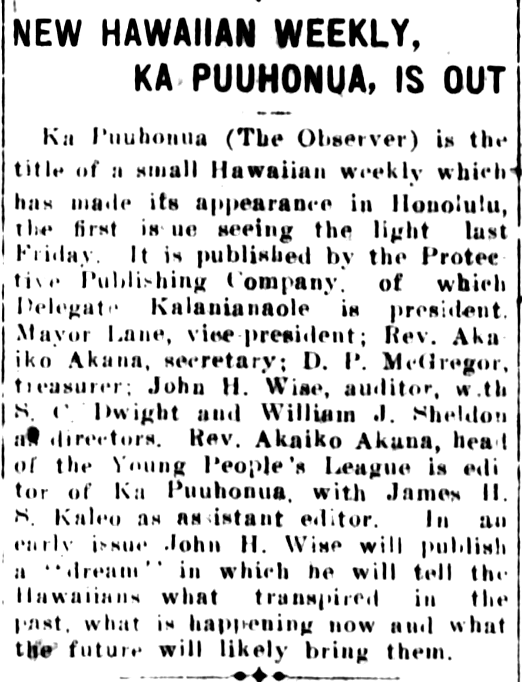
Ka Puuhonua (The Observer) is the title of a small Hawaiian weekly which has made its appearance in Honolulu, the first issue seeing the light last Friday. It is published by the Protective Publishing Company, of which Delegate Kalanianaole is president. Mayor Lane, vice president; Rev. Akaiko Akana, secretary; D. P. McGregor, treasurer; John H. Wise, auditor, with S. C. Dwight and William J. Sheldon as directors. Rev. Akaiko Akana, head of the Young People’s League is editor of Ka Puuhonua with James H. S. Kaleo as assistant editor. In an early issue John H. Wise will publish a “dream” in which he will tell the Hawaiians what transpired in the past, what is happening now and what the future will likely bring them.

(Hawaiian Gazette, 4/14/1916, p. 5)

NEW HAWAIIAN WEEKLY, KA PUUHONUA, IS OUT

The Hawaiian Gazette, Volume IX, Number 29, Page 5. April 14, 1916.

“Ko Hawaii Ponoi” begins, 1873.

“KO HAWAII PONOI.”

The first issue of a new Hawaiian-language newspaper named above, will appear on Wednesday, June 4, 1873. In this new newspaper, taken up will be things pertaining to prosperity, the progress of independence, and the safety of our lahui, the land, and the nation of King Lunalilo. Two Dollars for a single subscription per year, paid in advance.  BLACK & AULD, Publishers.

Honolulu, May 23, 1873

[The Hawaiian-Language Newspaper, Ko Hawaii Ponoi, was a weekly that actually began a couple of weeks later on 6/18/1873 and ran until 6/10/1874.]

(Kuokoa, 5/24/1873, p. 3)

"KO HAWAII PONOI."

Ka Nupepa Kuokoa, Buke XII, Helu 21, Aoao 3. Mei 24, 1873.

Mele for the Princess Likelike, the new governor of Hawaii Island, 1879.

[Found under: “Ka Huakai Kaapuni a ke Kiaaina Hou o Hawaii: ka Huakai ma Waimea, Hawaii.]

Leo, Boat Song.

1 Aloha Likelike
Ke Kiaaina hou,
Ke pani no S. Kipi,
Nona ke kanikau,
Mahalo ia oia;
Mai Hilo a Kau,
A hiki i Kohala,
Me Hamakua pu.

2 Aloha Likelike
Pomaikai no kakou;
Ua nana i kou maka,
Mahalo piha no:
E komo oli oe,
A hui me makou,
Ke pa’ipa’i nei na lima,
A oli na naau.

3 Ka ke Akua olele,
Oia kou panana,
A oia kou Palama,
A oia no kou La;
E ola e! E ola!
Ke Kiaaina hou;
E ke ‘Lii Likelike
E ola mau loa no.

[Melody, Boat Song.

Aloha Likelike
The new governor,
The replacement for S. Kipi,
Who is mourned for,
She is admired;
From Hilo to Kau,
Until Kohala,
Along with Hamakua.

Aloha Likelike
We are blessed;
We look at your visage,
Full of gratitude:
You come with joy,
And meet with us,
Our hands applaud,
And our hearts are happy.

The word of God,
Is your compass,
And it is your protection
It is your Sun;
Live! Live!
The new Governor;
O Alii Likelike
Long may you live.]

(Ko Hawaii Paeaina, 6/14/1879, p. 4)

Leo, Boat Song.

Ko Hawaii Pae Aina, Buke II, Helu 24, Aoao 4. Iune 14, 1879.