Sanford B. Dole, the Congregationalists, and Annexation, 1902.

THE HAWAIIAN SITUATION.

On Monday evening, April 28 last, Governor Dole was the guest of the Congregational Club of Boston. Elsewhere in this issue will be found a sketch made by Dole of the Hawaiian situation. It is characteristic of the man. Having the full support of the Administration behind him he is not afraid to say in public what he has been thinking in private for many long years. Let us see and take up his points one by one.

Point No. 1.—”The monarchy was overthrown and annexation was accomplished for the sake of good government for the islands; that is, for their benefit.”—It is true! Annexation was accomplished, by a handful of Congregationalists because the reciprocity treaty between the United States and Hawaii was in imminent danger of being abrogated. The monarchy was overthrown, so as to save the $40 per ton duty on sugar. It was then as it is now for the Congregationalists:—Money before principle.

Point No. 2:—”We have given you everything we have by being annexed.”—That is, Sanford B. Dole, and his Congregationalist friends have given to the United States that which did not belong to them. With the help of an American cruiser, American marines and an American Minister, they have robbed the native Hawaiians of their country so as to enable a few Congregationalist planters to keep up receiving big dividends from their sugar stocks which would have been materially cut down had a $40 duty been imposed upon each ton of sugar. The Springfield Republican adds the following comment to Point No. 2: “But the second point that they have given us all they have is not at all consistent with his first point that they sought Annexation for the benefit of the Islands, and it shows that they are still trying to work the United States for the benefit of the Hawaiians.” Continue reading

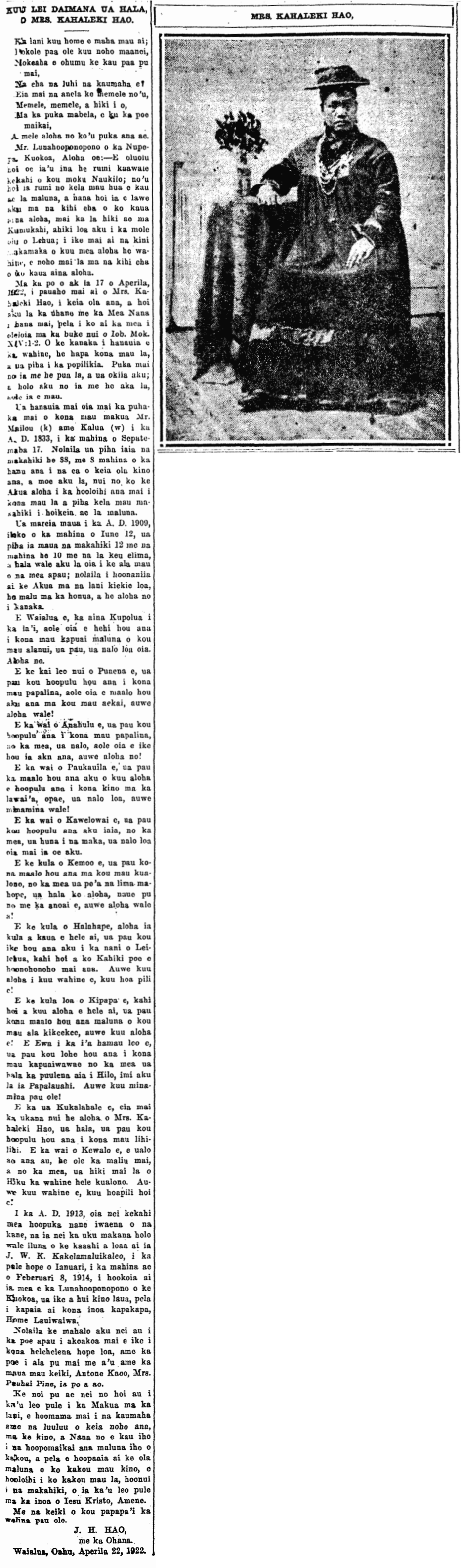
Mrs. Kahaleki Hao, Nane-ist, is no more, 1922.

MY LEI OF DIAMONDS, MRS. KAHALEKI HAO, HAS GONE.

Ka lani kuu home e maha mau ai;
Pokole paa ole kuu noho maanei,
Nokeaha e ohumu ke kau paa pu mai,
Na eha na luhi na kaumaha e?
Eia mai na anela ke memele no’u
Memele, memele, a hiki i o,
Ma ka puka mabela, e ku ka poe maikai,
A mele aloha no ko’u puka ana ae.¹

Mr. Editor, Aloha oe:—Please should there be space on your ship the Nautilus,² allow me space for the words placed above, and may the ship take them to the four corners of our beloved land, from the rising sun at Kumukahi all the way to the pleasant base of Lehua; so that the many friends of my beloved wife, who live across the four corner of our aina aloha may know.

On the night of the 17th of April, 1922, Mrs. Kahaleki Hao grew weary of this life, and her soul returned to the One who made it, and fulfilled was the words in Job XIV:1–2. O ke kanaka i hanauia e ka wahine, he hapa kona mau la, a ua piha i ka popilikia. Puka mai no ia me he pua la, a ua okiia aku; a holo aku no ia me he aka la, aole ia e mau.

She was born from the loins of her parents Mr. Mailou (m) and Kalua (f) in 1833, in the month of September 17. Therefore, it was after 88 years and 8 months of breathing the air of this worldly life that she took her sleep; God’s love was great indeed in extending her days for that many years mentioned above.

We were wed in 1909, in the month of June 12, and we were married for 12 years and 10 months and a number of days when she left on that path all must take; and so blessed be God in the high heavens, peace on earth, goodwill toward men.

O Waialua, land fragrant in the calm, her feet will no more tread upon your pathways, no more, she is gone. Aloha no.

O Roaring sea of Puaena, no more will you moisten her cheeks, she will no longer pass along your shores, auwe aloha wale!

O Waters of Anahulu, no more will you moisten her cheeks, for she has gone, and she will not be seen again, auwe aloha ino!

O Waters of Paukauila, my beloved will never again pass by to moisten her body fishing for opae, she has gone forever, auwe, how very regrettable!

O Waters of Kawelowai, you will no more moisten her, for her face is now hidden and she is lost to you forever.

O Plains of Kemoo, she will no more pass by your ridges, for her hands are crossed behind her back, my beloved has gone, she moved along with acknowledgement, auwe, so much aloha!

O Plains of Halahape, aloha to those plains that we traveled; you will no longer see the beauty of Leilehua, where the people of foreign lands are stationed. Auwe my aloha for my dear wife, my close companion!

O Wide expanse of Kipapa, where my beloved went; she will pass no more upon your meandering roads; auwe my love! O Ewa of the fish requiring silence, you will no more hear her footsteps, for the Puulena wind has gone off to Hilo in search of Papalauahi. Auwe for my endless regret!

O Kukalahale rain, here is important news of love, Mrs. Kahaleki Hao has gone; you will no more moisten her lashes. O Waters of Kewalo, I call out without being heard, for Hiku, the woman who travels on the ridges has arrived. Auwe, my wife, my close companion!

In the year 1913, she was one of those who published nane alongside the men, and it was she who sponsored the prize which traveled on the steam engine in the last week of January, and was caught by J. W. K. Kakelamaluikaleo the next month, on February 8, 1914; this was conducted by the Editor of the Kuokoa, and they met face to face, and that is why she is called by the pen name, Home Lauiwaiwa.

And so I give my appreciation to all those who gathered to see her last countenance, and those who stayed up with me and my children Antone Kaoo, Mrs. Puahai Pine, that night and day.

I also beseech in my prayer to the Father in heaven to lighten the burdens and sadnesses of this life in body, and it is He who will give blessings upon us, and and such gives life to our bodies, extending our days, and prolonging our years; that is my prayer in the name of Jesus Christ, Amen.

My endless regards to the boys of your press.

J. H. HAO,

and Family.

Waialua, Oahu, April 22, 1922.

[You will never know what you can find in death announcements. The mention of Kahaleiki Hao being a woman nane artist associated with the identity “Home Lauiwaiwa” was an exciting find. Most of the riddles in the newspapers were signed with pen names, and only a few of their actual identities are known today.]

¹Number 585, “My home is in heaven, my rest is not here.” Found in Lyons, Lorenzo, ed. Buke Himeni Hawaii. New York: Ko Amerika Ahahui Teraka, 1872.

²From the time Jules Verne’s “Twenty Thousand Leagues Under the Sea” was translated into Hawaiian and published in the Kuokoa (12/18/1875–3/30/1878), various motifs from the story were incorporated in Hawaiian writing.

(Kuokoa, 4/28/1922, p. 3)

KUU LEI DAIMANA UA HALA, O MRS. KAHALEKI HAO.

Ka Nupepa Kuokoa, Buke LXI, Helu 17, Aoao 3. Aperila 28, 1922.

A sweet mele for Home Lihau Pua, 1914.

HE WEHI KEIA NO LIHAU PUA.

1.—He pua nani oe i poniia,
I kila paaia me ka makua mana loa,
I lei i wehi no kuu kino,
A he hiwahiwa hoi na kuu aloha.

Hui.

He nani wale o Home Lihau pua,
I ka holu nape mai a ka lau o ka niu,
Ilaila i hoohihi ai ka manao,
I kuu home aloha i ka wehi o na pua.

2.—Onaona wale hoi pua Pikake,
He moani aala ke hiki mai,
He ala huihui ke honi aku,
A he mea mau ia no Lihau pua.

3.—He u’i he nani wale o Home Lihau pua,
I walea i ka olu a Home Lihau pua,
I ke kaomi malie a ke kehau,
Ilaila maua ike iho ai,
Ka owe hone mai a ka leo o ke kai.

4.—Nawai e ole ko’u hoohihi,
A he pua mai oe no ka wekiu,
Ua kinikohu ia kou aloha,
I lei hooheno no kuu kino.

5.—He aloha e ka leo o kuu aloha,
I ka pane ana mai me ka nahenahe,
E nonoi nui aku i ke Akua,
Aia ilaila kou palekana.

6.—Kau aku ka manao no ka nu hauoli,
Ka makua mana loa ko’u kokua ia,
Ka hokuloa hoi ko’u kiai mau,
A puka i ka ao malamalama.

7.—Haina ka puana i loheia mai,
No Lihau pua keia hooheno,
Ua hilo paa ia ko’u aloha,
I kuu home aloha i ka wehi o na pua.

Hakuia e Mrs. Kaehanui,

Kalaupapa, Molokai, Ianuari 21, 1914.

[Does anyone know where Home Lihau Pua is? Might it be someone’s home in Kalaupapa itself, or a home that Mrs. Kaehanui left to go to Kalaupapa?]

(Kuokoa, 2/13/1914, p. 5)

HE WEHI KEIA NO LIHAU PUA.

Ka Nupepa Kuokoa, Buke LII, Helu 7, Aoao 5. Feberuari 13, 1914.

Republican candidates for Maui, 1904.

REPUBLICAN TICKET ON MAUI ISLE

HON. PHILIP PALI OF LAHAINA.

MOSES K. NAKUINA OF MOLOKAI.

W. J. COELHO OF WAILUKU.

GEORGE COPP.

A. N. HAYSELDEN, NOMINEE FOR SENATOR.

HON. W. P. HAIA OF HANA.

JOHN KALINO OF HAMAKUAPOKO.

(Hawaiian Gazette, 9/23/1904, p. 5)

REPUBLICAN TICKET ON MAUI ISLE

Hawaiian Gazette, Volume XXXIX, Number 77, Page 5. September 23, 1904.

Great historian Samuel Manaiakalani Kamakau dies, 1876.

Hon. S. M. Kamakau has gone!

With sadness we announce the somber news before our friends this morning, of the passing of the spirit of the Hon. S. M. Kamakau at his home, leaving behind his earthly body. He died at 2 in the afternoon this past Tuesday [September 5th] at his home in Kahehuna. This famous Hawaiian was born in Ewa, at Mokuleia, Waialua, on Oahu, on the 29th of October, 1815. His father was Kapakanaka, the child of Kuhemu, the child of Haupu. His mother was Kaaoaoakahaiaka, daughter of Leihulu and Kaonohiakala. He wed his wife, S. Hai, who is grieving, at the sheltering breadfruit of Lele, Lahaina, on the 24th of November, 1844. During their days together living quietly, they had seven children, four who died and three still living. He was known by the lahui as one who kept the genealogies of the alii of Hawaii nei, and the history of this archipelago, and with his death, it is like Hawaii has been dealt with a great loss of an adviser in such things, being that it was as if he was the only one who reached such a rank.

He was a man that was proficient in governmental duties, he was employed in that capacity often, and he was a Representative for many sessions until he died, he being a Representative for this district. His name was famous in the newspapers with his thoughts on the history of the alii, and mostly for the history of Kamehameha I, and we believe that his death is a disaster for Hawaii. He was a man who thought much of the Bible, he was pious and lived righteously. He joined the Catholic faith recently because of his opposition to some things, however, he was devout in the word of God. He was 61 years old and 10 months. Yesterday, his earthly body was carried to its final home and there was a grand and stately funeral to be remembered hereafter. How sad!

(Lahui Hawaii, 9/7/1876, p. 2)

Hon. S. M. Kamakau, ua hala!

Ka Lahui Hawaii, Buke II, Helu 37, Aoao 2. Sepatemaba 7, 1876.

Inter-island airline service, 1928.

RETURNING WITH TWO PILOTS AND TWO AIRPLANES

Announcing his desire to have permanent airplanes in our islands within sixty days of him stepping once again on Hawaii nei, E. H. Lewis landed in Honolulu nei on the morning of Friday of this past week with two pilots who will fly the two planes he purchased in America.

These men brought by Lewis are experts. The planes did not arrive with Lewis, but according to him, should there be no complications, the planes will arrive in Honolulu within 60 days.

The crafts can carry ten passengers at a time, and these will be the planes that fly regularly between Honolulu and Hilo and from Hilo back to Honolulu nei.

(Alakai o Hawaii, 11/5/1928, p. 4)

HOI MAI LA ME ELUA PAILAKA ME ELUA MOKULELE

Ke Alakai o Hawaii, Buke 1, Helu 28, Aoao 4. Novemaba 5, 1928.

Kahili crafted for Governor Farrington, 1928.

FIVE KAHILI MADE FOR THE GOVERNOR

FIVE KAHILI FOR THE GOVERNOR

From the Workers Under Mokumaia

Yesterday evening, these kahili were shown in Waikiki.

The kahili will become the property of the territory.

According to Mokumaia, the workers are showing their congratulations to the governor as did the makaainana do for the alii in times past.

On May 2nd, the work on the kahili began, and it was completed on the 17th of May.

F. B. M. Kahea [Frederick Beckley Malulani Kahea] was the one who knew how to construct kahili.

J. K. Mokumaia was the great general of the chiefs.

[The beginning of the caption seems to be dropped out.] some Hawaiians are making five kahili to gift to Governor Farrington this coming 9th of June.

On the right of the picture is M. Keawe, J. Kapaiki, Mokumaia, Piko Kamahaa, Clara Kaaipua, Minnie Kakalia, Kahea, and Makekehau. The large kahili took 8,000 feathers each.

(Alakai o Hawaii, 5/24/1928, p. 1)

HANAIA ELIMA KAHILI NO KE KIAAINA.

Ke Alakai o Hawaii, Buke I, Helu 4, Aoao 1. Mei 24, 1928.

Robert Wilcox sounds off, 1898.

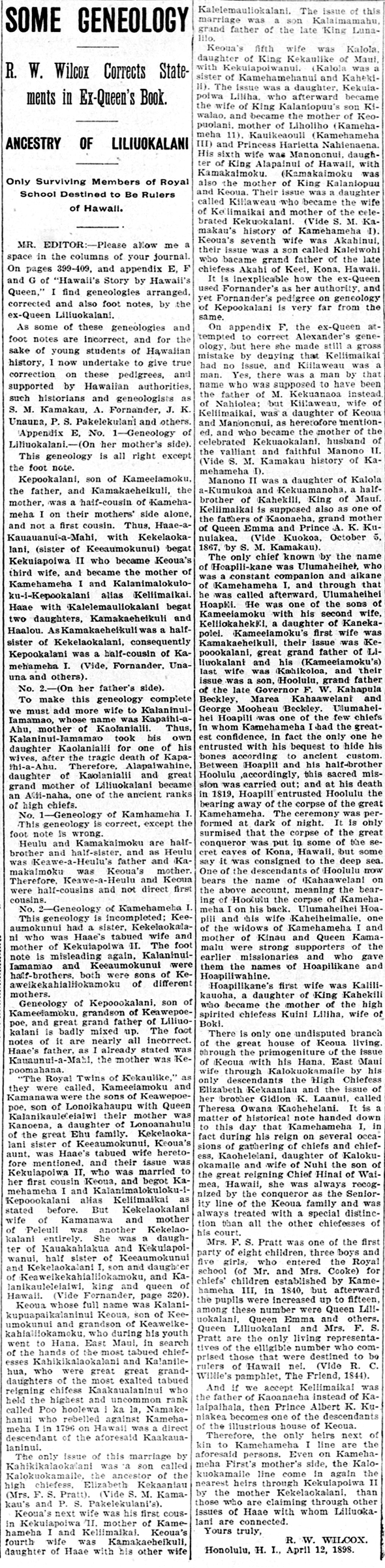
SOME GENEOLOGY

R. W. Wilcox Corrects Statements in Ex-Queen’s Book.

ANCESTRY OF LILIUOKALANI

Only Surviving Members of Royal School Destined to Be Rulers of Hawaii.

MR. EDITOR:cPlease allow me a space in the columns of your journal. On pages 399–409, and appendix E, F and G of “Hawaii’s Story by Hawaii’s Queen,” I find geneologies arranged, corrected and also foot notes, by the ex-Queen Liliuokalani

As some of these geneologies and foot notes are incorrect, and for the sake of young students of Hawaiian history, I now undertake to give true correction on these pedigrees, and supported by Hawaiian authorities, such historians and geneologists as S. M. Kamakau, A. Fornander, J. K. Unauna, P. S. Pakelekulani and others.

Appendix E, No. 1—Geneology of Liliuokalani.—(On her mother’s side).

This geneology is all right except the foot note.

Kepookalani [Kepoookalani], son of Kameeiamoku, the father, and Kamakaeheikuli, the mother, was half-cousin of Kamehameha I on their mothers’ side alone, and not a first cousin. Thus, Haae-a-Kauauanui-a-Mahi, with Kekelaokalani, (sister of Keeaumokunui) begat Kekuiapoiwa II who became Keoua’s third wife, and became the mother of Kamehameha I and Kalanimokuioku-i-Kepookalani alias Keliimaikai. Haae with Kalelemauliokalani begat two daughters, Kamakaeheikuli and Haalou. As Kamakaeheikuli was a half-sister of Kekelaokalani, consequently Kepookalani was a half-cousin of Kamehameha I. (Vide, Fornander, Unauna and others).

No. 2.—(On her father’s side).

To make this geneology complete we must add more wife to Kalaninui-Iamamao, whose name was Kapaihi-a-Ahu, mother of Kaolanialii. Thus, Kalaninui-Iamamao took his own daughter Kaolanialii for one of his wives, after the tragic death of Kapaihi-a-Ahu. Therefore, Alapaiwahine, daughter of Kaolanialii and great grand mother of Liliuokalani became an Alii-naha, one of the ancient ranks of high chiefs.

No. 1—Geneology of Kamehameha I.

This geneology is correct, except the foot note is wrong.

Heulu and Kamakaimoku are half-brother and half-sister, and as Heulu was Keawe-a-Heulu’s father and Kamakaimoku was Keoua’s mother. Therefore, Keawe-a-Heulu and Keoua were half-cousins and not direct first cousins.

No. 2—Geneology of Kamehameha I.

This geneology is incompleted; Keeaumokunui had a sister, Kekelaokalani who was Haae’s tabued wife and mother of Kekuiapoiwa II. The fott note is misleading again, Kalaninui-Iamamao and Keeaumokunui were half-brothers, both were sons of Keaweikekahialiiokamoku of different mothers.

Geneology of Kepoookalani, son of Kameeiamoku, grandson of Keawepoepoe, and great grand father of Liliuokalani is badly mixed up. The food notes of it are nearly all incorrect. Haae’s father, as I already stated was Kauaunui-a-Mahi [Kauauanui-a-Mahi], the mother was Kepoomahana.

“The Royal Twins of Kekaulike,” as they were called, Kameeiamoku and Kamanawa were the sons of Keawepoepoe, son of Lonoikahaupu with Queen Kalanikauleleiaiwi their mother was Kanoena, a daughter of Lonoanahulu of the great Ehu family. Kekelaokalani sister of Keeaumokunui, Keoua’s aunt, was Haae’s tabued wife heretofore mentioned, and their issue was Kekuiapoiwa II, who was married to her first cousin Keoua, and begot Kamehameha I and Kalanimalokuloku-i-Kepoookalani alias Keliimaikai as stated before. But Kekelaokalani wife of Kamanawa and mother of Peleuli was another Kekelaokalani entirely. She was a daughter of Kauakahiakua and Kekuiapoiwanui, half sister of Keeaumokunui and Kekelaokalani I, son and daughter of Keaweikekahialiiokamoku, and Kalanikauleleiaiwi, king and queen of Hawaii. (Vide Fornander, page 320).

Keoua whose full name was Kalanikupuapaikalaninui Keoua, son of Keeumokkunui [Keeaumokunui] and grandson of Keaweikekahialiiokamoku, who during his youth went to Hana, East Maui, in search of the hands of the most tabued chifesses of Kahikikalaokalani and Kalanilehua, who were great great grand-daughters of the most exalted tabued reigning chiefess Kaakaualaninui who held the highest and uncommon rank called Poo hoolewa i ka la, Namakehanui who rebelled against Kamehameha I in 1796 on Hawaii was a direct descendant of the aforesaid Kaakaualaninui.

The only issue of this marriage by Kahikikalaokalani was a son called Kalokuokamaile, the ancestor of the high chiefess, Elizabeth Kekaaniau (Mrs. F. S. Pratt). (Vide S. M. Kamakau’s and P. S. Pakelekulani’s).

Keoua’s next wife was his first cousin Kekuiapoiwa II, mother of Kamehameha I and Keliimaikai. Keoua’s fourth wife was Kamakaeheikuli, daughter of Haae with his other wife Kalelemauliokalani. The issue of this marriage was a son Kalaimamahu, grand father of the late King Lunalilo.

Keoua’s fifth wife was Kalola, daughter of King Kekaulike of Maui with Kekuiapoiwanui. (Kalola was a sister of Kamehamehanui and Kahekili). The issue was a daughter, Kekuiapoiwa Liliha, who afterward became the wife of King Kalaniopuu’s son Kiwalao, and became the mother of Keopuolani, mother of Liholiho (Kamehameha II), Kauikeaouli (Kamehameha III) and Princess Haarietta Nahienaena. His sixth wife was Manononui, daughter of King Alapainui of Hawaii, with Kamakaimoku. (Kamakaimoku was also the mother of King Kalaniopuu and Keoua. Their issue was a daughter called Kiilaweau who became the wife of Keliimaikai and mother of the celebrated Kekuokalani [Kekuaokalani]. (Vide S. M. Kamakau’s histor of Kamehameha I). Keoua’s seventh wife was Akahinui, their issue was a son called Kaleiwohi who became grand father of the late chiefess Akahi of Keei, Kona, Hawaii.

It is inexplicable how the ex-Queen used Fornander’s as her authority, and yet Fornander’s pedigree on geneology of Kepookalani [Kepoookalani] is very far from the same.

On appendix F, the ex-Queen attempted to correct Alexander’s geneology, but here she made still a gross mistake by denying that Keliimaikai had no issue, and Kiilaweau was a man. Yes, there was a man by that name who was supposed to have been the father of M. Kekuanaoa instead of Nahiolea; but Kiilaweau, wife of Keliimaikai, was a daughter of Keoua and Manononui, as heretofore mentioned, and who became the mother of the celebrated Kekuaokalani, husband of the valiant and faithful Manono II. (Vide S. M. Kamakau history of Kamehameha I).

Manono II was a daughter of Kalola-a-Kumukoa and Kekuamanoha, a half-brother of Kahekili, King of Maui. Keliimaikai is supposed also as one of the fathers of Kaonaeha [Kaoanaeha], grand mother of Queen Emma and Prince A. K. Kunuiakea. (Vide Kuokoa, October 5, 1867, by S. M. Kamakau).

The only chief known by the name of Hoapili-kane was Ulumaheihei, who was a constant companion and aikane of Kamehameha I, and through that he was called afterward, Ulumaheihei Hoapili. He was one of the sons of Kameeiamoku with his second wife, Keliiokahekili, a daughter of Kanekapolei. Kameeiamoku’s first wife was Kamakaeheikuli, their issue was Kepoookalani, great grand father of Liliuokalani and his (Kameeiamoku’s) last wife was Kahikoloa, and their issue was a son, Hoolulu, grand father of the late Governor F. W. Kahapula Beckley, Maraea Kahaawelani and George Mooheau Beckley. Ulumaheihei Hoapili was one of the few chiefs in whom Kamehameha I had the greatest confidence, in fact the only one he entrusted with his bequest to hide his bones according to ancient custom. Between Hoapili and his half-brother Hoolulu, accordingly, this sacred mission was carried out; and at his death in 1819, Hoapili entrusted Hoolulu the bearing away of the corpse of the great Kamehameha. The ceremony was performed at dark of night. It is only surmised that the corpse of the great conqueror was put in some of the secret caves of Kona, Hawaii, but some say it was consigned to the deep sea. One of the descendants of Hoolulu now bears the name of Kaawelani on the above account, meaning the bearing of Hoolulu the corpse of Kamehameha I on his back. Ulumaheihei Hoapili and his wife Kaheiheimalie, one of the widows of Kamehameha I and mother of Kinau and Queen Kamamalu were strong supporters of the earlier missionaries and who gave them the names of Hoapilikane and Hoapiliwahine.

Hoapilikane’s first wife was Kalilikauoha, a daughter of King Kahekili who became the mother of the high spirited chiefess Kuini Liliha, wife of Boki.

There is only one undisputed branch of the great house of Keoua living through the primogeniture of the issue of Keoua with his Hana, East Maui wife through Kalokuokamaile by his only descendants the High Chiefess Elizabeth Kekaaniau and the issue of her brother Gidion K. Laanui [Gideona K. Laanui], called Theresa Owana Kaohehelani. It is a matter of historical note handed down to this day that Kamehameha I, in fact during his reign on several occasions of gathering of chiefs and chiefess, Kaohelelani, daughter of Kalokuokamaile and wife of Nuhi the son of the great reigning Chief Hinai of Waimea, Hawaii, she was always recognized by the conqueror as the Seniority line of the Keoua family and was always treated with a special distinction than all the other chiefesses of his court.

Mrs. F. S. Pratt was one of the first party of eight children, three boys and five girls, who entered the Royal school (of Mr. and Mrs. Cooke) for chiefs’ children established by Kamehameha III, in 1840, but afterward the pupils were increased up to fifteen, among these number were Queen Liliuokalani, Queen Emma and others. Queen Liliuokalani and Mrs. F. S. Pratt are the only living representatives of the elligible number who comprised those that were destined to be rulers of Hawaii nei. (Vide R. C. Willie’s pamphlet, The Friend, 1844).

And if we accept Keliimaikai was the father of Kaoanaeha instead of Kalaipaihala, then Prince Albert K. Kuniakea [Albert K. Kunuiakea] becomes one of the descendants of the illustrious house of Keoua.

Therefore, the only heirs next of kin to Kamehameha I line are the aforesaid persons. Even on Kamehameha First’s mother’s side, the Kalokuokamaile line come in again the nearest heirs through Kekelaokalani, than those who are claiming through other issues of Haae with whom Liliuokalani are connected.

Yours truly,

R. W. WILCOX.

Honolulu, H. I., April 12, 1898.

[It is worth noting that Wilcox repeatedly calls Liliuokalani, “ex-Queen” and submits this critique to the Pacific Commercial Advertiser, a newspaper which is at this time ostensibly against the monarchy. His criticisms are written in English most certainly because the Queen’s book was published in English.

If you still haven’t got the recently published new and revised edition of the Queen’s Story, you should consider picking up a copy!]

(Pacific Commercial Advertiser, 5/25/1898, p. 5)

SOME GENEOLOGY

The Pacific Commercial Advertiser, Volume XXVII, Number 4928, Page 5. May 25, 1898.