Speaking of Queen Kapiolani, here is a set of sweet mele composed in her honor! 1881.

HE KAPA NO KAPIOLANI.

O-mai o Kapiolani ka wahine nona ke kapa la,
I hana ia i ka lewa anuu i ka lewa lani;
I ka pae opua i kukulu o Kahiki—
Hiki ko kapa la i Hawaii,
He kapa la no Kapiolani
Ke Alii wahine nona ua kapa ke-o-la
O-mai ana hoi ko kapa la-e.
Aia i ka hikina ko kapa la
O ka la hiki ma Kumukahi
Hookahi no oe e ka Lani
Ko kapa o ka maka o ka la
Kukuna o ka la ko kapa
Hana ia mai e ke ao polohiwa
Ka onohi o ka la ko kapa
Hana ia mai e ke ao-lewa
Lihilihi o ka la ko kapa
Hana ia mai la e ka opua
I kapa aahu no ka Lani
No Kapiolani i ka iu o na moku,
E ola o ka Lani i ke ao
A kau i ka pua aneane.
Aia i ka mahina ko kapa,
Ke konane hohola i ka honua,
Hana ia i ka malu o ke ao,
I ka ihi ka-pu o na Lani,
Hii ia mai la e Hoohoku,
Laua me Mahealani,
I kapa aahu no ka Lani,
O Kapiolani i ka iu o ka moku
E ola o ka La ni i ke ao
A kau i ka pua aneane.
Aia i ka hoku ko kapa
O ke ao kaalewa i ka lani
Hana ia mai la e Makalii
Ko kapa o ke ao naulu
Hii ia mai la e Kaaona
Ko kapa nani o ka uila
I kapa aahu no ka Lani
O Kapiolani i ka iu o ka moku
E ola o ka Lani i ke ao,
A kau i ka pua aneane.
Aia i Kumulani ko kapa
O ka ua koko i ka ili kai
Ke hohola mai la i ka moana
Hii ia e ka ohuku ale
Punohu ko kapa e ka Lani
Hana ia e Kane Kanaloa
Loa wale ka noho’na a ka Lani
A kau i ka pua aneane.
Mrs. Kaleihiwahiwa.

HE HELE NO KAPIOLANI.

Ke hele mai nei ke Kuini,
O Kapiolani no he inoa,
Ua paihiihi ka honua,
I ka hele ana a Kapiolani,
Nau ka hele la i ike ia,
Ua haa ka opua i ka lewa,
Ku e ka punohu mamua,
I ka hele a ka Lani kiekie
Pio ana e ke anuenue,
Halii ana e ka ua koko,
Haina ka hele i ike ia,
No Kapiolani la e o mai.
Ke hele mai nei ke Kuini,
O Kapiolani no he inoa,
Nau ka hele la i ike ia,
Haa e Hawaii o Keawe,
Ui ae Hiiaka i ka poli;
Nawai neia kupueu,
Hai mai o Maui o Kama,
Moopuna wau na Makalii,
Ninau Molokai a Hina,
No ke aha nei hele a ka Lani,
Hai mai Oahu o Kuhihewa,
A he hele hooulu lahui,
I pono no ka makaainana,
Olioli Kauai o Mano,
Lohe aku Niihau me Lehua,
Eiae o ka Lani a hiki mai,
Haina ka hele i ike ia
O Kapiolani la e o mai.
Mrs. Kaleihiwahiwa.

HE PUA ROSE NO KAPIOLANI.

Auhea wale oe e ka ua,
Ma ka lau koa la o Nuuanu,
O ke Kamakahala ka’u pua,
A i koolua hoi no ka Ahihi,
E maliu mai e ke onaona,
Eia ko lei hulu mamo,
O ka oo manu o Lea,
Kuu laahia wale i ka leo,
I ka lahui ipo ahi
Mahea hoi au e ke hoa,
E hoopumehana ia ai,
Ma ko oealo iho au,
I ka poli i ka pili umauma,
O ke kapa ia e mehana ai,
O na po kehau anu,
Eia au a hiki aku,
Me ka mohai a ka hihio,
E aho au e hooko,
I ka leo  hoi o ke Kahuli,
I kuleana ai o Ulili,
E hone nei i ke kualono,
Ua kohu kanikani a ula,
Ke o i ka ili o ke kai,
Akahi a lana ka manao,
Eia i ko’u waihona,
I ka pa i—ki pili aoao,
Haina mai ana ka puana,
O Kapiolani i ka iu o luna.
Mrs. Kaleihiwahiwa.

HE INOA NO KE OHO O KAPIOLANI.

Akahi hoi au a ike la,
Ke konane lai a ka mahina la,
O ka noho nani a ke Kuini,
O Kapiolani no kuu lani,
Eia i ke one kaulana,
I ke one kapu o Kuhihewa,
Ua kuhi au o ka lau niu,—
A-e-he holu nape nei i ka makani,
Eia no ka o ke oho,
O ke oho kapu o na lani,
Haina ia ana ko oho,
O Maewaikalani he inoa,
E o mai oe e ka Iwa,
O Kapiolani i ka iu o luna.
Mrs. Kaleihiwahiwa.

HE INOA APO-LIMA O KAPIOLANI.

He inoa keia no ke Apo-lima,
No Kapiolani i ka iu o luna,
Eia ia la ke hulali nei,
Ke anapu mai la la i ko lima,
Ua hana ia mai e Kinigula,
A i apo-lima hoi no ke Kuini,
Hanohano oe la ke noho mai,
Ka alohi mai a ou map [mau] apo-lima,
Ua like me ka hau o ka mauna,
Ka ha-ale i ka piko o Maunakea,
Kinohinohi oe ke iho,
I na hana noiau a ka wahine,
Ua like pu me ka ula o ke ahi,
I ka a i ka poli ou e ka Iwa,
Haina nona ka ke apo,
O Kapiolani i ka iu o luna.
Mrs. Kaleihiwahiwa.

HE KOMO LIMA NO KAPIOLANI.

Nani wale ke Komo Kaimana,
Hana ia mai la e Rukini,
Ke a mai la i Ladana,
Ke anapu ae la i Parisa,
Na Pae Aina o Kahiki.
Hiki mai ka Uwila Olelo,
Ma ka Moana kai anu Hema,
Kau lia ia iho i ka Hema,
I pili pono i ka Akau,
Ua kau a like ka manao,
Ua iliwai like pono ia,
I na Ona Hui o Palani,
I uwepa ia i ka Puuwai,
I ka Elele uweke kapalili,
Liilii hua momi o Kina,
Waiwai kumukuai nu i,
Ua nui ua piha ke kaona,
Na mea hou o ka Nupepa,
Eia la hoapaapa ilaila,
Huli mai eia ka mehana,
Ho-iho a pulu i ka ua,
Aole i ka wai kehau,
Haina ia’e i lohe ia,
Ka Wahine hoi nona ke Komo,
Kapiolani i ka iu o luna,
Ke Kuini o Hawaii nei.
Mrs. Kaleihiwahiwa.

HE ALOHA NO KAPIOLANI.

Hoonani mau ia ke Kuini,
O Kapiolani no he inoa,
A he hiwahiwa no ke ao nei,
Mai ka Hikina a ke Komohana,
Hana mau ka waha o ka lokoino,
Kau mau ana i ka lehelehe,
Kumu ole ka hana a Hawaii,
Maluna hoi o nei lani,
E oni wale mai no oe,
Aohe e loaa ke’lii,
A he ihi a he kapu ia nei,
A he pua kau i ka wekiu,
Aole e loaa keʻlii,
Ia oe e ka Maukauka,
A heaha keia wahakani,
Au la e Hawaii o Keawe,
A he manu ke hoa e like ai,
Kau like i ka lae kahakai,
A he lohe olelo mai ko’u,
I ka nune o ke kaona,
E ola kuu Lani Ihikapu,
Ma ka inoa o ke Kahi-kolu.
Mrs. Kaleihiwahiwa.
Ka-ua Paakea o Hale-kela.
Kapalama, Aperila 12, 1881.

[This newspaper, Ka Elele Poakolu, is yet another one not available online even if it is microfilmed. I am not sure how ulukau.org missed digitizing this when they were under agreement many years ago to put up all of the available newspapers online… To view the pages, you have to find your way down to one of the institutions which have Hawaiian-Language Newspaper microfilms.

Might anyone have any biographical information on Mrs. Kaleihiwahiwa?]

(Elele Poakolu, 4/13/1881, p. 6)
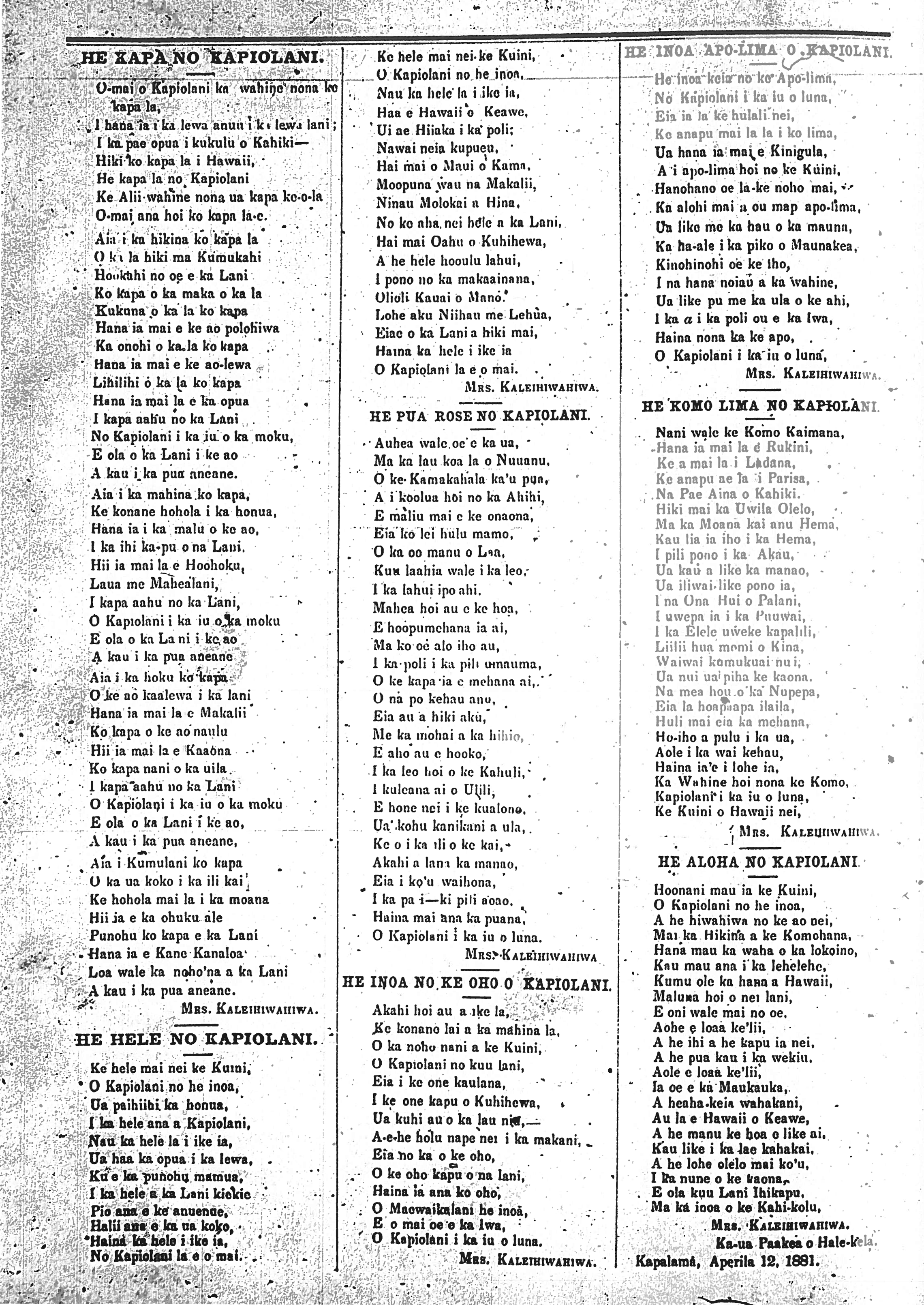
HE KAPA NO KAPIOLANI...

Ka Elele Poakolu, Buke II, helu 6, Aoao 6. Aperila 13, 1881.
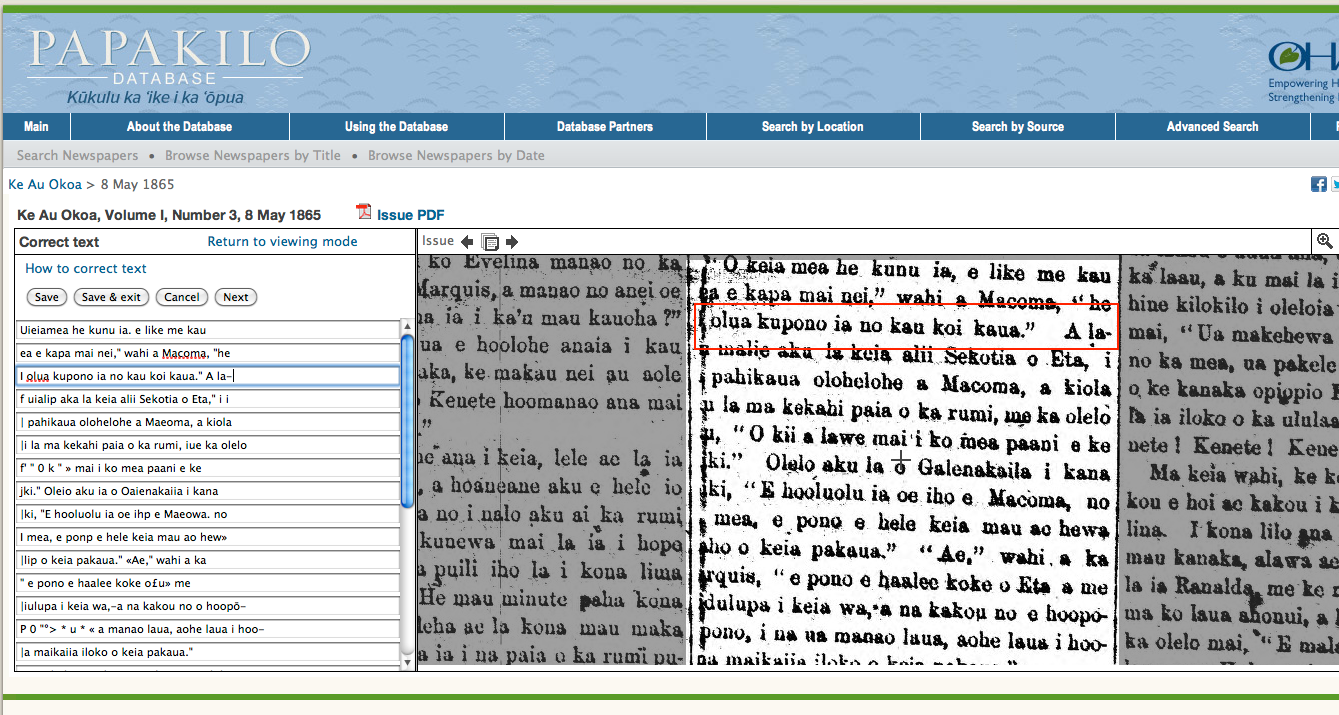
The original newspapers won’t be around forever, 2012.

Today i noticed there is yet another volunteer project trying to get people to type in text from the Hawaiian-Language Newspapers using images that are not clear. This time people are being asked to correct text done by Cambodians.  I won’t speak on the ramifications of using Cambodians to OCR Hawaiian newspapers, because that is a whole separate issue in itself.

I will say once again, however, that i believe the information written in the Hawaiian-Language Newspapers is important enough to reproduce accurately so that we can search and find what was originally written within its pages. I don’t know if there is anyone who feels any different.

The example given in the ad calling for volunteers shows precisely why we need to FIRST get good, clean images of the newspapers AND THEN typescript them so they are word-searchable. The highlighted column will never be fully legible using this image, because there is a big fold running down the left side, obscuring two or three letters in each line. There are pages and pages like this (and many are even less legible).

Is getting 70 or 80 or 90% of the words sufficient? What if your kupuna wrote something or was written about; would 90% of it be good enough for you? What if the one time her name was mentioned in the article was a part that was folded over, or was too dark to read…

Volunteer for the inside???

Volunteer for the inside???

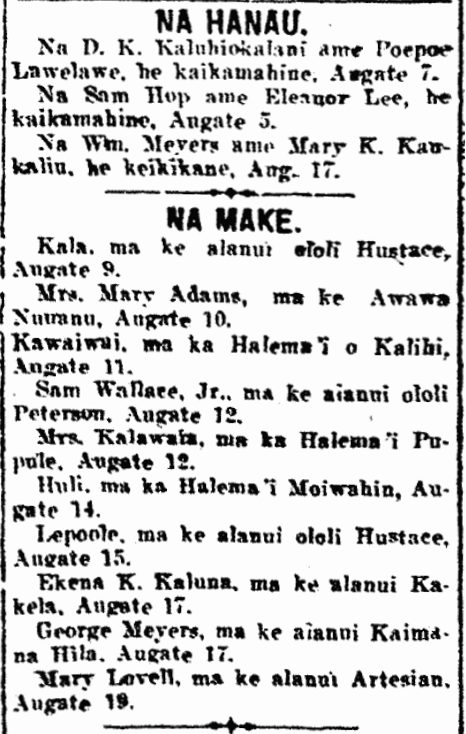
Vital Statistics, 1912.

BIRTHS.

To D. K. Kaluhiokalani and Poepoe Lawelawe, a daughter, August 7.

To Sam Hop and Eleanor Lee, a daughter, August 5.

To William Meyers and Mary K. Kaukaliu, a son, August 17.

DEATHS.

Kala, on Hustace Lane, August 9.

Mrs. Mary Adams, in Nuuanu Valley, August 10.

Kawaiwai, at Kalihi Hospital, August 11.

Sam Wallace, Jr., on Peterson Lane, August 12.

Mrs. Kalawaia, at the Insane Asylum, August 12.

Huli, at Queen’s Hospital, August 14.

Lepoole, on Hustace Lane, August 15.

Ekena K. Kaluna, on Castle Street, August 17.

George Meyers, on Kaimana Hila Street, August 17.

Mary Lovell, on Artesian Street, August 19.

(Kuokoa, 8/23/1912, p. 8)

NA HANAU. / NA MAKE.

Ka Nupepa Kuokoa, Buke XLVIII, Helu 34, Aoao 8. Augate 23, 1912.

Punchbowl to go to the rich, 1912.

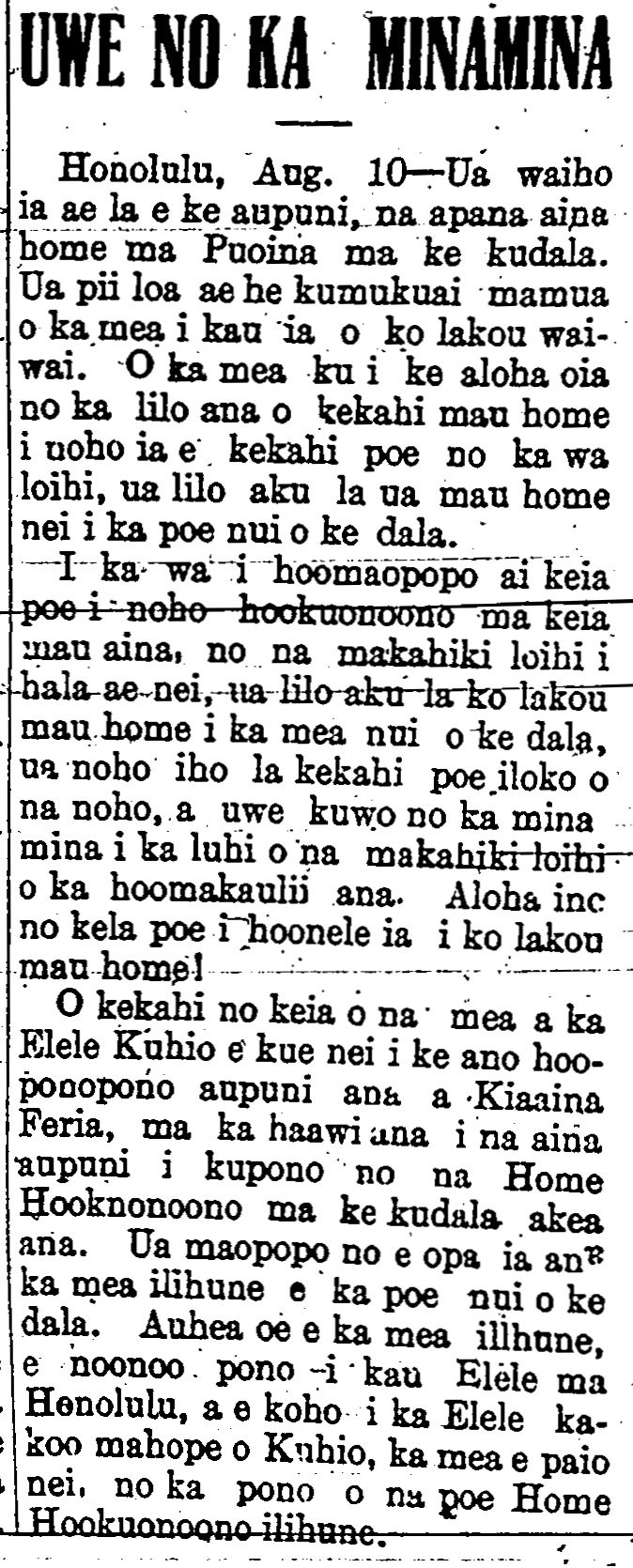
CRYING IN REGRET

Honolulu, Aug. 10—The government has set aside the home lots at Puoina [Punchbowl] to be auctioned off. The prices have gone much higher than their value. What is so sad is that some homes which have been lived in by people for a long time will go to those who have a lot of money.

When these people who have homesteaded on these lands for many years in the past learned that their homes will go to the rich, some sat down in chairs and cried in despair over all the long years spent saving. How sad for those people who will lose their homes!

This is one of the things that Representative Kuhio opposes in the administering of the government by Governor Frear, that being the putting up for open auction lands suitable for Homesteads. It is clear that the poor will be crushed by the wealthy. Listen, oh you poor people, think carefully about your Representative of Honolulu, and choose a Representative who supports Kuhio, the one who is fighting for the rights of the poor Homesteaders [na poe Home Hookuonoono].

[The newspaper in which this article appears, “Ka Hoku o Hawaii,” is only available online from the middle of 1917. Although ulukau.org received funding many years ago to digitize all Hawaiian-Language Newspapers, many inexplicably fell through the crack. All the twelve prior years (which includes the issue from which this article was taken) can at this stage only be seen on microfilm…]

(Hoku o Hawaii, 8/22/1912, p. 1)

UWE NO KA MINAMINA

Ka Hoku o Hawaii, Buke 7, Helu 12, Aoao 1. Augate 22, 1912.

Six ideas on how to most effectively use this blog ⑥, 2012.

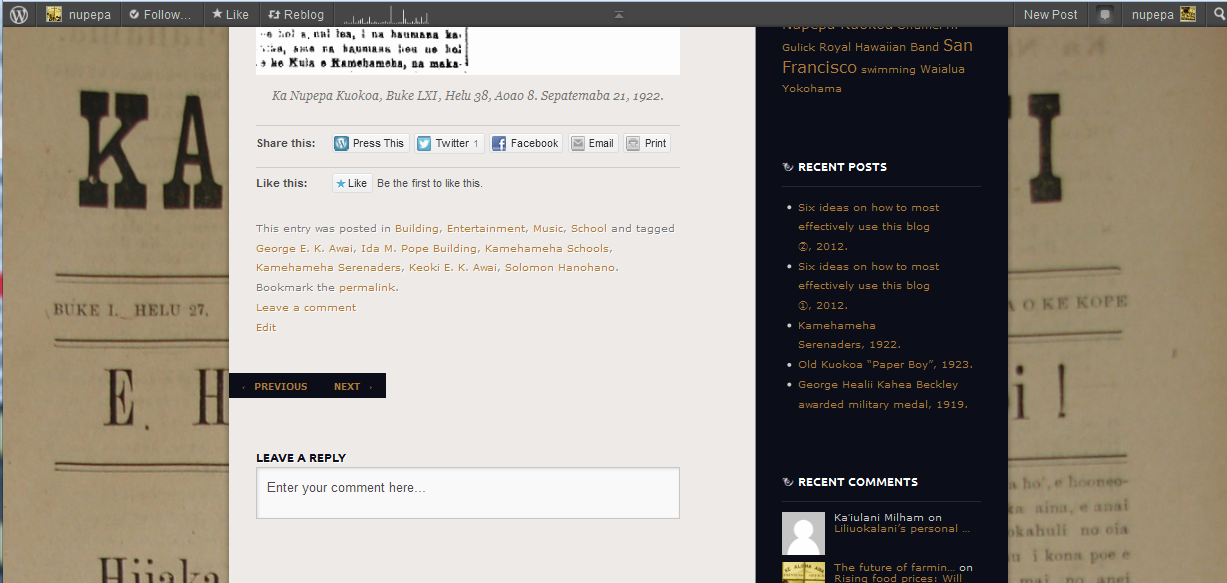
SELECTING A SINGLE POST

http://www.nupepa-hawaii.com is the easiest way to select a single post (article) to repost on Facebook or Twitter, or to email to a friend, or to simply print out!

When you click on the Heading of a post, only that particular post will appear on the page.

On the bottom will appear buttons that will allow you to repost it on WordPress, Twitter, and Facebook. The next button will make it easy to email that post to someone you think might be interested. And clicking on the next button will let you print it out.

Below that is a space where you can leave comments and questions!

Selecting the Header

Selecting the Heading

Helpful Buttons and Space to Leave Comments and Questions

Helpful Buttons and Space to Leave Comments and Questions


Six ideas on how to most effectively use this blog ⑤, 2012.

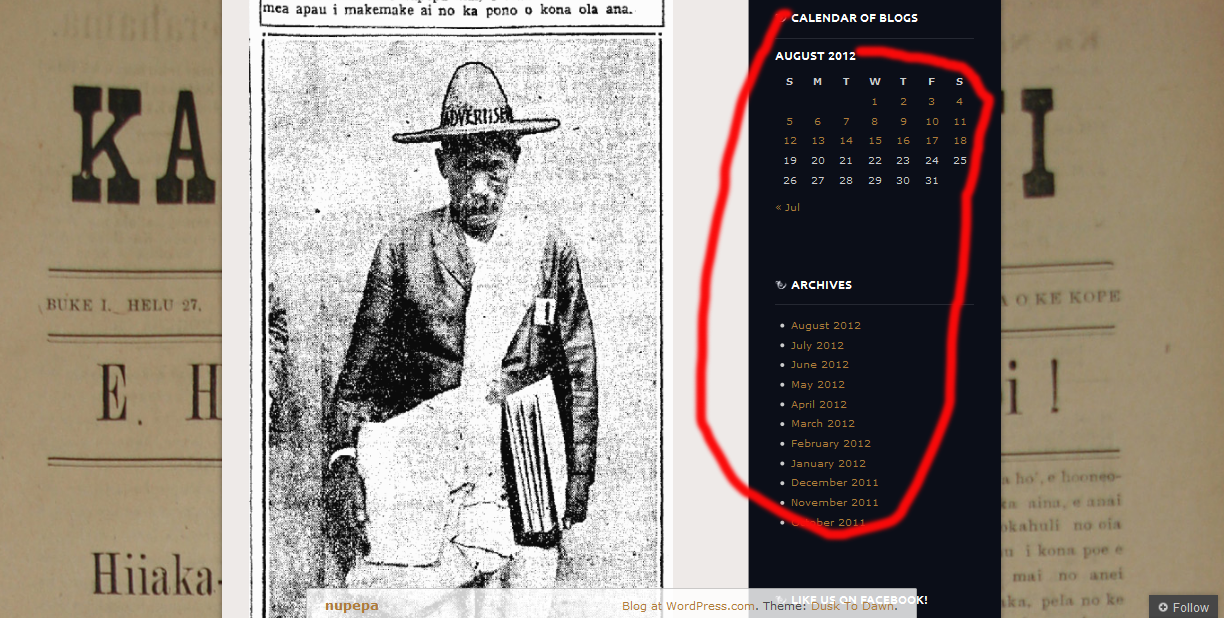
http://www.nupepa-hawaii.com is the easiest way to browse through past posts by Calendar Date.

The next items on the right-hand bar are two ways to browse through posts by Calendar Date.

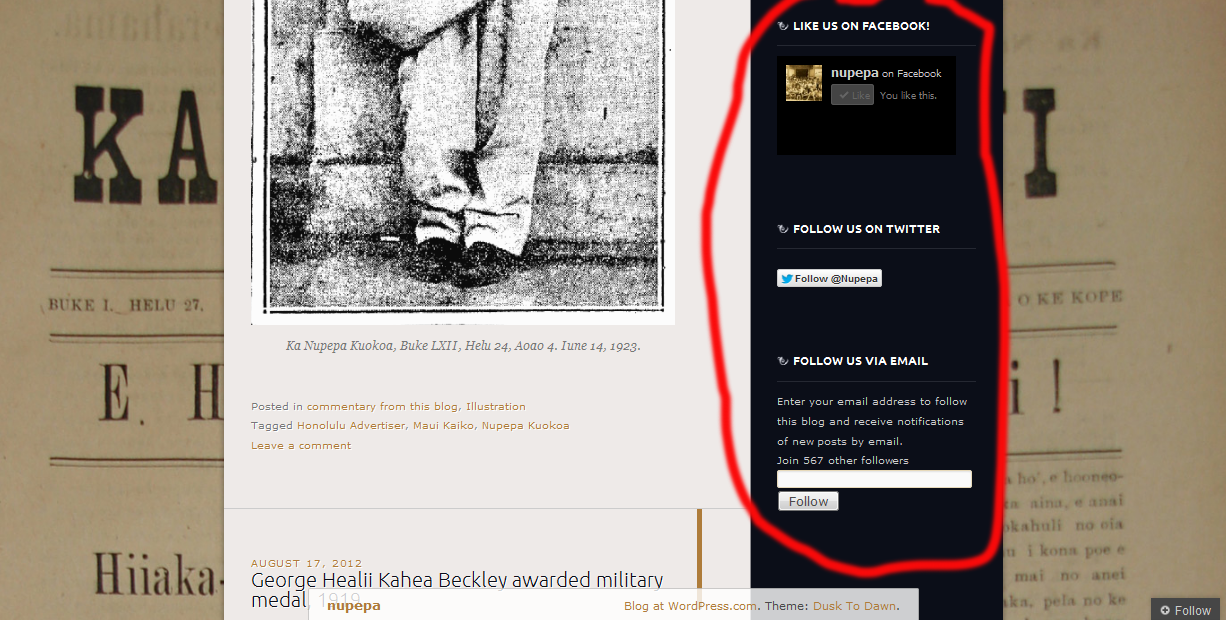
Below that is where you can sign up to get notices of new posts by Facebook, Twitter, or by Email.

Calendar of Blogs and Archives

Calendar of Blogs and Archives

Like us on Facebook, Twitter, or via Email

Like us on Facebook, Twitter, or via Email


Six ideas on how to most effectively use this blog ④, 2012.

http://www.nupepa-hawaii.com is the easiest way to browse through recent posts and recent comments.

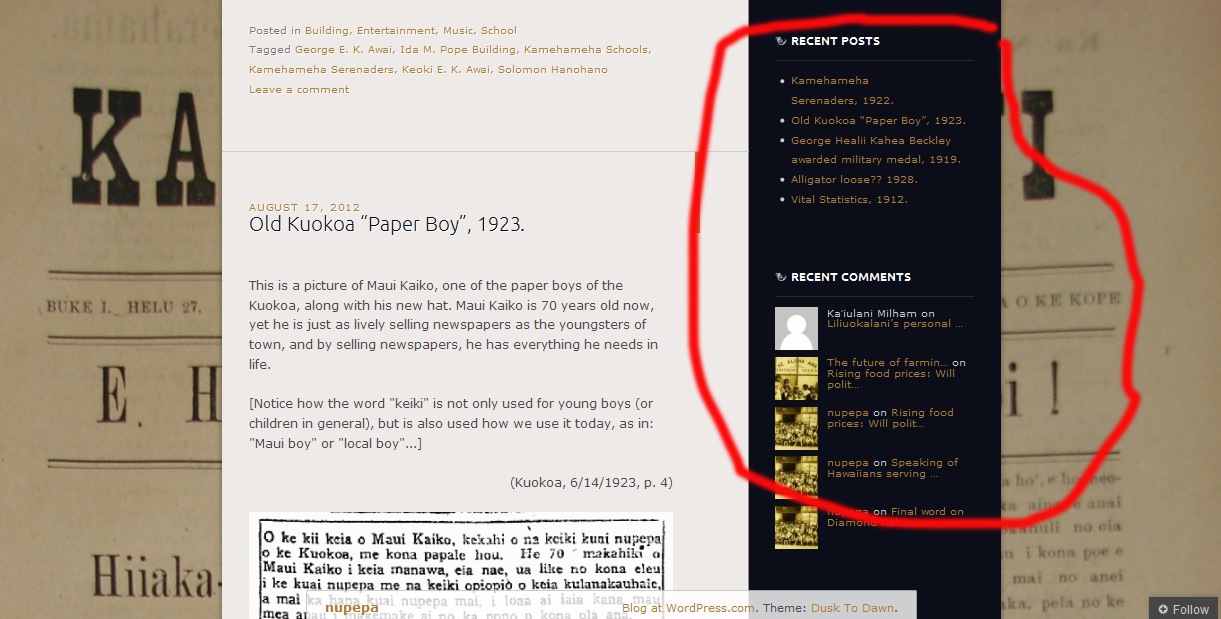
On the right side of the page, you will see next on the bar RECENT POSTS and RECENT COMMENTS.

Most of the Comments seem to come from me, but once in a while there are great responses from people moved to comment, like this one from Ka’iulani Milham on Queen Liliuokalani’s jewelry being auctioned off to help orphans: https://nupepa-hawaii.com/2012/08/12/liliuokalanis-personal-adornments-sold-1924/#comment-1188

Please feel free to comment and to ask questions. Maybe someone will have the response you are looking for!

Recent Posts and Recent Comments

Recent Posts and Recent Comments

Six ideas on how to most effectively use this blog ③, 2012.

http://www.nupepa-hawaii.com is the easiest way to look through the tags from all the previously uploaded articles.

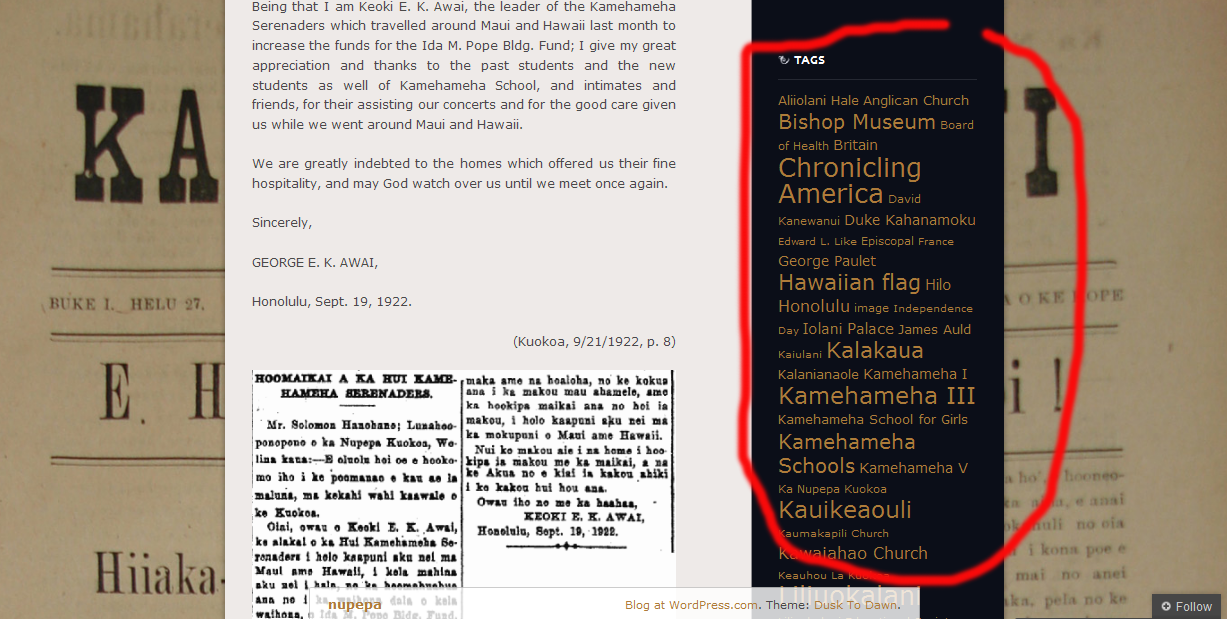
The next choice on the bar to the right side of the page is TAGS.

The tags are the next on the right bar. The larger the tag is, the more articles there are related to the tags. Currently it seems there are quite a number of articles dealing with the Bishop Museum, Chronicling America, Hawaiian flag, Kamehameha III, and Kamehameha Schools.

Tags

Tags