[found under “This and That”]
At dawn on this past Thursday, the residence of Kahikina Kelekona burned down, makai of Iwilei.
(Nupepa Elele, 3/7/1891, p. 3)

Nupepa Elele, Buke XII, Helu 30, Aoao 3. Maraki 7, 1891.
At dawn on this past Thursday, the residence of Kahikina Kelekona burned down, makai of Iwilei.
(Nupepa Elele, 3/7/1891, p. 3)
Nupepa Elele, Buke XII, Helu 30, Aoao 3. Maraki 7, 1891.
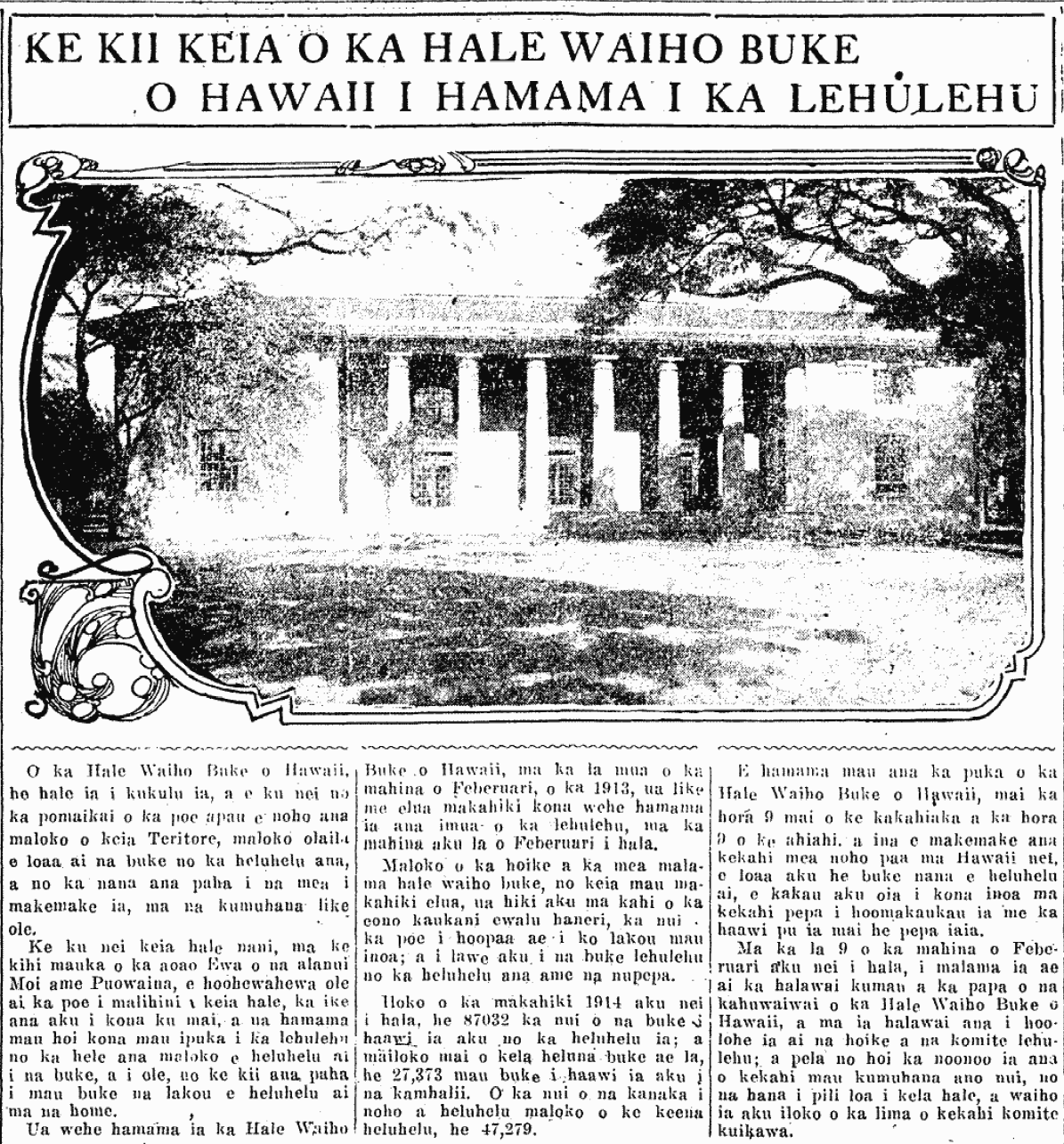
The Library of Hawaii is a building that was built and now stands for the benefit of all people living in this Territory; within it, there are books to read and look at of things of your interest, in all different subjects.
This beautiful structure stands on the corner mauka on the Ewa side of King Street and Punchbowl, so as not to be mistaken by those unfamiliar with where this building stands; and it’s doors are always opened to the public to enter to read books, or to get books for them to read at home.
The Library of Hawaii was opened on the first day of February, 1913; it has been two years that it has been open to the public, this past February.
According to the statement of the caretaker of the library, within these two years, the number of patrons who registered reached about six-thousand eight-hundred; they took out many books and newspapers to read.
In 1914, this past year, 87,032 books were lent out, and from within that number, 27,373 were lent to children. The number of patrons who sat and read within its reading room was 47,279.
The doors of the Library of Hawaii are always open from 9 in the morning to 8 [?] in the evening, and should someone residing in Hawaii wish to get a book to read, he must fill out his name on a ready made form, and he will receive a paper [library card?].
On the 9th of this past February, the regular meeting of the treasury board of the Library of Hawaii, and at that meeting was heard the reports of the many different committees, and also about a consideration of a number of grand plans relating closely to this library, and they were put in the hands of a special committee.
(Kuokoa, 3/5/1915, p. 5)
Nupepa Kuokoa, Buke LIII, Helu 10, Aoao 5. Maraki 5, 1915.
Here is a picture of the Hawaii State Library as we know it today.

Hale Waiho Buke o Hawaii. Novemaba 1, 2011
On the 6th of this November, found in a hidden cave in Hookena, South Kona, on the island of Hawaii, was a holua-sliding board of ancient times of Hawaii. This surfboard [sic] was found by our companion and good friend, Mr. N. K. Pukui, one of the young gentlemen travelling about for the group, “The Hawaiian Realty and Maturity Co.” When he found this board, the kamaaina of Hookena told him, this finding of the sled was new to them.
It is believed that this holua board was left in that cave for two-hundred years, from the time of Keawenuiaumi, the King of Hawaii.
According to the understanding of the oldsters of Hookena, they remember the words of their parents and grandparents, that it was a holua-sliding board of a chiefess of Hookena from long ago, named Kaneamama, and her older sister was the kaukau alii of Keauhou. These women, they were women who loved recreation. While Kaneamama was ruling Hookena, she declared to her people [kanaua? kanaka?] that they were to build a sledding course. This course was completed, and that chiefess rode upon this board. It is said that there is no sled equal to this one in any museum all over the world. This sled was made from breadfruit wood, and it is a thing of beauty to behold.
A surfboard was also found. These boards can be seen in the Office of the Group, “The Hawaiian Realty and Maturity Co.,” here in Honolulu.
(Na’i Aupuni, 12/6/1905, p. 2)

Na'i Aupuni, Buke I, Helu 9, Aoao 2. Dekemaba 6, 1905.
“HEIAU.”—We heard this word associated with the luakini [church] of Kawaiahao. It did not come from an “enemy,” but a friend called it that in public. But this is what we say: that word is associated with idol worship of the old days; it is not changed into a name referring to the truly sanctified places by this generation now living. The name luakini, that is what is transformed for the Christian religion by our fathers. Therefore, O Friends, do not call the house of God, a heiau.
(Kuokoa, 11/3/1866, p. 2)
Nupepa Kuokoa, Buke V, Helu 44, Aoao 2. Novemaba 3, 1866.
Hoola Luahine—In these recent past days, women have been seen wearing tilted to the side, high-crowned hats made with skill, and when looking at this, it is becoming to the youth and to the elderly as well; and for this reason, this type of hat is called, a “hoola luahine [reviving old lady].” We are appreciative of this endeavor; it decreases the money spent on foreign hats.
(Kuokoa, 12/4/1875, p. 2)
Nupepa Kuokoa, Buke XIV, Helu 49, Aoao 2. Dekemaba 4, 1875.
When Maunumu of Keokea, Kona, Hawaii died, his age reached 116 years, the one who made people consider that he saw Kamehameha I, “Ka Nai Aupuni” of Hawaii nei, before his death. There was no time when this man spoke of what he saw in his childhood, except for the time when he was asked by a missionary many years ago. It is said by some Hawaiians who are now 70, that they know Maunumu and he is old; when they were young it was believed that this man saw and knew Kamehameha. Should that indeed be so, then his days upon this earth were truly long.
(Aloha Aina, 8/16/1918, p. 2)
Aloha Aina, Buke XXIII, Helu 33, Aoao 2. Aukake 16, 1918.
On the Wilhelmina of this past Wednesday [10/8/1913], Duke Kahanamoku and his teammates of the Hui Nalu left for San Francisco, for the competition with the other swimming contestants who will enter into the swimming contest which will be held in the second half of this month at that city.
(Kuokoa, 10/10/1913, p. 4)
Nupepa Kuokoa, Buke LI, Helu 40, Aoao 4. Okatoba 10, 1913.
The swimmers of the Hui Nalu received and invitation from San Francisco to go to the Portola show to be held in San Francisco, and that they arrive one week prior to the when the event will be held, so that they have time to enjoy and practice ahead.
This invitation was received by the Promotion Committee on the eve of this past Thursday by way of wireless telegraph, requesting that the boys of the Hui Nalu board the steamship Ventura on the 3rd of October instead of them waiting until the 8th.
There are many boys of the Hui Nalu who want to fulfill this invitation, however, some of them must work, and it seems that there are only a few of them that might be able to oblige.
One big obstruction faced by Kahanamoku and his teammates in going, is the lack of funds in their account, and so the fund-raising committee wants to raise two-hundred dollars, which would be sufficient for the travel expenses for the Hawaii boys. The committee is determined to raise those funds before the 8th of October, and to put the Hawaii boys aboard the steamship Wilhelmina so that they will have a lot of time before the Portola Festival [Oct. 22–25, 1913] in San Francisco, on the 22nd of October.
(Kuokoa, 10/3/1913, p. 5)
Nupepa Kuokoa, Buke LI, Helu 39, Aoao 5. Okatoba 3, 1913.
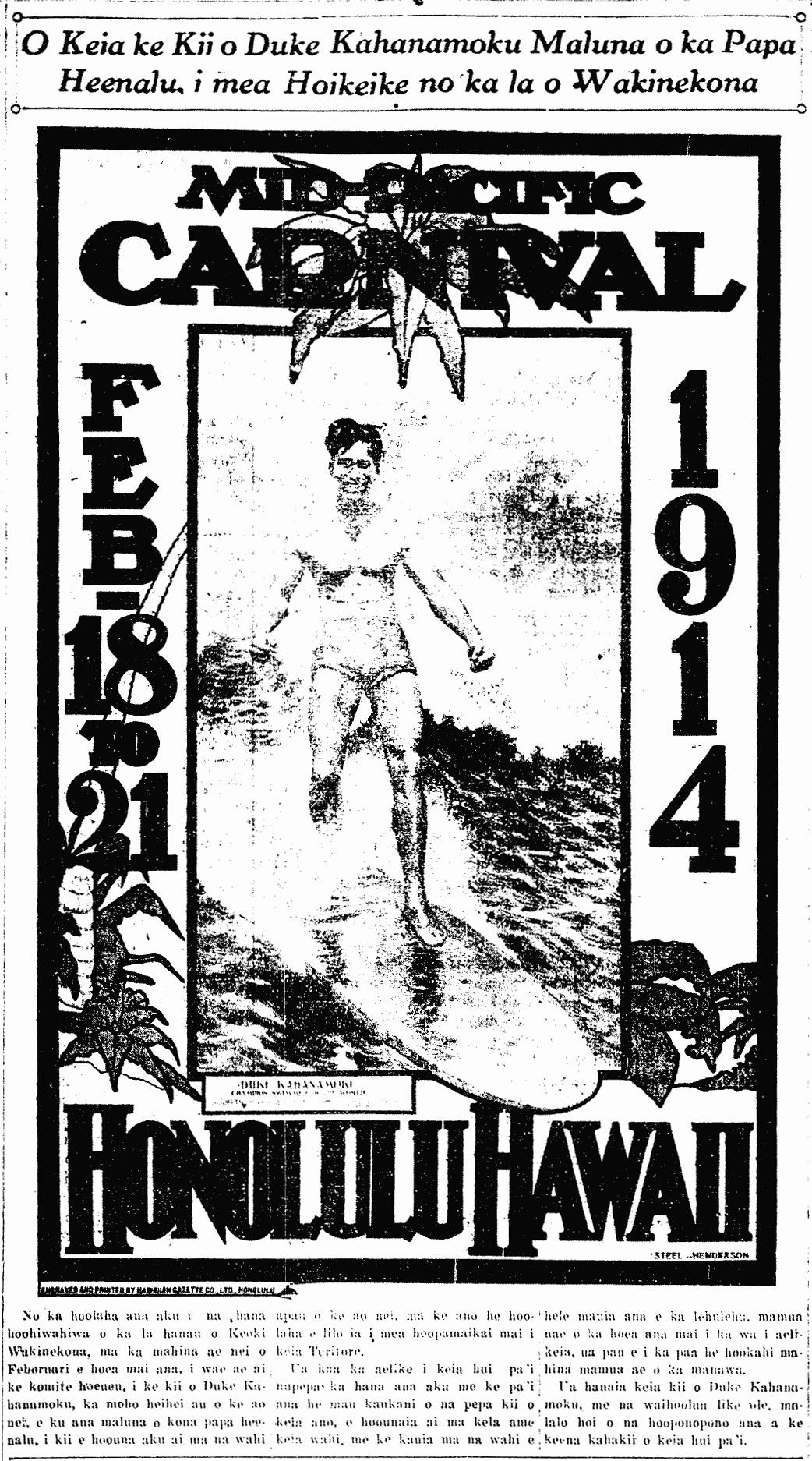
MID-PACIFIC CARNIVAL
FEB 18 to 21 1914
DUKE KAHANAMOKU
CHAMPION SWIMMER OF THE WORLD
[Illegible line follows, that does not appear in other images online…]
HONOLULU HAWAII
STEEL–HENDERSON
ENGRAVED AND PRINTED BY HAWAIIAN GAZETTE CO., LTD., HONOLULU.
To advertise the celebration of the birth of Washington, in the coming month of February, the Promotion Committee has chosen the picture of Duke Kahanamoku, the swimming champion of the world, standing atop of his surfboard, as a picture to send all over the world as advertisement to benefit this Territory.
This newspaper company received the contract to create and print some thousands of these illustrations, to be sent all over, and posted at places where crowds assemble; it was finished a month before the date of completion as set in the contract.
This image of Duke Kahanamoku is done in multiple colors, under the direction of the art department of this publishing company.
(Kuokoa, 10/3/1913, p. 5)
Nupepa Kuokoa, Buke LI, Helu 39, Aoao 5. Okatoba 3, 1913.

