Wooden Kii found in Haleiwa, 1906.

[Found under: “This and That”]

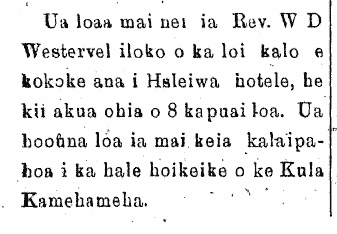
Rev. W. D. Westervelt found a wooden akua image made of ohia that was 8 feet in length in a taro patch near the Haleiwa Hotel. This kalaipahoa was sent was sent to the museum of Kamehameha School.

(Na’i Aupuni, 8/30/1906, p. 3)

Ua loaa mai nei ia Rev W D Westervel...

Ka Na'i Aupuni, Buke II, Helu 76, Aoao 3. Augate 30, 1906.

Speaking of immigration… 2012.

Tradition and Transition: Stories of Hawai‘i Immigrants

Tradition and Transition

Fall 2011 – Summer 2013

Castle Hall’s second floor gallery features special treasured stories in focus cases, a timeline of Hawaiian history, video stations, and significant artifacts and document to relay the history of Japanese in Hawai‘i.

Inspiring stories abound when the discussion centers on the challenges faced by immigrants coming to a new homeland. Tradition and Transition, Stories of Hawai‘i Immigrants presents these and celebrates the diversity brought by all ethnic groups who contribute to the economic strength and cultural multiplicity of Hawai‘i.

Tradition and Transition, Stories of Hawai‘i’s Immigrants celebrates the stories of challenge and victory, tales of hardship matched with those of success. It is a story that focuses on the strength of human spirit and the power of change.

For children, a Pā‘ani Place is forfor kids to learn about multi-ethnic playthings and pastimes.

The hallway adjacent to the main exhibition gallery is Ho‘olaule‘a Hall, filled with large photomurals, hanging celebratory items, and smaller exhibit cases that focus on multiethnic celebrations.

At the end of the Ho‘olaule‘a Hall, will be Ho‘okipa Parlor, a recreation of the interior of a plantation home living room, welcoming visitors who wish to sit a while and browse books on various local ethnic traditions or watch some old news reels of plantation-era Hawai‘i.

Tradition and Transition: Stories of Hawai‘i’s Immigrants is funded by generous gifts from the Atsuhiko & Ina Goodwin Tateuchi Foundation and Hawai‘i Imin Shiryō Hozon Kai.

Tateuchi Foundation

[Don’t forget to check out this ongoing exhibit at the Bishop Museum! The description is taken from the Bishop Museum page.]


James Auld gets married. 1862.

[Found under: “NEWS OF HAWAII NEI.”]

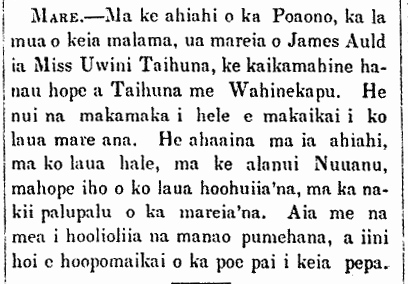
MARRIED.—On Saturday evening, the first day of this month, James Auld was married to Miss Uwini Taihuna, the youngest daughter of Taihuna and Wahinekapu. There were many friends who went to see the wedding. There was a party at their house that evening, on Nuuanu Avenue, after they were joined by the gentle tie of marriage. With those who were filled with joy are the warm thoughts and hopes that they will be blessed from the people who print this paper.

[See Kuokoa 9/3/1864, p. 4, for mele inoa composed for Harry W. Auld (Uwilakulani), the first child of Kimo (James) and Uwinihepa! The mele inoa are composed by Apela and Kaniwahie of Kawela, Molokai.—This was found searching the Bishop Museum’s Archives online search!!

Wow… Also found online: “Taihuna” is also known as “Wong Tai-hoon” or “Tyhune”. See: Three Chinese Stores in Early Honolulu, Wai-Jane Char (Hawaiian Journal of History, Volume 08, 1974.]

(Kuokoa, 3/8/1862, p. 2)

MARE.

Ka Nupepa Kuokoa, Buke I, Helu 15, Aoao 2. Maraki 8, 1862.

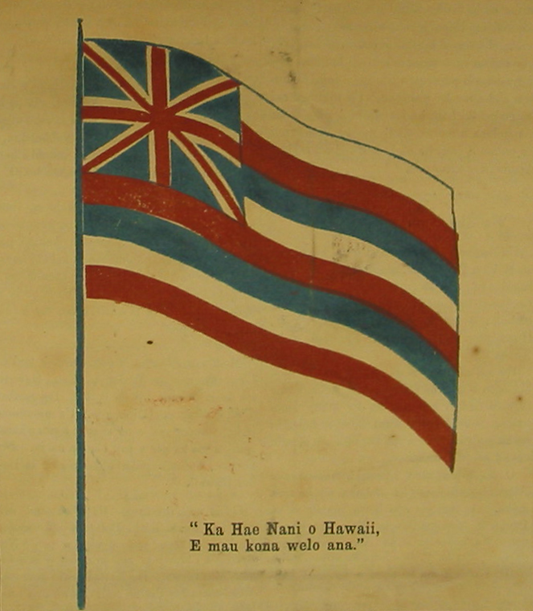
The Hawaiian Flag—a closeup. 1862.

“The Beautiful Flag of Hawaii,
Let it forever wave.”

[The image of the Hawaiian Flag as it appeared to the readers of the Kuokoa in 1862! (Courtesy of the library/archives at the Bishop Museum.)

The Library and Archives at the Museum holds so much priceless information! They need more funding to do important things!!]

"Ka Hae Nani o Hawaii...

Ka Nupepa Kuokoa, Buke I, Helu 6, Aoao 1. Ianuari 1, 1862.

Less than a week before the new system at Bishop Museum Library and Archives kicks in!

“In alignment with Bishop Museum’s new strategic plan, the Library and Archives collections have been identified as an area of priority in the effort to develop increased access to Museum resources for our community. Effective March 1, 2012, the Library and Archives will temporarily suspend public reference hours and provide limited, by-appointment access to its collections. This temporary closure will allow staff the necessary time to support a museum and community effort to plan and implement a new model of operation for this area. “

Here is the link to the new form you must fill out and submit to make an appointment to request use of the Library and Archives.

Kamehameha III’s Feather Cape returned to Hawaii, 1927.

THE FEATHER-CAPE OF KAMEHAMEHA IS RETURNED

Ceremony in Respect to the Ahuula is Carried Out in the Crown Room of the Palace Last Monday

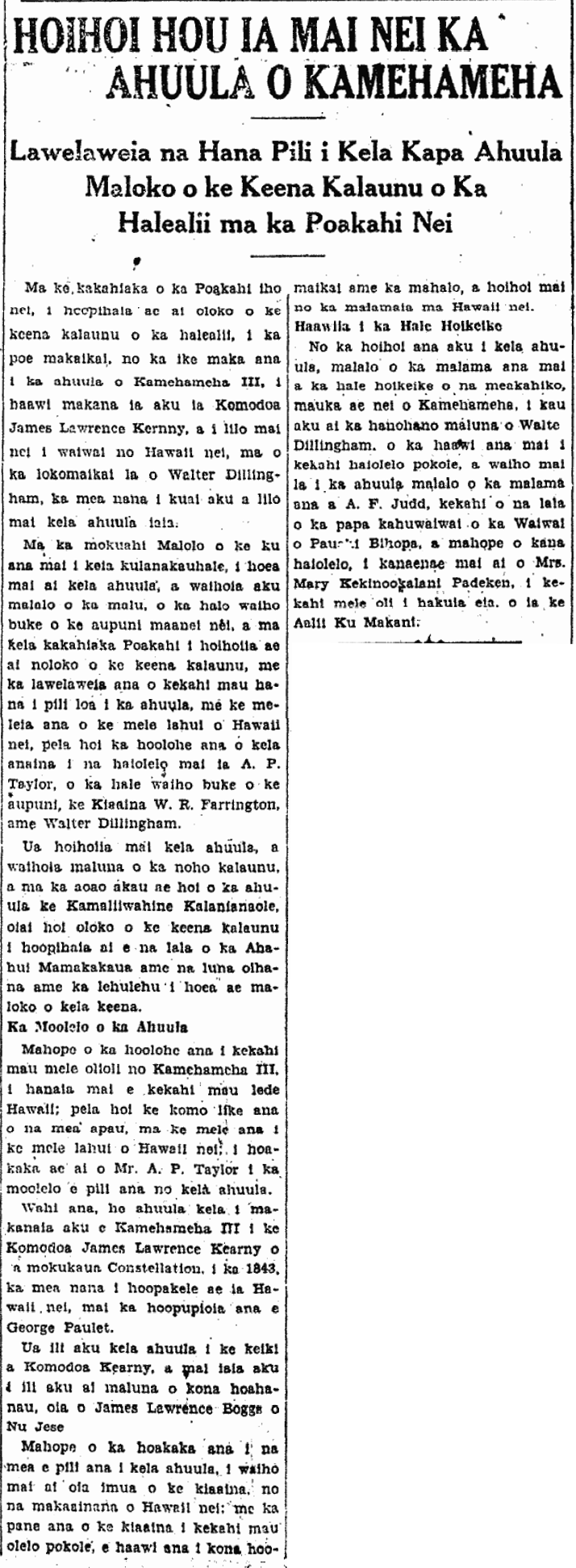
In the morning of last Monday, the throne room of the palace was filled with visitors to see the ahuula of Kamehameha III gifted to Commodore James Lawrence Kernny, and now becoming a treasure for Hawaii nei, through the generosity of Walter Dillingham, the one who purchased the ahuula.

The ahuula arrived aboard the steamer Malolo which arrived in town, and was entrusted to the safekeeping of the national archives, and on that Monday was returned to the throne room with ceremony befitting the ahuula, along with the singing of patriotic songs of Hawaii nei, as well as the hearing by the crowd of speeches given by A. P. Taylor of the national arvhives, Governor W. R. Farrington, and Walter Dillingham.

The ahuula was returned and draped upon the throne, and to the right was the Princess Kalanianaole, while the throne room was filled with members of the Mamakakaua Association and heads of businesses and the multitudes there in that room.

The Story of the Ahuula

After hearing some songs for Kamehameha III, composed by some Hawaiian ladies, the crowd entered while singing the anthem of Hawaii. And Mr. A. P. Taylor explained the history of the ahuula.

According to him, this was an ahuula gifted to Commodore James Lawrence Kearny of the warship Constellation, by Kamehameha III, in the year 1843. He was the one who saved Hawaii from the subjugation by George Paulet.

The ahuula was inherited by the child of Commodore Kearny, and from there to his cousin, James Lawrence Boggs of New Jersey.

After the explanation of its story, the ahuula was presented before the governor for the makaainana of Hawaii nei, whereupon the governor spoke a bit, while giving his thanks and appreciation for it being returned here to be cared for in Hawaii nei.

Given to the Museum

The honor was given to Walter Dillingham for his return of the ahuula for stewardship by the museum up above Kamehameha, and he gave a short speech and placed the ahuula under the care of A. F. Judd, one of the members of the board of the Trust of Pauahi Bishop. After his speech, Mrs. Mary Kekinookalani Padeken presented a chant composed by her, “Aalii Ku Makani.”

[If this sounds familiar, I am reposting it from the old Facebook site. Posts on FB are not easily searched, and so periodically I am thinking of doing reposts of those articles…]

(Kuokoa, 12/1/1927, p. 1)

HOIHOI HOU IA MAI NEI KA AHUULA O KAMEHAMEHA

Ka Nupepa Kuokoa, Buke LXVI, Helu 53, Aoao 1. Dekemaba 1, 1927.

Hawaiian Ethnological Notes, Bishop Museum.

This is a priceless resource left to us mainly by Mary Kawena Pukui. There are translations (in all stages) of all kinds of material. For more information on the body as well as online search access, see below. (Note that not all of the HEN is listed online.):

http://data.bishopmuseum.org/HEN/index.php

The reason I am bringing this up now is because one of the translations in the collection is of those Moanalua articles! So for a much better translation of the previous article as well as the whole series, check it out at the Museum. Its is available under the call number: HEN Newspapers, 2/17/1922 – 8/31/1922.

One more thing. Although that Moanalua series translation (and those like it) found in HEN does not appear in any publication as a whole, information extracted from it appears in a great number of publications we are all most likely familiar with!

Bishop Museum Library and Archives accessible by appointment only, 2012.

From the museum website:

“In alignment with Bishop Museum’s new strategic plan, the Library and Archives collections have been identified as an area of priority in the effort to develop increased access to Museum resources for our community. Effective March 1, 2012, the Library and Archives will temporarily suspend public reference hours and provide limited, by-appointment access to its collections. This temporary closure will allow staff the necessary time to support a museum and community effort to plan and implement a new model of operation for this area. ”

see: http://www.bishopmuseum.org/research/library/libarch.html

Wise Sayings of the people of old. 1922.

PROVERBS.

In order for us to hold on to all of the olelo noeau and all of the ingenious deeds of the Hawaiian people, we very much want everyone to assist the Bishop Museum in their collecting and explaining of wise and witty sayings known amongst this race.

So that this endeavor will move forward, whenever an ancient olelo noeau comes to mind, or perhaps a riddle, do write it down and send it to the museum; and if not to there, send it directly to the Kuokoa with clarification of its hidden meaning or deep wit.

Here are some olelo noeau sent from the museum to this newspaper:

Uhiuhi lau mamane, kahe ka wai o Kapapala.

Hookahi no hawa’e, lauhue Kona.

Kau ke poo i ka uluna, o Welehu ka malama.

Aohe hana a Kauhikoa, ua kau ka waa i ke aki.

Haehae ka manu, ke aleale nei ka wai.

E aho hoi ka make i ke kaua, he nui na moepuu.

Nakeke na iwi o Hua i ka la.

Uliuli kai pali o Kahikinui, kolo mai ka ohu la he ino.

Ua komo ka i’a i ka makaha, ua puni i ka nae.

Kulia i ka nuu, i ka paepae kapu o Liloa.

Aohe loea i ka wae opae.

Hoi hou ka paakai i Waimea.

Aohe u’i hele wale o Kohala.

Wehea iho maluna o Hihimanu.

E ike ia kaua hoa kanaka, o kipa hewa ke aloha i ka ilio; he ilio hoi ia, e, he kanaka hoi au, a!

Ka poe unaunahi hee o Kula.

Hilinai Puna, kalele ia Kau.

Hihi Kaunoa, hihi Mana; aloha wale ia laau makua ole.

Kiilili pua hau o Kalena.

Maemae i ke kai ka pua o ka hala.

Maewa wale i ka pali o Kahiwa. Niniu Puna i ke ala.

Nui pumaia, ohaka oloko.

Eleelepi ka waha o kanaka.

He wa ulu keia o ka hoi.

Ua le’a kaina a ka la’i, ua malie.

Make ke kalo, ola i ka naio.

Aia i kula i ka alaalapuloa.

E hoomanao i ka lua o ka ohiki.

Ako Nuuanu i ka hale halauloa a ka makani; ako Manoa i ka hale a ka ehu.

Na manu kolea kau ahua.

[And presumably from the responses came the publication we all know today as “‘Ōlelo No‘eau: Hawaiian Proverbs and Poetical Sayings”. If you don’t have a copy, this is a must have…]

(Kuokoa, 9/21/1922, p. 2)

NA OLELO NOEAU.

Ka Nupepa Kuokoa, Buke LXI, Helu 38, Aoao 2. Sepatemaba 21, 1922.
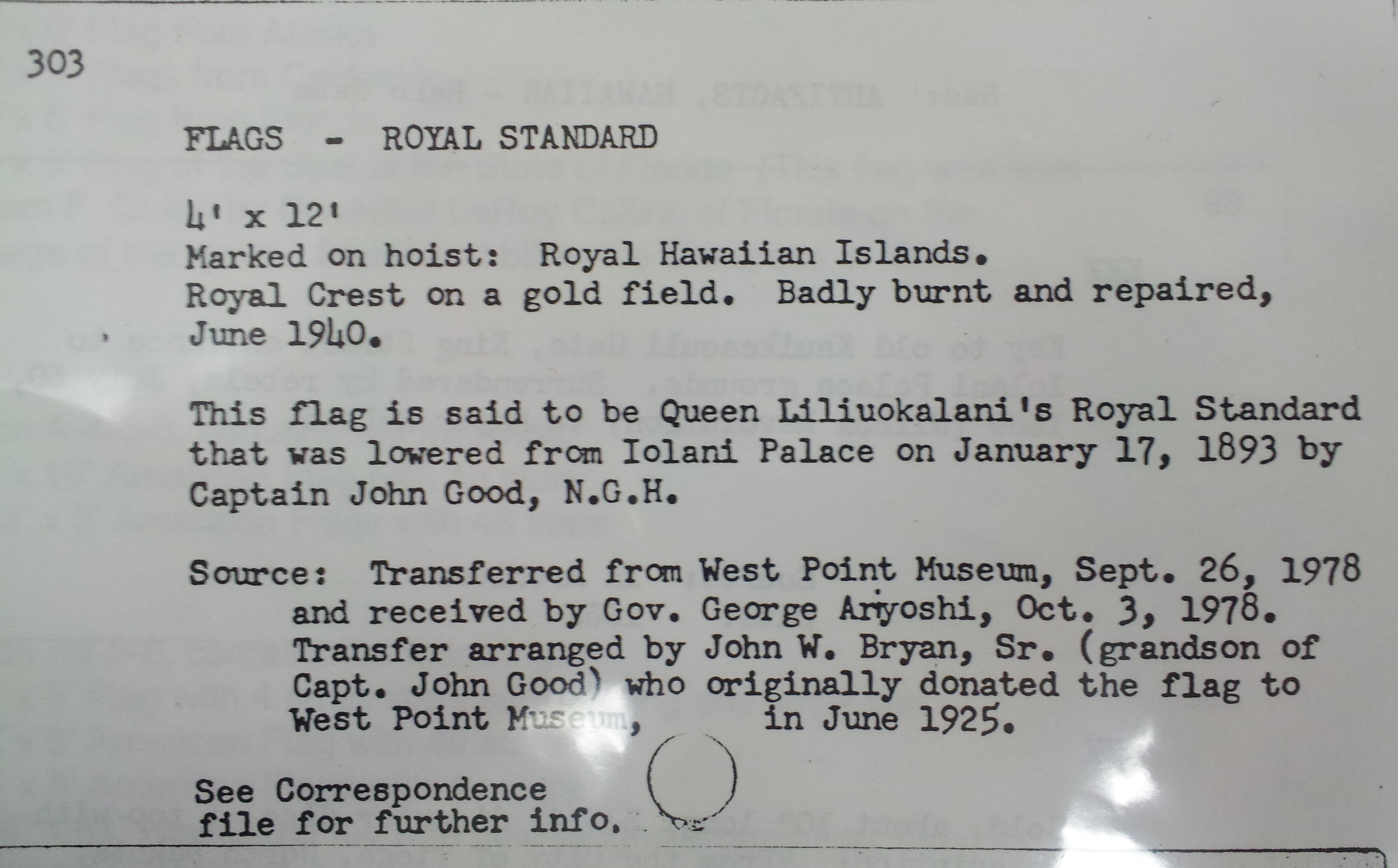
More on the flag from Iolani Palace, 2011.

After putting up the article from 1918 about the search for the flag from the Palace earlier this week, I went to the Archives just to see.

303

FLAGS – ROYAL STANDARD
4′ x 12′
Marked on hoists: Royal Hawaiian Islands.
Royal Crest on a gold field. Badly burnt and repaired,
June 1940.

This flag is said to be Queen Liliuokalani’s Royal Standard that was lowered from Iolani Palace on January 17, 1893 by Captain John Good, N. G. H.

Source: Transferred from West Point Museum, Sept. 26, 1978 and received by Gov. George Ariyoshi, Oct. 3, 1978. Transfer arranged by John W. Bryan, Sr. (grandson of Capt. John Good) who originally donated the flag to West Point Museum, in June 1925.

See Correspondence file for further info.

Hawaii State Archives card catalogue

from Archives, 12/9/2011