“Kaua i ka Nani o Hilo” and finding things where you might not expect. 1895.

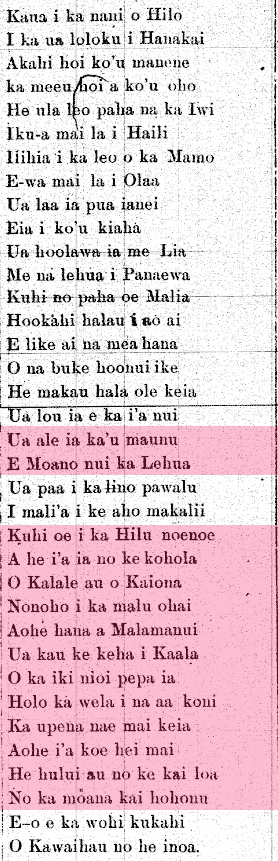
“Kaua i ka Nani o Hilo”

[This mele for Kalakaua is taken from an article entitled “OWAI LA O J. L. KUKAHI, KA IHEPA NUI O KA WAA PAE E PEE NEI?”, which is a scathing criticism by D. M. Punini, Jr. over an ongoing argument concerning the naming of Hawaiian traditional months. But here, I wanted to show once again, that you never know what you will find and where.

The version of “Kaua i ka Nani o Hilo” most widely known today is probably the one from the Roberts Collection at the Bishop Museum, which is quoted here. The Museum’s Mele Index can be searched online here. But notice that the Punini version has additional verses (highlighted in red).

Also note that “Kawaihau” is one of the names for Kalakaua.]

Kaua i ka nani o Hilo

I ka ua loloku i Hanakahi

Akahi hoi ko’u manene

ka meeu hoi a ko’u oho

He ula leo paha na ka Iwi

Iku-a mai la i Haili

Ilihia i ka leo o ka Mamo

E-wa mai la i Olaa

Ua laa ia pua ianei

Eia i ko’u kiaha

Ua hoolawa ia me Lia

Me na lehua i Panaewa

Kuhi no paha oe Malia

Hookahi halau i ao ai

E like ai na mea hana

O na buke hoonui ike

He makau hala ole keia

Ua lou ia e ka i’a nui

Ua ale ia ka’u maunu

E Moano nui ka Lehua

Ua paa i ka lino pawalu

I mali’a i ke aho makalii

Kuhi oe i ka Hilu noenoe

A he i’a ia no ke kohola

O Kalale au o Kaiona

Nonoho i ka malu ohai

Aohe hana a Malamanui

Ua kau ke keha i Kaala

O ka iki nioi pepa ia

Holo ka wela i na aa koni

Ka upena nae mai keia

Aohe i’a koe hei mai

He hului au no ke kai loa

No ka moana kai hohonu

E—o e ka wohi kukahi

O Kawaihau no he inoa.

(Leo o ka Lahui, 4/2/1895, p. 3)

OWAI LA O J. L. KUKAHI, KA IHEPA NUI O KA WAA PAE E PEE NEI?

Ka Leo o ka Lahui, Buke II, Helu 1078, Aoao 3. Aperila 2, 1895.

Woah. This is some story! Hawaiian living abroad comes home to visit… after 38 years. 1915.

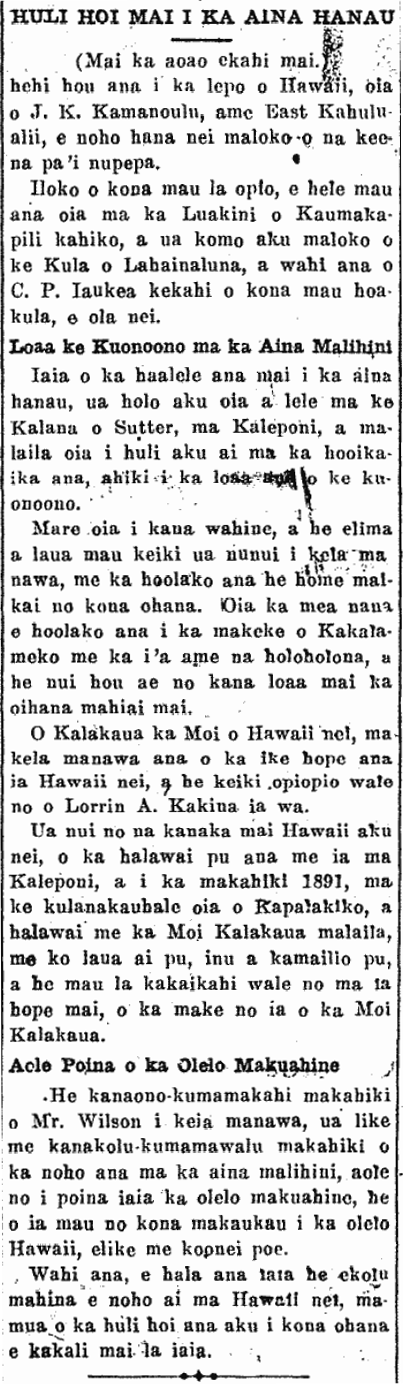
THAT HAWAIIAN RETURNS TO SEE HIS HOMELAND ONCE MORE.

JOHN BELL WILSON

After leaving Honolulu thirty-eight years ago, that Hawaiian, John Bell Wilson is his name, returned to see once again his family and homeland while he was still in good health, on the steamship Matsonia this past Wednesday, filled with shock at how the places he was familiar with in his childhood had changed.

John Bell Wilson left Honolulu nei when he was a youngster of twenty-three years in age on a sailboat, because there were few steamships in his day, but it was upon a beautiful steamship that he returned to see the land of his birth and his friends, as he was shocked at the change of Honolulu from an almost nothing town which he left to a beautiful town which one admires.

His eyes met up with new sights of Honolulu and ethnicities which were unfamiliar to him; and as he travelled here and there, there were no friends who he knew in his youth, except for but a few who were still living which he met up with, those friends who he went around with in those days gone by.

Heard of the Death of His Mother

When John Bell Wilson returned to see his homeland, he had one big thing on his mind, that was meeting affectionately with his mother, who he thought was still living, but she was not, and this left him heartbroken.

Mr. Wilson was depressed at the death of his mother, being that from the time he left this land until his return, he did not write his mother; and when he asked his friends when he landed ashore about his mother, this was when he was told she had passed long ago to the other side, three years ago.

He went immediately to find the grave where his mother was laid to rest, and he planned to build a memorial to her, as a show of remembrance from a thoughtless child for his beloved mother.

Not Recognizing Honolulu

According to the words of Mr. Wilson after he saw the scenery unfamiliar to him, he could not recall the old Honolulu, because the town had changed so much from when he left, however he did have recollections of the major streets of town.

When he travelled about looking here and there, those scenes were not familiar to him, except for just a few people who went around with him and played with him in the days of his childhood. The small children he left behind were now very elderly and some of them had white hair.

Some of the familiar people who he saw on the first day he

(See page four.)

(Kuokoa, 2/5/1915, p. 1)

HULI HOI MAI IA KANAKA HAWAII E IKE HOU I KA AINA HANAU

Ka Nupepa Kuokoa, Buke LIII, Helu 6, Aoao 1. Feberuari 5, 1915.

RETURNED TO THE HOMELAND

(From page one.)

stepped once again on the soil of Hawaii, were J. K. Kamanoulu and East Kahulualii who work at the newspaper printing office.

In the days of his childhood, he went often to the old Kaumakapili Church, and he was enrolled at Lahainaluna School, and according to him, C. P. Iaukea is one of his friends who is still living.

Became Wealthy in a Foreign Land

When he left the land of his birth, he got off at Sutter County, California, and there he sought very hard until he became well off.

He married his wife, and they currently have five grown children, and he provided a good home for his family. He is the one who supplies the market of Sacramento with fish and meat, and he also makes profits from the farming industry.

Kalakaua was the King of Hawaii nei at the time he last saw Hawaii, and Lorrin A. Thurston was but a child.

There are many people from Hawaii who have met up with him in California, and in the year 1891, in the town of San Francisco, he met with King Kalakaua there, and they dined together, drank and talked, and just a few days after that was when King Kalakaua died.

Did Not Forget His Mother Tongue

Mr. Wilson is now sixty-one years old, so he was living thirty-eight years abroad, and he has not forgotten his native language, he is still fluent in Hawaiian, just as the people here are.

According to him, he will spend three months staying in Hawaii before returning to his family who await him.

(Kuokoa 2/5/1915, p. 4)

HULI HOI MAI I KA AINA HANAU

Ka Nupepa Kuokoa, Buke LIII, Helu 6, Aoao 4. Feberuari 5, 1915.

On the trail of the Japanese New Testament gifted to Kalakaua, 2011.

[So i am still looking for that Bible given at the Yokohama Union Church to King Kalakaua, when he visited there in 1881. Check out these other articles found in The Friend]

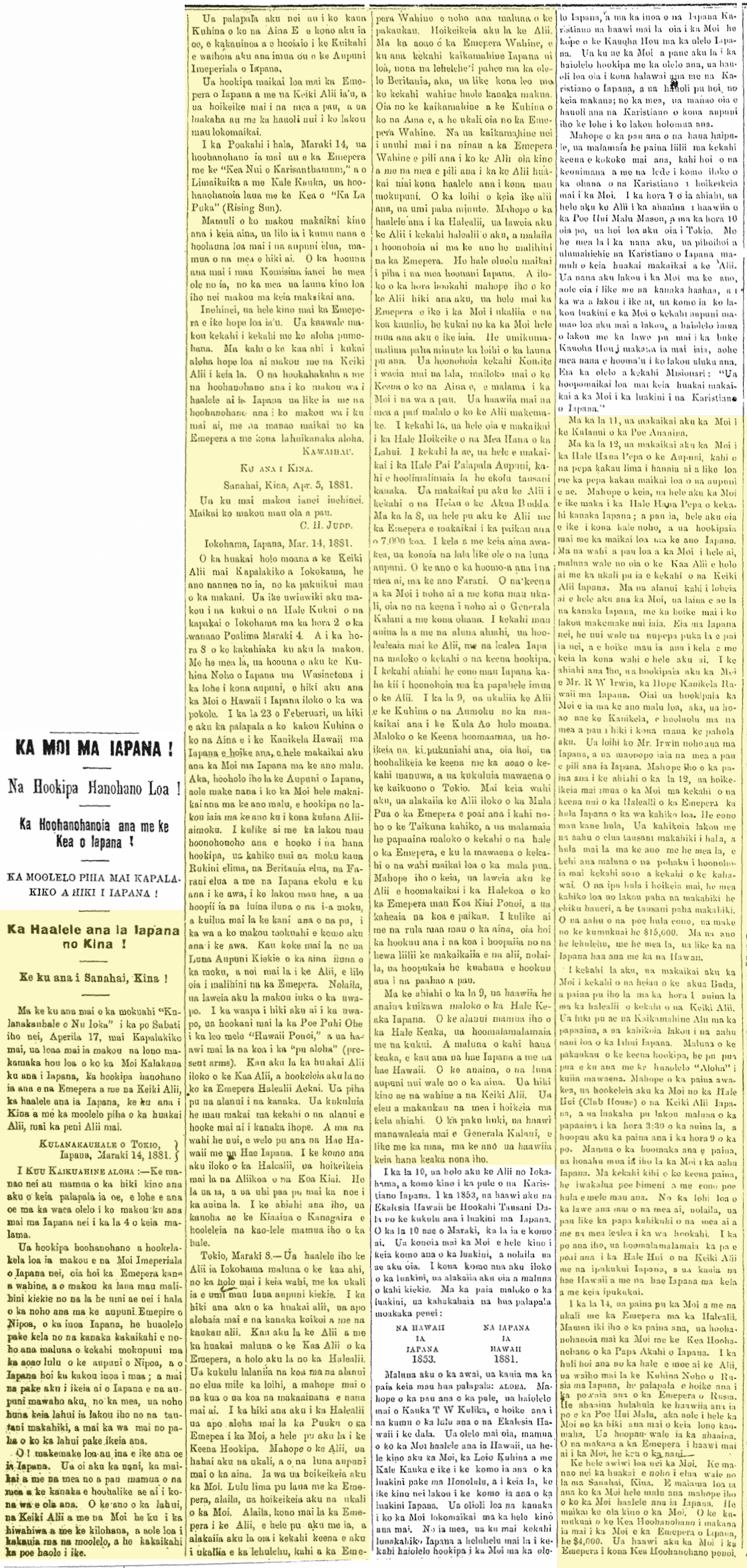
HIS MAJESTY IN JAPAN.

And the other article referred to therein,

Cast Thy Bread upon the Waters and Thou Shalt find it after Many Days.

Yokohama Union Church.

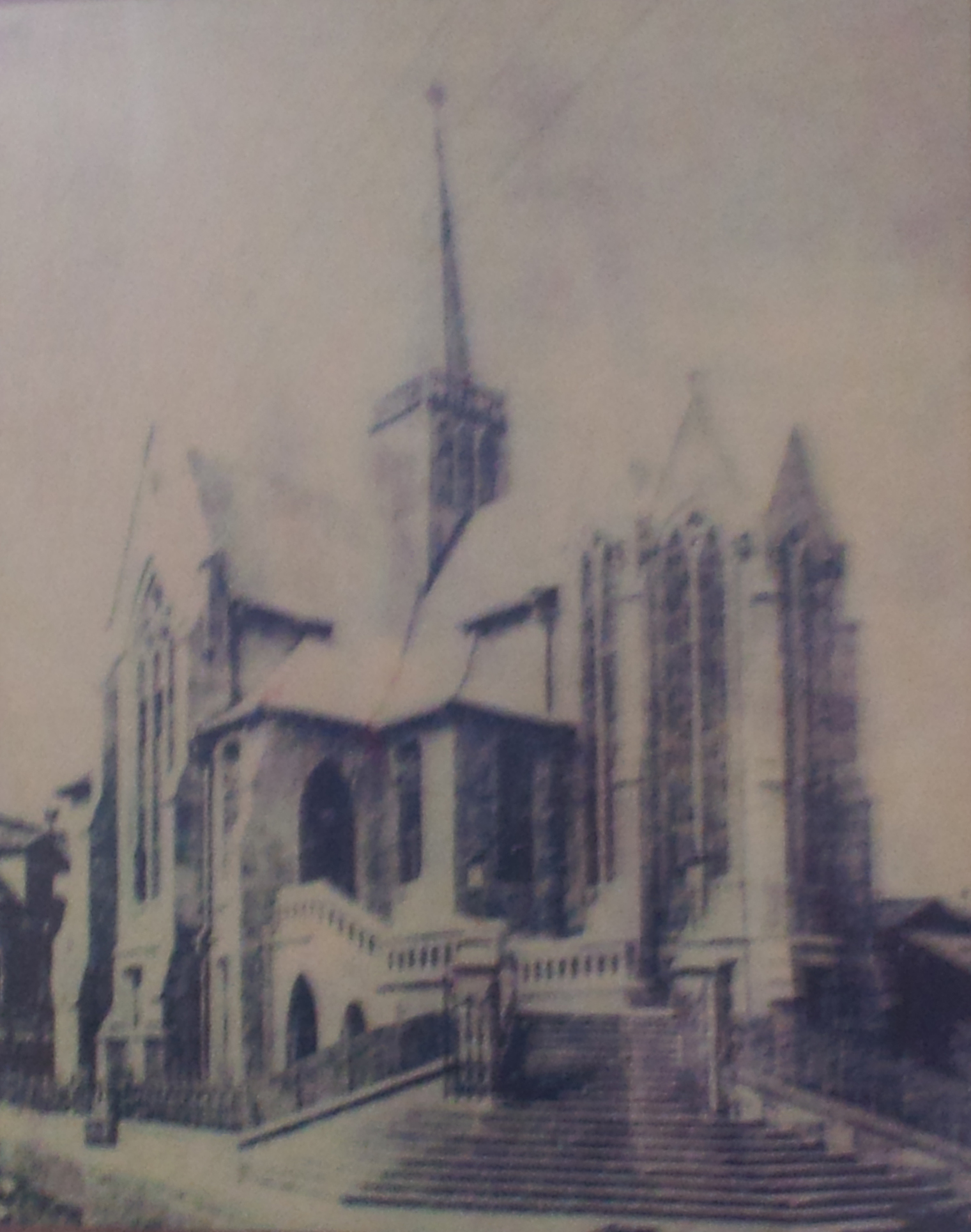
The church pastors did have this picture of the old church which was located on what is now a girl’s school nearby (Ferris). They do not believe that this is the church, because they hear it was built later (but there are no documentation to any of this)…

11/17/2011

Old Yokohama Union Church

…so I can’t say I stood where Kalakaua stood 130 years ago, but all I can say for sure is that it was close by…

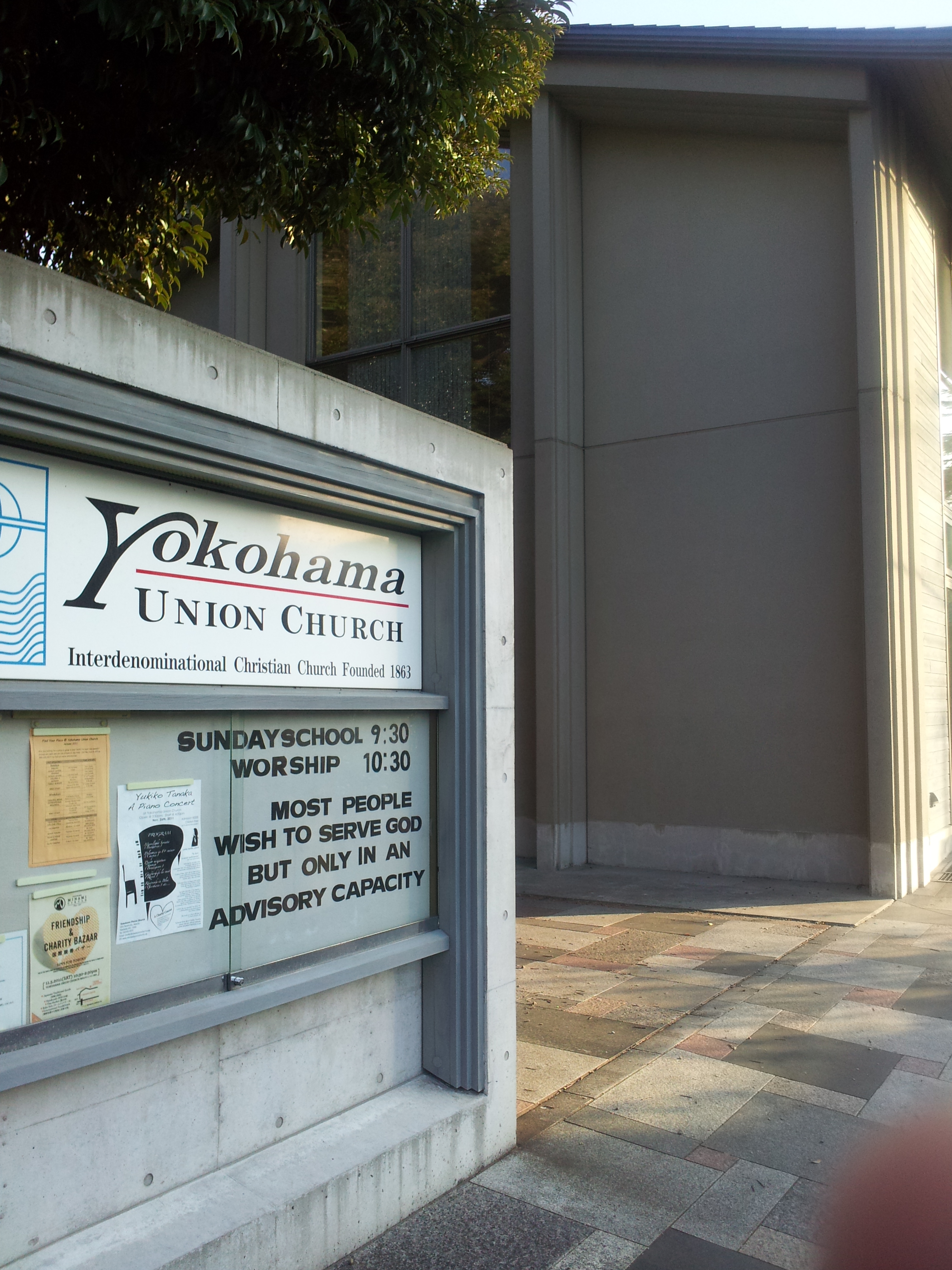
Yokohama Union Church, 2011.

The people in the archives were helpful and showed me the Union Church in Yokohama on a modern map. So I finally ended up here.

66-2 Yamate-cho, Naka-ku, Yokohama.

11/17/2011

Yokohama Union Church

…obviously it is was a new building. So I went to talk to the pastors and they had  no idea of the history of the church even after being there for more than 10 years. It seems history is lost with earthquakes and bombings.

In honor of Kalakaua’s birthday yesterday, I went in search of this church which he visited 130 years ago, 1881.

[Excerpt from:

“THE KING IN JAPAN

“Extremely Regal Welcome!

“Honored with the Cross of Japan!

“THE ENTIRE STORY FROM SAN FRANCISCO TO JAPAN!”]

On the 10th, the Royal One went to Yokohama, and joined in prayer with the Christians of Japan. In 1853, the churches of Hawaii donated One Thousand Dollars for the building of a church in Japan. The 10th of March was the opening. The King was invited to attend the opening of the church, and he agreed. When he walked into the church, he was lead to a high area. On the walls of the church, written in clear, large letters were:

Hawaii to Japan 1853.

Japan to Hawaii 1881.

Above the pulpit, on the wall was the letters: ALOHA. After the prayer, Doctor T. W. Gulick spoke on the reasons that the Hawaiian churches donated the money. He said, before the King left Hawaii, the King, the Attorney General, and Kale Kauka personally went to see the opening of the Chinese church in Honolulu; and on this day, they see in person the opening of the Japanese church. The people were overjoyed at the Kings good will, in his coming in person. At that, one of the Japanese elders stood and read a speech of welcome to the King in Japanese, and in the name of the Japanese Christians he gifted the King with a copy of the New Testament in Japanese. The King stood up and responded to the welcome speech by saying, he was happy to meet with the Christians of Japan, and that he was also overjoyed with the gift; because he believed the Christians of his nation would be thrilled to hear of the progress.

After the worship, a small party was held in a room close by, where gentlemen and ladies who entered into the family of Christians were shown to the King. At 7 in the evening, the Alii went to a party given by the Masons, and at 10 that night, he returned to Tokyo. It appeared as if the Christians of Japan were excited and happy at this appearance of the Alii. They looked at him as if he was not of the lower class, and when saw that their church was entered by a King of a far away land, and that he spoke before them and accepted the gift of the New Testament, none of them could control their nervousness. Here are the words of one of the Missionaries: “The King visiting the church is a great blessing to the Christians of Japan.”

  (Ko Hawaii Pae Aina, 4/23/1881, p. 2)

KA MOI MA IAPANA!

Ko Hawaii Pae Aina, Buke IV, Helu 17, Aoao 2. Aperila 23, 1881.

Kalakaua’s study abroad program, 1881.

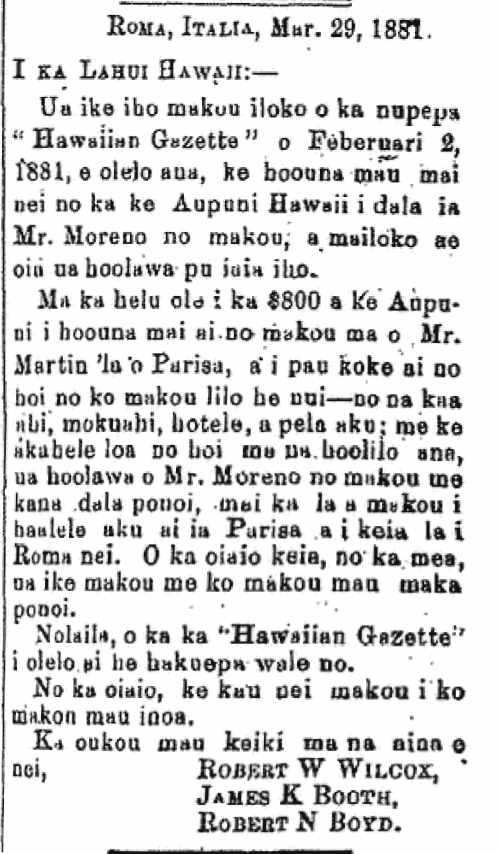
ROME, ITALY, Mar. 29, 1881.

TO THE LAHUI HAWAII:—

We saw in the newspaper “Hawaiian Gazette” of February 2, 1881, where it states, that the Hawaiian Government constantly sends money to Mr. Moreno for us, and from within this sum, he supports himself.

Without counting the $800 that the Government sent for us by way of Mr. Martin of Paris, that was soon spent on our many expenses—for the trains, steamships, hotels, and so forth; while being careful with our spending; Mr. Moreno took care of the remainder with his own money, from the day we left Paris until this day here in Rome. This is the truth, for we saw this with our own eyes.

Therefore, what the “Hawaiian Gazette” said was plain deception.

To attest to the truth, we affix our names.

Your children in foreign lands,

Robert W. Wilcox,
James K. Booth,
Robert N. Boyd.

(Ko Hawaii Pae Aina, 5/14/1881, p. 3)

ROMA, ITALIA, Mar. 29, 1881...

Ko Hawaii Pae Aina, Buke IV, Helu 20, Aoao 3. Mei 14, 1881.