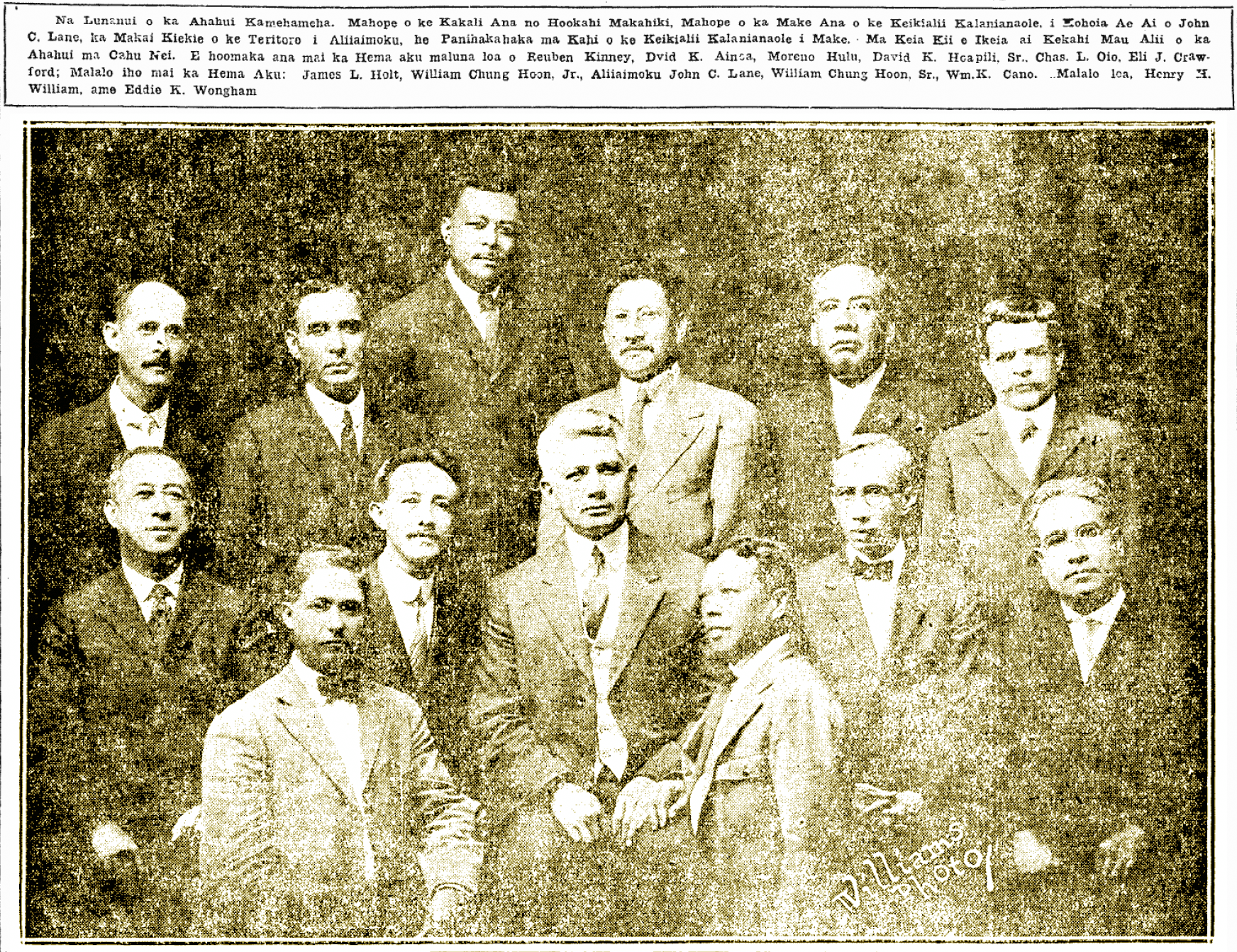
Royal Order of Kamehameha officers, 1923.

The Officers of the Ahahui Kamehameha. After Waiting for One Year After the Death of Prince Kalanianaole, John C. Lane, the High Sheriff of the Territory, was Elected as Aliiaimoku, the Replacement for the Deceased Prince Kalanianaole. In This Picture, Several Alii of the Ahahui of Oahu Nei Can be Seen. Starting from the Left top: Reuben Kinney, Dvid [David] K. Ainoa, Moreno Hulu, David K. Hoapili, Sr., Charles L. Oio, Eli J. Crawford; Next row down from the Left: James L. Holt, William Chung Hoon, Jr., Aliiaimoku John C. Lane, William Chung Hoon, Sr., William K. Cano. All the way on the bottom: Henry H. William and Eddie K. Wongham.

[This image is eerily clear for one taken from the current online images of the Hawaiian-Language Newspapers. Most of the pictures are just barely recognizable…]

(Kuokoa, 2/15/1923, p. 3)

Na Lunanui o ka Ahahui Kamehameha.

Ka Nupepa Kuokoa, Buke LXII, Helu 7, Aoao 3. Feberuari 15, 1923.

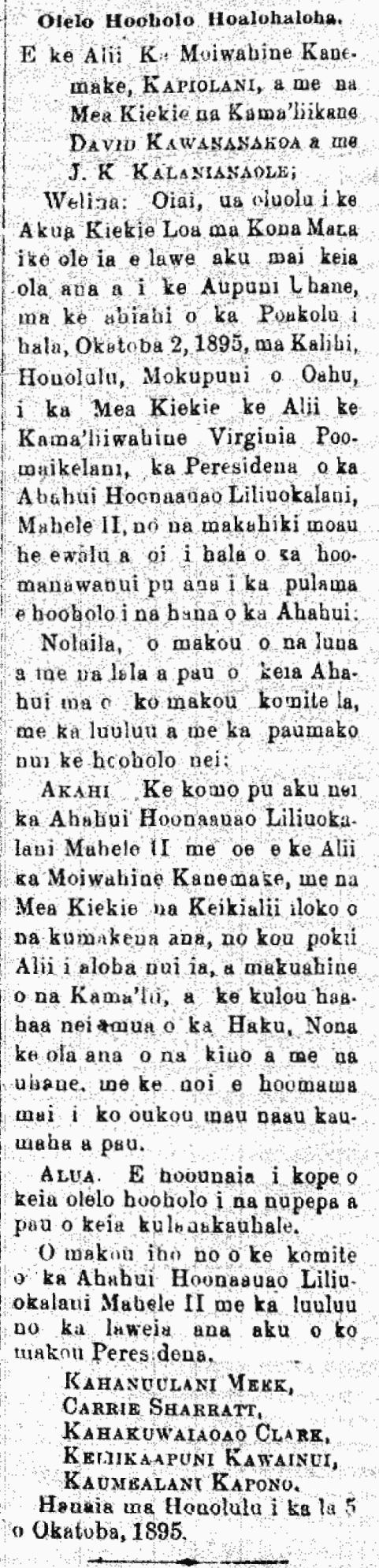
Words of condolences from the Liliuokalani Educational Society at the passing of Poomaikelani, 1895.

Resolution of Condolences.

To the Alii, the Dowager Queen Kapiolani; and Their Highnesses, Princes David Kawananakoa and J. K. Kalanianaole;

Greetings: Whereas the Almighty God has kindly in His unfathomable Power taken from this life to the Land of Souls, on the evening of this past Wednesday, October 2, 1895, at Kalihi, Honolulu, Island of Oahu, Her Highness, the Alii, Princess Virginia Poomaikelani, the President of the Liliuokalani Educational Society, Division II, for many years, eight or more, for which she patiently cared for along with us the advancement of the works of the Society.

Therefore, we, the officers and all of the members of the Society, through our committee, with sadness and grief, have resolved:

First. The Liliuokalani Educational Society, Division II, join with you, the Alii, the Queen Dowager and their Highnesses, the Princes, in your grief for your greatly beloved younger Royal sibling, the mother of the Royal Children, and we bow before the Lord, Whose is the life in the body and the soul, as we ask him to lighten your heavy hearts.

Second. A copy of this resolution shall be sent to all of the newspapers of this town.

We of the committee of the Liliuokalani Educational Society, Division II, with sorrow, at the taking of our President.

Kahanuulani Meek,

Carrie Sharratt,

Kahakuwaiaoao Clark,

Keliikaapuni Kawainui,

Kaumealani Kapono.

Done at Honolulu on the 5th of October, 1895.

(Makaainana, 10/14/1895, p. 2)

Olelo Hooholo Hoalohaloha.

Ka Makaainana, Buke IV----Ano Hou, Helu 16, Aoao 2. Okatoba 14, 1895.

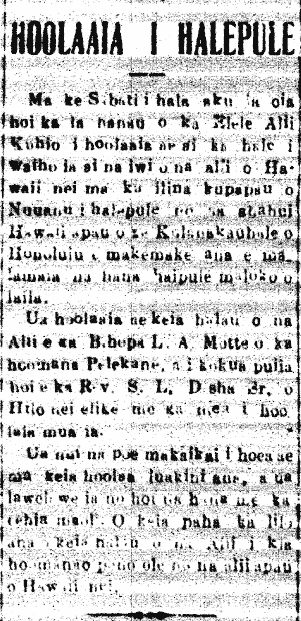
The royal mausoleum converted into a chapel, 1922.

DEDICATED AS A CHAPEL

On this past Sunday, that being the birthday of the Royal Representative Kuhio, the mausoleum that holds the bones of the alii of Hawaii nei in the cemetery of Nuuanu was made into a chapel for all the Hawaiian societies of Honolulu who wish to hold services there.

This house of the Chiefs was consecrated by the Bishop L. A. Motte [John D. LaMothe] of the Anglican Church [hoomana Pelekane] and assisted by Rev. S. L. Desha, Sr. of Hilo, as was planned earlier.

There were many people who came to see the consecration, and the ceremony was done with much reverence. This will likely make this house of the Alii a unforgettable [?] monument to all the alii of Hawaii.

[Much of the Hilo newspaper, Hoku o Hawaii, is digitized badly, and can hardly be read. This particular article is one of the better ones. I hope all of the illegible articles are not important ones!]

(Hoku o Hawaii, 3/30/1922, p. 3)

HOOLAAIA I HALEPULE

Ka Hoku o Hawaii, Buke XV, Helu 44, Aoao 3. Maraki 30, 1922.

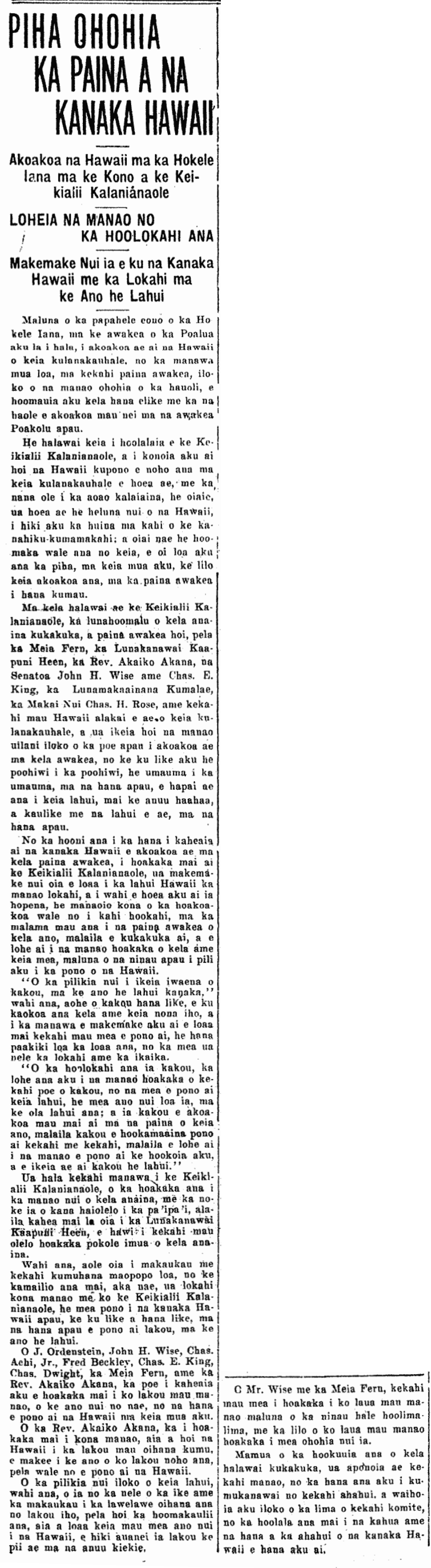
Kuhio and the Hawaiian Civic Clubs. 1918.

THE PARTY OF HAWAIIANS  WAS FILLED WITH ENTHUSIASM

Hawaiians Gathered at the Young Hotel at the Invitation of Prince Kalanianaole

HEARD WAS IDEAS FOR UNIFICATION

Desired that Hawaiians Stand Together as a People

On the sixth floor of the Young Hotel, at noon this past Tuesday, the Hawaiians of this town gathered for the first time, for a luncheon amid enthusiasm and joy, and this will be a regular thing, like the haole regularly meet at noon on Wednesdays.

This was a meeting organized by Prince Kalanianaole, and Hawaiians of good standing who live here in town were invited to attend, without attention being paid to political affiliation; it is true, many Hawaiians came, and the total number was about seventy-one; and being that this is just the beginning, it will be more full in the future, should this gathering at lunch become a regular thing.

At this meeting was Prince Kalanianaole, the chairman of this meeting and luncheon, and also Mayor Fern, Circuit Judge Heen, Rev. Akaiko Akana, Senators John H. Wise and Charles E. King, Representative Kumalae, Sheriff Charles H. Rose, and some other Hawaiian leaders of town; and everyone gathered there that afternoon seemed spirited to stand shoulder to shoulder, chest to chest, in all things; to lift this lahui from the low level to be equal with the other ethnicities in all aspects.

In order to move forward the agenda for which the Hawaiians gathered at that luncheon, Prince Kalanianaole explained that he greatly wished that the Hawaiian people would think as one, and as a means to that ends, he believes that meeting together in one place by holding regular luncheons of that sort, is where you’d discuss things and hear explanation from different people on all questions regarding the well-being of Hawaiians.

“The great problem seen amongst us, as a people,” according to him, is that we don’t cooperate; we all stand independently, and when we want good works to be done, it is very hard to accomplish for we lack unity and strength.

“Unifying ourselves, and listening to people talk about things that will benefit this lahui is very important for the perpetuation of the lahui; and as we gather regularly at meals of this sort, we will become familiar with each other, and we will hear ideas that should be carried out, and we will be seen as a lahui.”

Some time was spent by Prince Kalanianaole explaining the goals of that gathering while his speech was encouraged by applause, then he called up Circuit Judge Heen to give a few words of clarification before the crowd.

According to him, he was not prepared with a clear topic to talk about, however, he was in agreement with Prince Kalanianaole; all Hawaiians must stand together and work as one in all endeavors that will better themselves as a lahui.

J. Ordenstein, John H. Wise, Charles Achi, Jr., Fred Beckley, Charles E. King, Charles Dwight, Mayor Fern, and Rev. Akaiko Akana were called to explain their overall thoughts as to what is to be done to benefit Hawaiians from here forth.

Rev. Akaiko Akana shared his thoughts; when Hawaiians go back to their traditional occupations [?] and cherish their way of life, that is the only way Hawaiians will be blessed.

The big problem with this lahui, according to him, is the lack of knowledge and readiness to go into business for themselves and so too with being economical; when these important things are acquired by Hawaiians, they will be able to climb to a high level.

Mr. Wise and Mayor Fern were some who spoke of their ideas on the question of leasing a building [?], and their ideas were heard with much enthusiasm.

Before the meeting was adjourned, one idea was approved, to draft a constitution for a club, and to place it in the hands of a committee to lay out the foundation and mission that this association of Hawaiians would carry out.

(Kuokoa, 11/29/1918, p. 1)
PIHA OHOHIA KA PAINA A NA KANAKA HAWAII

Ka Nupepa Kuokoa, Buke LVI, Helu 48, Aoao 1. Novemaba 29, 1918.
Kuhio and the water of Wahiawa, 1912.

KUHIO OPPOSES THE SALE OF WAHIAWA’S WATER

WASHINGTON, February 1.—Delegate Kuhio submitted a protest to the secretary of the department of war opposing the plan announced by the war department t0 lease out the rights to the water rights of Wahiawa to the highest bidder. He clarified in his complaint that the land and water rights of lands set aside for the military by the Federal Government for the use of the military, and by right it is improper that the water be taken as an income-making commodity for the Federal Government. The delegate feels that the Federal Government is allowed to take and use the water on the lands set aside for the military, but the the entirety of the remaining water should fall under the authority of the Territory of Hawaii; or perhaps a different route, that the income made from sale or lease of this water should all come back to the Territory and should not go to the Federal Government. This idea of Delegate Kuhio’s  is greatly supported by the representatives of this Territory in Washington.

(Kuokoa, 2/16/1912, p. 5)

KU-E O KUHIO I KE KUAIIA O KA WAI O WAHIAWA

Ka Nupepa Kuokoa, Buke XLVIII, Helu 7, Aoao 5. Feberuari 16, 1912.