On the moving of the Na-ha Stone to Hilo Library 100 years ago, and its history (3 of 6), 1915.

THE STORY OF THE NA-HA STONE

(Continued)

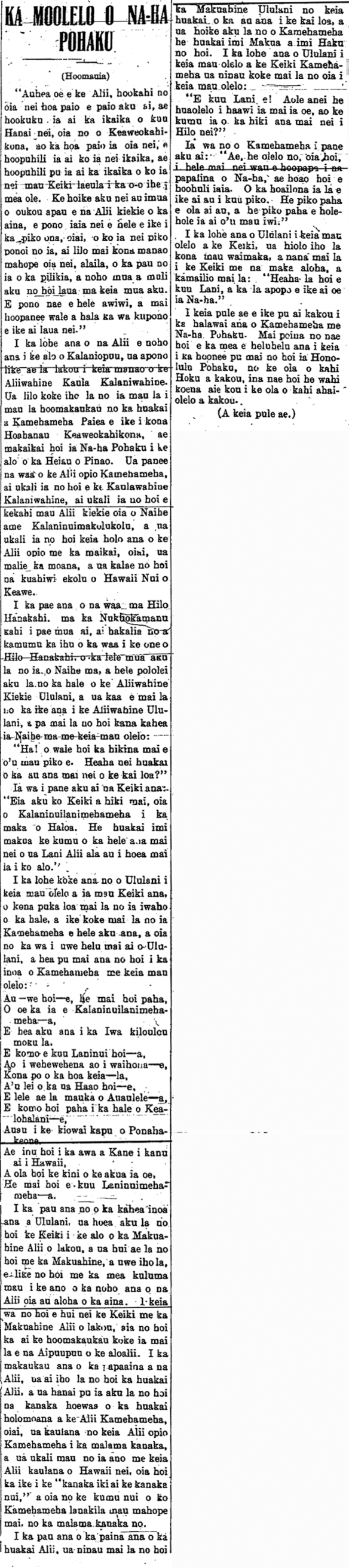
“Hear me, O Alii; he has but one opponent to fight where the strength of this hanai of mine will be challenged, that is Keaweokahikona, and this is his one opponent that will thwart his strength, and who will also thwart the strength of his young experts in spear throwing, making it into nothing. I say before you all, O high Chiefs of the land, he must go see this relative of his, for he [Keaweokahikona] is his own blood relative [piko], and should he [Keaweokahikona] decide to follow him, then there will be no more difficulties and they will live as leader and follower from here forth. But he must go quickly and not put it off until the time they should meet has past.

When the alii living in the court of Kalaniopuu heard this, they all approved of this idea of this Prophet Chiefess Kalaniwahine. The days were soon spent preparing for the journey of Kamehameha Paiea to see his cousin Keaweokahikona, and to visit the Naha Stone in the front of Pinao Heiau. The canoes of the young chief Kamehameha were set forth, and they were escorted by a number of high chiefs, they being Naihe and Kalaninuimakolukolu, and these travels of the young chief was accompanied by grace with the seas being calm and the three mountains of Great Hawaii of Keawe were clear.

When the canoes landed at Hilo Hanakahi, they first came ashore at Nukuokamanu [Kanukuokamanu], and as soon as the prow of the canoe rumbled against the sand of Hilo Hanakahi, Naihe folks disembarked first and headed straight for the house of the High Chiefess Ululani; the news had reached the Chiefess Ululani in advance and she called out to Naihe with these words:

“Ha! Hey, my relatives have arrived. What is the reason for your taking this trip across the wide sea?”

At this time her children responded: “Your child is arriving, that is Kalaninuilanimehamehaikamakaohaloa. This is a voyage of that Heavenly Chief to seek a mother, and that is why I appear before you.”

(Hoku o Hawaii, 12/16/1915, p. 2)

KA MOOLELO O NA-HA POHAKU

Ka Hoku o Hawaii, Buke 10, Helu 28, Aoao 2. Dekemaba 16, 1915.
On the moving of the Na-ha Stone to Hilo Library 100 years ago, and its history (2 of 6), 1915.

…the bitter words of Keawemauhili for his charge, Naeole gathered the young leaves of the bitter gourd [ipu awaawa] and broiled them until cooked, and fed them to Kamehameha as if it were young taro leaves,  and it is said that Naeole did this so that the biting and bitter words of Keawemauhili for his charge were neutralized, and those words spoken were those famous words of Hawaii nei of the olden days. “Nip the bud of the wauke while still young.” [“E o-u ka maka o ka wauke oi opiopio.”]

When Kamehameha grew older, and his own father, Keouanui, died, believed to have “been fed a cup of koheoheo by Alapainui here in Hilo,” [“hanai apu koheoheo ia e Alapainui ma Hilo nei,”] that is given poison in his food; Kalaniopuu, Keoua’s elder brother, was in the district of Kau, but moved forth to war with Alapainui, and war was fought where Kalaniopuu retreated. Afterwards war was waged upon the Son of Alapainui, and he died near Kawaihae, and all of Hawaii Island became ruled by Kalaniopuu. Continue reading

On the moving of the Na-ha Stone to Hilo Library 100 years ago, and its history (1 of 6), 1915.

THE STORY OF THE NA-HA STONE

These passing days, the Board of Trade of Hilo [Papa o ka Hui Kalepa o Hilo] is considering moving the Naha Stone [Na-ha Pohaku] from where it now is placed and putting it by the Library of the Hilo Town, and the Editor of the Hoku o Hawaii [S. L. Desha] was asked to tell of some things pertaining to this Royal Stone, and which were contained in the old history of this land, and that will become something for the Natives of this land to understand things about the history of this Birth Stone of the Alii of the Naha Class.

The Naha Stone spoken of in this story is the great Pohaku that is lies in Piihonua in Hilo Town on the Hilo side of Waianuenue Avenue, and is in front of the first house foundation of Governor Kipi of Hilo, and that place is named after an old Heiau called “Pinao.”

In the history of this Royal Stone, it is said that the Pohaku was brought from the Wailua River on Kauai, and it was brought upon double-hulled canoes, and it was brought by a high Chief of long ago named MAKALIINUIKUAKAWALE (m), and this pohaku was brought as a sign of chiefly births and this Pohaku Alii was placed before the Pinao Heiau. Continue reading

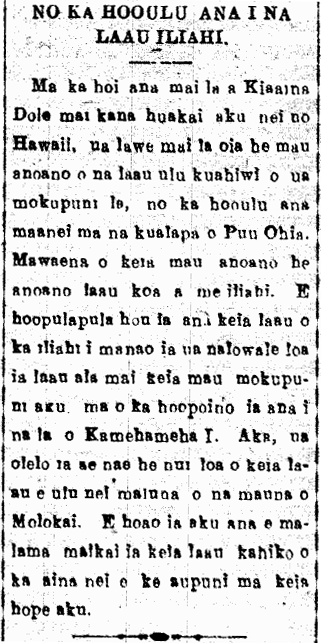
Reforesting Puu Ohia, Oahu, 1900.

PERTAINING TO GROWING SANDALWOOD.

On the return of Governor Dole from his travels to Hawaii, he brought back some seed of trees growing in the mountains of that island to grow here on the ridges of Puu Ohia [Tantalus]. Among these were koa and iliahi seeds. This tree, the iliahi, will be increased; it was believed no longer existing on these islands because of abuse during the days of Kamehameha I. However, it is said that there is a great number of these trees growing in the mountains of Molokai. From here forth, the government will try to care well for these ancient tree of the land.

(Aloha Aina, 8/25/1900, p. 5)

NO KA HOOULU ANA I NA LAAU ILIAHI.

Ke Aloha Aina, Buke VI, Helu 34, Aoao 5. Augate 25, 1900.

“Kearny cloak” aboard the Malolo, 1927.

[Found under: “Nuhou Kuwaho”]

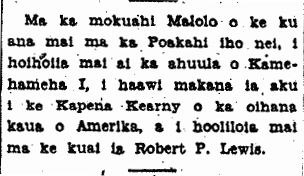
By way of the steamship Malolo which arrived this past Monday, returned was the feather cape of Kamehameha I that was presented to Captain Kearny of the armed forces of America, and which was obtained through purchase by Robert P. Lewis.

(Kuokoa, 11/24/1927, p. 4)

Ma ka mokuahi Malolo...

Ka Nupepa Kuokoa, Buke LXVI, Helu 52, Aoao 4. Novemaba 24, 1927.

Kamehameha Day proclaimed, 1871.

BY AUTHORITY.

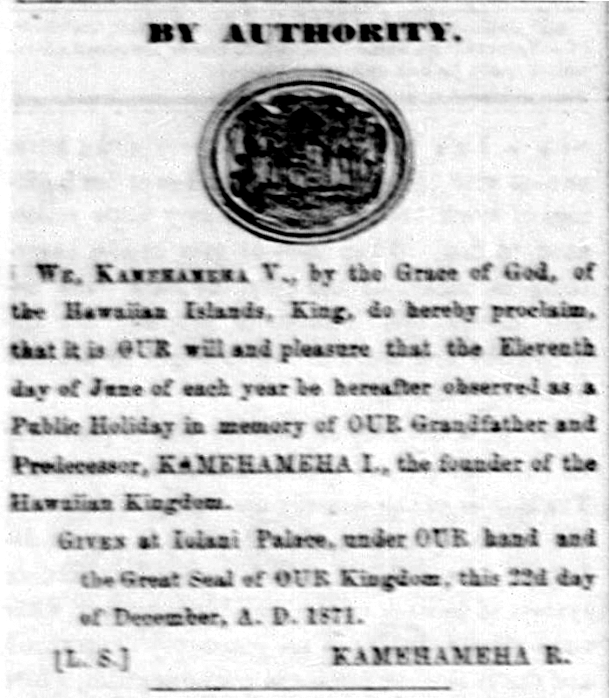
We, Kamehameha V., by the Grace of God, of the Hawaiian Islands, King, do hereby proclaim, that it is OUR will and pleasure that the Eleventh day of June of each year be hereafter observed as a Public Holiday in memory of OUR Grandfather and Predecessor, KAMEHAMEHA I, the founder of the Hawaiian Kingdom.

Given at Iolani Palace, under OUR hand and the Great Seal of OUR Kingdom, this 22nd day of December, A. D. 1871.

[Legal Seal] KAMEHAMEHA R.

(Hawaiian Gazette, 12/27/1871, p. 2)

BY AUTHORITY.

Hawaiian Gazette, Volume VII, Number 50, Page 2. December 27, 1871.

Official Proclamation of the first Kamehameha Day Holiday, 1872.

[Found under: “MA KE KAUOHA.”]

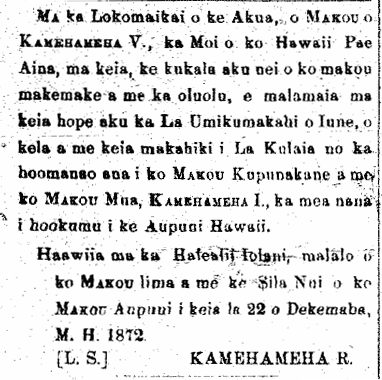
By the Blessings of God, We, Kamehameha V., the King of the Hawaiian Islands, through this, proclaim that it is our desire and pleasure that from here forth, the eleventh day of June, of every year will be a Holiday to memorialize Our Grandfather and Our Progenitor, Kamehameha I., the one who founded the Nation of Hawaii.

Given at Iolani Palace, by Our hand and Great Seal of Our Nation on this 22nd of December, 1872.

[Legal Seal] KAMEHAMEHA Rex.

(Au Okoa, 12/28/1871, p. 2)

Ma ka Lokomaikai o ke Akua...

Ke Au Okoa, Buke VII, Helu 37, Aoao 2. Dekemaba 28, 1871.

Announcing the first Kamehameha Day, 1872.

[Found under: “NU HOU KULOKO.”]

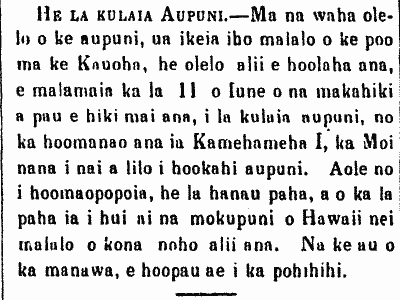
National Holiday.–According to the spokesman of the nation [Ke Au Okoa], seen under the heading, “By Order,” was proclaimed the word of the king that the 11th of June every year will be observed as a national holiday to memorialize Kamehameha I, the King who unified the kingdom into one. It is not known whether it is his birthday, or whether it is the day that the islands of Hawaii were united under his rule. Time will clear up the confusion.

(Kuokoa, 12/30/1871, p. 2)

He la kulaia Aupuni.

Ka Nupepa Kuokoa, Buke X, Helu 52, Aoao 2. Dekemaba 30, 1871.

More on the first Kamehameha Day, 1872.

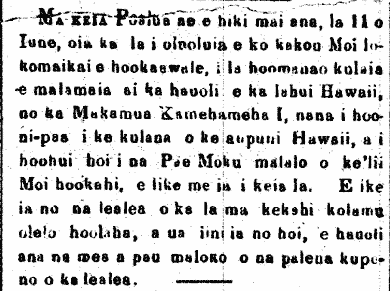
On this upcoming Tuesday, the 11th of June; this is the day which pleases our benevolent King, to set aside as a memorial holiday where the Hawaiian people should rejoice in honor of the progenitor Kamehameha I, who established the Hawaiian nation and who united the archipelago beneath one King, as it is today. The festivities of the day can be seen in the announcements column and it is desired that all enjoy themselves within the proper bounds.

(Au Okoa, 6/6/1872, p. 2)

Ma keia Poalua ae e hiki mai ana...

Ke Au Okoa, Buke VIII, Helu 8, Aoao 2. Iune 6, 1872.

The first Kamehameha Day, 1872.

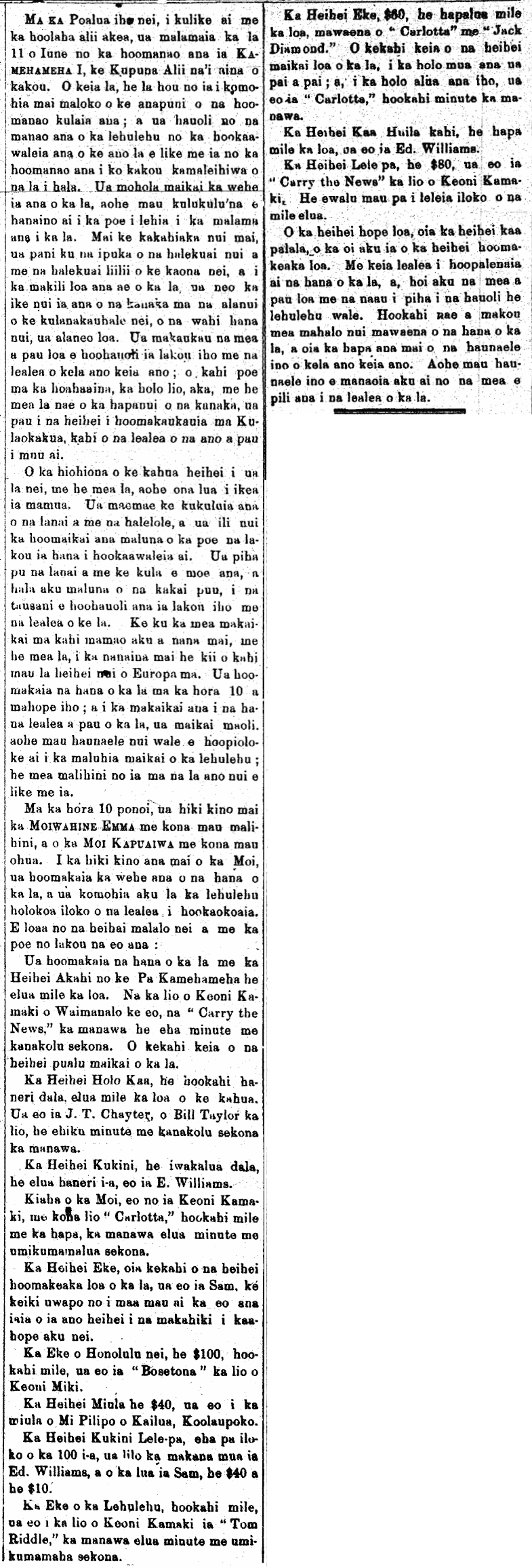
On this past Tuesday, in accordance with the royal proclamation, the 11th of June was celebrated as a day of remembrance of Kamehameha I, the Royal Ancestor who conquered our aina. This is a new day included in the circle of holidays, and the minds of the populace are happy about this type of day set aside to remember our cherished one of days gone by. The day dawned beautifully; there were no droplets to interfere with those who skillfully took care of the day. From early morning the doors of the shops of the town, both large and small, were shut. And when the sun came all the way out, there were not many people seen on the streets of town, and the great work places were deserted. All things meant to entertain themselves were prepared—some people made parties while others rode horses; however, it seemed as if most of the people were all at the races organized at Kulaokahua, the usual place for all types of entertainment.

The atmosphere of the race tracks that day seemed better than all previous days. Lanai and tents were set up impeccably, and those that undertook that task received much appreciation. The lanai, fields, and hills were filled with thousands who amused themselves with the events of the day. If an observer stood and watched from afar, it was as if he were seeing a picture of a race day somewhere like in Europe. The events of the day started at 10 or so, and after watching all the day’s activities, it was truly wonderful. There were no great commotions to disturb the peace among the crowd–this is something unfamiliar on special days like these.

At 10 o’clock sharp, Queen Emma arrived with her guests, and King Kapuaiwa with his entourage. At the appearance of the King, the activities of the day commenced, and all of the crowd joined in the gaieties that were set up. Below, you will find the races and those that won.

[Various horse races, winners, and prizes are listed.]

The final race, the wheelbarrow race was the most humorous. This entertainment marked the close of the festivities of the day. And everyone left with hearts filled with much glee. We are greatly pleased with one thing, and that is the decrease in the number of outbreaks of various sorts. There were no big riots thought to be related to the events of the day.

(Au Okoa, 6/13/1872, p. 2)

Ma ka Poalua iho nei...

Ke Au Okoa, Buke VIII, Helu 9, Aoao 2. Iune 13, 1872.