The death of Jonah Piikoi and his autobiography, 1859.

The death of J. Piikoi.

On the 26th of April, the Honorable J. Piikoi, one of the alii of this Hawaiian archipelago died. He was a much admired man for his competence and his determination in the duties given to him. He was 55 years old, and the sickness he died of was of quick pulse [? aalele nui], and problems with his blood flow, and he died.

Before the death of Piikoi, he prepared a story of his life, from his birth until the day he wrote it, that being the 7th of April. This is it below:

The Autobiography of J. Piikoi

I was born in the month of Ikuwa, that being January, in the year of the Lord 1804.

I was born in Waimea, Kauai, and that was where I was raised until the first Liholiho landed on Kauai on the 22nd of the month of  July, 1821. Continue reading

Death of Kaahumanu II, Kinau, 1839.

DEATH.

KAAHUMANU II.

At Honolulu on the 4th of this April.

She became sick on the 30th of December, in the early  morning; the sickness was paralysis. Her left hand and leg became paralyzed, and on the 31st, she was overcome by  sleep: She slept until the paralysis of her left side abated, but her sleep increased until the 2nd of April, and her siblings [? hoahanau] could not wake her. Continue reading

Honolulu Hale torn down to build a parking lot, 1917.

Historic Building  of ’30s to Be Razed Soon
Honolulu Hale Sold to Frank Godfrey for $10

Honolulu Hale, build about 1836 by Kamehameha III, which was sold today for $10.

Historic Honolulu Hale sold for $10 to one lone bidder Frank Godfrey, today at noon when King Kalakaua’s dinner bell called together a small group of spectators to witness the last event in the life of the building. Within 60 days the building will be torn down and the ground upon which it stands will be cleared of all traces of it, according tothe agreement which the purchaser signed after the auction. The auction was conducted by Elmer L. Schwarzberg of James F. Morgan Co. and in the curious crowd were a number of Honolulu’s kamaainas—old-timers. Continue reading

On the birthday of Kamehameha III, 1958.

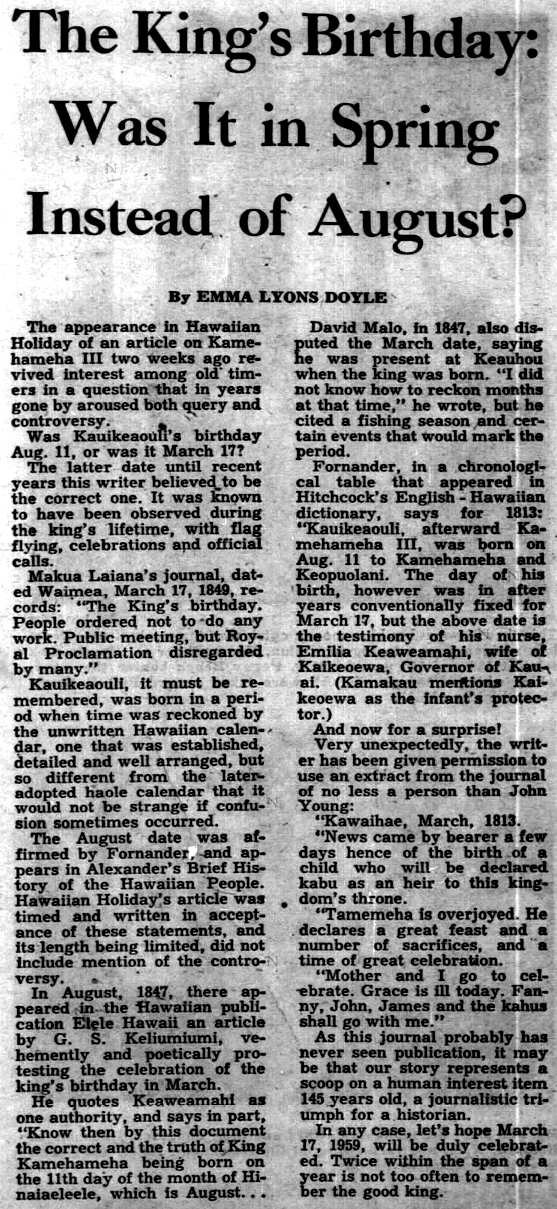
The King’s Birthday: Was It in Spring Instead of August?

By EMMA LYONS DOYLE

The appearance in Hawaiian Holiday of an article on Kamehameha III two weeks ago revived interest among old timers in a question that in years gone by aroused both query and controversy.

Was Kauikeaouli’s birthday Aug. 11, or was it March 17?

The latter date until recent years this writer believed to be the correct one. It was known to have been observed during the king’s lifetime, with flag flying, celebrations and official calls.

Makua Laiana’s [Lorenzo Lyons’] journal, dated Waimea, March 17, 1849, records: “The King’s birthday. People ordered not to do any work. Public meeting, but Royal Proclamation disregarded by many.”

Kauikeaouli, it must be remembered, was born in a period when time was reckoned by the unwritten Hawaiian calendar, one that was established, detailed and well arranged, but so different from the later-adopted haole calendar that it would not be strange if confusion sometimes occurred.

The August date was affirmed by Fornander, and appears in Alexander’s Brief History of the Hawaiian People. Hawaiian Holiday’s article was timed and written in acceptance of these statements, and its length being limited, did not include mention of the controversy.

In August, 1847, there appeared in the Hawaiian publication Elele Hawaii [10/6/1847, pp. 99–100] an article by G. S. Keliumiumi, vehemently and poetically protesting the celebration of the king’s birthday in March.

He quotes Keaweamahi as one authority, and says in part, “Know then by this document the correct and the truth of King Kamehameha being born on the 11th day of the month of Hinaiaeleele, which is August…

David Malo, in 1847, also disputed the March date, saying he was present at Keauhou when the king was born. “I did not know how to reckon months at that time,” he wrote, but he cited a fishing season and certain events that would mark the period.

Fornander, in a chronological table that appeared in Hitchcock’s English – Hawaiian dictionary, says for 1813: “Kauikeaouli, afterward Kamehameha III, was born on Aug. 11 to Kamehameha and Keopuolani. The day of his birth, however was in after years conventionally fixed for March 17, but the above date is the testimony of his nurse, Emilia Keaweamahi, wife of Kaieoewa [Kaikioewa], Governor of Kauai. (Kamakau mentions Kaikeoewa as the infant’s protector.)

And now for a surprise!

Very unexpectedly, the writer has been given permission to use and extract from the journal of no less a person than John Young:

“Kawaihae, March, 1813.

“News came by bearer a few days hence of the birth of a child who will be declared kabu as an heir to this kingdom’s throne.

“Tamehameha is overjoyed. He declares a great feast and a number of sacrifices, and a time of great celebration.

“Mother and I go to celebrate. Grace is ill today. Fanny, John, James and the kahus shall go with me.”

As this journal probably has never seen publication, it may be that our story represents a scoop on a human interest item 145 years old, a journalistic triumph for a historian.

In any case, let’s hope March 17, 1959, will be duly celebrated. Twice within the span of a year is not too often to remember the good king.

(Advertiser, 8/24/1958, Hawaiian Holiday, p. 7)
Advertiser_8_24_1958_HH_7.png

Honolulu Advertiser, 102nd Year, Number 34,394, Hawaiian Holiday, Page 7. August 24, 1958.
Memorial to King Kamehameha III, 1912.

Memorial To Kamehameha III Perhaps To Be Built

The Daughters of Hawaii residing in Honolulu have decided to build a Memorial to Kamehameha III, the kindhearted Alii, in the place where the alii  was born in Keauhou, and sent Miss Ana Paris to look at the place and report back to the Association. Continue reading

Kaahumanu Society commemorates King Kauikeaouli, 1924.

In Kawaiahao Church, on Sunday, the 16th of March, the Kaahumanu society will hold a commemoration for King Kauikeaouli, like the announcement that was printed in this paper, and all the members of the Kaahumanu  Societies are wanted to have a commemorative gathering of that type on their islands.

(Kuokoa, 3/6/1924, p. 1)

Kuokoa_3_6_1924_1.png

Ka Nupepa Kuokoa, Buke LXIII, Helu 10, Aoao 1. Maraki 6, 1924.

150 years ago, people were reading about the arrival of Catholicism, in S. M. Kamakau’s great history, 1869.

THE HISTORY OF HAWAII.

By S. M. Kamakau.

NUMBER 97.

Pertaining to the Reign of Kauikeaouli over the Nation, he being called Kamehameha III.

Pertaining to the arrival of Catholicism, in the year 1827 [1837].

In the month of September, in the year 1836. A Catholic priest [kahuna katolika Roma] arrived, the Rev. Aresaniao R. Walsh [Rev. Arsenius Robert Walsh], from Britain. He were not expelled, but was forbidden by the Chiefs, that he should not proselytize amongst the Hawaiians. But he went and argued with some Protestant priests [Kahuna Hoole Pope]. He indeed converted Hawaiians and secretly Baptized some people. Continue reading

The Hon. Daniela Kahaulelio’s reminiscences of Lahaina, 1898.

The History

— OF —

Lahaina Town

Composed by the
Hon. D. Kahaulelio,
The Judge of the Shade of the Breadruit Trees of Lele.

S. P. KALAMA WAIAWAAWA.

This is a story pertaining to the one of this issue:

King Kamehameha III was sailing aboard an American warship for the Kanilehua rains of HIlo, and along with him was G. P. Kauka [G. P. Judd], the father of the Chief Justice A. F. Kauka [A. F. Judd], was with him; he was a favorite and a translator for the alii aboard the ship. The Captain wanted his officers to explain clearly the length in time and the direction, and while the officers were making preparations, S. P. Kalama Waiawaawa asked the King:

What are they doing? Continue reading

Name song for Kamehameha V by Kamehameha III, 1868.

HE INOA NO KAMEHAMEHA V.

Kalani nui Kapuaiwa i ke kapu he inoa,
O ulupuni o ke aloha uluahewa,
O hoolailai e ko mai ke ano,
He ano aloha no kuu makuahine,
No’u keia liliha kumakena,
E luanuu a Keakalaniakau,
O ke kakau uhi kikowana o kewe,
Inoa makapala o Ahukini,
O oe kai luna o Kahakoililani,
I ka he o Mamakalau o Waikulani,
O Waikulani o ka manu haalilo,
Nana ia Lani na Ekamapu,
Na ka manu mapu o Kaulia,
Nana i leleluna o Numehalani,
I lele kohai i ka wa o Lauahea,
I ke kowa kapu o Hinamalailena,
I maka noenoe lani wahine a ma,
E hanini wale ana no ka waimaka,
Aloha oe—Olia? Continue reading