Kamehameha Day proclaimed, 1871.

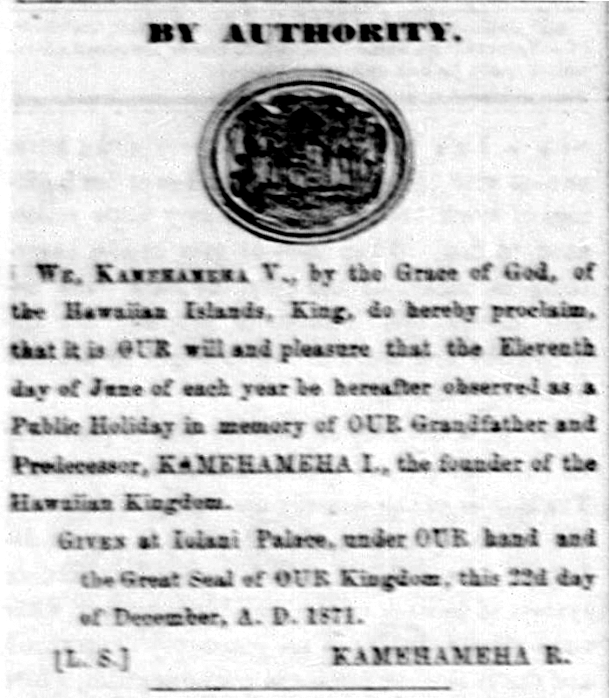
BY AUTHORITY.

We, Kamehameha V., by the Grace of God, of the Hawaiian Islands, King, do hereby proclaim, that it is OUR will and pleasure that the Eleventh day of June of each year be hereafter observed as a Public Holiday in memory of OUR Grandfather and Predecessor, KAMEHAMEHA I, the founder of the Hawaiian Kingdom.

Given at Iolani Palace, under OUR hand and the Great Seal of OUR Kingdom, this 22nd day of December, A. D. 1871.

[Legal Seal] KAMEHAMEHA R.

(Hawaiian Gazette, 12/27/1871, p. 2)

BY AUTHORITY.

Hawaiian Gazette, Volume VII, Number 50, Page 2. December 27, 1871.

Official Proclamation of the first Kamehameha Day Holiday, 1872.

[Found under: “MA KE KAUOHA.”]

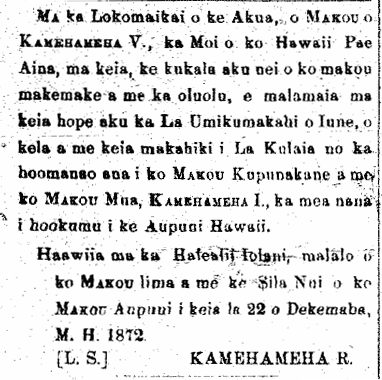
By the Blessings of God, We, Kamehameha V., the King of the Hawaiian Islands, through this, proclaim that it is our desire and pleasure that from here forth, the eleventh day of June, of every year will be a Holiday to memorialize Our Grandfather and Our Progenitor, Kamehameha I., the one who founded the Nation of Hawaii.

Given at Iolani Palace, by Our hand and Great Seal of Our Nation on this 22nd of December, 1872.

[Legal Seal] KAMEHAMEHA Rex.

(Au Okoa, 12/28/1871, p. 2)

Ma ka Lokomaikai o ke Akua...

Ke Au Okoa, Buke VII, Helu 37, Aoao 2. Dekemaba 28, 1871.

Announcing the first Kamehameha Day, 1872.

[Found under: “NU HOU KULOKO.”]

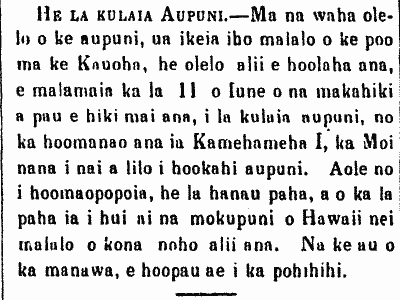
National Holiday.–According to the spokesman of the nation [Ke Au Okoa], seen under the heading, “By Order,” was proclaimed the word of the king that the 11th of June every year will be observed as a national holiday to memorialize Kamehameha I, the King who unified the kingdom into one. It is not known whether it is his birthday, or whether it is the day that the islands of Hawaii were united under his rule. Time will clear up the confusion.

(Kuokoa, 12/30/1871, p. 2)

He la kulaia Aupuni.

Ka Nupepa Kuokoa, Buke X, Helu 52, Aoao 2. Dekemaba 30, 1871.

More on the first Kamehameha Day, 1872.

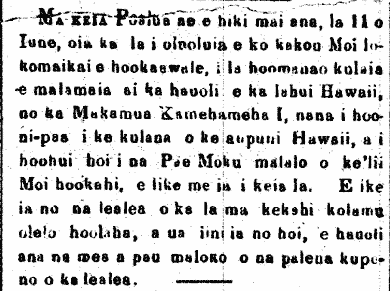
On this upcoming Tuesday, the 11th of June; this is the day which pleases our benevolent King, to set aside as a memorial holiday where the Hawaiian people should rejoice in honor of the progenitor Kamehameha I, who established the Hawaiian nation and who united the archipelago beneath one King, as it is today. The festivities of the day can be seen in the announcements column and it is desired that all enjoy themselves within the proper bounds.

(Au Okoa, 6/6/1872, p. 2)

Ma keia Poalua ae e hiki mai ana...

Ke Au Okoa, Buke VIII, Helu 8, Aoao 2. Iune 6, 1872.

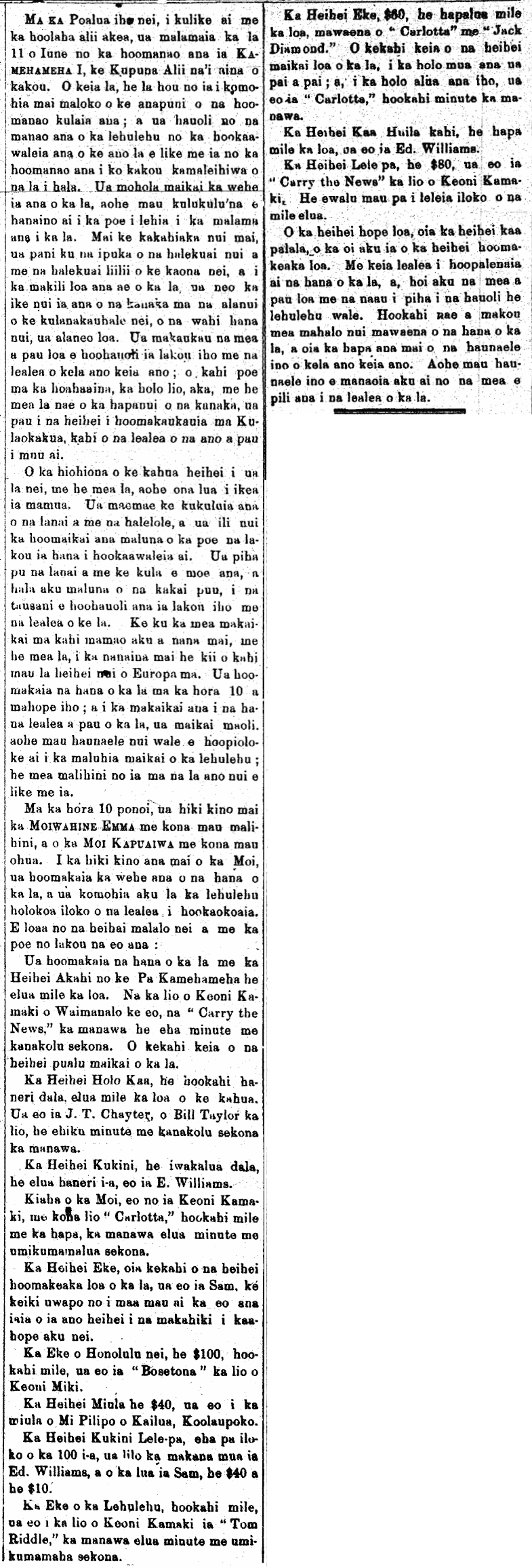
The first Kamehameha Day, 1872.

On this past Tuesday, in accordance with the royal proclamation, the 11th of June was celebrated as a day of remembrance of Kamehameha I, the Royal Ancestor who conquered our aina. This is a new day included in the circle of holidays, and the minds of the populace are happy about this type of day set aside to remember our cherished one of days gone by. The day dawned beautifully; there were no droplets to interfere with those who skillfully took care of the day. From early morning the doors of the shops of the town, both large and small, were shut. And when the sun came all the way out, there were not many people seen on the streets of town, and the great work places were deserted. All things meant to entertain themselves were prepared—some people made parties while others rode horses; however, it seemed as if most of the people were all at the races organized at Kulaokahua, the usual place for all types of entertainment.

The atmosphere of the race tracks that day seemed better than all previous days. Lanai and tents were set up impeccably, and those that undertook that task received much appreciation. The lanai, fields, and hills were filled with thousands who amused themselves with the events of the day. If an observer stood and watched from afar, it was as if he were seeing a picture of a race day somewhere like in Europe. The events of the day started at 10 or so, and after watching all the day’s activities, it was truly wonderful. There were no great commotions to disturb the peace among the crowd–this is something unfamiliar on special days like these.

At 10 o’clock sharp, Queen Emma arrived with her guests, and King Kapuaiwa with his entourage. At the appearance of the King, the activities of the day commenced, and all of the crowd joined in the gaieties that were set up. Below, you will find the races and those that won.

[Various horse races, winners, and prizes are listed.]

The final race, the wheelbarrow race was the most humorous. This entertainment marked the close of the festivities of the day. And everyone left with hearts filled with much glee. We are greatly pleased with one thing, and that is the decrease in the number of outbreaks of various sorts. There were no big riots thought to be related to the events of the day.

(Au Okoa, 6/13/1872, p. 2)

Ma ka Poalua iho nei...

Ke Au Okoa, Buke VIII, Helu 9, Aoao 2. Iune 13, 1872.

Just because something appears in a newspaper doesn’t necessarily make it true, 1865.

[Found under: “NOTES OF THE WEEK.”]

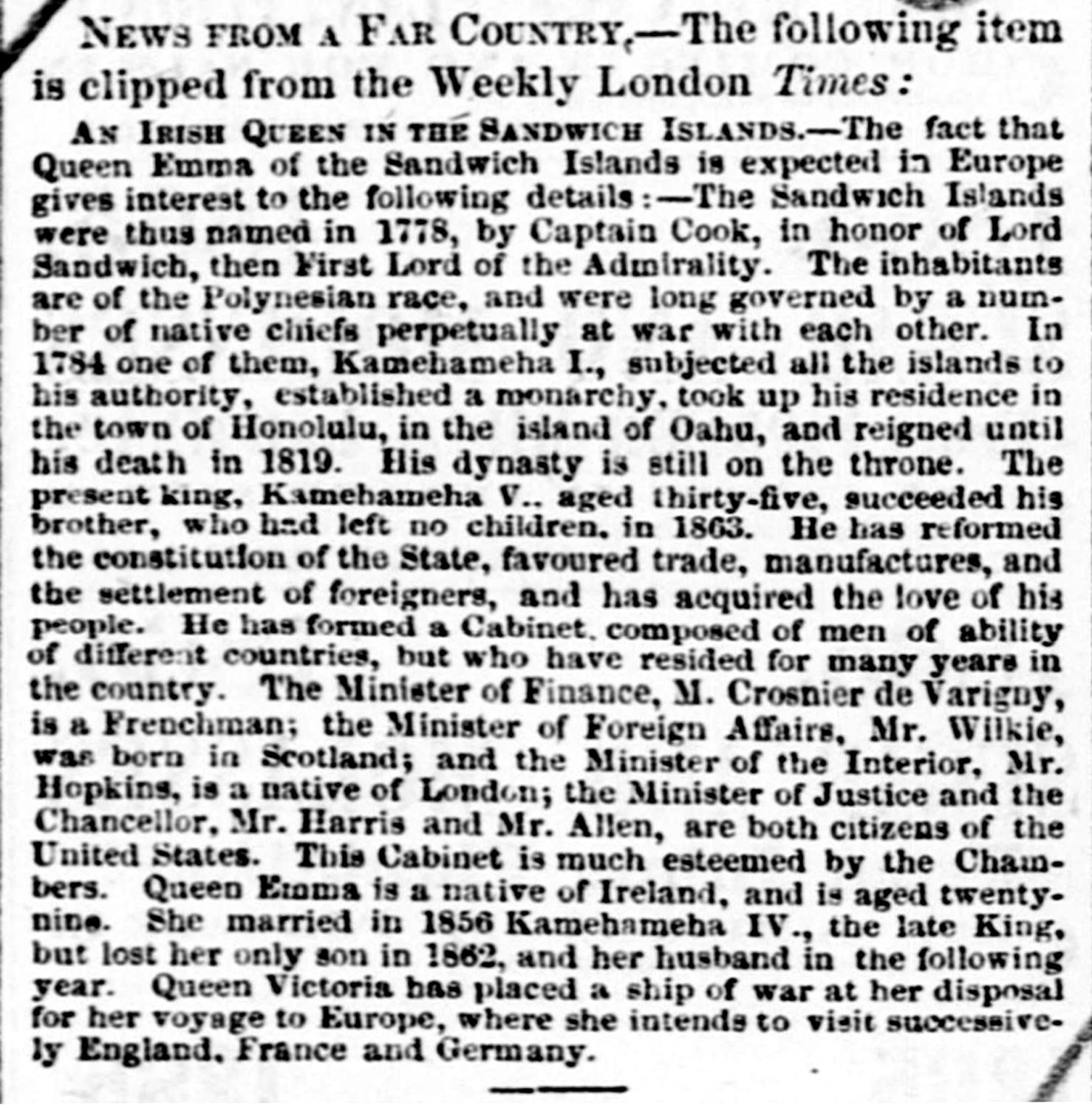
News from a Far Country.—The following item is clipped from the Weekly London Times:

An Irish Queen in the Sandwich Islands.—The fact that Queen Emma of the Sandwich Islands is expected in Europe gives interest to the following details:—The Sandwich Islands were thus named in 1778, by Captain Cook, in honor of Lord Sandwich, then First Lord of the Admirality. The inhabitants are of the Polynesian race, and were long governed by a number of native chiefs perpetually at war with each other. In 1784 one of them, Kamehameha I., subjected all the islands to his authority, established a monarchy, took up his residence in the town of Honolulu, in the island of Oahu, and reigned until his death in 1819. His dynasty is still on the throne. The present King, Kamehameha V., aged thirty-five, succeeded his brother, who had left no children, in 1863. He has reformed the constitution of the State, favoured trade, manufactures, and the settlement of foreigners, and has acquired the love of his people. The Minister of Finance, M. Crosnier de Varigny, is a Frenchman; the Minister of Foreign Affairs, Mr. Wilkie, was born in Scotland; and the Minister of Interior, Mr. Hopkins, is a native of London; the Minister of Justice and the Chancellor, Mr. Harris and Mr. Allen, are both citizens of the United States. This Cabinet is much esteemed by the Chambers. Queen Emma is a native of Ireland, and is aged twenty-nine. She married in 1856 Kamehameha IV., the late King, but lost her only son in 1862, and her husband in the following year. Queen Victoria has placed a ship of war at her disposal for her voyages to Europe, where she intends to visit successively England, France and Germany.

(Pacific Commercial Advertiser, 9/30/1865, p. 2)

News from a Far Country...

The Pacific Commercial Advertiser, Volume X, Number 13, Page 2. September 30, 1865.

Joseph Emerson interrupts meeting at the Kapuukolo Church, 1893.

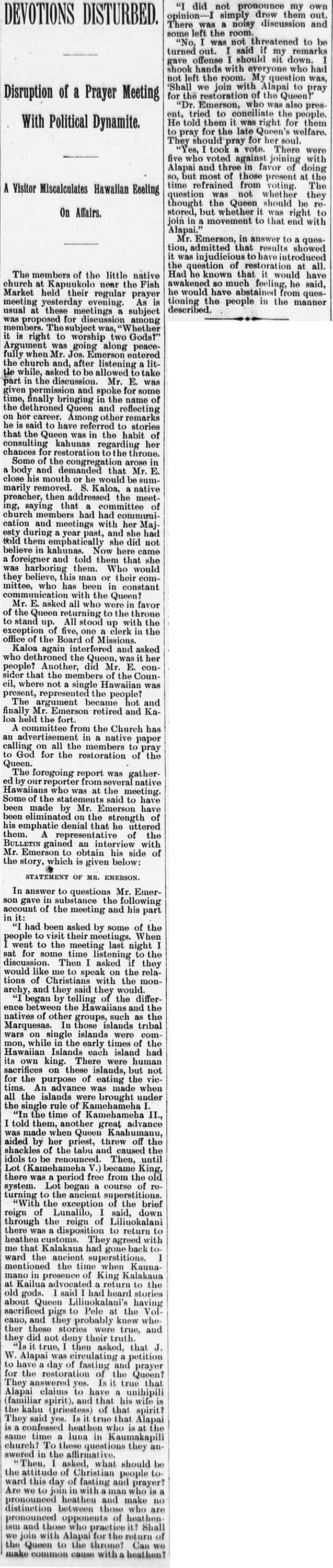
DEVOTIONS DISTURBED.

Disruption of a Prayer Meeting With Political Dynamite.

A Visitor Miscalculates Hawaiian Feeling On Affairs.

The members of the little native church at Kapuukolo near the Fish Market held their regular prayer meeting yesterday evening. As is usual at these meetings a subject was proposed for discussion among members. The subject was, “Whether it is right to worship two Gods?” Argument was going along peacefully when Mr. Jos. Emerson entered the church and, after listening a little while, asked to be allowed to take part in the discussion. Mr. E. was given permission and spoke for some time, finally bringing in the name of the dethroned Queen and reflecting on her career. Among other remarks he is said to have referred to stories that the Queen was in the habit of consulting kahunas regarding her chances for restoration to the throne.

 Some of the congregation arose in a body and demanded that Mr. E. close his mouth or he would be summarily removed. S. Kaloa, a native preacher, then addressed the meeting, saying that a committee of church members had had communication and meetings with her Majesty during a year past, and she had told them emphatically she did not believe in kahunas. Now here came a foreigner and told them that she was harboring them. Who would they believe, this man or their committee, who has been in constant communication with the Queen?

Mr. E. asked all who were in favor of the Queen returning to the throne to stand up. All stood up with the exception of five, one a clerk in the office of the Board of Missions.

Kaloa again interfered and asked who dethroned the Queen, was it her people? Another, did Mr. E. consider that the members of the Council, where not a single Hawaiian was present, represented the people?

The argument became hot and finally Mr. Emerson retired and Kaloa held the fort.

A committee from the Church has an advertisement in a native paper calling on all the members to pray to God for the restoration of the Queen.

The foregoing report was gathered by our reporter from several native Hawaiians who was at the meeting. Some of the statements said to have been made by Mr. Emerson have been eliminated on the strength of his emphatic denial that he uttered them. A representative of the Bulletin gained an interview with Mr. Emerson to obtain his side of the story, which is given below:

STATEMENT OF MR. EMERSON.

In answer to questions Mr. Emerson gave in substance the following account of the meeting and his part in it:

 “I had been asked by some of the people to visit their meetings. When I went to the meeting last night I sat for some time listening to the discussion. Then I asked if they would like me to speak on the relations of Christianity with the monarchy, and they said they would.

“I began by telling of the difference between the Hawaiians and the natives of other groups, such as the Marquesas. In those islands tribal wars on single islands were common, while in the early times of the Hawaiian Islands each island had its own king. There were human sacrifices on these islands, but not for the purpose of eating the victims. An advance was made when all the islands were brought under the single rule of Kamehameha I.

“In the time of Kamehameha II., I told them, another great advance was made when Queen Kaahumanu, aided by her priest, threw off the shackles of the tabu and caused the idols to be renounced. Then, until Lot (Kamehameha V.) became King, there was a period free from the old system. Lot began a course of returning to the ancient superstitions.

“With the exception of the brief reign of Lunalilo, I said, down through the reign of Liliuokalani there was a disposition to return to heathen customs. They agreed with me that Kalakaua had gone back toward the ancient superstitions. I mentioned the time when Kaunamano in the presence of King Kalakaua at Kailua advocated a return to the old gods. I said I had heard stories about Queen Liliuokalani’s having sacrificed pigs to Pele at the Volcano, and they probably knew whether these stories were true, and they did not deny their truth.

“Is it true, I then asked, that J. W. Alapai was circulating a petition to have a day of fasting and prayer for the restoration of the Queen? They answered yes. Is it true that Alapai claims to have a unihipili (familiar spirit), and that his wife is the kahu (priestess) of that spirit? They said yes. Is it tre that Alapai is a confessed heathen who is at the same time a luna in Kaumakapili church? To these questions they answered in the affirmative.

“Then, I asked, what should be the attitude of Christian people toward this day of fasting and prayer? Are we to join in with a man who is a pronounced heathen and make no distinction between those who are pronounced opponents of heathenism and those who practice it? Shall we join with Alapai for the return of the Queen to the throne? Can we make common cause with a heathen?

“I did not pronounce my own opinion—I simply drew them out. There was a noisy discussion and some left the room.

“No, I was not threatened to be turned out. I said if my remarks gave offense I should sit down. I shook hands with everyone who had not left the room. My question was, ‘Shall we join with Alapai to pray for the restoration of the Queen?’

“Dr. Emerson, who was also present, tried to conciliate the people. He told them it was right for them to pray for the late Queen’s welfare. They should pray for her soul.

“Yes, I took a vote. There were five who voted against joining with Alapai and three in favor of doing so, but most of those present at the time refrained from voting. The question was not whether they thought the Queen should be restored, but whether it was right to join in a movement to that end with Alapai.”

Mr. Emerson, in answer to a question, admitted that results showed it was injudicious to have introduced the question of restoration at all. Had he known that it would have awakened so much feeling, he said, he would have abstained from questioning the people in the manner described.

[This article was translated in Leo o ka Lahui, 2/9/1893, p. 2. It is interesting that there is a note appended to the end of the translated article that they did not have time to translate Emerson’s response.]

(Daily Bulletin, 2/7/1893, p. 3)

DEVOTIONS DISTURBED.

The Daily Bulletin, Volume V, Number 644, Page 3. February 7, 1893.

Charles Mathews performs at the Royal Hawaiian Theatre, 1871.

[Found under: “NOTES OF THE WEEK.”]

Charles Mathews in the Cannibal Islands.—This celebrated Comedian, who gave us a taste of his powers last February, writes a characteristic letter, in which he gives his impressions of us. We copy:

Reached Honolulu the capital of the Island of Oahu, and the seat of the government of the Hawaiian group, on Saturday, the 19th; eighteen days, four thousand and thirteen miles and three quarters! (accuracy again—exact as an architect’s estimate £4,000 35s. 1–2d.). Head winds (of course) all the way; longest passage (of course) ever known, and certainly the weariest. Heavy rolling seas, not a sail, or fish sighted, the only excitement we had arisen from the odd novelty of two Thursdays coming together in one week, two 9ths of February, arm-in-arm. At Honolulu, one of the loveliest little spots upon earth, I acted one night “by command, and in the presence of His Majesty Kamehameha V, King of the Sandwich Islands” (not ‘Hoky Poky Wonky Fong’ as erroneously reported), and a memorable night it was. Continue reading

History of Kawaiahao Church, 1885.

KAWAIAHAO CHURCH

The readers of the Kuokoa will probably not be unable to recognize the features of the building pictured above; it is the church of Kawaiahao. It is an old building and one that is greatly beloved by a portion of our people, this mother church of ours. Its predecessor on these grounds was a church of pili grass; and the stone building was completed in 1842, constructed by the loving hands of the alii and makaainana of times gone by. It was Kekuanaoa and Bingham [Binamu] Sr. who selected the area where it was to be built and supervised its construction, however Bingham returned to America before the completion of this building.

There were many renowned events which were done in Kawaiahao such that it is as if the building was the place to carry out grand and fine deeds of the past, of the nation and the people. It was in this building that a number of the Legislative Sessions of the nation were opened, if this writer is not mistaken. It was in this building that Kamehameha V opened the Constitutional Convention [Ahaolelo Hooponopono Kumukanawai] on the 7th of July, 1864. Continue reading

William Hyde Rice’s Hawaiian Legends in English, 1923.

[From the Preface of “Hawaiian Legends by William Hyde Rice”]

The collection of Hawaiian legends of which a translation is given in the following pages represents the work of many years by William Hyde Rice of Kauai. However, it is only within the last few years that Mr. Rice has translated the legends from his Hawaiian manuscripts. He has tried to make his version as literal as possible, preserving at the same time the spirit of the original Hawaiian, its flavor, rhythm, and phrasing. He has avoided adding modern embroidery of fancy, as well as figures of speech foreign to the Hawaiian language and to its thought and expression.

….

Mr. Rice has been exceptionally well prepared for this work, as he has been familiar with the Hawaiian language from his earliest childhood. In fact until he was twenty, he never thought in English but always in Hawaiian, translating mentally into his mother tongue. In 1870 when he became a member of the House of Representatives, during the reign of Kamehameha V, Governor Paul Kanoa and S. M. Kamakau, the historian, both well-known Hawaiian scholars, gave Mr. Rice much help with his Hawaiian, especially teaching him the proper use of various complicated grammatical constructions, and explaining obscure variations in pronunciation and meaning.

The sources of the legends in this collection are varied. A number of the stories Mr. Rice remembers having heard as a child, and now rare ones were gathered in later years. Many are from more than one source, but have corresponded even in details, and almost word for word. The legend of Kamapuaa, for instance, is one of the first which Mr. Rice remembers hearing. When a boy, the places mentioned in this story were pointed out to him: the spot where the demi-god landed, where he found the hidden spring, and where he rooted up the natives’ sugar-cane and sweet potatoes. The story of “The Small Wise Boy and the Little Fool” he has also been familiar with since childhood. The places mentioned in this tale can likewise be pointed out.

Most of the legends are from Kauai sources, but a number have been gathered from the other islands of the group. Whenever Mr. Rice heard of an old Hawaiian who knew any legends, he went to him, sometimes going to several to trace a special story, as for instance, the “Jonah and the Whale” story, “Makuakaumana”, which after a long search he finally procured from Mr. Westervelt. This curious story seem to be more modern than the others of the collection. While hunting for a reliable version of this story, Mr. Rice incidentally heard the story of “Manuwahi” at Heeia from an old Hawaiian.

“The Bird Man”, “Holuamanu”, “The Destruction of Niihau’s Akua”, and “The Girl and the Mo-o”, were obtained from Mr. Francis Gay, who is one of the best living scholars of the Hawaiian language. The Niihau legend was heard from several other sources as well. Mr. Gay also gave the legends of the “Rainbow Princess” and the “Shrimp’s Eyes”; the ti plants mentioned in the latter legend can still be pointed out, growing at the mouth of a little valley near Holuamanu. The Hawaiian manuscript of part of the Menehune story was obtained from J. A. Akina, while the story of the “Rain Heiau” was told to him in 1912 by a man named Naialau, who has since died at Kalaupapa. “How Lizards Came to Molokai” and Paakaa and Ku-a-paakaa” were told Mr. Rice by a man from Hawaii named Wiu, while the Rev. S. K. Kaulili, who is still living at Koloa, Kauai, gave him the most complete version of the “Rolling Island”.

During Mr. George Carter’s term as Governor, a reception was given in his honor, at Hanalei, where Mr. Rice was much interested in the very fine oli (chanting) of an old Hawaiian, named Kaululua. From him he obtained a number of legends, including that of “Ulukaa” from corresponding versions of other already in his collection. Other legends have been lost forever on account of ill-timed ridiculing by some chance companion, for Mr. Rice has found that the old people who know the legends are very sensitive, and when they find an unsympathetic auditor, refuse to continue their stories.

[It is often just as important to read the front matter and the back matter of a book than simply heading straight to the main text itself. Many times you can learn a lot of important information.

The stories credited to W. H. Rice found in the Hoku o Hawaii are probably the ones Rice collected over the years.]

(Rice, William Hyde. “Hawaiian Legends. Bernice P. Bishop Museum Bulletin 3.” Honolulu: The Museum, 1923.)

Hawaiian Legends

Hawaiian Legends by William Hyde Rice