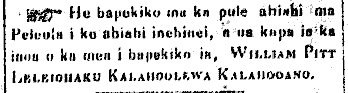
There was a baptism [bapekiko] at the evening prayer at Peleula on eve of yesterday, and the one who was baptized was named, William Pitt Leleiohaku [Leleiohoku] Kalahoolewa Kalahooano.
(Hoku o ka Pakipika, 2/5/1863, p. 2)
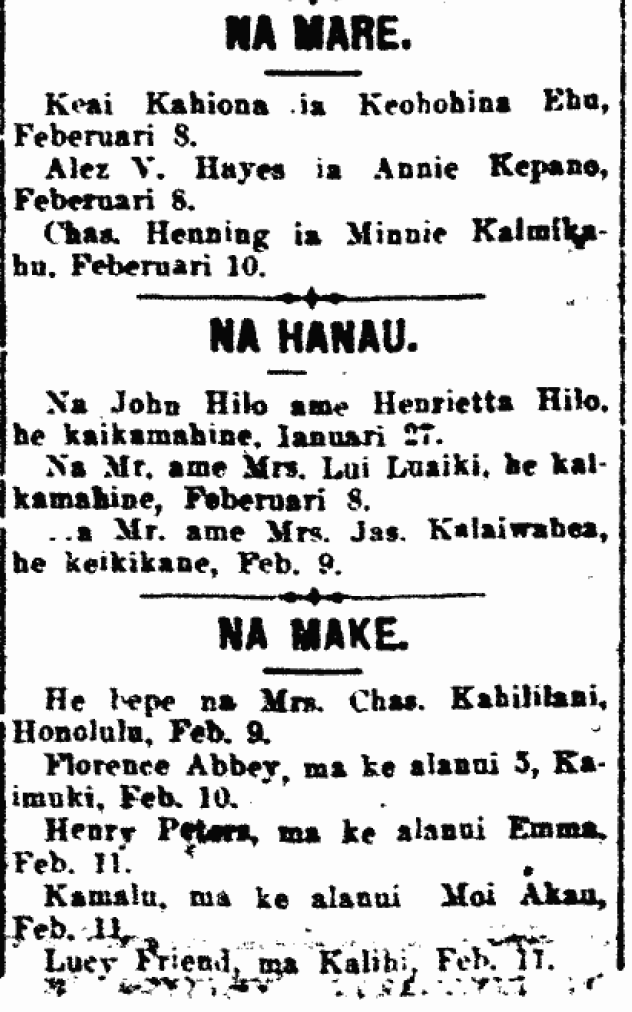
Keai Kahiona to Keohohina Ehu, February 8.
Alez V. Hayes to Annie Kepano, February 8.
Charles Henning to Minnie Kaimikahu, February 10.
To John Hilo and Henrietta Hilo, a daughter, January 27.
To Mr. and Mrs. Lui Luaiki, a daughter, February 8.
To Mr. and Mrs. James Kalaiwahea, a son, Feb. 9.
A baby of Mrs. Charles Kahililani, Honolulu, Feb. 9.
Florence Abbey, on 5th Avenue, Kaimuki, Feb. 10.
Henry Peters, on Emma Street, Feb. 11.
Kamalu, on South King Street, Feb. 11.
Lucy Friend, in Kalihi, Feb. 11.
(Kuokoa, 2/14/1913, p. 8)
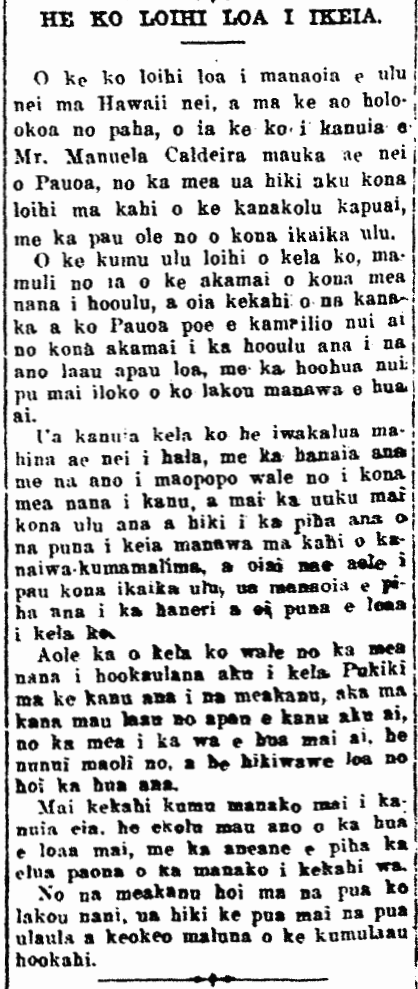
The tallest sugarcane thought to be growing in Hawaii, and perhaps the whole world, is the cane planted by Mr. Manuela Caldeira in the uplands of Pauoa; it’s height reaches about thirty feet, without it losing any of its growing vigor.
The reason for it growing so tall is because of the skill of the one growing it, and he is someone Pauoa’s people speak often of for his knowledge in growing all sorts of plants, and making them fruit profusely when it is time for them to fruit.
The sugarcane was planted twenty months ago, while being cared for as the one who planted them only knows how, and it grew from when it was small until now where it has some ninety-five nodes; and as its growing strength has not abated, it is believed that this cane will reach over a hundred nodes.
It isn’t for just that cane that the Portuguese man has found fame for planting, but for all the things he plants, because when they fruit, it is very abundant, and the fruiting happens quickly.
From a single mango tree that was planted, gotten are three types of mangoes, and at times one mango will weigh almost two pounds.
As for plants grown for the beauty of its flowers, red flowers and white ones bloom on a single tree.
(Kuokoa, 2/14/1913, p. 6)
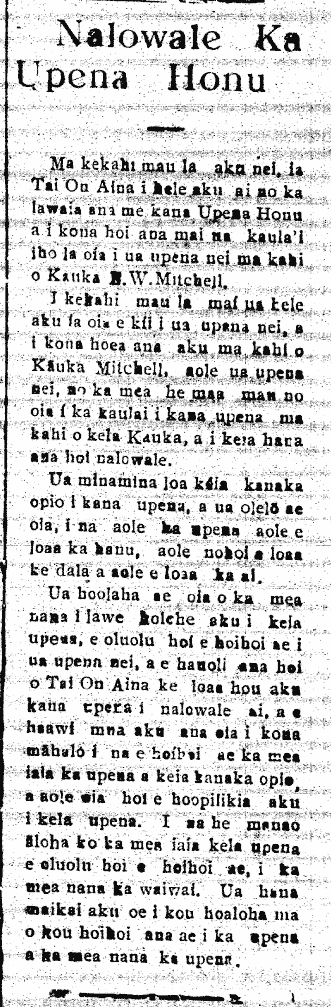
Several days ago, Tai On Aina went to fish with his Turtle Net, and upon his return, he left his net to dry by Dr. E. W. Mitchell’s [the first initial is not clear] place.
Some days later, he went to fetch the net, but when he arrived at Dr. Mitchell’s, there was no net; he was accustomed to drying his net by that doctor’s place, but this time it disappeared.
This young man is at a lost over his net, and he said that without his net, he can’t catch turtles, and thus can’t make money and then can’t get food.
He announced to the one who mischievously took the net, if he could kindly return this net, which would make Tai On Aina happy to get his lost net back; and he offers his thanks in advance should that person who has the net of this young man returns it without damaging it. Should that person who has the net has some aloha, please return it to whom the property belongs. You will be doing a good deed to your friend by returning the net to the one it belongs to.
(Hoku o Hawaii, 2/14/1933, p. 3)
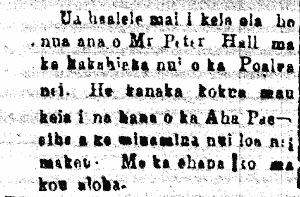
Mr. Peter Hall left this life in the early morning this Tuesday. He was a constant help to the Aha Paeaina [Island-Wide Convention of Churches], and we bemoan his passing. Our aloha goes out to his family.
(Hoku o Hawaii, 2/14/1933, p. 4)
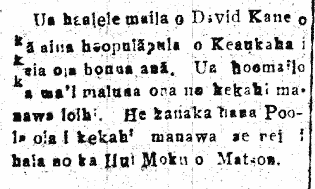
David Kane of the Hawaiian Homestead of Keaukaha [aina hoopulaupula o Keaukaha] left this life. He was growing thinner with illness for a long time. He was a stevedore for a time before for the Matson Navigation Company.
(Hoku o Hawaii, 2/14/1933, p. 3)