Unknown's avatar

About nupepa

Just another place that posts random articles from the Hawaiian Newspapers! It would be awesome if this should become a space where open discussions happen on all topics written about in those papers!! And please note that these are definitely not polished translations, but are just drafts!!! [This blog is not affiliated with any organization and receives no funding. Statements made here should in now way be seen as a reflection on other organizations or people. All errors in interpretation are my own.]

The Bernice Pauahi Bishop Museum, 1911.

THE MUSEUM

On the 2nd of October, the museum mauka of the Kamehameha School for Boys will be opened, and everyone will be able to tour it without payment during the time allowed.

In the museum there are many things that Hawaiians have not seen, and it is hoped that Hawaiians will see what is collected in this building.

From the time this was built at Kamehameha School until today, there have not been many Hawaiians who have come to tour, but it is important for the kamaaina to see these things before the malihini get a chance to see first of what they only have heard of before visiting Hawaii nei.

In this issue of the Kuokoa is an announcement by the trustees of the Kamehameha School explaining fully the days on which the museum will be opened to the public, along with the days that it is restricted and cannot be visited by all people.

(Kuokoa, 9/8/1911, p. 8)


KA HALE HOIKEIKE O NA MEA KAHIKO

Ka Nupepa Kuokoa, Buke XLVII, Helu 36, Aoao 8. Sepatemaba 8, 1911.

More blogs from the Bishop Museum: Anthropology, 2014.

This blog has been up for a little longer than the nupepa-hawaii.com blog has been up. If you are into anthropology of Hawaii and the Pacific, this is probably a blog you will enjoy. It is a little difficult to maneuver without any tags or many categories, but if you have the time to click back and forth, check them out.

ANTHROPOLOGY

Department of the Bishop Museum

Secret Societies in Hawaii, 1914.

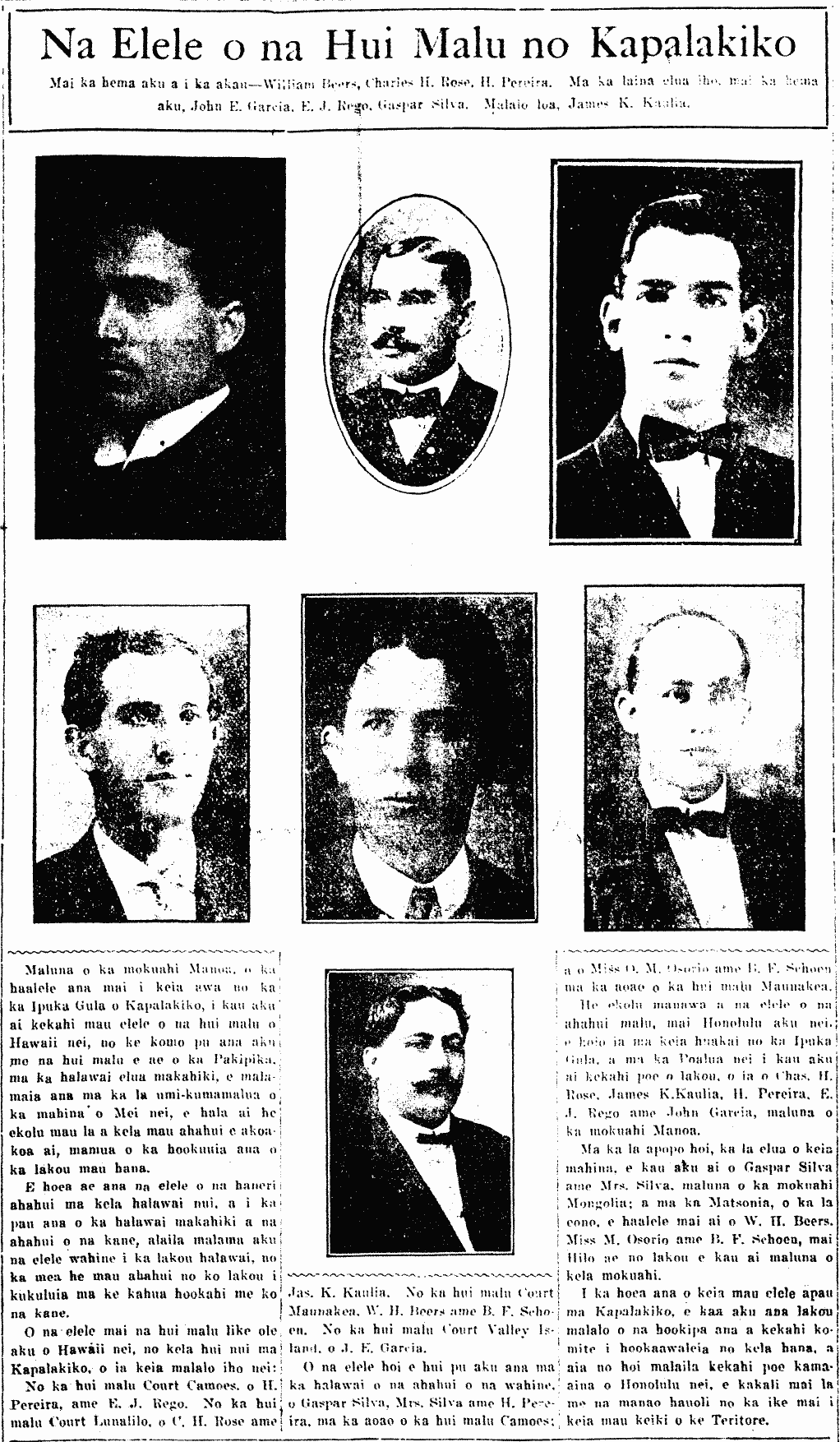
The Representatives of the Secret Societies Off To San Francisco

From the left to right—William Beers, Charles H. Rose, H. Pereira. On the second line below, from the left, John E. Garcia, E. J. Rego, Gaspar Silva. On the very bottom, James K. Kaulia.

Aboard the steamship Manoa leaving this port for the Golden Gate of San Francisco, rode some representatives of secret societies [hui malu] of Hawaii to join with other secret societies of the Pacific in their biennial meeting being held on the twelveth of this May, spending three days in meetings with these societies before their activities are let out.

The representatives of hundreds of secret societies will attend this great meeting, and at the conclusion of the annual men’s gathering, then the women will hold their meeting for they have established societies on the same foundation as the men.

The representatives from the various secret societies of Hawaii nei headed for this huge gathering in San Francisco are:

From the secret society of Court Camoes, H. Pereira and E. J. Rego. From the secret society Court Lunalilo, C. H. Rose and James Kaulia. From the secret society Court Maunakea, W. H. Beers and B. F. Shoen. From the secret society Court Valley Island, J. E. Garcia.

The representatives meeting at the women’s gathering are: Gaspar Silva, Mrs. Silva, and H. Pereira from the Camoes; and Miss D. M. Osorio and B. F. Shoen from the secret society of Maunakea.

The secret society representatives from Honolulu will be travelling to the Golden Gate in three trips; this Tuesday, some of them, Charles H. Rose, James K. Kaulia, H. Pereira, E. J. Rego, and John Garcia, boarded the steamship Manoa.

Tomorrow, the second of this month, Gaspar Silva and Mrs. Silva will board the Mongolia; and on the Matsonia of The sixth, W. H. Beers, Miss M. Osorio, and B. F. Shoen will leave, and it is from Hilo that they will board that steamship.

When all of the representatives reach San Fransico, they will come under the care of a committee set aside for that purpose, and there are people there who are kamaaina of Honolulu who await happily to see these keiki of the Territory.

[These all fall under the Ancient Order of Foresters.]

(Kuokoa, 5/1/1914, p. 1)
Na Elele o na Hui Malu no Kapalakiko

Ka Nupepa Kuokoa, Buke LII, Helu 18, Aoao 1. Mei 1, 1914.
More on Don Blanding, 1939.

About Don Blanding

Don Blanding

Moses Company, Limited announced the arrival of plates decorated by this famous poet, Don Blanding, a they are being displayed in their store and are placed in one of their show windows. You can see the true value of his recollections. His abilities in painting is incomparable.

You can begin your collection of plates for $8.80. They are beautiful to look at, and can be used everyday.

Should you desire to see some of those plates, go to the book store of the Moses Company. Continue reading →

Don Blanding poem in English, 1939.

Don Blanding Dedicates Poem To Old Hawaiians

Don Blanding, Hawaii’s own poet, now visiting in Hilo, has finished a poem and dedicated it to “those grand old Hawaiians you see sitting on the doorsteps of the little houses along the road in Kona watching life go by, smiling.”

Here’s the new poem:

Tutu

“Tutu” is the affectionate Hawaiian name for grandparents or very old people.)

I would grow old as you are old, Tutu,
Seasoned with loving, mellow with gracious giving,
I would have hair like your grayed hair, Tutu,
Each silver thread a service stripe of living.

I would have eyes like your kind eyes, Tutu,
The veil of tears pierced by gay laughter’s twinkle,
I would have lips that smile like yours, Tutu,
A line from Life’s rich story in each wrinkle.

I would look back as you look back, Tutu,
Remembering all the good, the rest forgetting,
I would face death as you face death, Tutu,
Grateful of heart, undaunted, unregretting.

—Don Blanding

July 9, 1939

(Hoku o Hawaii, 7/12/1939, p. 6)

Don Blanding Dedicates Poem To Old Hawaiians

Ka Hoku o Hawaii, Volume XXXIV, Number 11, Aoao 6. July 12, 1939.

More on the originator of Lei Day, Don Blanding, 1939.

Don Blanding Dedicates this poem to the oldsters of Hawaii

This was translated into Hawaiian for the writer by Mrs. Mary Kawena Pukui of the Bishop Museum. These mele in English and Hawaiian will come out in the new book by Don Blanding, Drifter’s Gold, which will be published in the last week of September.

Tutu

WRITTEN BY DON BLANDING

E iini no au e kahiko aku e like me kou kahiko ana, e Tutu,
I ike i ka hua o ke aloha, i haawi oluolu aku,
E iini no au e like ko’u oho me kou oho poohina, e Tutu,
O na oho kuakea pakahi, he makana no keia ola ana.

E iini no au e like o’u mau maka me kou mau maka oluolu, e Tutu
I piha i ka waimaka a puka mai hoi ka aka ana,
E iini no au e loaa ia’u ka minoaka ana e like me kou, e Tutu,
O na alu pakahi o kou papalina, he waiwai i kaha ia e keia ola ana.

E iini no au e nana i hope e like me kou nana ana, e Tutu,
E hoomanao ana i na mea maikai, e hoopoina aku i ka nui,
E iini no au e nana aku i ka maka o ka make ana e like me oe, e Tutu,
Me ka naau hoomaikai, wiwoole a kaumaha ole.

(Hoku o Hawaii, 7/12/1939, p. 1)

Hoolaa o Don Blanding keia mele no na Hawaii kahiko

Ka Hoku o Hawaii, Volume XXXIV, Nuimber 11, Aoao 1. Iulai 12, 1939.