Unknown's avatar

About nupepa

Just another place that posts random articles from the Hawaiian Newspapers! It would be awesome if this should become a space where open discussions happen on all topics written about in those papers!! And please note that these are definitely not polished translations, but are just drafts!!! [This blog is not affiliated with any organization and receives no funding. Statements made here should in now way be seen as a reflection on other organizations or people. All errors in interpretation are my own.]

Words for/from the youth of today, 2014.

Silent Constituencies and Building a Voice

I am a millennial and this year I am registering to vote.

The August primary will be my first opportunity to cast a ballot for publicly elected officials since I voted for Al Gore in a 1st grade presidential practice election.

I am genuinely eager to have my voice heard in the political sphere for the first time, even if it is in the form of one small piece of paper.

What makes me excited is that I’ve heard that those small pieces of paper can add up.

I am also a Hawaiian who is registering to vote…

[This obviously does not come from the the historic Hawaiian newspapers, but this same issue was written about time and time again in its pages, and it is interesting that we see this call for action being renewed today. For the entire article by Wyatt Bartlett of the island of Kama appearing on Civil Beat, see: Silent Constituencies and Building a Voice.]

Follow up on previous post about Peter K. Morse, 1926.

KAINANA HIRAM PASSES ON TO OTHER WORLD

At eleven o’clock in the night of last Tuesday, Mrs. Hiram, who was a kamaaina to the people of this town, Mrs. Elizabeth Kainana Puahi Hiram, grew weary of this life at her home on Makee Road¹ in Waikiki.

She was born on the 22nd of June, 1853, therefore, at her passing, she was 73 years old.

On the evening of this past Sunday, her funeral was held at the mortuary of M. E. Silva.

¹Although spelled Makee, this is pronounced Makī, just as how Ena of Ena Road is pronounced Ina.

(Kuokoa, 8/5/1926, p. 6)

HALA O KAINANA HIRAM MA KELA AO

Ka Nupepa Kuokoa, Buke LXV, Helu 31, Aoao 6. Augate 5, 1926.

Letter from a son away serving in the armed forces to his mother, 1918.

PETER K. MORSE

A SON WRITES TO HIS MOTHER.

The picture above is of a Hawaiian boy who left Hawaii nei to join the armed forces in England, and he is currently a corporal in the cavalry for the British cavalry in Canada.

This is the son of Mrs. Kainana Hiram of Kapahulu, Waikiki, whose name is Peter Kalanikuhookahi Morse, and his letter was penned to his mother on the 24th of November. Continue reading →

Happy Mother’s Day, 1933.

MOTHER’S DAY OBSERVED ONCE MORE.

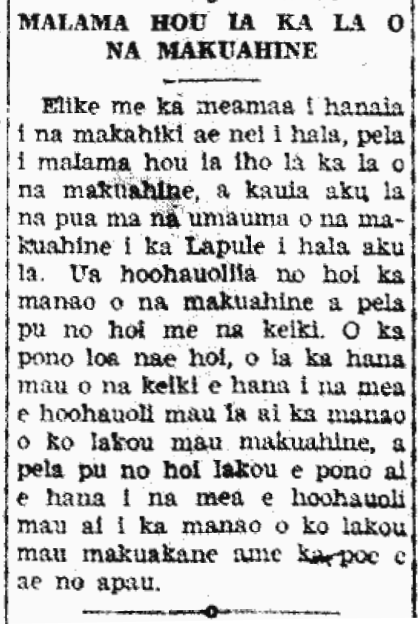
Just as has been the custom these past years, the day for mothers has been observed, and flowers were placed on the breasts of the mothers on this past Sunday. Gladdened were the mothers as well at the children. What really should be done is that the children should always do what makes their mothers happy, and so too should they always do what makes their fathers happy and everyone else.

(Alakai o Hawaii, 5/25/1933, p. 2)

MALAMA HOU IA KA LA O NA MAKUAHINE

Ke Alakai o Hawaii, Buke 6, Helu 4, Aoao 2. Mei 25, 1933.

Beginnings of Mother’s Day in Hawaii nei, 1913.

MOTHER’S DAY.

It would appear that this is the third or second year perhaps here in Honolulu in which we have remembered mothers on this past Sunday; this is foreign to us, but it will maybe become something regular in the future, like the other foreign observances that have come amongst us.

While our mothers are still living is the time that they should be remembered, and not just for that day that was set aside, but we believe that we are indebted for all that our mother’s put up with for our sake, and we invite each and everyone to give in all manner their love to their mothers. Continue reading →

Newspapers and history and yesterday and tomorrow, 2014.

Whenever i talk to people about doing research in the Hawaiian-Language Newspapers or in any historical material for that matter, i try to prepare them saying that you never know what you will find in its pages. History, after all, is not only made up of heroes and patriots, but it also inevitably includes thieves and charlatans as well.

Let us be brave and search out connections great and small. Granted, you may very well find that one of your ohana embezzled money from one of the king’s trusts or another actually signed the Provisional Government’s annexation petition. On the other hand, what if you found that one of your ohana saved another person’s life, or another was sent to jail for participating in the rebellion of 1895.

Regardless of what we may find, the past cannot be changed, but what we can do by better understanding history is to learn from its mistakes and to emulate its successes, and to use this knowledge to work towards making a better Hawaii, and a better world for the new generations to come.

More on Emma Nakuina, W. T. Brigham, and the Bishop Museum, 1897.

NOT COURTEOUS

Treatment of Ladies at Bishop Museum.

An Open Protest to the Trustees of the Kamehameha Schools.

MR. EDITOR:—The undersigned with three other ladies, Hawaiians of the highest respectabily, standing and position, with five little children, were sitting this morning in the shade of the Kamehameha Museum enjoying the fine showing made by the naval men drilling on the College campus. Chairs had been offered by a Kamehameha graduate, he placing them on the grass plot adjoining the Museum. After a little while, Mr. Brigham, the curator of the Museum, drove by within a few feet of us. He scowled most savagely at us. In a few minutes a Portuguese workman came to order us away from the place.

As it has invariably been the custom to throw the College grounds open to the public when any sort of a public or semi-public show is taking place within its precincts, we did not pay any attention to his orders, thinking it a piece of officiousness on the part of an ignorant person, and the man went away. After a while the man re-appeared and ordered us off again, saying he was acting by Brigham’s orders, and to use force if necessary. He took hold of the chair of the wife of a prominent official and tipped it partly over. She sprang up to avoid a fall, as did two other ladies. I, being at the very corner of the building and a little in advance of the others did not perceive the man until he had taken hold of my chair and had partly spilled me on my knee. I turned around to protest, when he grabbed my arm and pulled me out of my chair, saying “you get out of this, those are my orders from Mr. Brigham. If you don’t go yourself, I make you go. Mr. Brigham don’t allow any one to get on this grass.”

There were quite a number of carriages standing around, occupied by spectators of the drill.

The actions of the Portuguese were so rough and insulting that the attention of quite a number were attracted to our forcible ejectment. Continue reading →

Emma Metcalf Nakuina affronted, 1897.

Contemptuous Act Against Women.

Being that the parading was being held in the uplands of the Kamehameha School for Boys, on the plains of Kaiwiula, Mrs. Emma Metcalf Nakuina went attended by Mrs. R. W. Maea [Mrs. Rudolph William Meyer] of Kalae, Molokai and two of her daughters, Mrs. Mutch and Mrs. Hitchcock. They went and sat in a calm and shady place at the Bishop Museum, atop a area covered with manienie grass, and the son of the one named first, F. W. Kahapula Beckley, brought them chairs. Continue reading →

New hours of the Bishop Museum, 1911.

ANNOUNCEMENT.

On the 2nd of October, 1911 and thereafter until a new announcement is made, the Bernice P. Bishop Museum will be opened to the public from 10 a. m. until the 4 p. m. EVERYDAY except Sundays, Wednesdays, and the four holidays of each year, they being Memorial Day [La Lupua], Independence Day [La Kuokoa], Thanksgiving [La Hoalohaloha], and Christmas [La Karisimaka]. Permits to visit the museum will not be issued to the passengers aboard the steamships on Wednesdays as previously was done.

BY ORDER OF THE TRUSTEES.

Sept. 1, 1911.

[These days, the Museum is open everyday from 9:00 a. m. to 5:00 p. m., except on Tuesdays and ka La Karisimaka.]

(Kuokoa, 9/8/1911, p. 8)

HOOLAHA.

Ka Nupepa Kuokoa, Buke XLVII, Helu 36, Aoao 8. Sepatemaba 8, 1911.