Unknown's avatar

About nupepa

Just another place that posts random articles from the Hawaiian Newspapers! It would be awesome if this should become a space where open discussions happen on all topics written about in those papers!! And please note that these are definitely not polished translations, but are just drafts!!! [This blog is not affiliated with any organization and receives no funding. Statements made here should in now way be seen as a reflection on other organizations or people. All errors in interpretation are my own.]

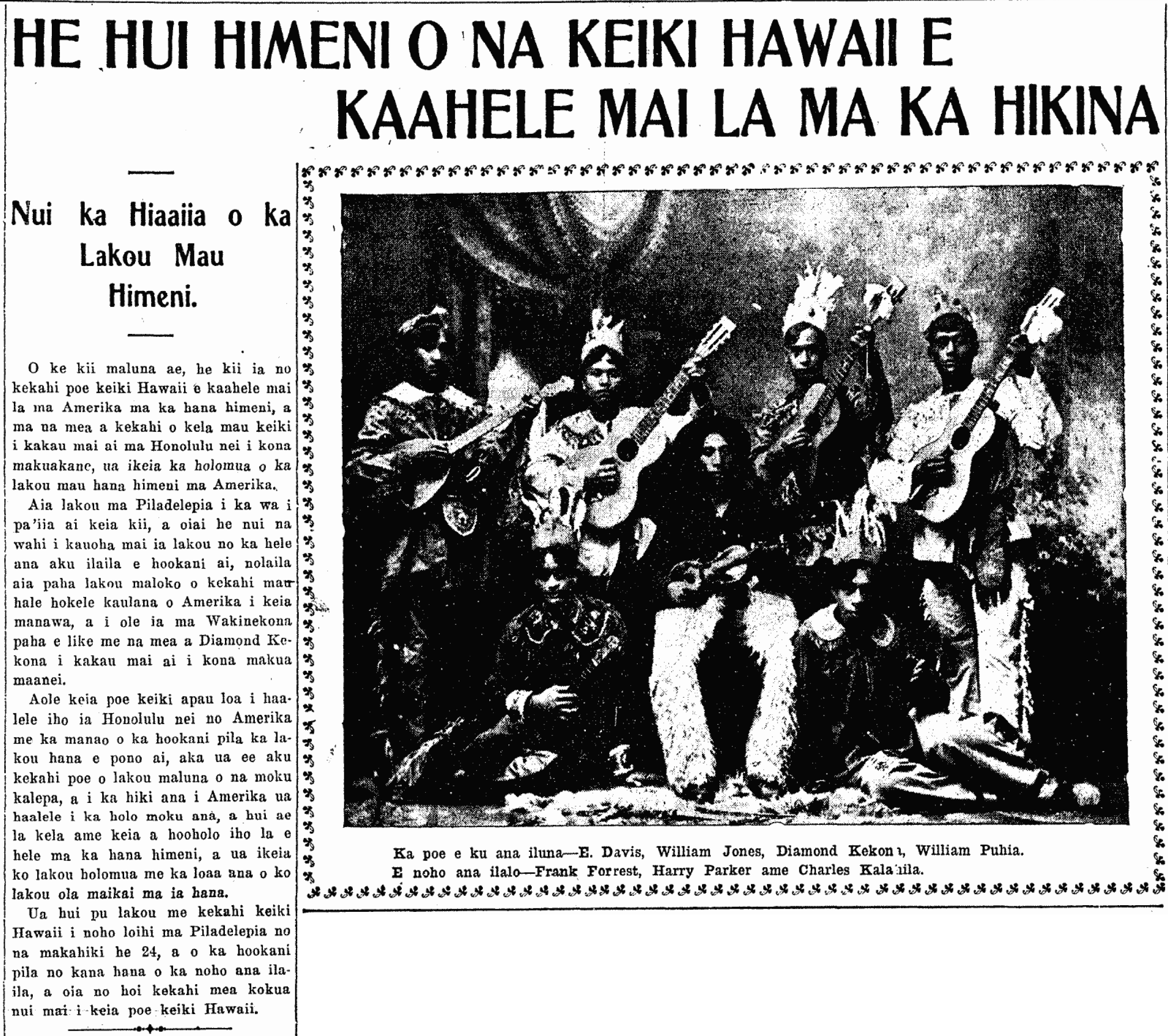
Hawaiians singing on the East Coast, 1908.

A SINGING GROUP OF HAWAIIAN YOUTHS TOURING IN THE EAST

Their Singing was Received with Much Delight

The picture above is a picture of some Hawaiian youths travelling America singing, and from what one of them wrote to Honolulu to his father, we can see they are making progress in their singing in America.

They were in Philadelphia at the time this picture was taken, and being that there are many places where they have been requested to go to perform music, they might be in some famous hotels now in America, or perhaps in Washington according to what Diamond Kekona wrote to his father here.

All of these boys did not leave Honolulu for America thinking that they would be making a living playing music, but some boarded trading ships, and upon arriving at America, they gave up sailing and met up with each other and decided to go around singing, and their progress has been witnessed along with them making a good living.

They met a young Hawaiian who was living in Philadelphia for 24 years, and he was working playing music and he was one who helped these Hawaiian boys immensely.

Those standing—E. Davis, William Jones, Diamond Kekona, William Puhia.

Seated—Frank Forrest, Harry Parker and Charles Kalahila.

(Kuokoa, 11/27/1908, p. 1)

HE HUI HIMENI O NA KEIKI HAWAII E kAAHELE MAI LA MA KA HIKINA

Ka Nupepa Kuokoa, Buke XLIII, Helu 48, Aoao 1. Novemaba 27, 1908.

Hypnotists at the Savoy banned? 1911.

Those magical haole that were always performing at the Savoy were banned by Sheriff Jarrett, because they are always seen making children sleep on a bed for forty-eight hours.

(Kuokoa Home Rula, 9/22/1911, p. 2)

Ua papa ia ae kela haole...

Kuokoa Home Rula, Buke IX, Helu 38, Aoao 2. Sepatemaba 22, 1911.

The Hypnotists at the Savoy, 1911.

Savoy Theatre

POSITIVELY THE LAST WEEK

of

AYESHA

and

BARNETT

THE WORLD’S GREATEST

HYPNOTISTS.

Packed to the Doors Last Night.

NEW SENSATIONS NIGHTLY.

Rightly Termed the Funniest Show

on Earth.

If You Want to Laugh, Don’t Miss It.

POPULAR PRICES.

(Hawaiian Star, 9/12/1911, p. 6)

Savoy Theatre

The Hawaiian Star, Volume XIX, Number 6070, Page 6. September 12, 1911.

Moses Kawaa hypnotized at the Savoy Theatre, 1911.

[Found under: “Nuhou Kuloko.”]

Here are the astonishing haole showing their amazing feats at the Savoy. On the night of this past Monday, the young boy by the name of Moses Kaawa [Kawaa] was put to sleep, and he is on display in one of the windows of the furniture store of Hopp [Hapa] for two days, and on the night of this past Wednesday, he was awakened from his sleep after sleeping for forty-eight hours. This coming week, someone will be put to sleep and buried in the ground with some space for him to breathe. This theater is always filled with spectators!

(Aloha Aina, 9/16/1911, p. 4)

Eia no na haole hookalakupua...

Ke Aloha Aina, Buke XVI, Helu 37, Aoao 4. Sepatemaba 16, 1911.

Sleeping in a window front, 1911.

FATHER WANTS SON IN HYPNOTIC SLEEP WAKED

Kawaa, father of S. W. Mosis, who at the present time lies asleep in J. Hopp & Co.’s window, is frightened of the effects that the long sleep may have on his son and asked this morning that Barnett should wake him up.

Barnett argued the point with him however, and refused to do anything of the kind stating that the boy was all right and that no harm would come to him. The father went away very dissatisfied with the whole business and Mosis will sleep on until tomorrow night when he will be brought back to life at the Savoy.

(Evening Bulletin, 9/12/1911, p. 6)

FATHER WANTS SON IN HYPNOTIC SLEEP WAKED

Evening Bulletin, Number 5029, Page 6. September 12, 1911.

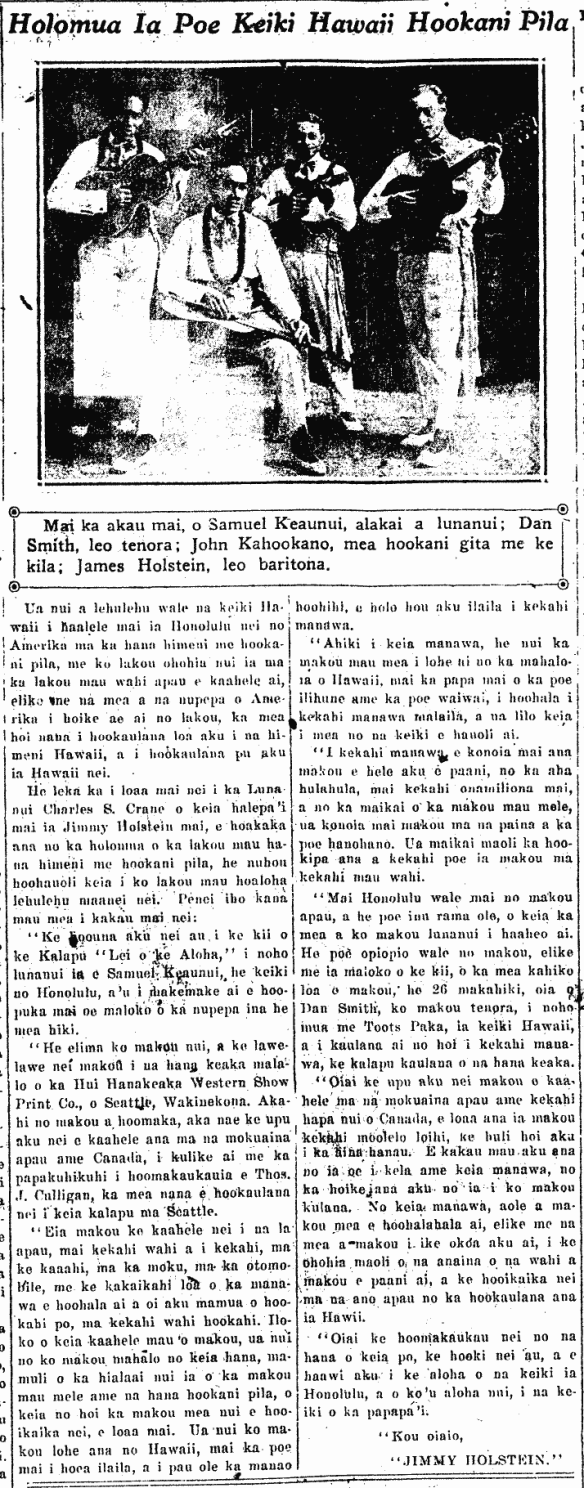
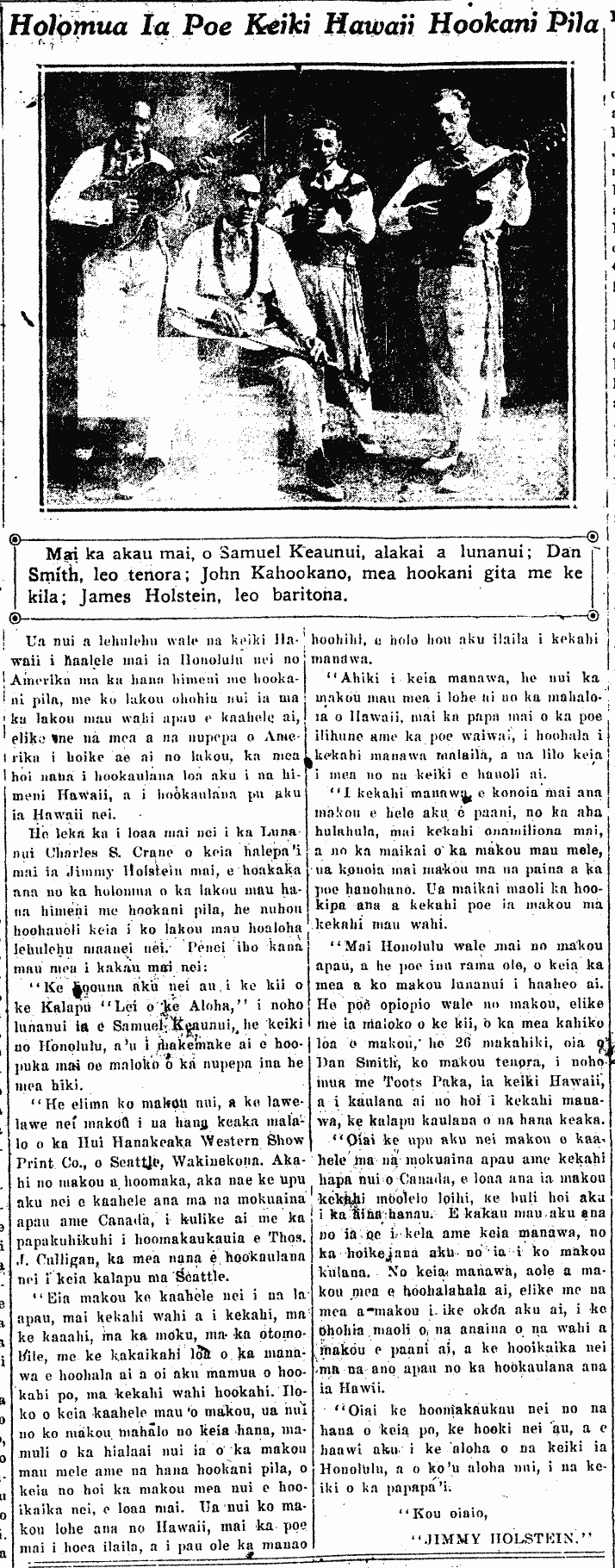
J. C. K. Hopkins and his band travelling around America, 1914.

SOME HAWAIIAN BOYS TRAVELLING AMERICA SINGING AND PLAYING MUSIC

From the left to right: Joe Kama; Peter Corney; J. C. K. Hopkins, the leader; the haole to whom belongs the movies; and Moses Kawaa.

The picture above is of some Hawaiian boys travelling around some places in America, along with a movie company, using music to make a living in the unfamiliar lands.

When the Hawaiian boys left Hawaii nei, they did not imagine that they would be singing and playing music in America, but with the passing of time, they found themselves getting together with each other and started this job, getting paid well by the week.

This picture was sent by Peter Corney to his mother here and he also stated that he was in very good health as well as his friends, and that he believes that the day will come when he will become a singer.

This boy left Honolulu nei when some haole came with a steamship in search of workers for a salmon fishing outfit and he spent several months working under his supervisors, and when the salmon fishing season was over, he returned to San Francisco and there he ran into Moses Kawaa and with some other boys, and they planned to go around singing and playing music.

Many here in Honolulu have not forgotten Moses Kawaa, the Hawaiian boy who was made to sleep in the window of the Lewers & Cooke building for twenty-four hours, two years ago.

These boys work under a haole who shows movies, and the movies that he shows all over the place are of scenes of Hawaii, like shots of the crater of Kilauea, shots of surfers, the expansive sugarcane plantations, pineapple fields, and many, many scenes taken in Hawaii nei and sent to America.

(Kuokoa, 3/13/1914, p. 5)

HE MAU KEIKI HAWAII E KAAHELE MAI LA MA AMERIKA MA KA HIMENI ME HOOKANI PILA

Ka Nupepa Kuokoa, Buke LII, Helu 11, Aoao 5. Maraki 13, 1914.

Waverly Building at the corner of Hotel and Bethel, 1909.

THE WAVERLY [WAVELA] STONE BUILDING

O FRIENDS: This picture that is being printed is an image of the stone building standing at the corner of Hotel [Hotele] and Bethel [Betela] Streets, called the Waverly Building [Hale Wavela], and on the second story is where the LANAKILA appears every Thursday of every week. It is on Bethel Street, makai of the Hotel Street corner where the stairs are to get to the second story. This is the Printing Office of the Paradise of the Pacific [Paredaiso o ka Pakipika].

[This “Paradise of the Pacific” magazine is the precursor to the magazine on the shelves today, “Honolulu Magazine”…]

(Lanakila, 7/15/1909, p. 4)

KA HALE POHAKU WAVELA

Ka Lanakila, Buke I, Helu 3, Aoao 4. Iulai 15, 1909.

Lei makers of Honolulu, 1909.

LADY FLOWER SEWERS OF THIS CAPITAL.

The picture above is of the sweet-eyed mothers and ladies of the flower gardens of Walikanahele, selling their flowers on the street sides of our Capital. Not only on the streets, they go aboard the steamships and the ships that are docked. Yes. Do good work. Keep at it.

(Lanakila, 7/22/1909, p. 4)

NA LEDE HUMUHUMU PUA O KE KAPITALA NEI.

Ka Lanakila, Buke I, Helu 4, Aoao 4. Iulai 22, 1909.

Hawaiians in Jacksonville, Oregon, 1868.

[Found under: “NU HOU KULOKO: Oahu.”]

From Oregon.—We have received a letter from J. A. Alapai from Oregon, County Jacksonwille, paying his year’s subscription for our Kilohana,¹ $4.00 in Stamps; we appreciate this subscriber who lives in lands far, far away, in his paying for the life of the Paper to our people nearby. And in that letter, he spoke of some Hawaiian men living in that place shown above, as well as some women. Here below are their names and their places in Hawaii nei:

W. B. Kanaina (m), from Lahaina, Maui; C. W. Kalua (m), from Puunoa, Lahaina, Maui; J. A. Kupapaulu (m), from Lahaina, Maui; B. L. B. Makakoa (m), from Moalii, Lahaina, Maui; H. E. Kamahiai (m), from Moalii, Lahaina, Maui; N. Inuawa (m), from North Kohala, Hawaii; C. L. Kahoinea (m), from Kailua, North Kona, Hawaii; J. A. Alapai, the one who wrote the letter, from Waipunalei, Hilo, Hawaii; and as for the women, J. U. Keaumalahia (f), from Kahaluu, South Kona, Hawaii; Mary Lumahai (f), from Kaumakani, Kipahulu, East Maui; and these Hawaiian women gave birth to two children, one each; one half Chinese named Ioane Amiuna, and one half Indian named Uluhani; and that is what Mr. J. A. Alapai presented to us of that place shown above, Jackonville County, Oregon.

¹”the Foremost,” is an epithet for the Kuokoa Newspaper.

[Hawaiians were and are to this day travellers. There are letters written by Hawaiians travelling about or living in lands afar written to the Hawaiian-Language Newspapers from early on until the very end. I wonder what became of these people, if they stayed there in Oregon, moved on to somewhere else, or came  back home to Hawaii nei…]

(Kuokoa, 8/29/1868, p. 2)

Mai Oregona mai.

Ka Nupepa Kuokoa, Buke VII, Helu 35, Aoao 2. Augate 29, 1868.