Unknown's avatar

About nupepa

Just another place that posts random articles from the Hawaiian Newspapers! It would be awesome if this should become a space where open discussions happen on all topics written about in those papers!! And please note that these are definitely not polished translations, but are just drafts!!! [This blog is not affiliated with any organization and receives no funding. Statements made here should in now way be seen as a reflection on other organizations or people. All errors in interpretation are my own.]

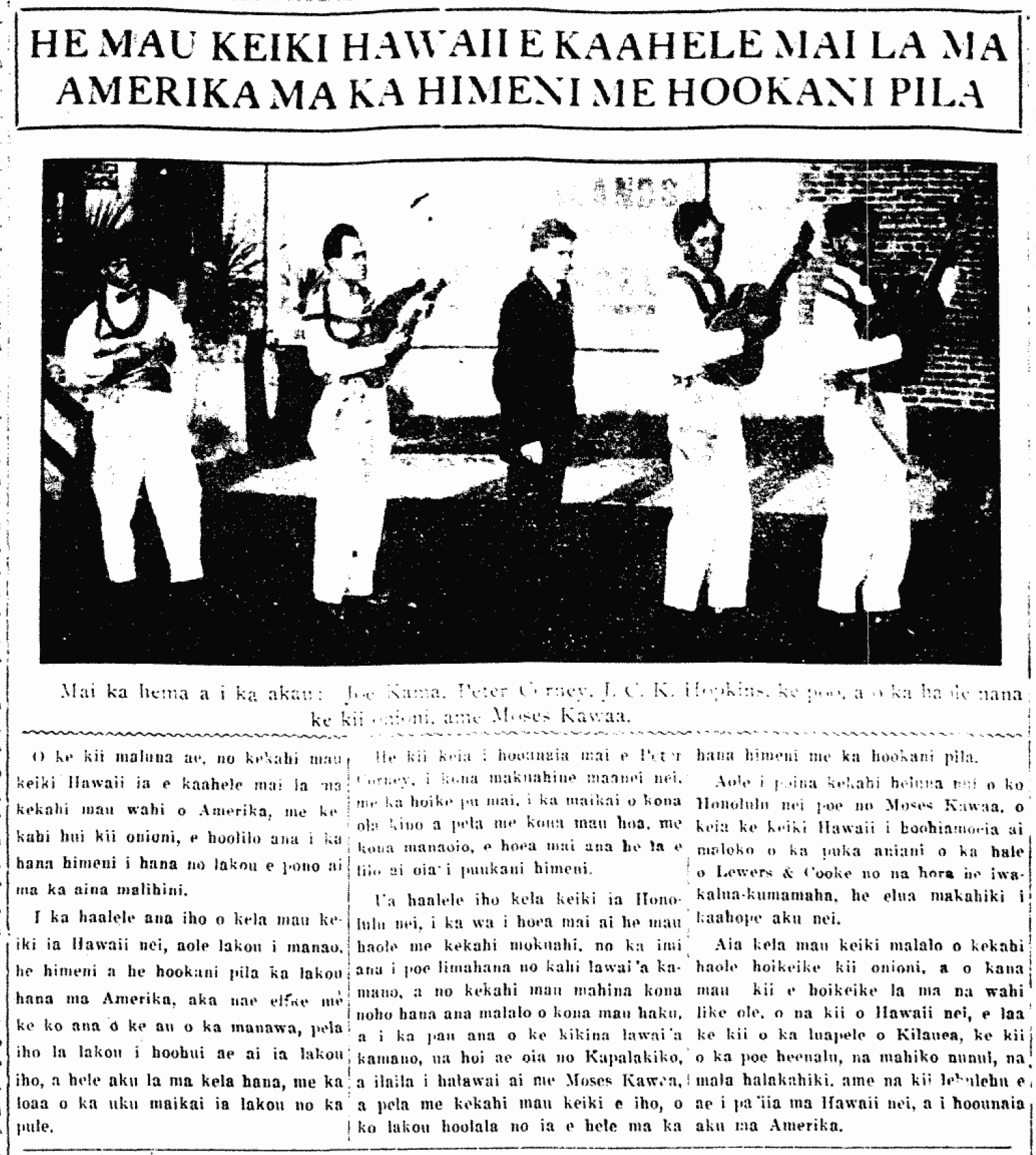
J. C. K. Hopkins and his band travelling around America, 1914.

SOME HAWAIIAN BOYS TRAVELLING AMERICA SINGING AND PLAYING MUSIC

From the left to right: Joe Kama; Peter Corney; J. C. K. Hopkins, the leader; the haole to whom belongs the movies; and Moses Kawaa.

The picture above is of some Hawaiian boys travelling around some places in America, along with a movie company, using music to make a living in the unfamiliar lands.

When the Hawaiian boys left Hawaii nei, they did not imagine that they would be singing and playing music in America, but with the passing of time, they found themselves getting together with each other and started this job, getting paid well by the week.

This picture was sent by Peter Corney to his mother here and he also stated that he was in very good health as well as his friends, and that he believes that the day will come when he will become a singer.

This boy left Honolulu nei when some haole came with a steamship in search of workers for a salmon fishing outfit and he spent several months working under his supervisors, and when the salmon fishing season was over, he returned to San Francisco and there he ran into Moses Kawaa and with some other boys, and they planned to go around singing and playing music.

Many here in Honolulu have not forgotten Moses Kawaa, the Hawaiian boy who was made to sleep in the window of the Lewers & Cooke building for twenty-four hours, two years ago.

These boys work under a haole who shows movies, and the movies that he shows all over the place are of scenes of Hawaii, like shots of the crater of Kilauea, shots of surfers, the expansive sugarcane plantations, pineapple fields, and many, many scenes taken in Hawaii nei and sent to America.

(Kuokoa, 3/13/1914, p. 5)
HE MAU KEIKI HAWAII E KAAHELE MAI LA MA AMERIKA MA KA HIMENI ME HOOKANI PILA

Ka Nupepa Kuokoa, Buke LII, Helu 11, Aoao 5. Maraki 13, 1914.
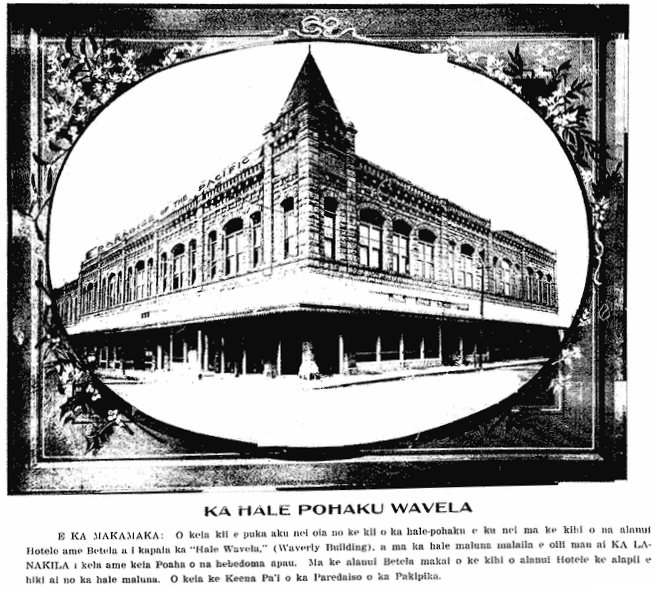
Waverly Building at the corner of Hotel and Bethel, 1909.

THE WAVERLY [WAVELA] STONE BUILDING

O FRIENDS: This picture that is being printed is an image of the stone building standing at the corner of Hotel [Hotele] and Bethel [Betela] Streets, called the Waverly Building [Hale Wavela], and on the second story is where the LANAKILA appears every Thursday of every week. It is on Bethel Street, makai of the Hotel Street corner where the stairs are to get to the second story. This is the Printing Office of the Paradise of the Pacific [Paredaiso o ka Pakipika].

[This “Paradise of the Pacific” magazine is the precursor to the magazine on the shelves today, “Honolulu Magazine”…]

(Lanakila, 7/15/1909, p. 4)

KA HALE POHAKU WAVELA

Ka Lanakila, Buke I, Helu 3, Aoao 4. Iulai 15, 1909.

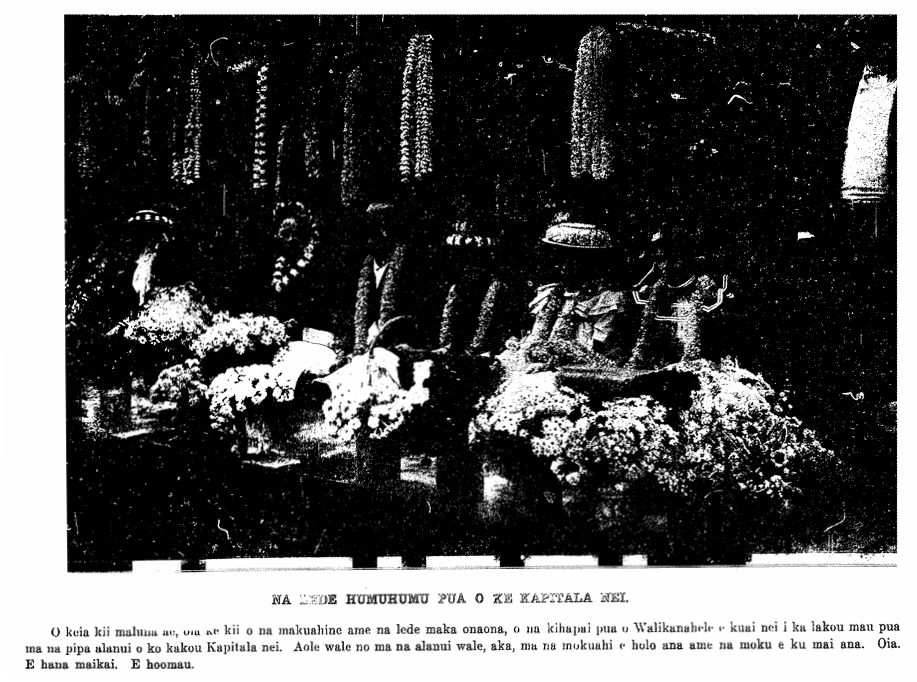
Lei makers of Honolulu, 1909.

LADY FLOWER SEWERS OF THIS CAPITAL.

The picture above is of the sweet-eyed mothers and ladies of the flower gardens of Walikanahele, selling their flowers on the street sides of our Capital. Not only on the streets, they go aboard the steamships and the ships that are docked. Yes. Do good work. Keep at it.

(Lanakila, 7/22/1909, p. 4)

NA LEDE HUMUHUMU PUA O KE KAPITALA NEI.

Ka Lanakila, Buke I, Helu 4, Aoao 4. Iulai 22, 1909.

Hawaiians in Jacksonville, Oregon, 1868.

[Found under: “NU HOU KULOKO: Oahu.”]

From Oregon.—We have received a letter from J. A. Alapai from Oregon, County Jacksonwille, paying his year’s subscription for our Kilohana,¹ $4.00 in Stamps; we appreciate this subscriber who lives in lands far, far away, in his paying for the life of the Paper to our people nearby. And in that letter, he spoke of some Hawaiian men living in that place shown above, as well as some women. Here below are their names and their places in Hawaii nei:

W. B. Kanaina (m), from Lahaina, Maui; C. W. Kalua (m), from Puunoa, Lahaina, Maui; J. A. Kupapaulu (m), from Lahaina, Maui; B. L. B. Makakoa (m), from Moalii, Lahaina, Maui; H. E. Kamahiai (m), from Moalii, Lahaina, Maui; N. Inuawa (m), from North Kohala, Hawaii; C. L. Kahoinea (m), from Kailua, North Kona, Hawaii; J. A. Alapai, the one who wrote the letter, from Waipunalei, Hilo, Hawaii; and as for the women, J. U. Keaumalahia (f), from Kahaluu, South Kona, Hawaii; Mary Lumahai (f), from Kaumakani, Kipahulu, East Maui; and these Hawaiian women gave birth to two children, one each; one half Chinese named Ioane Amiuna, and one half Indian named Uluhani; and that is what Mr. J. A. Alapai presented to us of that place shown above, Jackonville County, Oregon.

¹”the Foremost,” is an epithet for the Kuokoa Newspaper.

[Hawaiians were and are to this day travellers. There are letters written by Hawaiians travelling about or living in lands afar written to the Hawaiian-Language Newspapers from early on until the very end. I wonder what became of these people, if they stayed there in Oregon, moved on to somewhere else, or came  back home to Hawaii nei…]

(Kuokoa, 8/29/1868, p. 2)

Mai Oregona mai.

Ka Nupepa Kuokoa, Buke VII, Helu 35, Aoao 2. Augate 29, 1868.

Mrs. Akioka passes away, 1928.

A LOVING SENTIMENT FOR OUR MAMA, MRS. AKIOKA

Mr. Editor of Ka Hoku o Hawaii:

Aloha oe—

Please allow to include this sad parcel in some space in your newspaper to be published this week, in the issue of this new year. Our beloved mother left us, her children and family to grieve for her.

She was born in Canton, China, in 1857, in the month of April 23, and left her homeland when she was thirty-two years old and came to the Hawaiian Islands. She lived patiently with her husband in the beautiful valley of Waipio working under a poi company for several years. After this, her husband started his very own poi company. His capital was a single mule, some leased land, and a hired hand.

He did well for five years, and at that point, the two of them grew until the other poi companies dropped off. Today, it is one of the big poi factories of this beautiful valley supplying on the average 8,000 pounds of poi every week, feeding the workers of the ranches of Hawaii nei. Her husband (our father) died three years ago.

We are her children

Ernest Akioka

Edward Akioka

Herbert Akioka

(Hoku o Hawaii, 1/17/1928, p. 3)

HE MANAO ALOHA NO KO MAKOU MAMA MRS AKIOKA

Ka Hoku o Hawaii, Buke XXI, Helu 33, Aoao 3. Ianuari 17, 1928.

Mr. Akioka, a Chinese taro farmer/poi maker, dies, 1922.

AKIOKA PASSES AWAY.

MR. AKIOKA (CHINESE)

Mr. Editor of the Kuokoa Newspaper, Aloha kaua:—Please kindly allow me an open space of your newspaper, for our loved one, our father has left us, his children and his wife; he has peacefully left for that realm we must all go to.

He had a swelling sickness, and the doctor was fetched, but he did not get any relief and died.

Our father was born in the “land of flowers,” China, on the 30th of November, 1851, and he left us on the 18th of May, 1922; he was over 71 years old. Continue reading →

Lahaina, and Hawaii through history, 1941.

OLD LAHAINA PRISON
and
ANCIENT LAHAINA

By INEZ ASHDOWN

According to information gleaned from the Bishop Museum records and the Archives of Mr. E. Bryan Jr., curator at the Museum, the old Lahaina Prison was built in 1851 and completed in April 1852. This was during the reign of Kamehameha III, who ruled until 1854.

For “local color” at that time I have talked with old Hawaiians who are from 70 to 80 years of age, and have also spent many hours at the Wailuku library reading old volumes supplied by Mrs. Juliette Davis, Librarian. Continue reading →

Lahaina, a o Hawaii nei hoi o ka wa kahiko, 1941.

KA HALEPAAHAO KAHIKO O LAHAINA ame LAHAINA KAHIKO

(Kakauia e Inez Ashdown)

E like me na mea i hooloaa ia mai ka moolelo mai o Hale Hoahu o na Mea Kahiko o Bihopa mai ia Mr. E. H. Bryan Jr., mea malama o ua hale la, o ka Halepaahao kahiko o Lahaina i kukulu ia i ka M. H. 1851 a pau nohoi i ka makahiki 1852 i ka wa keia e noho moi ana o Kamehameha III, Kauikeaouli, i noho moi a hiki i ka makahiki 1854.

O ke ano oia au hui au a kamailio me na Hawaii kahiko o 70 a hiki i ke 80 makahiki, a pela pu nohoi ma o ka hoohala ana he mau hora lehulehu maloko o ka Hale Waiho Buke o Wailuku e heluhelu ana hoi i na buke kahiko i hoolako ia mai ia’u e Mrs. Juliette Davis, ka mea malama Hale Hoahu Buke. Continue reading →

Interesting translation, 1908.

HOW DIPHTHERIA IS CONTRACTED.

One often hears the expression, “My child caught a severe cold which developed into diphtheria,” when the truth that cold had simply left the lit- truth was that cold had simply left the wandering diphtheria germ. When Chamberlain’s Cough Remedy is given it not only cures the cold, but greatly lessens the danger of diphtheria or any other germ disease being contracted. There is no danger in giving this remedy, as it contains no opium or other harmful drug. For sale by all dealers. Benson, Smith & Co., agents for Hawaii.

(Hawaiian Star, 3/13/1908, p. 6)

HOWA DIPHTHERIA IS CONTRACTED.

The Hawaiian Star, Volume XV, Number 4978, Page 6. March 13, 1908.

KE ANO I HOOPAUIA AI O KA MA’I O KA PUU.

Ua lohe pinepineia keia olelo i ke kamailioia, “Ua loaa ka’u keiki i ke anu, a ku a puu maoli ae ma ka a-i,” a o ka mea oiaio no ea, mai ke anu mai i loaa mai ai ka anoano liilii a hiki i ke ku a puu maoli ana o ka a-i. I ka manawa i haawiia aku ai o ka Laau Kumu a Chamberlain, aole wale no o ke anu kana i hoola ai, aka ua hoopauia a hoemiia mai ka ma’i puu o ka a-i, a mau anoano e ae paha o kekahi ano ma’i. Aole loa he pilikia iki o ka haawi ana aku i keia laau oiai aole he opiuma iloko olaila, a laau hoopilikia e ae paha. Eia ke kuaiia nei e Benson, Smith & Co., Ltd., na akena no ka Paeaina Hawaii.

(Kuokoa, 3/13/1908, p. 4)

KE ANO I HOOPAUIA AI O KA MA'I O KA PUU.

Ka Nupepa Kuokoa, Buke XLIII, Helu 11, Aoao 4. Maraki 13, 1908.