Unknown's avatar

About nupepa

Just another place that posts random articles from the Hawaiian Newspapers! It would be awesome if this should become a space where open discussions happen on all topics written about in those papers!! And please note that these are definitely not polished translations, but are just drafts!!! [This blog is not affiliated with any organization and receives no funding. Statements made here should in now way be seen as a reflection on other organizations or people. All errors in interpretation are my own.]

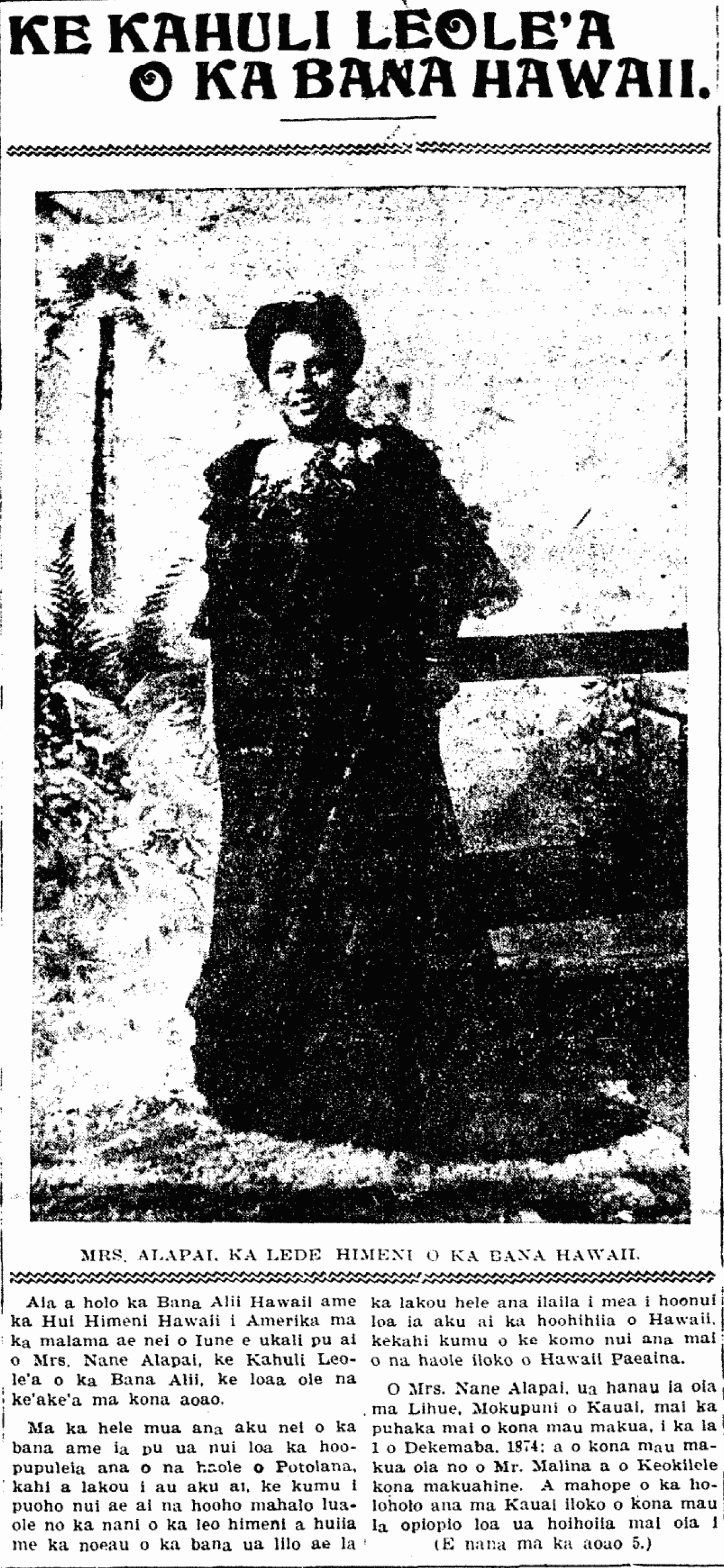
Nane Alapai, 1906.

THE HAPPY-VOICED KAHULI OF THE HAWAIIAN BAND

When the Royal Hawaiian Band and the Hawaiian Glee Club leaves for America in the next month of June, Mrs. Nane Alapai [Nani Alapai], the Beautiful-Voiced Kahuli of the Hawaiian Band will accompany them, should there be no obstructions in her way.

When the band first went with her along, the haole of Portland, where they travelled to, were driven crazy, and that is the reason that there was unequaled exclaim for the beauty of of the singing along with the skill of the band; and their travelling there caused a great interest in Hawaii, which is why there is a great influx in the number of haole coming to the Hawaiian Islands.

Mrs. Nane Alapai [Nani Alapai], was born in Lihue, on the island of Kauai, from the loins of her parents, on the 1st of December, 1874; her parents are Mr. Malina and Keokilele is her mother. And after going around Kauai during her youth, she was taken…

(Kuokoa, 3/16/1906, p. 1)

KE KAHULI LEOLE'A O KA BANA HAWAII.

Ka Nupepa Kuokoa, Buke XLIV, Helu 11, Aoao 1. Maraki 16, 1906.

to Honolulu, where she was educated at the Catholic Boarding School for Girls. She married her husband, Mr. W. J. Alapai almost eleven years ago. She has some siblings other than her; five brothers and eight sisters.

When she joined the Royal Hawaiian Band until today, she spent nine years singing before an audience, and during that whole time, her singing has brought much delight in Hawaii’s people and more so in the malihini who come to Hawaii and then go to America; they are so much more delighted; and this is very valuable to Hawaii and to her herself, and this advertises Hawaii’s beauty; the beauty of her ridges, the beauty of her mountains, and the beauty of the songs of her people; it seems there will be a lot of Hawaiian singer born as a result.

(Kuokoa, 3/16/1906, p. 5)

KE KAHULI LEOLE'A O KA BANA HAWAII.

Ka Nupepa Kuokoa, Buke XLIV, Helu 11, Aoao 5. Maraki 16, 1906.

Bonine brings movies to Kalawao and Kalaupapa, 1909.

FIRST MOVING PICTURE SHOW TAKES SETTLEMENT BY STORM

On Thursday evening last a new miracle happened at Kalaupapa. On that evening R. K. Bonine, the moving-picture expert, threw his first picture on the screen before an audience of a thousand lepers, and there was a great gasp of awed astonishment and keen delight when the pictures really moved and did things. Cheers, tears, gasps and soul-satisfying laughter greeted the pictures in turn, and when the reels put aside for the first entertainment had been exhausted, the people of Kalaupapa and Kalawao, in a body, cheered their thanks to the man who had brought these wonders to them and to those in Honolulu who had through their contributions made these miracles possible.

It was a great day for the people of the Molokai Settlement, and it was a great day for Bonine. To the lepers had come a new marvel, greater far than the sight of the mighty White Fleet, which maneuvered past their shores last summer, greater than anything that had come to them. No place the world over have motion pictures made such a hit. Continue reading →

Hot air balloon in Paris, riding a camel in India, then an elephant in Egypt…, 1911.

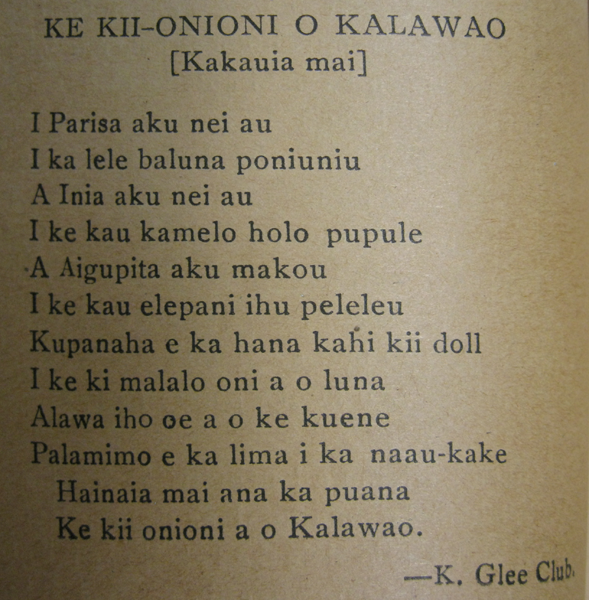
KE KII-ONIONI O KALAWAO
[Kakauia mai]

I Parisa aku nei au
I ka lele baluna poniuniu
A Inia aku nei au
I ke kau kamelo holo pupule
A Aigupita aku makou
I ke kau elepani ihu peleleu
Kupanaha e ka hana kahi kii doll
I ke ki malalo oni a o luna
Alawa iho oe a o ke kuene
Palamimo e ka lima i ka naau-kake
Hainaia mai ana ka puana
Ke kii onioni a o Kalawao
—K. Glee Club.

[Movie of Kalawao
(Submitted)

I was in Paris
On a dizzying hot-air balloon
I was in India
On a camel that went along crazily
We were in Egypt
On an elephant with a long trunk
Amazing is the action of this doll
Turn the key below and it moves above
Look at that waiter
Skilled are his hands with the sausage
Let the story be told
The movie of Kalawao.

Kalaupapa Glee Club.]

[Here is a mele about places far away, written it seems down in Kalawao after a movie of clips of various scenes was shown there. For the version more widely known today, see also “Palisa” in Na Mele o Hawaii Nei, pp. 84–85.]

(Au Hou, 8/24/1910, p. 12)

KE KII-ONIONI O KALAWAO

Ke Au Hou, Buke I, Helu 17, Aoao 12. Augate 24, 1910.

Hawaiian Language information from English-language newspapers! 1887.

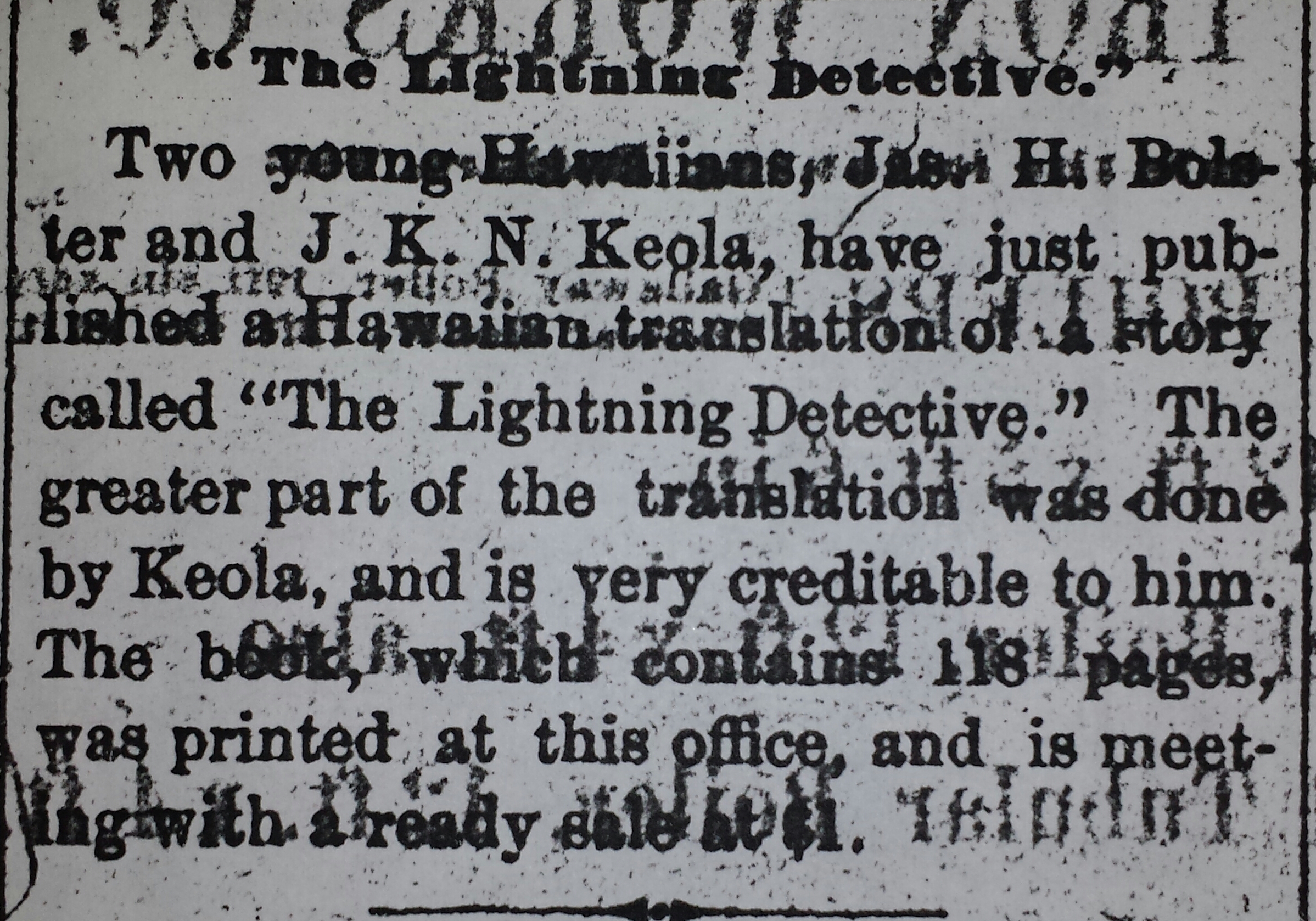
“The Lightning Detective.”

Two young Hawaiians, Jas. H. Boster and J. K. N. Keola, have just published a Hawaiian translation of a story called “The Lightning Detective.” The greater part of the translation was done by Keola, and is very creditable to him. The book, which contains 118 pages, was printed at this office, and is meeting with a ready sale at $1.

[There doesn’t seem to be a translator credited on the actual book, “He Buke Moolelo no Ka Makai Kiu Uila” published in 1887 by the P. C. Advertiser.¹ Who would have thought that translators of a Hawaiian book would be mentioned in an English newspaper (even if it was a newspaper printed by the company that did the publishing). This goes to show you that it is important to look at all sources available, whatever language it may be in, to find information!

Copies of this book are available at the Hawaiian Historical Society and Mission Children Society, photocopies are available at Hamilton Library at UHM.]

¹See David Forbes’ Hawaiian National Bibliography, vol. 4.

(Pacific Commercial Advertiser, 5/3/1887, p. 3)

"The Lightning Detective."

Pacific Commercial Advertiser, Volume VI, Number 104, Page 3. May 3, 1887.

Stopping by at Washington, D. C. on the way to see the Queen, 1887.

KING KALAKAUA’S WIFE.

QUEEN KAPIOLANI ARRIVES AT OUR NATIONAL CAPITAL.

Arrangements Made for the Queen to Call on the President and Mrs. Cleveland—A Benevolent Creature on Her Way to Visit Victoria—Queen Emma.

QUEEN KAPIOLANI.

Washington, May 4.—Queen Kapiolani, of the Hawaiian Islands, who arrived in San Francisco on April 20, arrived in Washington to-day and immediately went to the Arlington Hotel. Arrangements have been made for the queen to call on the president and Mrs. Cleveland at noon on Wednesday. The queen and suite will arrive here early Tuesday evening and go at once to the Arlington. A time will be appointed by the queen during her stay here for the diplomatic corps to call on her, and she will also probably receive calls from the naval officers who have been stationed at Honolulu, all of whom have met her majesty, and many of whom have danced with her.

After spending a few days here sight-seeing she will go to New York. From there she goes to England to be present at the Queen’s jubilee. She has never been out of her own country before, and is quite anxious to see the “greatest woman on the face of the earth,” as she calls Queen Victoria. Queen Kapiolani is not of what is known as royal blood in Honolulu. Strictly speaking neither is King Kalakaua of royal blood, as he was elected to the throne and did not inherit it. Continue reading →

Translations and vocabulary not found in dictionaries, 1903.

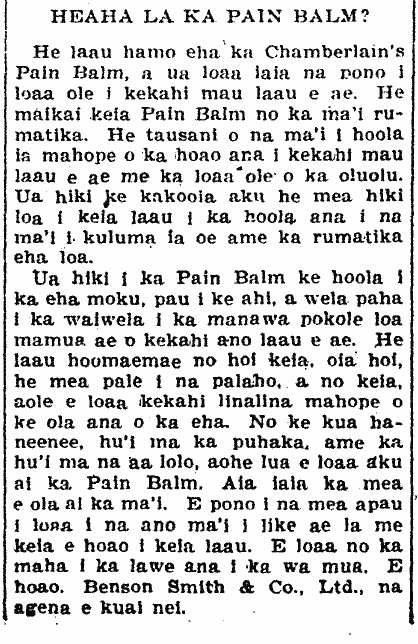
HEAHA LA KA PAIN BALM?

He laau hamo eha ka Chamberlain’s Pain Balm, a ua loaa iaia na pono i loaa ole i kekahi mau laau e ae. He maikai keia Pain Balm no ka ma’i rumatika. He tausani o na ma’i i hoola ia mahope o ka hoao ana i kekahi mau laau e ae me ka loaa ole o ka oluolu. Ua hiki ke kakooia aku he mea hiki loa i keia laau i ka hoola ana i na ma’i i kuluma ia oe ame ka rumatika eha loa.

Ua hiki i ka Pain Balm ke hoola i ka eha moku, pau i ke ahi, a wela paha i ka waiwela i ka manawa pokole loa mamua ae o kekahi ano laau e ae. He laau hoomaemae no hoi keia, oia hoi, he mea pale i na palaho, a no keia, aole e loaa kekahi linalina mahope o ke ola ana o ka eha. No ke kua haneenee, hu’i ma ka puhaka, ame ka hu’i ma na aa lolo, aohe lua e loaa aku ai ka Pain Balm. Aia iaia ka mea e ola ai ka ma’i. E pono i na mea apau i loaa i na ano ma’i i like ae la me keia e hoao i keia laau. E loaa no ka maha i ka lawe ana i ka wa mua. E hoao. Benson Smith & Co., Ltd., na agena e kuai nei.

(Kuokoa, 4/3/1903, p. 5)

HEAHA LA KA PAIN BALM?

Ka Nupepa Kuokoa, Buke XLI, Helu 14, Aoao 5. Aperila 3, 1903.

WHAT IS PAIN BALM?

Chamberlain’s Pain Balm is a liniment and, while adapted to all the ordinary uses of a liniment, has qualities which distinguish it from other remedies of this class. Pain Balm is especially beneficial for rheumatism. Thousands of cases can be cited in which it has effected a cure when the sufferer had previously tried the best medical service without securing relief. Pain Balm is positively guaranteed to give relief  in the most severe cases of chronic or acute rheumatism.

Pain Balm heals bruises, burns and scalds in less time than any other treatment. It is “antiseptic” that is, it prevents putrefaction and by so doing, generally prevents and unsightly scar remaining after the injury is healed. For lame back, lumbago and neuralgia, Pain Balm has no equal. It has the quality of “getting to the right spot.” No sufferer from these distressing affections should defer a trial of this remedy. One application gives relief. Try it. For sale by all dealers. Benson, Smith & Co., general agents.

[Actual translations of almost anything like this advertisement done in the past can shed light on vocabulary, turns of phrase, and so much more!]

(Hawaiian Star, 9/5/1903, p. 3)

WHAT IS PAIN BALM?

The Hawaiian Star, Volume XI, Number 3576, Page 3. September 5, 1903.

Royal Hawaiian Band on major tour, 1906.

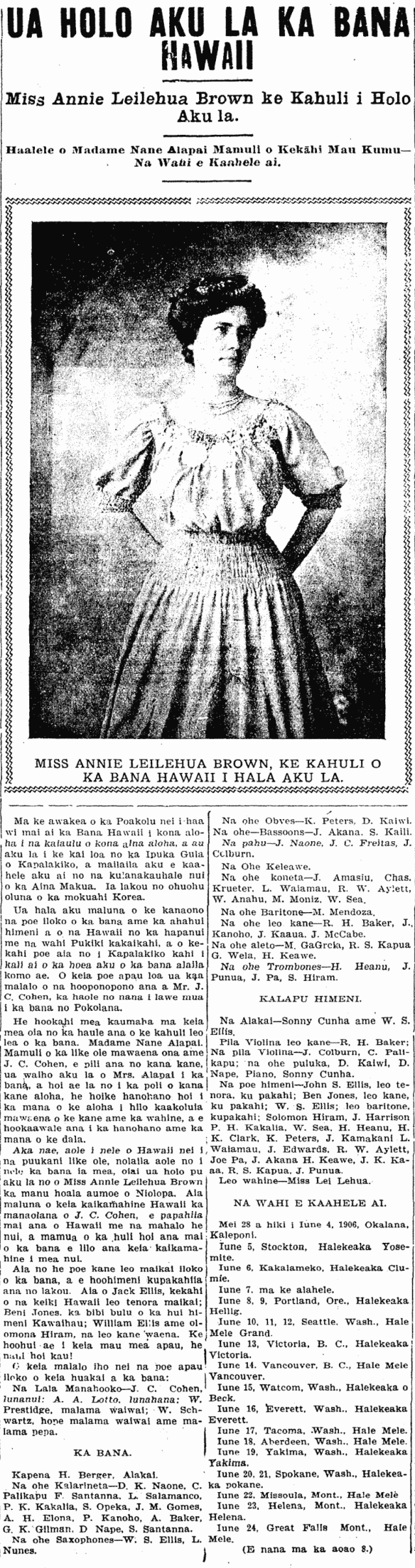
THE HAWAIIAN BAND HAS LEFT

Miss Annie Leilehua Brown is the Kahuli¹ that has Left.

Madame Nane [Nani] Alapai Pulled Out Over Some Issues—The Places They Will Visit.

MISS ANNIE LEILEHUA BROWN, THE KAHULI OF THE HAWAIIAN BAND WHO HAS LEFT.

On the evening of this past Wednesday, the Royal Hawaiian Band gave their aloha to the communities of their beloved land, and travelled across the wide ocean to the Golden Gate [Ipuka Gula] of San Francisco, and from there they will travel the major cities of the Father Land. They made the deck of the Steamer Korea adorned with them.

There were sixty people on there of the band and glee club, and the majority are Hawaiian, with a few Portuguese; and some people are waiting in San Francisco to join up with the band there. All of them are under the management of Mr. J. C. Cohen, the haole who took the band earlier to Portland [Pokolana].

There is one sad thing, and that is the dropping of the sweet-voiced singer of the band, Madame Nane [Nani] Alapai. Due to a differences between her and J. C. Cohen about her husband, Mrs. Alapai has left the band, and returned to the bosom of her beloved husband; this is a noble example of the power of aloha that is triply bound betwixt a man and his wife; and she will abandon the prestige and power of money.

Hawaii however does not lack in all sorts of singers, so that band is not missing a singer being that they were accompanied by Miss Annie Leilehua Brown, the bird that enlivens the nights of Niolopa. Upon this Hawaiian girl lies the hopes of J. C. Cohen that Hawaii will be lauded with much praise, and that before the band returns home, this girl will become something big.

There are men in that band with beautiful voices, and they will be made to sing solos. There is Jack Ellis, one of Hawaii’s fine tenors; Beni Jones, the bull of the Kawaihau Glee Club; William Ellis and Solomon Hiram, the baritones. When they are all singing together, it is just so beautiful!

These below are all of the people in this tour of the band:

Executive Staff—J. C. Cohen, general manager [lunanui]; A. A. Lotto, business representative [lunahana]; W. Prestidge, master of properties [malama waiwai]; W. Schwartz, assistant master of properties [hope malama waiwai] and librarian [malama pepa].

THE BAND.

Captain H. Berger, Director.

Clarinets—D. K. Naone, C. Palikapu, F. Santanna, L. Salamanco, P. K. Kakalia, S. Opeka, J. M. Gomes, A. H. Elona, P. Kanoho, A. Baker, G. K. Gilman, D. Nape, S. Santanna.

Saxophones—W. S. Ellis, L. Nunes.

Oboes—K. Peters, D. Kaiwi.

Drums—J. Naone, J. C. Freitas, J. Colburn.

The Brass Section.

Cornets—J. Amasiu, Charles Krueter, L. Waiamau, R. W. Aylett, W. Anahu, M. Moniz, W. Sea.

Baritone Horn—M. Mendoza.

Tubas—R. H. Baker, J. Kanoho, J. Kaaua, J. McCabe.

Alto Horns—M. Garcia, R. S. Kapua, G. Wela, H. Keawe.

Trombones—H. Heanu, J. Punua, J. Pa, S. Hiram.

GLEE CLUB.

Directors—Sonny Cunha and W. S. Ellis.

Double bass—R. H. Baker; Violinists—J. Colburn, C. Palikapu; flutists, D. Kaiwi, D. Nape; Piano, Sonny Cunha.

Singers—John S. Ellis, tenor, soloist; Ben Jones, bass, soloist; W. S. Ellis, baritone, soloist; Solomon Hiram, J. Harrison, P. H. Kakalia, W. Sea, H. Heanu, H. K. Clark, K. Peters, J. Kamakani, L. Waiamau, J. Edwards, R. W. Aylett, Joe Pa, J. Akana, H. Keawe, J. K. Kaaa, R. S. Kapua, J. Punua.

Female singer—Miss Lei Lehua [Leilehua]

THE PLACES THEY WILL TRAVEL.

May 28 to June 4, 1906, Oakland, California.
June 5, Stockton, Yosemite Theater.
June 6, Sacramento, Clumie Theater.
June 7, on the road.
June 8, 9, Portland, Oregon, Hellig Theater.
June 10, 11, 12, Seattle, Washington, Grand Music House.
June 13, Victoria, British Columbia, Victoria Theater.
June 14, Vancouver, B. C., Vancouver Music House.
June 15, Watcom, Washington, Beck Theater.
June 16, Everett, Washington, Everett Theater.
June 17, Tacoma, Washington, Music House.
June 18, Aberdeen, Washington, Music House.
June 19, Yakima, Washington, Yakima Theater.
June 20, 21, Spokane, Washington, Spokane Theater.
June 22, Missoula, Montana, Music House.
June 23, Helena, Montana, Helena Theater.
June 24, Great Falls, Montana, Music House.

¹Kahuli are the famous singing land shells which are often used to describe sweet-voiced singers.

(Kuokoa, 5/25/1906, p. 1)
UA HOLO AKU LA KA BANA HAWAII

Ka Nupepa Kuokoa, Buke XLIV, Helu 21, Aoao 1. Mei 25, 1906.

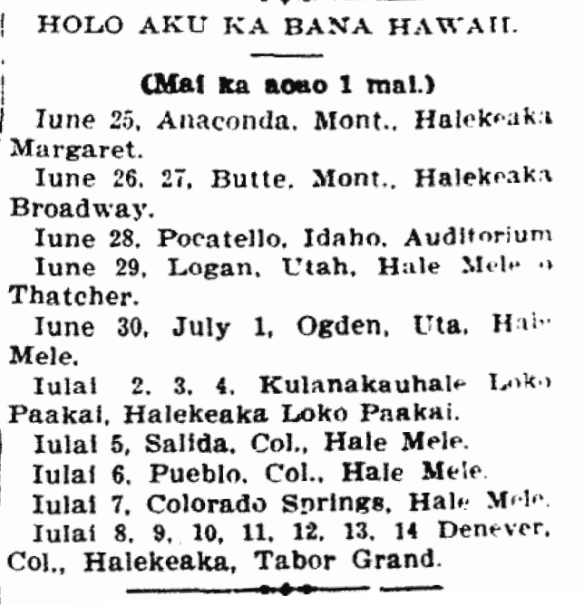
June 25, Anaconda, Montana, Margaret Theater.
June 26, Butte, Montana, Broadway Theater.
June 28, Pocatello, Idaho, Auditorium.
June 29, Logan, Utah, Thatcher Music House.
June 30, July 1, Ogden, Utah, Music House.
July 2, 3, 4, Salt Lake City, Salt Lake Theater.
July 5, Salida, Colorado, Music House.
July 6, Pueblo, Colorado, Music House.
July 7, Colorado Springs, Music House.
July 8, 9, 10, 11, 12, 13, 14, Denver, Colorado, Tabor Grand Theater.

(Kuokoa, 5/25/1906, p. 8)
HOLO AKU KA BANA HAWAII.

Ka Nupepa Kuokoa, Buke XLIV, Helu 21, Aoao 8. Mei 25, 1906.

Kamehameha Schools Song Contest, yesterday and today, 1944 / 2014.

[Found under: “News From Boys, Girls Kamehameha School”]

By HARRIETTE HURLEY

People who enjoy Hawaiian music have expressed the desire to know the meanings of the Hawaiian songs. Translations of the two prize songs to be used in the Kamehameha School for Girls’ song contest to be held on February 13, appear below.

Mrs Mary Kawena Pukui, translator at the Bishop Museum and director of Hawaiian activities at the Kamehameha Preparatory School, has translated the songs.

The junior division prize song is Pa’au’au Waltz. Selected for the senior division prize song is Lei Awapuhi.

Translation of Lei Awapuhi

I hear the voice of a loved one say
Let me pluck and wear the flower
To string a lei for my leaf bud to wear
My love was strongly attracted
To the choicest flower that ever bloomed
Let me, darling, string it into a lei,
O let your ginger lei be mine. Continue reading →

Hole Waimea i ka ihe a ka makani, 1927.

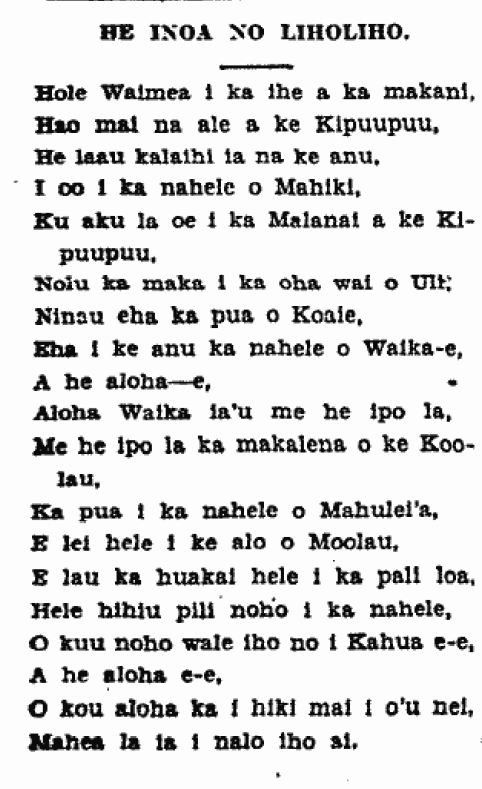
A NAME SONG FOR LIHOLIHO.

HE INOA NO LIHOLIHO.

Hole Waimea i ka ihe a ka makani,
Hao mai na ale a ke Kipuupuu,
He laau kalaihi ia na ke anu,
I oo i ka nahele o Mahiki,
Ku aku la oe i ka Malanai a ke Kipuupuu,
Nolu ka maka i ka oha wai o Uli,
Ninau eha ka pua o Koaie,
Eha i ke anu ka nahele o Waika-e,
A he aloha—e,
Aloha Waika ia’u me he ipo la,
Me he ipo la ka makalena o ke Koolau,
Ka pua i ka nahele o Mahulei’a,
E lei hele i ke alo o Moolau,
E lau ka huakai hele i ka pali loa,
Hele hihiu pili noho i ka nahele,
O kuu noho wale iho no i Kahua e-e,
A he aloha e-e,
O kou aloha ka i hiki mai i o’u nei,
Mahea la ia i nalo iho ai.

(Kuokoa, 7/14/1927, p. 6)

HE INOA NO LIHOLIHO.

Ka Nupepa Kuokoa, Buke LXVI, Helu 28, Aoao 6. Iulai 14, 1927.

Hawaiian boy in the military writes home to his mom, 1921.

A LETTER FROM A BOY TO HIS MOM.

JOHNSON KEALOHA

February 23, 1921.

To My beloved Mama:—I received your letter, and with much aloha for you and papa, I am writing this letter. I was pleased to find out that you guys received the check that I sent, that check that you sent to me and that I sent back.

Mama, I had a very happy experience here in Balboa; we had a swimming meet, competing with the swimming team of the Balboa Club. I won the 50 yard meet, and the competitor for the Balboa Club lost. Older brother Kalei was with me, he is now the captain of the Yeoman of the warship Wyoming. Kaehu won the 200 yard meet, this was a race where you swam face up. We lost the relay race [heihei paku’i], however some of us were right behind the winner. We will race once again on the 24th of this month with that same club. I believe that by the time you receive this letter, we will soon reach San Pedro in a couple of days.

I am in good health, and I hope that so too are you two and everyone as well at home. O Mama, one more thing I wanted to tell you, of which I am happy about, and that is this, I received my gold medals a few days ago, from the Mayor of New York. I will send the medals to you, when he returns to the states.

In a shooting practice amongst the Pacific and the Atlantic fleets, the Pacific won in a competition held in the sea of Panama. I will stop here, because I am returning to catch a skiff to go back on board the battleship New York, so much aloha for you and papa and all of the family.

March 15, 1921.

My dear Mama:—I am sending the two of you this dipoloma [palapala homaikai] given for crossing over the Mediterranean Sea [Kaiwaena] with a American battleship. I was going to send you this with the other things I sent you,  but I forgot because I was very rushed, so I will send you this “diploma” now, and I hope that you will get it.

Mama, I want you to frame this diploma in a big wooden frame so that it doesn’t get damaged, and I also hope that it will be something nice for the family to look at always. Both older brother Kalei and I crossed over the Mediterranean Sea. Write me if you get this diploma.

I am in good health, and so too is older brother, Kalei. I hope that there will be a swim meet between us and the club of South California this coming month; our superior is organizing a meet between the club of the warships of the Pacific and that of California.

I am stopping here and will write again to you mama. Give my aloha to papa and all the family at home. From you loving child,

JOHNSON KEALOHA.

(Kuokoa, 4/8/1921, p. 2)

HE LEKA NA KE KEIKI I KONA MAMA.

Ka Nupepa Kuokoa, Buke LIX, Helu 14, Aoao 2. Aperila 8, 1921.