Unknown's avatar

About nupepa

Just another place that posts random articles from the Hawaiian Newspapers! It would be awesome if this should become a space where open discussions happen on all topics written about in those papers!! And please note that these are definitely not polished translations, but are just drafts!!! [This blog is not affiliated with any organization and receives no funding. Statements made here should in now way be seen as a reflection on other organizations or people. All errors in interpretation are my own.]

Niihau folks visiting Kauai and a mele for the famed Niihau shell lei , 1940.

[Found under: “Bits of News from Kauai”]

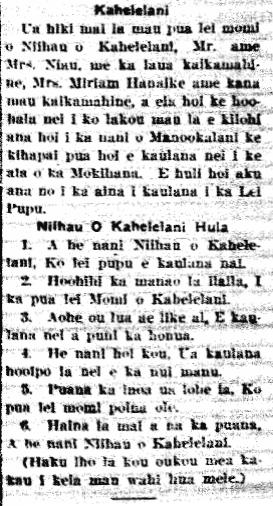
Kahelelani

Those lei blossoms, the momi of Niihau of Kahelelani, Mr. and Mrs. Niau, and their daughter Mrs. Miriam Hanaike and her daughters, have arrived, and they are spending their days gazing at the beauty of Manookalani [Kauai], the flower garden famous for the fragrance of Mokihana. They will return to the land famous for the Shell Lei [Lei Pupu].

Niihau O Kahelelani Hula

1. A he nani Niihau o Kahelelani, Ko lei pupu e kaulana nei.

2. Hoohihi ka manao la ilaila, I ka pua lei Momi o Kahelelani.

3. Aohe ou lua ae like ai, E kaulana nei a puni ka honua.

4. He nani hoi kou, Ua kaulana hooipo ia nei e ka nui manu.

5. Puana ka inoa ua lohe ia, Ko pua lei momi poina ole.

6. Haina ia mai a na ka puana, A he nani Niihau o Kahelelani.

(Your writer has composed these lines of poetry.)

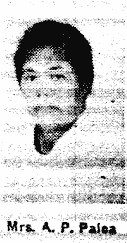
[Abbie P. Palea had a regular column in Hoku o Hawaii, writing about various happenings on Kauai. She often wrote in with poetic compositions by her own hand. Here is just one of them. Although you will find credit given to Joseph Kelly (Keʻale), at the Bishop Museum’s Niihau Shell Lei Exhibit going on now (see it while you can!), i would suggest that because there seems to be no counter claims in later newspapers to Palea’s statement, that “Niihau o Kahelelani Hula” was indeed written by her.

There is so much to be learned from the old Hawaiian-Language Newspapers!]

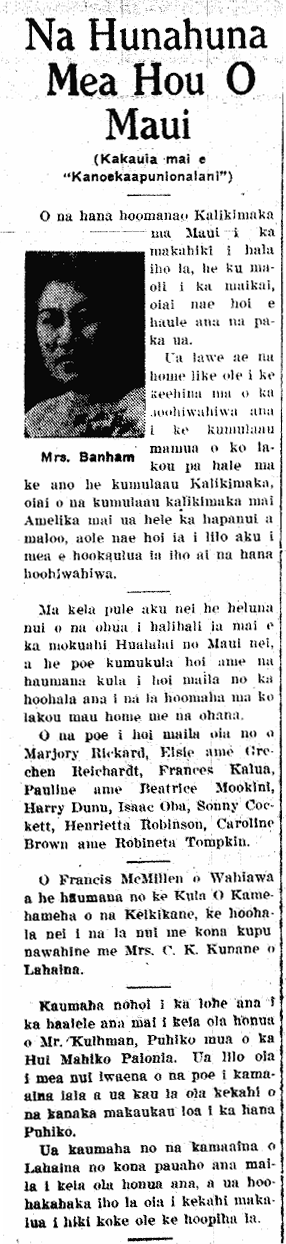
(Hoku o Hawaii, 8/28/1940, p. 1)

Hoku o Hawaii, Volume XXXV, Number 18, Page 1. Aukake 28, 1940.

Mrs. A. P. Palea

Kahelelani

Ka Hoku o Hawaii, Volume XXXV, Number 18, Page 1. Aukake 28, 1940.

Stunning Niihau Shell Lei Exhibit at the Bishop Museum, 2013.

Ni‘ihau Shell Lei

October 26, 2013 – January 27, 2014
Ni'ihau Shell LeiA private collection of over 60 stunning and pristine lei will be featured in “Ni‘ihau Shell Lei: Ocean Origins, Living Traditions” examines the science behind Ni‘ihau shells, as well as its manufacturing history and the master craftsman who make them.

This exhibit will be showcased in the Bishop Museum’s Long Gallery.

Mahalo to our sponsors:

  • Rapozo Kama‘aina Fund of the Hawai‘i Community Foundation
  • Hiroaki Elaine & Lawrence Kono Foundation
  • Hawaiian Malacological Society

Mele found everywhere in the newspapers. 1899.

[Found in: “HALEIWA HOTELE: Ka Ui Mahiehie ma Waialua”]

O ka loku hala ole
A ka ua i Maili,
Ili hewa ka manao ia nei,
Ka waiho la i ka lai.

Chorus: O oe kai hui iho la,
Ka manao e puapuai la,
Ei ae o Puu-o-Hulu,
Hului no au, ua hiki no.

Nau i lahui i ka leo,
Ike i ka makani Kaieulu [Kaiaulu],
Ka makani o ka aina,
Ilaila hoola’i na manu.

[Here is another interesting mele found in a nice description of an excursion aboard the train Kaala to the newly-opened Haleiwa Hotel. It is added into the narrative by the writer as he describes passing by Puuohulu. This inserting of mele into prose is something found often in Hawaiian writing. This composition seems very reminiscent of another perhaps more famous mele still sung today.]

(Kuokoa, 8/11/1899, p. 1)

O ka loku hala oe, A ka ua i Maili...

Ka Nupepa Kuokoa, Buke XXXVIII, Helu 32, Aoao 1. Augate 11, 1899.

Vital Statistics, 1913.

MARRIAGES.

Ernest Lishman to Maggie Ikaika, Oct. 24.
John Smith to Hattie Ku, Oct. 25.

BIRTHS.

To Joseph Perez Jr. and Annie Kawailani, a son, Oct. 9.
To Charles E. Paaluhi and Hapenuia, a daughter, Oct. 12.
To Moses Naehu and Maryann Moke, a son, Oct. 19.
To Ah Hoi and Luisa, a son, Oct. 23.
To Puha Kaina and Mary Pahu, a daughter, Oct. 27.

DEATHS.

Thomas Carter, at Kapiolani Home, Oct. 18.
Fanny Kailieha, on Auld Lane, Oct. 22.
Henry Williams, at the children’s hospital, Oct. 22.
Maile Kini, on Pauoa Street, Oct. 22.
George K. Wahalama, on King Street, Oct. 23.
Pokini K. Alapai, on Queen Street, Oct. 23.
Keawe Kaapuni, on Hotel Street, Oct. 23.
Joseph Kikaha, on Kamehameha Street, Oct. 23.
Dominica Lui, at the children’s hospital, Oct. 24.
Nahuina, in Honolulu, Oct. 25.
Robert Kalama, on Ala Moana Boulevard, Oct. 25.
B. H. Zablan, on Liliha Street, Oct. 25.

(Kuokoa, 10/31/1913, p. 4)

NA MARE. / NA HANAU. / NA MAKE.

Ka Nupepa Kuokoa, Buke LI, Helu 43, Aoao 4. Okatoba 31, 1913.

Vital Statistics, 1913.

MARRIAGES.

Solomon Mahu to Esther Kaulana, Oct. 4.
J. C. Cunningham to Adeline K. Bush, Oct. 15.
Charles Oina to Mary Poepoe, Oct. 20.

BIRTHS.

To R. W. Shingle and Ethel M. Campbell, a son, Sept. 17.
To Peter Kamali and Abbie Camacho, a son, Sept. 2.
To F. W. MacFarlane and Alice K. Campbell, a daughter, Sept. 20.
To Sam K. Keanu Sr. and Louisa Kapawaliilii [?], a son, Sept. 24.
To William Noa and Lepeka C. Chong, a daughter, Oct. 17.
To Eugene Duvauchelle and Julia Kahihikolo, a daughter, Oct. 10.
To Joseph M. Naone and Mary Kealohapauole, a son, Oct. 12.
To Eddie Peters and Susie Kiko, a daughter, Oct. 6.
To Mika Sopa and Lizzie Kamokuiki, a daughter, Oct. 10.
To Manuel Smith and Hatfie Keohohou, a son, Oct. 12.
To Antone Times and Maria Kaaihue, a son, Oct. 16.

DEATHS.

Mrs. Luika Kapukui, on Palolo Street, Oct. 15.
David H. Nakaula, on Vinyard Street, Oct. 15.
Mrs. Hattie Kaapuni Maui, on Waialae Street, Oct. 17.
A baby of William Noa, on Palolo Street, Oct. 17.
Lepeka C. Chong, on Palolo Street, Oct. 17.
Ioane K. Kameaaloha, at the Insane asylum, Oct. 19.

(Kuokoa, 10/24/1913, p. 4)

NA MARE. / NA HANAU. / NA MAKE.

Ka Nupepa Kuokoa, Buke LI, Helu 42, Aoao 4. Okatoba 24, 1913.

On kalo, poi, and life, 1901.

FARMING KALO.

When considering how we Hawaiians are being supplied with poi, there is not the slightest indication that the cost of our staple food will decrease, and it is also very clear that if what has happened in the past years continues on into the upcoming years, and we continue relying on the Chinese for our supply, it is obvious that the price of poi will shoot up, and we will not be able to eat poi.

As a result of the increase in the price of rice, the former taro lands are being planted with rice, and should the rice market continue to be favorable, then a majority of the Chinese will abandon taro and become rice farmers, then, the cost of kalo will skyrocket, and as a result, so too will the price of poi.

Therefore, in our opinion, Hawaiians should start farming kalo, and obtain its benefits; looking at the land situation these days, it is very clear that the price of poi will continue to rise for long into the future; and the Hawaiians or others perhaps who continue this occupation will not fail to reap its benefits.

That man will make himself prosper and he will supply those who are lacking poi at a fair price, and so we say, O Hawaiian people, go into the occupation of kalo farming, and there shall be many blessings.

[While rice is no longer being planted here, perhaps in its place are being planted buildings. What is there to be done today?]

(Lahui Hawaii, 6/22/1901, p. 4)

E MAHI KALO.

Ka Lahui Hawaii, Buke III, Helu 25, Aoao 4. Iune 22, 1901.


More on Moanalua Park, 1899.

MOANALUA PARK.

As long as Minister Damon [Damana] has been in possession of Moanalua, his desire to beautify, ornament, and to clean up the area has been increasing.

He is planting roses and vines of all sorts and these are growing and increasing inside and outside of the glass houses with their blossoming fragrant blossoms.

There are many people constructing new roads; one will be for the island which will be close to the house and one will go up to Alia Paakai.

Its beauty is intensifying every day. Mr. Damon will continue to bring in plants and fruits from other lands to adorn this Home of his, and it will please the eyes of those who visit.

(Lahui Hawaii, 3/25/1899, p. 5)

MOANALUA PA-KA.

Ka Lahui Hawaii, Buke 1, Helu 9, Aoao 5. Maraki 25, 1899.

Visitors to Moanalua Park, 1898.

GROUP OF VISITORS AT MOANALUA.

There was a truly great number of people who arrived in Moanalua, on the evening of last Saturday, to share in the delightful welcome extended by Minister Damon and Mrs. S. M. Damon. Some came by train, some came up by horse-drawn carriage. The reception began from 3 o’clock in the afternoon until 6 o’clock or so.

This was an unforgettable gathering to all who assembled there.

(Kuokoa, 10/7/1898, p. 3)

KE ANAINA HOOKIPA MA MOANALUA.

Ka Nupepa Kuokoa, Buke XXXVII, Helu 40, Aoao 3. Okatoba 7, 1898.

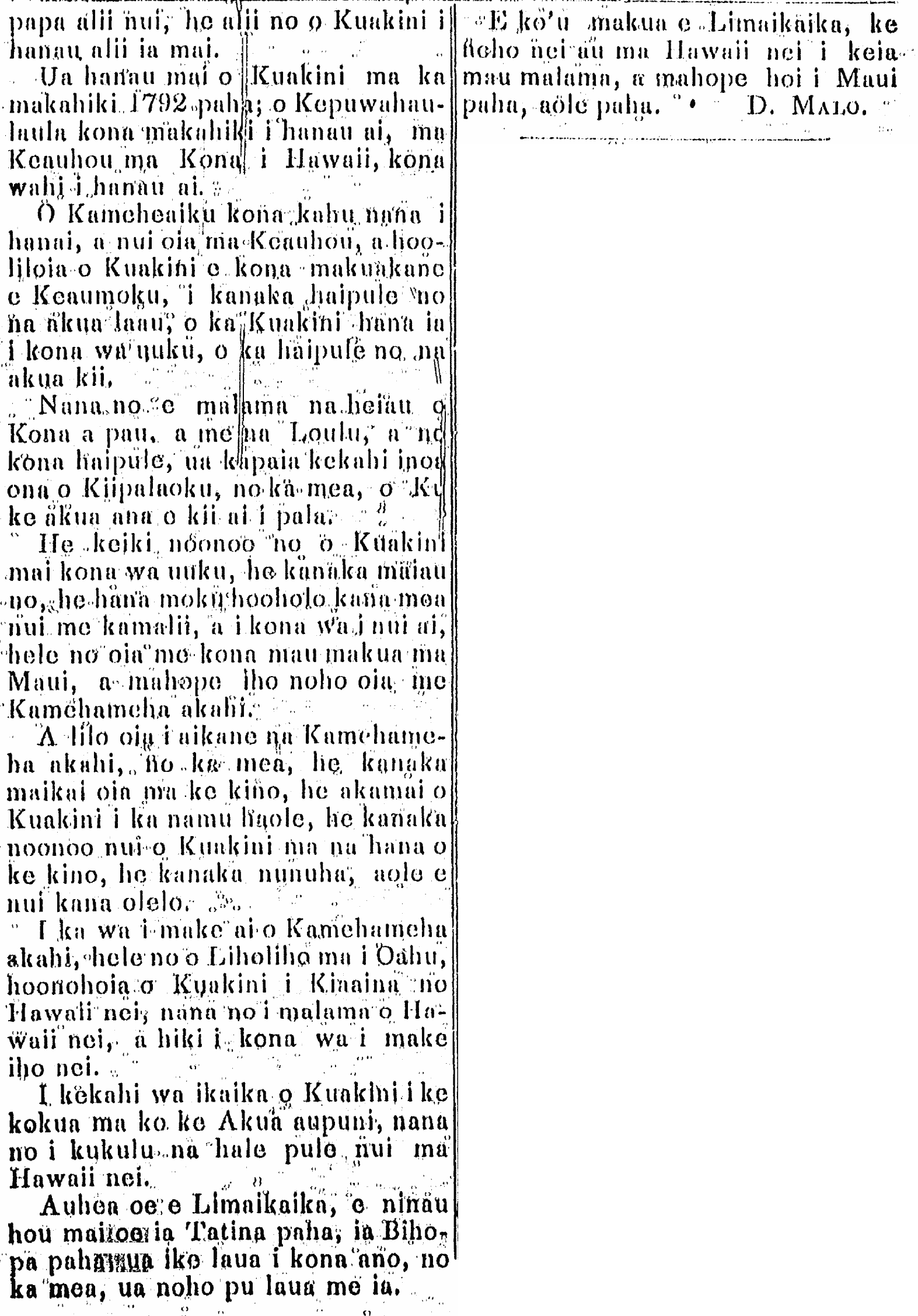
More on the Earthquake and Tsunami of 1862.

[Found under: “NEWS FROM HERE IN HAWAII.”]

We received a letter from D. W. Kaiue of Waialua, Molokai, written on the 3rd of Feb. telling of the great tsunami [kaikoo] at Molokai. And these are his words:

“This Tuesday, the 28th of this past January. A high tide began in Kona, Molokai. This is the first time such big waves were seen here; the kamaaina said that they had never seen such a big tsunami [kaikoo] like this before. The fishponds were destroyed, and the road at Keanoaio at Kumimi are ruined. The homes of Timoteo in Halawa were inundated, and the lanai was wrecked, on the night of the 29th; it was indeed a huge kaikoo, and a strong Earthquake at daybreak; the ground and homes shook for perhaps five Seconds. Those inside sleeping were awakened. The working of the Highest God is amazing.”

[See the comment by Gerard Fryer in response to the earlier post on this same natural disaster (as well as all the other uploaded related articles). The Hawaiian-Language Newspapers need to be studied for information in all fields of knowledge! …And again, in order for all the information from those newspapers to be read and understood, they need to be rescanned clearly before they disintegrate from the acids within the paper itself.]

(Kuokoa, 3/8/1862, p. 2)

Ua loaa ia makou, he palapala...

Ka Nupepa Kuokoa, Buke I, Helu 15, Aoao 2. Maraki 8, 1862.