Unknown's avatar

About nupepa

Just another place that posts random articles from the Hawaiian Newspapers! It would be awesome if this should become a space where open discussions happen on all topics written about in those papers!! And please note that these are definitely not polished translations, but are just drafts!!! [This blog is not affiliated with any organization and receives no funding. Statements made here should in now way be seen as a reflection on other organizations or people. All errors in interpretation are my own.]

A mele for the counter revolution, 1895.

KAALAWAI.

Kumaka ka ike’na ia Kaalawai
I ka peki wawae i ke kula loa
Mea ole ka loa a oia kula
Me ke kai hone mai i ka iliili
Me he ‘la a e i mai ana
Imi ia e ka pono o ka aina
Ilaila ohohia kuu manao
I ka ike ana aku i na hoa
Hooho Wilikoki me ka leo nui
Imua kakou a lanakila
Lana mai ka manao Nou e ka Lani
E hoi hou ana i ke Kalaunu
Eia makou ke paa nei
Mamuli o ke aloha i ka aina
O ke kani makawalu a na pu
Pau ka manaolana no ka ohana
Haina ia mai ana ka puana
No ka poe i aloha i ka aina.

Hakuia e
S. Kanehe.
Kawa.

KAALAWAI.
In plain sight was Kaalawai
Treading across its wide plains
The extent of that field is of no consequence
With the sea that whispers atop the pebbles
As if saying
Let pono for this land be sought out
There my mind is elated
To see my comrades
Wilcox cheers with voice aroar
Forward to victory!
Our belief is for You, O Heavenly One
That you will return to the Throne
Here we are, unyielding
Faithfully patriotic
With gunfire ringing out from all directions
No more do we hope to see our families
Let the refrain be told
For the patriotic ones.
Composed by S. Kanehe.
Kawa. [The prison]

[There was a man named Herman K. Kanehe, who was one of many patriots sentenced to 5 years at hard labor and a fine of $5000. But i could not find out information on this S. Kanehe.

It is also interesting to note that this composition is reminiscent of another composition known widely today…]

(Oiaio, 3/22/1895, p. 3)

KAALAWAI.

Ka Oiaio, Buke VII, Helu 3, Aoao 3. Maraki 22, 1895.

Faith, Hope, Love, and Tradition, 1874.

The Key to open the door of heaven, and all of its rooms.

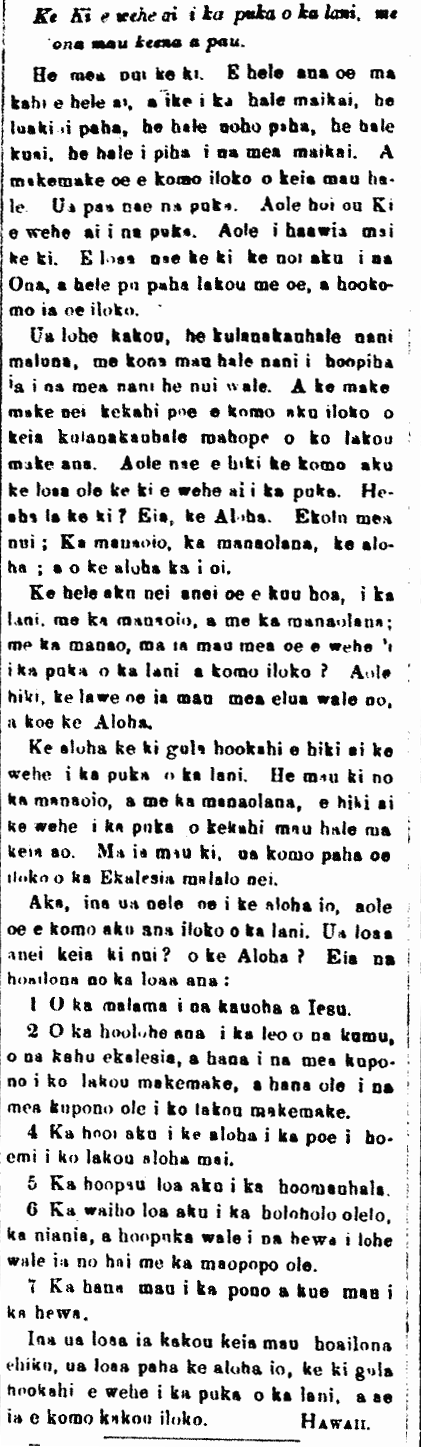
Keys are important. You go somewhere, and see a beautiful structure, perhaps it is a church, or a home, a store, or a building filled with wonderful things. And you want to enter into these buildings. The doors however are locked. You have no Key to open the doors. You are not given the key. You can obtain key if you ask of the Owner, and they perhaps will accompany you and let you in.

We have heard that there is a beautiful city up above, with its lovely houses filled with many great wonderful things. And should one want to enter into this city after they die. They cannot enter should they be without the key. What is this key? It is this, Aloha. There are three great things: faith [manaoio], hope [manaolana], and love [aloha]; but aloha is the greatest of all things.

Are you heading, O Friend, for heaven, with faith and hope, while believing that with these things you will open up the door of heaven and enter within? You can’t with just those two things, without Aloha.

Aloha is the single golden key that can open the door of heaven. Faith and hope are keys that can open some of the houses here in this world. With these keys, you perhaps have entered Churches down here.

However, should you be without true aloha, you shall not enter into heaven. Do you possess this great key? Aloha? Here are the signs that you have it:

1. You uphold the commandments of Jesus.

2. You listen to the words of the teachers, the church pastor, and you do what is righteous as per their desires and you don’t do what is wrong as per their desires.

4. Give more aloha to those who give you little aloha.

5. To cease totally begrudging others.

6. Set aside slander, gossip, and hearsay.

7. Do good always and never do bad.

Should we have these seven signs, we may perhaps be in possession of true aloha, the single golden key that can open the door of heaven, and we will be allowed within. HAWAII.

[It is also interesting to note that while the Bible was being translated into the Hawaiian Language, Hawaiians of course traditionally had the word, “Aloha.” As for “Manaolana” and “Manaoio,” (and “enemi” [enemy] as well), those had to be made up just for the Bible. See “No ka unuhi ana i ka Palapala Hemolele iloko o ka Olelo Hawaii.” Hae Hawaii, Iulai 8, 1857, 57–58.]

(Kuokoa, 5/16/1874, p. 4)

Ke Ki e wehe ai i ka puka o ka lani, me ona mau keena a pau.

Ka Nupepa Kuokoa, Buke XIII, Helu 20, Aoao 4. Mei 16, 1874.

Check out Hawaiian Historical Society’s new calendar, 2014.

2014 Hawaiian History Calendar

The Hawaiian Historical Society’s Hawaiian history calendar for 2014 includes significant dates and interesting facts about Hawaiʻi’s history, local holidays, and phases of the moon. The calendar features photos taken between 1899 and 1902 showing scenes of windward Oʻahu, the Old Pali Road, a fishing village and boats in Honolulu harbor, and rice fields. The photos are from the Daniel W. Snow Photograph Collection at the Hawaiian Historical Society.

Click here to order one for yourself, or for gifts for friends here and across the ocean!

More on Hattie L. S. Reinhardt and politics, 1944.

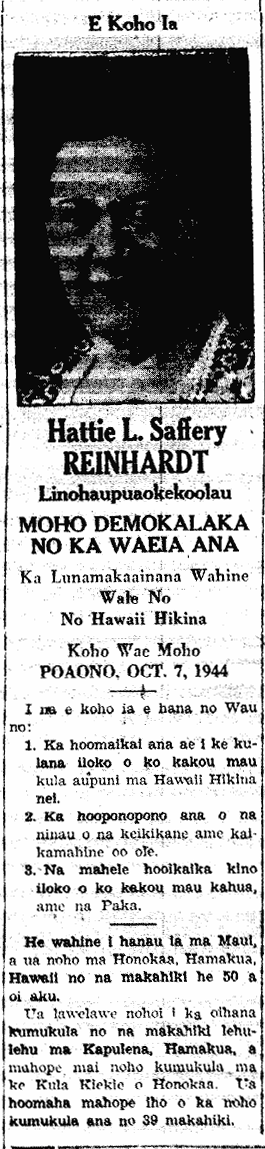
Vote For

Hattie L. Saffery
REINHARDT
Linohaupuaokekoolau

DEMOCRATIC CANDIDATE
FOR ELECTION

The Only
Woman Representative
For East Hawaii

Election
SATURDAY, OCT. 7, 1944

Should I be elected I will work for:

1. Benefit the state of our public schools here in East Hawaii.

2. Deal with the obstacles of girls and boys who have not yet reached adulthood.

3. Physical education in our Parks and grounds.

This is a woman born on Maui, and lived in Honokaa, Hamakua, Hawaii for over 50 years.

She had the occupation of school teacher for many years at Kapulena, Hamakua, and after that, she served as a teacher at Honokaa High School. She retired after teaching for 39 years.

(Hoku o Hawaii, 9/27/1944, p. 2)

E Koho Ia Hattie L. Saffery

Ka Hoku o Hawaii, Volume XXXIX, Number 23, Aoao 2. Sepatemaba 27, 1944.

Hattie Linohaupuaokekoolau Saffery Reinhardt, correspondent for Hamakua and Kohala, 1941.

Bits of News from Hamakua and Kohala

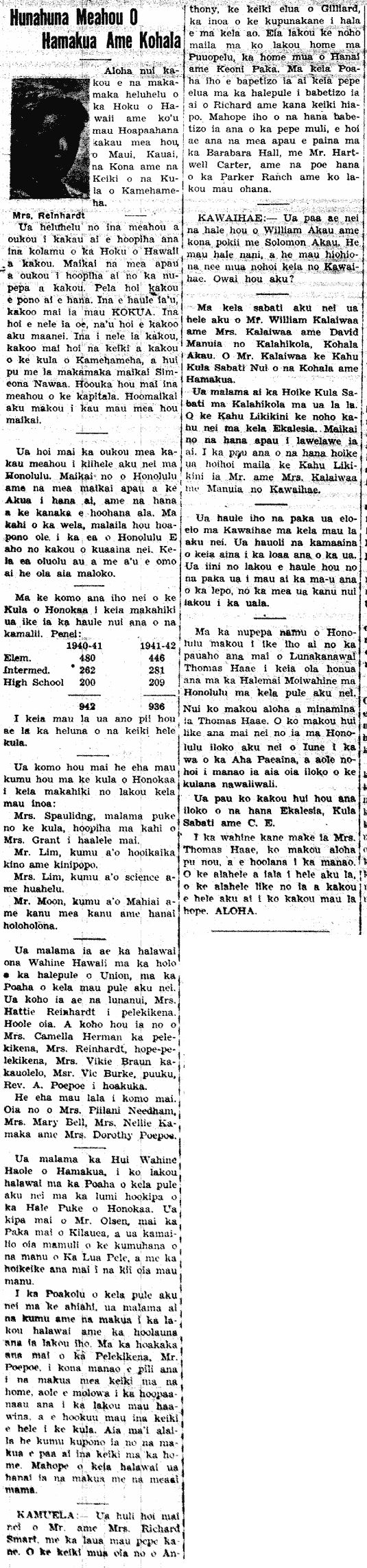
Aloha nui kakou, readers of the Hoku o Hawaii and my fellow news writers from Maui, Kauai, the two Kona [North and South], and the Children of Kamehameha Schools.

I’ve read the news you all have written filling the columns of our Hoku o Hawaii. All that you all have written to fill our newspaper have been fine. That is the way we should do it. Should I be put aside, I will support those who KOKUA. Should you not have material, I will give aid here. If we all are without, our children from the Kamehameha School will give support, along with that good friend, Simeona Nawaa. Do send more news from the capitol. We give appreciation for your choice news.

Your news writer has returned from her wandering in Honolulu. Honolulu is great, along with all the great many things God has created, as well as all that man is carrying out. Where it is hot, that is what I don’t like, the air of Honolulu. We in the countryside are better off. With this cool air which you and I breathe; there is life there within.

With the recent start of Honokaa School this year, there has been seen a severe drop in the number of children. Like this:

1940–41 1941–42
Elem.    480    446
Intermed.    262    281
High School    200    209
 ———  ———
   942    936

These past days, the number of children attending school has rebounded.

Four new teachers came to Honokaa School this year, their names being:

Mrs. Spaulding, librarian for the school; taking the place of Mrs. Grant who left.

Mr. Lim, fitness teacher and baseball.

Mrs. Lim, science and math teacher.

Mr. Moon, Farming and Agriculture and Animal husbandry teacher.

The Hawaiian Women’s meeting was held in the hall of the Union Church several Thursdays ago. The officers were selected; Mrs. Hattie Reinhardt as president. She refused. Reselected was Mrs. Camella Herman as president; Mrs. Reinhardt as vice president; Mrs. Vikie Braun as secretary; Mrs. Vic Burke as treasurer; and Rev. A. Poepoe as adviser.

Four members joined. They being Mrs. Piilani Needham, Mrs. Mary Bell, Mrs. Nellie Kamaka and Mrs. Dorothy Poepoe.

The Haole Women’s Board of Hamakua held their meeting last Thursday in the lobby of the Honokaa Library. Mr. Olsen paid a visit, from the Kilauea Park, and he talked on the subject of the birds of the Volcanic Crater, while showing pictures of the birds.

On the Wednesday of last week, in the evening, the teachers and parents held their meeting and introduced themselves. In the introduction by the President, Mr. Poepoe, pertaining to his thoughts on parents at home, was the idea that they should not be lax in the children’s studies, and that they should let them always go to school. If the child is sick, that is a proper reason for the parents to keep the child at home. After the meeting, the parents were fed a snack.

KAMUELA:—Mr. and Mrs. Richard Smart returned along with their baby boy. The first child is Anthony, the second is Gilliard, named for the grandfather who has gone to the other world. They are living at their home in Puuopelu, at the previous residence of Hanai and Keoni Paka [Hannah and John Parker]. This coming Thursday, the second baby will be baptized at the church where Richard and his first child were baptized. After the baptism of the youngest child, everyone will return to eat at Barabara hall, with Mr. Hartwell Carter and the workers of Parker Ranch and their families.

KAWAIHAE:—The new homes of William Akau and his younger brother, Solomon Akau, have been completed. They are beautiful houses, and it is a sign of progress for Kawaihae. Now who else?

This past sabbath, Mr. William Kalaiwaa and Mrs. Kalaiwaa and David Manuia  went to Kalahikiola in North Kohala. Mr. Kalaiwaa is the head Kahu of the Sunday Schools of two Kohala [North Kohala and South Kohala] and Hamakua.

On that day, they were holding the Sunday School Hoike at Kalahikiola. Pastor Likikini presides as kahu of the Church. Everything that took place was fine. After the hoike was through, Pastor Likikini took Mr. and Mrs. Kalaiwaa and Manuia back to Kawaihae.

Drenching raindrops fell at Kawaihae these past days. The kamaaina of this area were glad to receive rain. They hope the rain will fall again so that the soil remains damp, for they have planted much sweet potato.

We saw in the English newspaper of Honolulu that Judge Thomas Haae grew weary of this life at the Queen’s Hospital in Honolulu last week. We have great aloha and regret for Thomas Haae. We met up with him in Honolulu in June during the [church] Island-wide Convention, and it was not known that he was in weak condition.

We will no longer meet at the Church, Sunday School, and C. E. events.

To the widow, Mrs. Thomas Haae, to you goes our aloha, and let your thoughts be lightened. The path that he has taken is the same path that we shall take on our last days. ALOHA.

[Mrs. Reinhardt was the news correspondent for Hamakua and Kohala to the newspaper Hoku o Hawaii.]

(Hoku o Hawaii, 10/15/1941, p. 1)

Hunahuna Meahou O Hamakua Ame Kohala

Ka Hoku o Hawaii, Volume XXXVI, Number 25, Page 1. Okatoba 15, 1941.

New Perspectives on the History of Kalaupapa, 2013.

[This talk by Anwei Skinsnes Law should be put on your calendar. There is so much more to discover about those sent to Kalaupapa and Kalawao, and also about those who were left behind. Much of the first and second-hand accounts can be found within the pages of the Hawaiian-Language Newspapers!]

Halloween mayhem, 1933.

PRANKSTERS DO MISCHIEF UPON THE SHADE TREES

Once again the beautification of Honolulu was marred according to what was made known in the morning of this past Wednesday by Mrs. Charles Wilder, the commissioner of shade trees.

The members of the commission found seven fine trees planted on Dillingham Boulevard [Alanui Kilinihama] all cut down. These trees were about ten feet tall, and they were destroyed on this past Hallowe’en night.

This sort of mischief done all over this town was made known to the commission in the past; however, this recent wicked deed was by far the worst.

(Alakai o Hawaii, 11/9/1933, p. 1)

HANAINO KA POE KOLOHE I NA KUMULAAU MALUMALU

Ke Alakai o Hawaii, Buke 6, Helu 28, Aoao 1. Nowemapa 9, 1933.

Molokai correspondent, Ruby Apiki Bright, 1939.

NEWS ITEMS FROM MOLOKAI

INTRODUCTION

We, the managers of the newspaper Hoku o Hawaii, are blessed through receiving some news items from the Homestead lands of Molokai, the land which the Alii Kuhio put much effort into for the Hawaiians. This is received through the correspondence of the mother, Mrs. Ruby Apiki Bright.

Lot 2, Hoolehua

Sept. 5, 1839

To my dear patient Hoku:

Here is some baggage for the deck of our pride, should it be kindly allowed some free space. On this past 26th of August, the Catholics of Kaunakakai held a silver jubilee in commemoration of the building of their church, St. Sophia, and there was a fair, and the activities that day went well. They gave the name of that well-to-do mother of the Island of Hina [Molokai] to their church, that being Mrs. Sophie Judd Cooke—the open-hearted mother who spread forth her helping hands for its furnishing and building in the year 1914.

The Calvinists held a Bazaar for their benefit, selling all sorts of things on this past 2nd of this month. Everything was lovely.

……..

[Ruby Apiki Bright started her regular column reporting on news from Molokai on this day, September, 20, 1939, in Hoku o Hawaii. I hope some day soon, these papers will be rescanned again clearly so they are easily read!]

(Hoku o Hawaii, 9/20/1939, p. 1)

HUNAHUNA MEA HOU O MOLOKAI

Ka Hoku o Hawaii, Volume XXXIV, Number 21, Page 1. Sepatemaba 20, 1939.

Kuakini, and Hawaiian tradition, 1845.

BIOGRAPHY OF KUAKINI.

Kuakini was the son of Keeaumoku, the son of Kalanikauleleiaiwi, the sister of Keawe. They are the royal ancestors of Hawaii Island’s high chiefs, Kuakini was befitting the class of high chiefs amongst Hawaii’s alii nui.

Kuakini was the son of Namahana who was born from Kalanikuihonoikamoku, and they are Maui’s royal ancestors, and therefore, Kuakini is amongst Maui’s…

…class of high chiefs; Kuakini was born as an alii.

Kuakini was born in the year 1792 perhaps; he was born in the year of [battle of] Kepuwahaulaula; at Keauhou in Kona in Hawaii was where he was born.

His caretaker [kahu hanai] was Kameheaiku, and Kuakini grew up at Keauhou, and he was made by his father, Keeaumoku, to pray to the wooden gods; this was Kuakini’s duties in his youth, the worship of the wooden gods.

He was the one who cared for all the temples in Kona, along with the Loulu temples, and in regard to his worshiping, one of the names Kuakini was called was Kiipalaoku, for Ku was the god for whom he would fetch pala fern.

Kuakini was a thinker from when he was small; he was meticulous; he often would sail boats with the other children in his youth, and when he grew up, he went with his parents to Maui, and thereafter he lived with Kamehameha I.

He became an aikane of Kamehameha I, because Kuakini possessed a fine body, he was skilled in English, he thought much about the way a body functions, he was sullen, and was a man of few words.

When Kamehameha I died, Liholiho them went to Oahu, and Kuakini was appointed Governor of Hawaii, and it was he that was to care for Hawaii until his recent death.

When Kuakini was assisting intently with the kingdom of God, it was he who built the great churches here on Hawaii Island.

O Armstrong [Limaikaika], please ask of Thurston [Tatina] or Bishop [Bihopa], for they know what he was like for both of them lived with him.

O Father Armstrong, I am living here on Hawaii these months, and will then return to Maui, or perhaps not. D. MALO.

(Nonanona, 1/7/1845, pp. 89–90)

KA MOOOLELO O KUAKINI.

Ka Nonanona, Buke 4, Pepa 19, Aoao 89. Ianuari 7, 1845.

papa alii nui, he alii no o Kuakini...

Ka Nonanona, Buke 4, Pepa 19, Aoao 90. Ianuari 7, 1845

Maui news columnist, Kanoekaapunionalani Banham, 1940.

Bits of Maui News

(Written by “Kanoekaapunionalani”)

Mrs. Banham

The Christmas celebration on Maui last year was very nice, even if the rain was falling.

Every household took steps [to celebrate] by decorating the tree in their front yard as a Christmas tree, being that a majority of the christmas trees from America were dried up; but this did not hold up their festivities.

Last week there were a huge number of passengers carried here to Maui by the steamer Hualalani, and there were teachers and students who returned to spend their vacation at home with their families.

Those who came back are Marjory Rickard, Elsie and Grechen Reichardt, Frances Kalua, Pauline and Beatrice Mookini, Harry Dunn, Issac Oha [Oba?], Sonny Cockett, Henrietta Robinson, Caroline Brown and Robineta Tompkin.

Francis McMillen of Wahiawa, a student of the Kamehameha School for Boys, is spending his grandmother, Mrs. C. K. Kunane of Lahaina.

It is sad to hear of the passing from this world of Mr. Kulhman, the first Cane Burner [Puhiko] of the Pioneer Mill Company [Hui Mahiko Paionia]. He became important amongst the kamaaina, and he was one of the most skilled at Burning Cane.

The locals of Lahaina are saddened at his passing, and he has left a hole that cannot be soon filled.

[Lahainaluna School dorm matron Alice Kanoekaapunionalani Kunane Banham had a regular column in the Hilo newspaper, Hoku o Hawaii, where she reported all sorts of Maui news of the day.]

(Hoku o Hawaii, 1/3/1940, p. 1)

Na Hunahuna Mea Hou O Maui

Ka Hoku o Hawaii, Volume XXXIV, Number 36, Page 1. Ianuari 3, 1940.