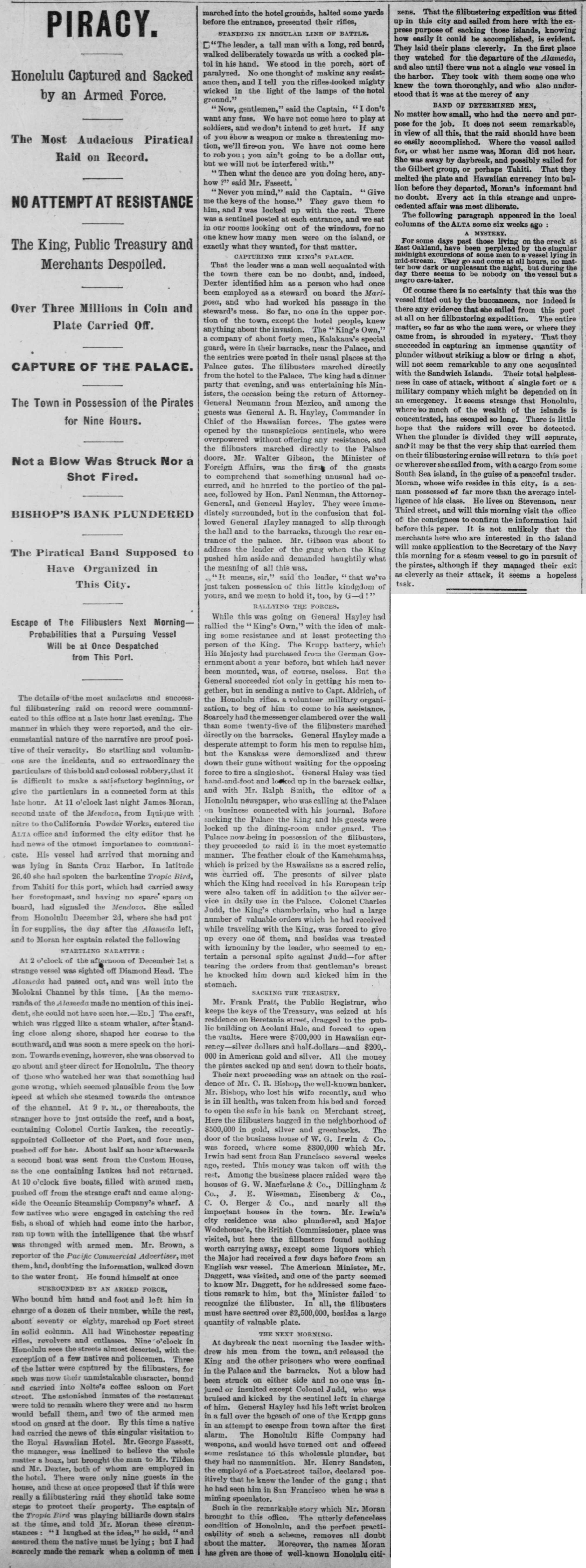
PIRACY.
Honolulu Captured and Sacked by an Armed Force.
The Host Audacious Piratical Raid on Record.
NO ATTEMPT AT RESISTANCE
The King, Public Treasury and Merchants Despoiled.
Over Three Millions in Coin and Plate Carried Off.
CAPTURE OF THE PALACE.
The Town in Possession of the Pirates for Nine Hours.
Not a Blow Was Struck Nor a Shot Fired.
BISHOP’S BANK PLUNDERED
The Piratical Band Supposed to Have Organized in This City.
Escape of The Filibusters Next Morning — Probabilities that a Pursuing Vessel Will be at Once Despatched from This Port.
The details of the most audacious and successful filibustering raid on record were communicated to this office at a late hoar last evening. The manner” in which they were reported, and the circumstantial nature of the narrative are proof positive of their veracity. So startling and voluminous are the incidents, and so extraordinary the particulars of this bold and colossal robbery, that it is difficult to make a satisfactory beginning, or give the particulars in a connected form at this late hour. At 11 o’clock last night James Moran, second mate of the Mendoza, from Iquique with nitre to the California Powder Works, entered the Alta office and informed the city editor that he had news of the utmost importance to communicate. Hie vessel had arrived that morning and was lying in Santa Cruz Harbor. In latitude 26, 40 she had spoken the barkentine Tropic Bird, from Tahiti for this port, which had carried away her foretopmast, and having no spare spars on board, had signaled the Mendoza. She sailed from Honolulu December 2d, where she had pat in for supplies, the day after the Alameda left, and to Moran her captain related the following
STARTLING NARATIVE :
At 2 o’clock of the afternoon of December 1st a strange vessel was sighted off Diamond Head. The Alameda had passed out, and was well into the Molokai Channel by this time. [As the memoranda of the Alameda made no mention of this incident, she could not have seen her. — Ed.] The craft, which was rigged like a steam whaler, after standing close along shore, shaped her course to the southward, and was soon a mere speck on the horizon. Towards evening, however, she was observed to co about and steer direct for Honolulu. The theory of those who watched her was that something had gone wrong, which seemed plausible from the low speed at which she steamed towards the entrance of the channel. At 9 p. m., or thereabouts, tho stranger hove to just outside the reef, and a boat, containing Colonel Curtis Iaukea, the recentlyappointed Collector of the Port, and four men, poshed off for her. About half an hour afterwards a second boat was sent from the Custom House, as the one containing Iaukea had not returned. At 10 o’clock five boats, filled with armed men, pushed off from the strange craft and came alongside the Oceanic Steamship Company’s wharf. A few natives who were engaged in catching the red fish, a fchoal of which had come into the harbor, ran up town with the intelligence that the wharf was thronged with armed men. Mr. Brown, a reporter of the Pacific Commercial Advertiser, met them, and, doubting the information, walked down to the water front. He found himself at once
SURROUNDED BY AN ARMED FORCE,
Who bound him hand and foot and left him in charge of a dozen o£ their number, while the rest, about’ seventy or eighty, marched up Fort street in solid column. All had Winchester repeating rifles, revolvers and cutlasses. Nine ‘o’clock in Honolulu sees the 6treets almost deserted, with the exception of a few natives and policemen. Three of the latter were captured by the filibusters, for Each was now their unmistakable character, bound and carried into Nolte’s coffee saloon on Fort street. The astonished inmates of the restaurant were told to remain where they were and no harm would befall them, and two of the armed men stood on guard at the door. By this time a native had carried the news of this singular visitation to the Royal Hawaiian Hotel. Mr. George Fassett, the manager, was inclined to believe the whole matter a hoax, but brought the man to Mr. Tilden and Mr. Dexter, both of whom are employed in the hotel. There were only nine guests in the house, and these at once proposed that if this were really a filibustering raid they 6honld take some 6teps to protect their property. The captain of the Tropic Bird was playing billiards down stairs at the time, and told Mr. Moran these circumstances : “I laughed at the idea,” he said, “and assured them the native must be lying ; but I had scarcely made the remark when a column of men marched into the hotel grounds, halted some yards before the entrance, presented their rifles,
STANDING IN REGULAR LINE OF BATTLE.
“The leader, a tall man with a long, red beard, walked deliberately towards as with a cocked pistol in his hand. We stood in the porch, sort of paralyzed. No one thonght of making any resistance then, and I tell yoa the rifles ‘looked mighty wicked in the light of the lamps of the hotel ground.”
” Now, gentlemen,” said the Captain, ” I don’t want any foes. We have not come here to play at soldiers, and we don’t intend to get hurt. If any of yon show a weapon or make a threatening motion, we’ll fire-on yon. We have not come here to rob you ; yon ain’t going to be a dollar out, but we will not be interfered with.”
“Then what the deuce are you doing here, anyhow?” said Mr. Fassett.
” Never you mind,” said the Captain. ” Give me the keys of the house.” They gave them to him, and I was locked up with the rest. There was a sentinel posted at each entrance, and we sat in our rooms looking out of the windows, for no one knew how many men were on the island, or exactly what they wanted, for that matter.
CAPTURING THE KING’S PALACE.
That the leader was a man well acquainted with the town there can be no doubt, and, indeed, Dexter identified him as a person who had once been employed as a steward on board the Mariposa, and who had worked his passage in the steward’s moss. So far, no one in the upper portion of the town, except the hotel people, knew anything about the invasion. The ” King’s Own,” a company of abont forty men, Kalakaua’s special guard, were in their barracks, near the Palace, and the sentries were posted in their usual places at the Palace gates. The filibusters marched directly from the hotel to the Palace. The king had a dinner party that evening, and was entertaining his Ministers, the occasion being the return of Attorney General Neumann from Mexico, and among the gne6ts was General A. B. Hayley, Commander in Chief of the Hawaiian forces. The gates were opened by the nnsnspicious sentinels, who were overpowered without offering any resistance, and the filibusters marched directly to the Palace doore. Mr, Walter Gibson, the Minister of Foreign Affairs, was the tir:-| of the guests to comprehend that something unusual had occurred, and he hurried to the portico of the palace, followed by Hon. Paul Neuman, the AttorneyGeneral, and General Hayley. They were immediately snrrounded, but in the confusion that followed General Hayley managed to slip through the hall and to the barracks, through tho rear entrance of the palace. Mr. Gibson was about to address the leader of the gang when the King pushed him aside and demanded haughtily what the meaning of all this was.
“It means, sir,” said tho leader, “that we’ve just taken possession of this little kindgdom of yours, and we mean to hold it, too, by G — d ! “
RALLYING THE FORCES.
While this was going on General Hayley had rallied the ” King’s Own,” with the idea of making some resistance and at least protecting tho person of the King. The Krupp battery, which His Majesty had purchased from the German Government about a year before, but which had never been mounted, was, of course, useless. But the General succeeded riot only in getting his men together, but in sending a native to Capt. Aldrich, of the Honolulu rifles, a volunteer military organization, to beg of him to come to his assistance. Scarcely had the messenger clambered over the wall than some twenty-five of the filibuster.* marched directly on the barracks. General Hayley made a desperate attempt to form his men to repalse him, bat the Kanakas were demoralized and threw down their guns without waiting for the opposing force to fire a single shot. General Haley was tied hand-and-foot and loeked up in the barrack cellar, and with Mr. Ralph Smith, the editor of a Honolulu newspaper, who was calling at the Palace on business connected with his journal. Before hacking the Palace the King and his guests were locked up the dining-room under guard. The Palace now being in possession of the filibusters, they proceeded to raid it in the most systematic manner. The feather cloak of the Kamehamahas, which is prized by the Hawaiians as a sacred relic, was carried off. The presents of silver plate which the King had received in his European trip were aleo taken off in addition to the silver service in daily use in the Palace. Colonel Charles Judd, the King’s chamberlain, who had a large number of valuable orders which he had received while traveling with the King, was forced to give up every one 6f them, and besides was treated with urnominy by the leader, who seemed to entertain a personal spite against Judd — for after tearing the orders from that gentleman’s breast he knocked him down and kicked him in the stomach.”
SACKING THE TREASURY.
Mr. Frank Pratt, the Public Registrar, who keeps the keys of the Treasury, was seized at his residence on Beretania street, dragged to the public building on Aeolani Hale, and forced to open the vaults. Here were $700,000 in Hawaiian currency—silver dollars and half-dollars— and $200,000 in American gold and silver. All the money the pirates sacked up and sent down to their boats. Their next proceeding was an attack on the residence of Mr. C. R. Bishop, the well-known banker. Mr. Bishop, who lost his wife recently, and who is in ill health, was taken from his bed and forced to open the safe in his bank on Merchant streej. Here the filibusters bagged in the neighborhood of §500,000 in gold, silver and greenbacks. Th9 door of the business house of W. G. Irwin & Co. was forced, where some $300,000 which Mr. Irwia had sent from San Francisco several weeks ago, rested. This money was taken off with the rest. Among the business places raided were the houses of G. W. Macfarlane & Co., Dillingham & Co., J. E. Wiseman, Eisenberg & Co., C. O. Berger & Co., and nearly all the important houses in the town. Mr. Irwin’s city residence was also plundered, and Major Wodehouse’e, the British Commissioner, place was visited, but here the filibusters found nothing worth carrying away, except some liquors which the Major had received a few days before from an English war vessel. The American Minister, Mr. Daggett, was visited, and one of the party seemed to know Mr. Daggett, for he addressed some facetious remark to him, but the Minister failed ‘ to recognize the filibuster. In all, the filibusters mast have secured over $2,500,000, besides a large quantity of valuable plate.
THE NEXT MORNING.
At daybreak the next morning the leader withdrew his men from the town, and released the King and the other prisoners who were .confined in the Palace and the barracks. Not a blow had been struck on either side and no one was injured or insulted except Colonel Judd, who was bruised and kicked by the sentinel left in charge of him. General Hayley had his left wrist broken in a fall over the breach of one of the Krupp guns in on attempt to escape from town after the first alarm. The Honolulu Rifle Company had weapons, and would have turned oat and offered some resistance to this wholesale plunder, but they had no ammunition. Mr. Henry Sandsten, the employs of a Fort-street tailor, declared positively that he knew the leader of the gang ; that he had seen him in San Francisco when he was a mining speculator.
Such is the remarkable story which Mr. Moran brought to this office. The utterly defenceless condition of Honolulu, and the perfect practicability of snch a scheme, removes all doubt about the matter. Moreover, the names Moran has given are those of well-known Honolulu citizens. That the filibustering expedition was fitted np in this city and sailed from here with the express purpose of sacking those islands, knowing how easily it could be accomplished, is evident. They laid their plans cleverly. In the first place they watched for the departure of the Alameda, and also until there was not a single war vessel in the harbor. They took with them some one who knew the town thoroughly, and who also understood that it was at the mercy of any .
BAND OF DETERMINED MEN.
No matter how small, who had the nerve and purpose for the job. It does not seem remarkable, in view of all this, that the raid should have been so easily accomplished. Where the vessel sailed for, or what her name was, Moran did not hear. She was away by daybreak, and possibly sailed for the Gilbert group, or perhaps Tahiti. That they melted plate and Hawaiian currency into bullion before they departed, Moran’s informant had no doubt. Every act in this strange and unprecedented affair was most dliberate.
The following paragraph appeared in the local columns of the Alta some six weeks ago :
A MYSTERY.
For some days past those living on the creek at East Oakland, have been perplexed by the singular midnight excursions of some men to a vessel lying In mid-stream. They go and come at all hours, no matter how dark or unpleasant the night, bat daring the day there seems to be nobody on the vessel but a negro care-taker.
Of course there is no certainty that this was the vessel fitted oat by the buccaneers, nor indeed is there any evidence that she sailed from this port at all on her filibustering expedition. The entire matter, so far as who the men were, or where they came from, is shrouded in mystery.- That they succeeded in capturing an immense quantity of plunder without striking a blow or firing a shot, will not seem remarkable to any one acquainted with the Sandwich Islands. Their total helplessness in case of attack, without a” single fort or a military company which might be depended on in an emergency. It seems strange that Honolulu, where so much of the wealth of the islands is concentrated, has escaped so long. There is little hope that the raiders will ever be detected. When the plunder is divided they will separate, and”it may be that the very ship that carried them on their filibustering cruise will return to this port or wherever she sailed from, with a cargo from some South Sea island, in the guise of a peaceful trader. Moran, whose wife resides in this city, is a seaman possessed ef far more than the average intelligence of his class. He lives on Stevenson, near Third Street, and will this morning visit the offices of the consignees to confirm the information laid before this paper. It is not unlikely that the merchants here who are interested in the island will make application to the Secretary of the Navy this morning for a steam vessel to go in pursuit of the pirates, although if they managed their exit as cleverly as their attack, it seems a hopeless task.
[This is one of the more exciting things i have seen lately! Anybody know anything about this??
This site, California Digital Newspaper Collection, seems to be separate from Chronicling America, and makes available many California newspapers! Here is a list of what is online and word-searchable!]
(Daily Alta California, 12/15/1884, p. 1)

Daily Alta California, Volume XXXVII, Number 12664, Page 1. December 15, 1884.



 nupepa