More on Lunalilo’s birthday, 1874.

Birthday of the King.

The day passed partially in happiness and partially in sadness. Being that the one whose day this holiday of the lahui is for is there languishing in weakness. The celebration here for his 39th birthday was held peacefully with proper cheer. With the break of dawn of the morning of Saturday, the town was rattled by the boom of the cannons from the battery of Puowina.¹ Before the passing of 11 o’clock, out came the firemen as they paraded on the streets with their fire trucks decorated with the verdure of the forest and flowers, until they returned once again to their station. At each fire station, they had prepared a banquet for themselves while their fine friends were invited to share in this with them. When 11 o’clock arrived exactly, cannons were shot off again from Puowina, along with the warship, Tenedos, which was docked in the harbor; and in the evening as well, cannons were shot off a third time from Puowina. Parties were held at many places, and the streets were teeming with people and those on horseback. All of the flagpoles on land and those on the ships were decorated with flags; the warship Tenedos was adorned from bow to stern.

The nature of the day and its sights were peaceful; there were no commotions aroused, nor were there many drunken people seen on the streets.

¹Puowina is one of the many variants for what we see mostly as Puowaina today [Punchbowl].

(Ko Hawaii Ponoi, 2/4/1874, p. 2)
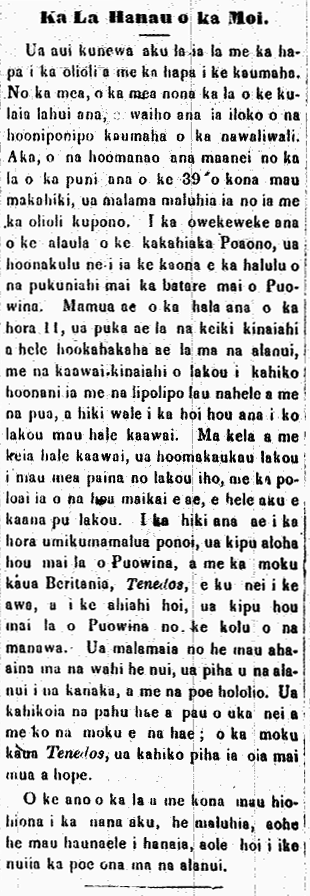
Ka La Hanau o ka Moi.

Ko Hawaii Ponoi, Buke I, Helu 34, Aoao 2. Feberuari 4, 1874.
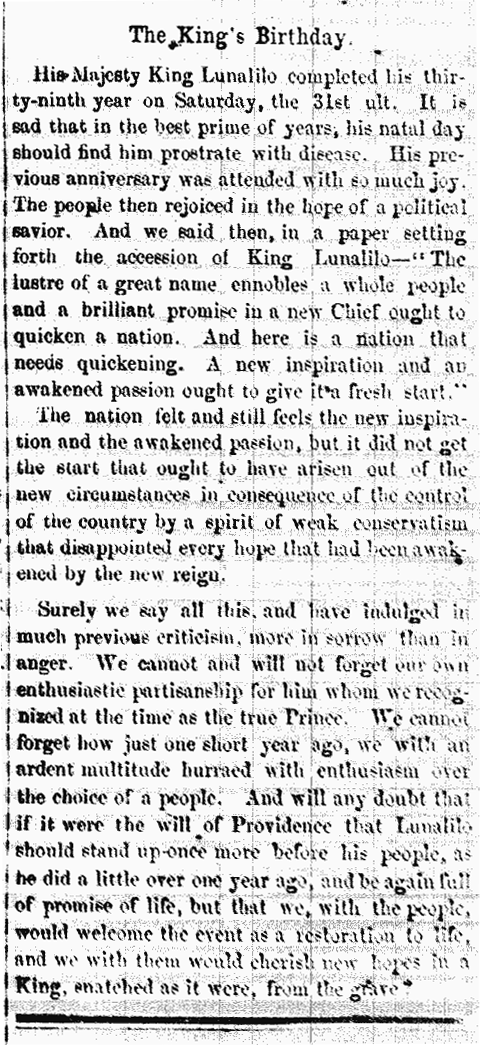
King Lunalilo’s second birthday and last as King of the Hawaiian Archipelago, 1874.

The King’s Birthday.

His Majesty King Lunalilo completed his thirty-ninth year on Saturday, the 31st ult. It is sad that in the best prime of years, his natal day should find him prostrate with disease. His previous anniversary was attended with so much joy. The people then rejoiced in the hope of a political savior. And we said then, in a paper setting forth the accession of King Lunalilo—”The lustre of a great name ennobles a whole people and a brilliant promise in a new Chief ought to quicken a nation. And here is a nation that need quickening. A new inspiration an awakened passion ought to give it a fresh start.”

The nation felt and still feels the new inspiration and the awakened passion, but it did not get the start that ought to have arisen out of the new circumstances in consequence of the control of the country by a spirit of weak conservatism that disappointed every hope that had been awakened by the new reign.

Surely we say all this, and have indulged in much previous criticism, more in a sorrow than in anger. We cannot and will not forget our own enthusiastic partisanship for him whom we recognized at the time as the true Prince. We cannot forget how just one short year ago, we with an ardent multitude hurraed with enthusiasm over a choice of a people. And will any doubt that if it were the will of Providence that Lunalilo should stand up once more before his people, as he did a little over one year ago, and be again full of life, but that we, with the people, would welcome the even as a restoration to life, and we with them would cherish new hopes in a King, snatched as it were, from the grave.

(Nuhou, 2/3/1874, p. 6)

The King's Birthday.

Ka Nuhou Hawaii, Buke I, Helu 14, Aoao 6. Feberuari 3, 1874.

Excursion of the Princess Regent Liliuokalani, 1881.

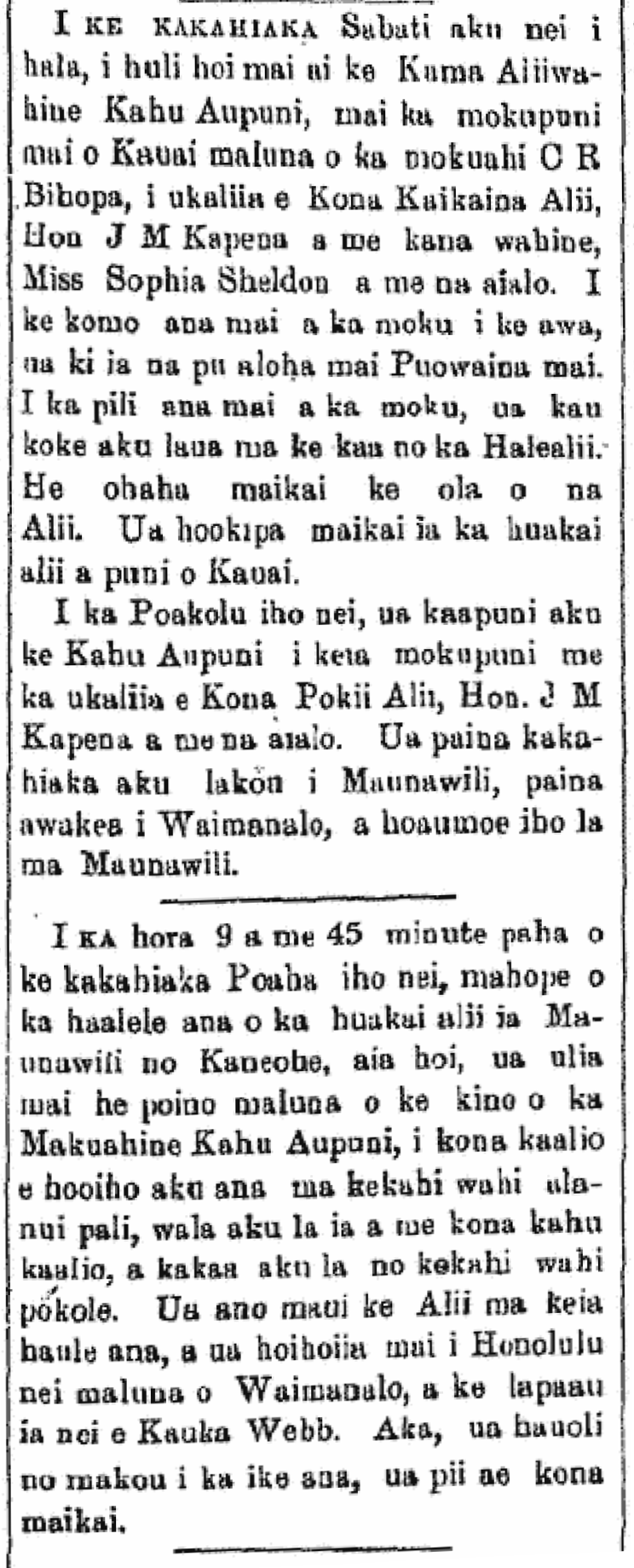
On the morning of this past Sunday, the Princess Regent [Kahu Aupuni] returned from the island of Kauai aboard the steamship C. R. Bishop, accompanied by Her Royal Younger Sister [Likelike], Miss Sophia Sheldon, and her attendants. When the ship entered the harbor, guns of salute were shot from Puowaina. When the ship landed, the two of them immediately boarded a car for the Palace. The Alii was in fine health. The royal excursion was welcomed warmly all around Kauai.

This past Wednesday, the Regent did a circuit of this island accompanied by Her Royal Younger Sibling, Hon. J. M. Kapena, and her attendants. They had breakfast in Maunawili, had lunch at Waimanalo, and spent the night in Maunawili.

———————

At perhaps 45 minutes past the hour of 9 on the morning of this past Thursday, after the royal excursion left Maunawili for Kaneohe, an accident befell the Mother Regent, when her carriage was descending a cliff road, she was thrown backwards along with her driver, and tumbled for a short time. The Alii was somewhat bruised in the fall, and was brought back to Honolulu aboard the Waimanalo, and she is being treated by Doctor Webb. But we are happy to see that she is improving.

[Perhaps the newspaper is playing down the severity of Liliuokalani’s injuries. In “Hawaii’s Story,” she sounds like she is in quite a lot of pain.]

(Ko Hawaii Pae Aina, 10/8/1881, p. 2)

I ke kakahiaka Sabati aku nei...

Ko Hawaii Pae Aina, Buke IV, Helu 41, Aoao 2. Okatoba 8, 1881.

In anticipation of King Kalakaua’s return from his tour around the world, 1881.

HONORING THE ALII, KING KALAKAUA.

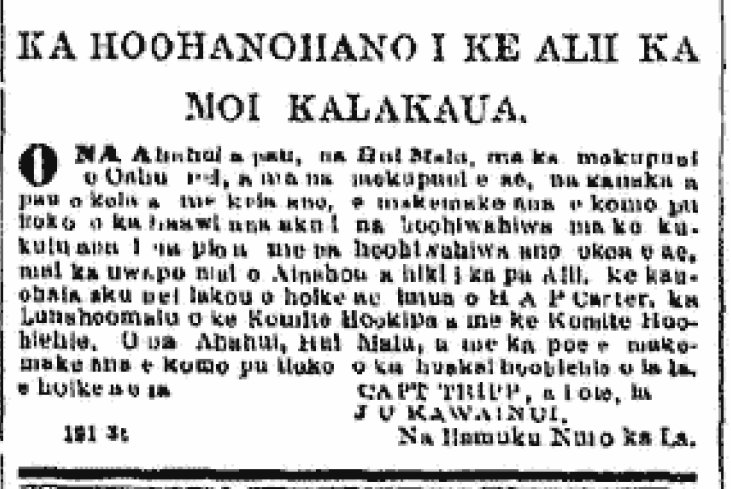
All of the Associations, the Secret Societies, on this island of Oahu, and the other islands, people of all ethnicities, who want to join in giving glory by putting up arches and other public displays from the wharf of Ainahou until the Palace grounds, are ordered to appear before H. A. P. Carter, the Chairman of the Welcoming Committee and the Exaltation Committee. The Associations, the Secret Societies, and those who want to join in the parade of the day, notify CAPT. TRIPP or

J. U. Kawainui,

The Marshals of the Day.

[In “Hawaii’s Story,” Liliuokalani looks back to the day of her brother’s return:

“…With that enthusiasm always shown by the Hawaiian people in doing honor to their sovereigns, the grandest preparations were made throughout the islands to welcome the arrival of the king. In Honolulu the joy was general, and the foreign element was well represented in the festivities. The streets were given up to the people, and and were crowned with triumphal arches. Before the day of his expected landing at the wharf, the most elaborate preparations had been made to give him a royal greeting. The mottoes, in the selection of which numberless parties had consulted me, were displayed in every part of the city, and there was an especial arch designed for each district of the island of Oahu.]

(Ko Hawaii Pae Aina, 10/8/1881, p. 2)

KA HOOHANOHANO I KE ALII KA MOI KALAKAUA.

Ko Hawaii Pae Aina, Buke IV, Helu 41, Aoao 2. Okatoba 8, 1881.

More on Mrs. Heleluhe going to take the place of Kahele Nahaolelua, and name variations, 1897.

MRS. HELELUHE HEADED FOR AMERIKA.

Because Mrs. Kahele Nahaolelua has been away from the presence of the Queen due to her illness, Mrs. Vakeki Heleluhe has been ordered to  seek out the Royal One in Washington; she will be leaving the mother land on the Australia of this next Wednesday, May 5th, for the skin-nipping cold of America, and while she is treads through San Francisco, her care will be under the guidance of J. A. Palmer [Pama], the Queen’s secretary. And for you, O Mrs. Vakeki Heleluhe, is our prayer, that your ocean voyage be accompanied by God’s protection and may he put you ashore on dry land in good health, and may he be with you on water and on land. And when you meet with the Heavenly Alii of the lahui, give the royal one our great aloha.

[According to David Forbes, from the new edition of “Hawaii’s Story,” Mrs. Heleluhe was sometimes referred to as “Waikiki”. Here we see her as “Vakeki”.

See another article on Mrs. Heleluhe’s departure here.

Also, to be added to the index of the new edition should be:

Heleluhe, Wakeke Ululani, 106, 258, 338, 385, 391]

(Aloha Aina, 5/1/1897, p. 6)

MRS. HELELUHE NO AMERIKA.

Ke Aloha Aina, Buke III, Helu 18, Aoao 6. Mei 1, 1897.

Words of praise for C. R. Bishop on today, his birthday, 1896.

MEMORIALS.

….¹

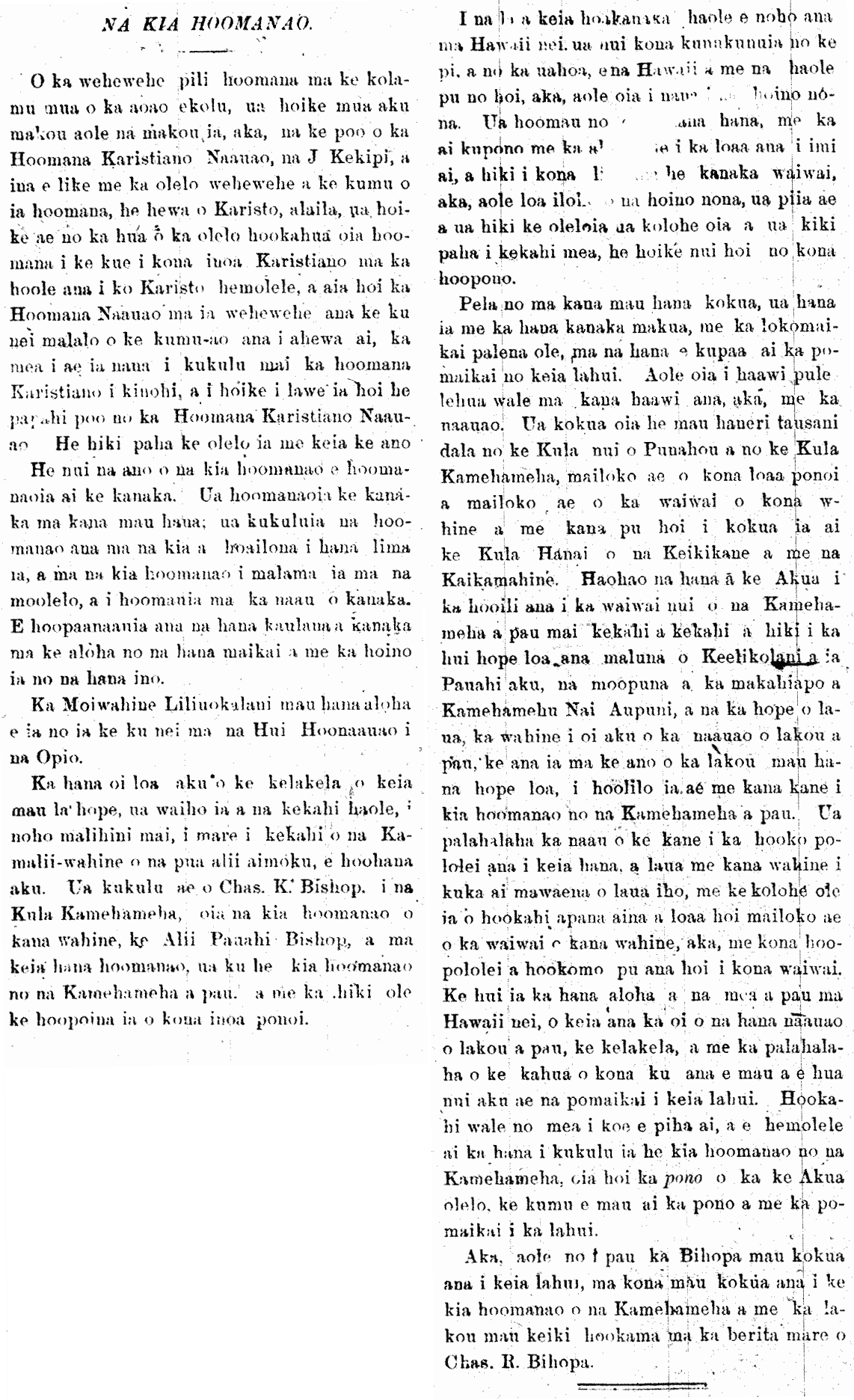
There are many kinds of memorials [kia hoomanao] to remember people by. A person is remembered for his deeds, in memorials built as pillars and monuments, in reminiscences, and preserved in the hearts of the many. Famous deeds of people are remembered with aloha for the good, and with scorn for the bad.

Queen Liliuokalani’s beloved efforts stand today as the Hui Hoonaauao i na Opio [Liliuokalani Educational Society].

The epitome of great deeds of these past days was done by a haole who lived here as a malihini and married one of the Princesses amongst the royal youth. Charles R. Bishop built the Kamehameha Schools, the memorial for his wife, the Alii Pauahi Bishop; and by this act of commemoration, a memorial now stands for all of the Kamehamehas, and it is impossible to forget their name.

 In the days when this haole friend was living here in Hawaii, he was often criticized for his stinginess and defiance by Hawaiian and haole alike, but he paid no care to this criticism. He continued with his work, ate healthily, [illegible digital image], until he was a rich man; but in all the criticism for him, there is no way that it could be said that he was a scoundrel or that he cheated someone; and this says a lot for his uprighteousness.

Likewise with his charity work, he acted with maturity and kindness without end in his steadfast support for the benefit of this lahui. In giving, he was not frivolous in his giving, but gave wisely. He donated hundreds of thousands of dollars to the Punahou College and to the Kamehameha Schools, from his own estate and from that of his wife’s; and from his own, also benefited were the Boarding School for  Boys and Girls. How wondrous is God in his passing down the great entire wealth of the Kamehamehas from one to another until it all came down to Keelikolani and then to Pauahi, the grandchildren of the first born of Kamehameha Nai Aupuni; and it was the last of the two, the one most knowledgeable of them all, as measured by their final deeds, which she created with her husband as a memorial for all of the Kamehamehas. This man was of a great mind in his carrying out meticulously this work which he and his wife discussed between themselves, without misappropriating a single parcel of land included in the estate of his wife, but instead he was conscientious and included his own estate. When put together with all the other beloved deeds by everyone in Hawaii nei, this is measured as the most wise of them all, the height and breadth of its foundation will go on and bear forth much benefits for this lahui. There is but yet one thing to complete and to perfect the building of this memorial to the Kamehamehas, that being the righteousness of God’s words, the basis upon which the good and the blessings of the lahui will continue.

But Bishop’s help for our people is not done in his continued assistance to the memorial to the Kamehamehas and their foster children [keiki hookama] in the covenant of marriage of Charles R. Bishop.

¹The first paragraph was left out because it was somewhat irrelevant to this particular post, and was commentary on J. Kekipi and the Christian Science [Hoomana Karistiano Naauao] faith.

(Oiaio, 2/21/1896, p. 2)

NA KIA HOOMANAO.

Ka Oiaio Puka La, Buke I, Helu 37, Aoao 2. Feberuari 21, 1896.

The Queen’s Protest, 1893.

KUKALA KUE A KE ALIIAIMOKU.

“O wau, Liliuokalani, ma ka lokomaikai o ke Akua, malalo o ke Kumukanawai o ke Aupuni Hawaii, Moiwahine, ma keia ke hoike paa nei i Ko’u kue i kekahi hana a mau hana paha a pau i lawelawe ia e kue ana Ia’u iho a me ke Aupuni Kumukanawai o ke Aupuni Hawaii e kekahi poe e koi ana ua kukulu lakou he Aupuni Kuikawa no ka manawa no keia Aupuni.

“Ke ae wale nei no Au mamuli o ka mana oi ikaika o Amerika Huipuia nona hoi ke Kuhina Elele Nui, ka Meamahaloia John L. Stevens, ua kauoha aku i na koa o Amerika Huipuia e hoopae ia mai ma Honolulu, a ua kukala ae e kokua no oia i ua Aupuni Kuikawa ʼla no ka Manawa i oleloia.

“Nolaila, i mea e kaupale aku ai i na hookuia ana o na puali i hoolawa ia me na lako kaua, a malia paha o hoopoino ia ke ola; nolaila, malalo o keia Kuahaua Kue a i kauhola ia hoi e ua mana ikaika ʼla, ke ae wale nei no Au e panee aku i Ko’u Mana a hiki i ka manawa a ke Aupuni o Amerika Huipuia, mamuli o na mea oiaio e waiho ia aku ai imua ona, e hoololi ai i na hana a kona Luna Aupuni a e hoonoho hou Ia’u maluna o ka mana A’u e koi nei ma ke ano Aliiaimoku o ka Paeaina Hawaii.”

“Hanaia ma Honolulu, i keia la 17 o Ianuari, M. H. 1893.”

“[Kakauinoaia:]

LILIUOKALANI, R.

Samuel Parker,
Kuhina o ko na Aina E.

Wm. H. Cornwell,
Kuhina Waiwai.

Jno. F. Colburn,
Kuhina Kalaiaina.

A. P. Peterson,
Loio Kuhina.

“Ia S. B. Dole a me kekahi poe e ae o ke Aupuni Kuikawa no ka Manawa o ka Paeaina Hawaii.”

[The Queen’s protest was printed in entirety the very next day in the Hawaiian-Language Newspaper, Hawaii Holomua. Images of this paper are unfortunately not available online, and it is only word searchable at nupepa.org, and not at papakilodatabase.com, but click the link below for an image of the page in which the protest was printed.

For English, see for instance: p. 120 of Report of Commissioner to the Hawaiian Islands, 1893.]

(Hawaii Holomua, 1/18/1893, p. 2)

HawaiiHolomua_1_18_1893_2

The Queen leaves Washington, D. C., 1900.

LILIU ARRIVES IN SAN FRANCISCO

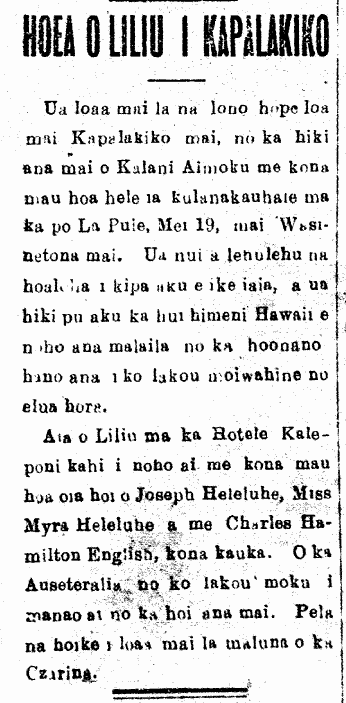
We have received the latest news from San Francisco [Kapalakiko], about the arrival of the Queen and her travelling companions in that city on Sunday, May 19th from Washington. There are many friends who visit to see her, and the Hawaiian singing group living there came to honor their queen for two hours.

Liliu is at the California Hotel with her companions, Joseph Heleluhe; Miss Myra Heleluhe; and Charles Hamilton English, her doctor. They are planning to return home on the Australia. That is what we hear from the Czarina.

(Aloha Aina, 6/2/1900, p. 4)

HOEA O LILIU I KAPALAKIKO

Ke Aloha Aina, Buke VI, Helu 22, Aoao 4. Iune 2, 1900.

Joseph Heleluhe, 1900.

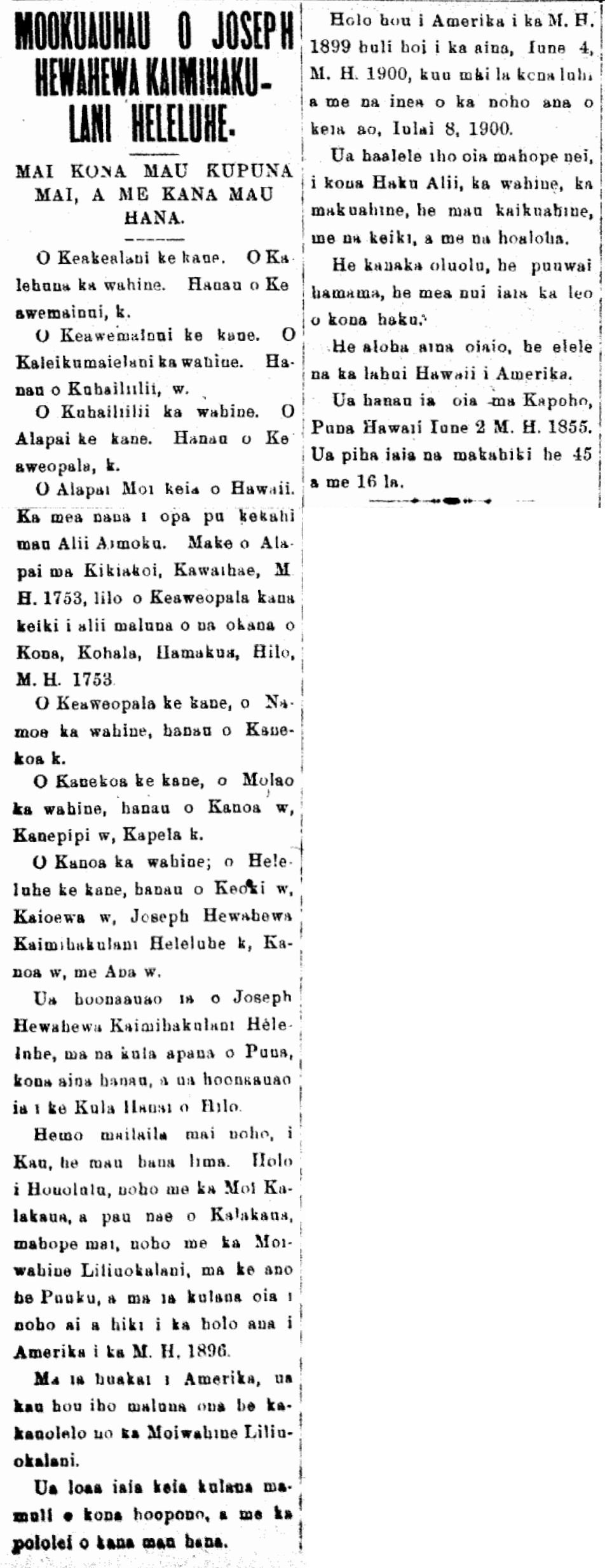
THE GENEALOGY OF JOSEPH HEWAHEWA KAIMIHAKULANI HELELUHE.

FROM HIS KUPUNA, ALONG WITH HIS ACCOMPLISHMENTS.

Keakealani was the man. Kalehuna was the woman. Born was Keawemainui (m).

Keawemainui was the man. Kaleikumaielani was the woman. Born was Kuhailiilii (f).

Kuhailiilii was the woman. Alapai was the man. Born was Keaweopala (m).

This was Alapai, the King of Hawaii. The one who crushed a number of Rulers [Alii Aimoku]. Alapai died at Kikiakoi, Kawaihae, in the year 1753, and Keaweopala his child became the ruler of the districts [okana] of Kona, Kohala, Hamakua, and Hilo, in 1753.

Keaweopala was the man. Namoe was the woman. Born was Kanekoa (m).

Kanekoa was the man. Molao was the woman. Born was Kanoa (f), Kanepipi (f), and Kapela (m).

Kanoa was the woman. Heleluhe was the man. Born was Keoki (f), Kaioewa (f), Joseph Hewahewa Kaimihakulani Heleluhe (m), Kanoa (f), and Ana (f).

Joseph Hewahewa Kaimihakulani Heleluhe was educated in the district schools of Puna, his land of birth, and educated at Hilo Boarding School [Kula Hanai o Hilo].

He graduated, and then lived in Kau, and did physical labor. He moved to Honolulu and lived with King Kalakaua, and after Kalakaua was done, he then lived with Queen Liliuokalani as her Steward [Puuku], and remained in that capacity until they went to America in 1896.

On that journey to America, upon him was also placed the duty of secretary to Queen Liliuokalani.

He received that position because of his propriety, and his meticulousness.

They went once again to America in 1899 and returned home to the aina on June 4, 1900; he left behind his labors and hardships of life in this world on July 8, 1900.

He left behind him, his Royal Mistress [Haku Alii], his wife, his mother, a number of sisters, his children, and his friends.

He was an amicable man with an open heart, and the voice of his Queen was important to him.

He was a true patriot, and he was an envoy from the Hawaiian nation to America.

He was born in Kapoho, Puna, Hawaii, on June 2, 1855. He made 45 years old and 16 days.

(Aloha Aina, 7/28/1900, p. 1)

MOOKUAUHAU O JOSEPH HEWAHEWA KAIMIHAKULANI HELELUHE.

Ke Aloha Aina, Buke VI, Helu 30, Aoao 1. Iulai 28, 1900.