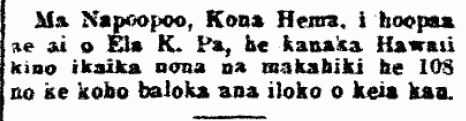
Ahahui Kamehameha, 1922.

THE AHAHUI KAMEHAMEHA ELECTS ITS NEW OFFICERS.

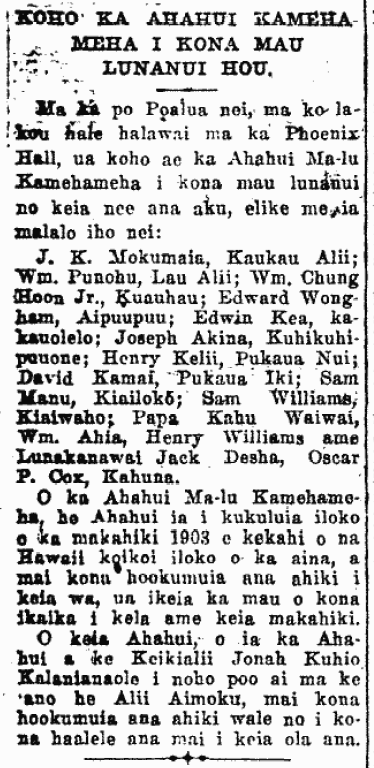
On the Tuesday night, at their meeting house at Phoenix Hall, the Kamehameha Secret Society [Ahahui Ma-lu Kamehameha] selected their officers for to move forward, as shown below:

J. K. Mokumaia, Kaukau Alii; William Punohu, Lau Alii; William Chung Hoon, Jr., Kuauhau; Edward Wongham, Aipuupuu; Edwin Kea, secretary; Joseph Akina, Kuhikuhipuuone; Henry Kelii, Pukaua Nui; David Kamai, Pukaua Iki; Sam Manu, Kiailoko; Sam Williams, Kiaiwaho; Board of Trustees, William Ahia, Henry Williams, and Judge Jack Desha, Oscar P. Cox, Kahuna.

The Kamehameha Secret Society is an Organization established in the year 1903 by some leading Hawaiians of the land, and from its beginnings until today, its continued strength is seen yearly.

This Association is the one Prince Jonah Kuhio Kalanianaole was the head of, as the Alii Aimoku, from its inception until he left this life.

(Kuokoa, 5/11/1922, p. 4)

KOHO KA AHAHUI KAMEHAMEHA I KONA MAU LUNANUI HOU.

Ka Nupepa Kuokoa, Buke LXI, Helu 19, Aoao 4. Mei 11, 1922.

More on officers of Ahahui Kamehameha, 1923.

JOHN C. LANE THE HEAD OF THE AHAHUI KAMEHAMEHA

After waiting a whole year after the death of Prince Kalanianaole, the Aliiaimoku of the Ahahui Kamehameha [Royal Order of Kamehameha], John C. Lane was chosen the replacement to fill his hole, so that he is the present head of the Ahahui Kamehameha until his replacement is elected sometime in the future when the officers are chosen.

John C. Lake was chosen aliiaimoku on the 29th of January, and in other words, he is the head of all of the chapters who are members of the Ahahui Kamehameha.

In that meeting that was held, it was decided that the organization would hold regularly every year, a day of remembrance for Prince Kalanianaole, the one who organized and established the Ahahui Kamehameha from when he was very young until it became the hugest of all Hawaiian organizations.

On this year, the 25th of March will be the day that the Ahahui Kamehameha will remember Prince Kalanianaole, by holding a prayer gathering at Kawaiahao Church, and invitations were sent to the other Hawaiian organizations of this town to join along in this gathering of remembrance.

For that meeting of remembrance, it is hoped that all the Hawaiian organizations will wear their uniforms, and in the afternoon of that day, the Ahahui Kamehameha will hold a party with all of the officers in attendance, and they will all eat as one of the foods prepared.

Up until this time, the main islands of Hawaii nei have all established their own chapters; Maui was the last island to join as a chapter in this organization, this past December.

To increase the membership of the Ahahui Kamehameha, it will be the duty of the members of this organization to search out and find new members here forth, with no confusion as to the number of new members that are to join.

The Ahahui Kamehameha on Kauai is the Ahahui Kaumualii, with its membership reaching about 200, and A. G. Kaulukou is the Mamoalii.

The organization on Hawaii Island is called Ahahui Mamalahoa, and William H. Beers is the Mamoalii.

The Ahahui Hawaii is the name of the organization here on Oahu, and B. N. Kahalepuna is the Mamoalii, with its membership of 250.

The Ahahui and their Officers

Here below are the officers of the Ahahui Kamehameha (Oahu):

1. Aliiaimoku, Prince Jonah K. Kalanianaole (deceased).

2. Alii, Dr. George H. Huddy. 3.

Officers of the Ahahui Kamehameha.

B. N. Kahalepuna, Mamo Alii; James H. Boyd (deceased). 4. Alii, Abraham Fernandez (deceased).

5. Alii, Charles H. Rose; 6. Alii, Carlos A. Long; 7. Alii, George E. Smithies (deceased); 8. Alii, Nagaram Fernandez (deceased).

9. Alii, James L. Holt; 10. Alii, David Kanuha; 11. Alii, Charles L. Oio; 12. Alii, John K. Kamanoulu.

13. Aliiaimoku, John C. Lane (replacement for Prince Kalanianaole); 14. Alii, Moreno K. Hulu; 15. Alii, Joseph K. Kanepuu (deceased); 16. Alii, William Chung Hoon.

17. Hope Aliiaimoku, William Chung Hoon, Jr.; 18. Alii, Edward K. Wongham; 19. Alii, Andrew I. Bright; 20. Alii, David K. Hoapili, Sr.

21. Alii, Eli J. Crawford; 22. Alii, Reuben Kinney; 23. Alii, Henry H. Williams.

24. Alii, Stephen L. Desha, Sr.; 25. Alii, George L. Desha, Sr.; 26. Alii, Samuel K. Pua.

The Ahahui Kaumualii.

27. Alii, J. Mahiai Kaneakua; 28. Alii, Nicholas K. Hoopii.

J. K. Mokumaia, Kaukaualii; William Punohu, Laualii; Edward K. Kea, Kakaolelo; William Chung Hoon, Jr., Kuauhau; Edward K. Wongham, Aipuupuu.

Oscar P. Cox, Kahuna; Joseph H. Akina, Kuhikuhipuuone; Henry Kelii, Pukaua Nui.

Samuel K. Kakelaka, Pukaua Iki; Samuel Manu, Kiai Loko; Samuel M. Williams, Kiai Waho.

Board of Trustees—William Ahia, Henry H. Williams, J. R. Desha.

Ahahui Mamalahoa.

This chapter of the Ahahui Kamehameha was established on April 18, 1907, and these are the officers:

William H. Beers, Mamo Alii; Stephen L. Desha, Sr., George L. Desha, Sr., and Samuel K. Pua.

Ahahui Kaumualii.

This chapter of the Ahahui Kamehameha was established in December 1918, and these are the officers:

A. G. Kaulukou, Mamo Alii; John Hano, Kaukaualii; I. K. Kaauwai, Sr., Laualii.

S. K. Kaahu, Kakaolelo; Henry Blake, Kuauhau; W. O. Crowell, Aipuupuu; H. W. Waiau, Kahuna.

Samuel Keliinoi, Kuhikuhipuuone; John Naleimaile, Pukaua Nui; E. C. Lovell, Pukaua Iki; F. W. Akana [?], Kiai Loko; David Pele, Kiai Waho.

The Alii:—J. Mahiai Kaneakua, Nicholas K. Hoopi.

Ahahui Kahekili.

In the month of December, on the 2nd, of 1922, recently past, this chapter was established, and the officers are:

W. E. Bal, Sr., Kaukaualii; Clem Crowell, Laualii; Frang K. Kalua, Kakaolelo; C. F. N. Rose, Kuauhau; Charles Wilcox, Aipuupuu; Stephen Lake, Kahuna; William Hoopii, Kuhikuhipuuone; George Kauwenaole, Pukaua Nui.

J. Hiona, Pukaua Iki; M. Ross, Kiai Loko; W. Cockett, Kiai Waho.

Executive Committee—S. E. Kalama, Guy Goodness, W. F. Kaae.

[Does anyone know if the name of the member of the Ahahui Kaumualii is “F. W. Akana”? It is hard to read from the image online…]

(Kuokoa, 2/15/1923, p. 3)

O JOHN C. LAKE KE POO O KA AHAHUI KAMEHAMEHA

Ka Nupepa Kuokoa, Buke LXII, Helu 7, Aoao 3. Feberuari 15, 1923.
Kaahumanu Society elects new officers, 1922.

ANNUAL MEETING OF THE KAAHUMANU SOCIETY.

At three in the afternoon on Wednesday of last week, the Ahahui Kaahumanu held its seventeenth annual meeting at the usual place, to elect the new officers of the association, and to listen to the annual report of the officers.

During the year, there were twelve members who left this life; nine members were each paid for by the society for their burials, and three members who died left benefits after they left this life to the society. The expenses for those members who died reached a total of $665.

The expenses to assist ailing members of the society reached $479.30; according to the many testimonies, the society is progressing well.

There were twelve new members included into the society on that day, and their names are below:

Jennie Kapahu Wilson, Mrs. Bernice Kaehanaoleokalani Kaaiakawaha Spitz, Mrs. Stella Kalikokalani Hanohano, Miss Miriam Kahakuhaakoi Kinney, Annie Paahana Laipila, Mrs. Elizabeth Holoaumoku Gittel, Miss Erna Holoaumoku Gittel, Mrs. Elizabeth Keliinoi Kinolahilahi Bayless, Mrs. Molly Kameeaulani Kapuaokekau Cummings, Miss Mary Kahale Cummings, Miss Haumealani Sheldon, Mrs. Elizabeth Kalaulaokalani Mitchell.

The society was thrilled at the joining of the young members, because the time will come that they will the place of the old members to move the endeavors of the society forward.

The old officers were reelected at this annual meeting; some of the officers held on to each of their positions for the past seventeen years. Here are the names of the officers who were reelected:

Miss Lucy Kamalalehua Kaheiheimalie Peabody, president [peresidena]; Mrs. Helen Kaukuikamokuikekapuokanehunamoku Kamaiopili, vice president [hope peresidena]; Mrs. Elizabeth Lahilahi Napuaikaumakani Webb, secretary [kakauolelo]; Mrs. Lilia Kahuakaiulaakanani Aholo, assistant secretary [kokua kakauolelo]; Mrs. Esther Kailihao Wilson Kelle, treasurer [puuku]; Mrs. Ellen Hooipoinalanielua Dwight, auditor [lunahooia].

Miss Mary Kanailani Sylva, committe to look after the ailing members of the society.

The member of the executive committe [papa hooko]: Mrs. Irene Ii Haalou Kahalelaukoa Holloway, Mrs. Louise Iehu Hapai Ahrens, Mrs. Caroline Kapuaianahulu Robinson, Mrs. Aha Kawehiokalani Ayau, Mrs. Elizabeth Nalehua Kukalia Kahookano, Mrs. Julia Paakonia Kahanamoku, Mrs. Mary Nanea Luana Simeson, Mrs. Caroline Ke Kaua Kuamoo Wallace. Henry Smith, pastor [kahu].

After the meeting was adjourned, there was light refreshments to satisfy all who gathered at the meeting.

(Kuokoa, 6/22/1922, p. 7)

KA HALAWAI MAKAHIKI A KA AHAHUI KAAHUMANU.

Ka Nupepa Kuokoa, Buke LXI, Helu 25, Aoao 7. Iune 22, 1922.

A visit to the Mormon settlement, Iosepa, Utah, 1912.

Travelling to Find Hawaiians in Iosepa, Utah.

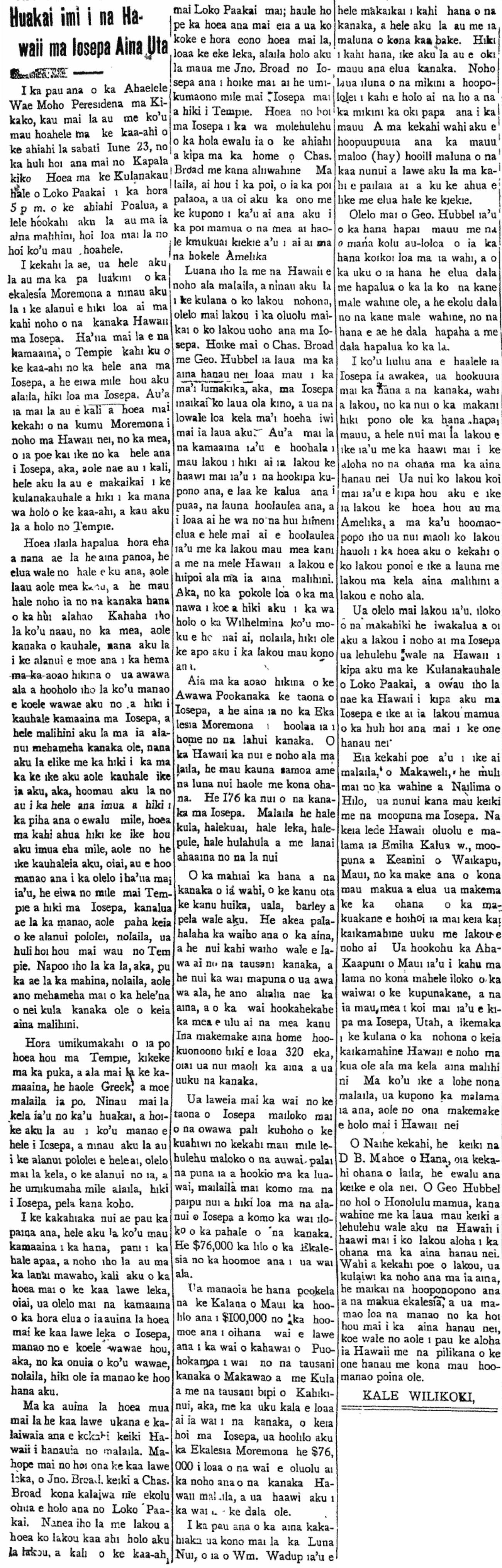
Following the Presidential Nominating Convention in Chicago, I boarded the evening train, along with my travelling companions, on the sabbath, June 23, to return to San Francisco. We arrived at Salt Lake City at 5 p. m. on Tuesday evening, and I jumped off alone in that foreign land while my companions continued all the way.

The next day, I went to grounds of the Mormon temple and asked for the way to get to where the Hawaiians lived in Iosepa. I was told by the locals that Tempie was where the train stopped to go to Iosepa, and eight more miles and you’d reach Iosepa. I was restrained to wait for one of the Mormon teachers who lived here in Hawaii, for they knew the way to Iosepa, but I did not wait, I toured about the city until the time the train departed, and I boarded for Tempie.

I arrived there at 4:30 and saw a barren land with but two buildings, no trees, no crops, and they were just houses for the men who worked on the railroad. I was shocked, because there was no one home; I looked at the road lying to the south, to the east of the valley and I decided to walk until the houses of the locals of Iosepa, and so I went as a malihini on that lonely deserted road; I looked as far as my eyes could see, and there were no homes in sight, but I continued walking forward for eight miles and reached a hillock from which I could see four more miles, but I couldn’t see any houses, while I recalled what was told to me, that it was eight miles from Tempie to Iosepa; I was confused, thinking that maybe this wasn’t the correct road, so I turned back once again for Tempie. The sun went down, but the moon came out, so the trip on this deserted foreign land was not forlorn.

I arrived back in Tempie at eleven that night, knocked on the door, and the kamaaina, who was a Greek, awoke, and I slept there that night. He asked me about my travels, and I told him that I was headed for Iosepa, and I asked him the right way to get there, and he told me that that was indeed the road but he estimated that it was fourteen miles before reaching Iosepa.

Early the next morning, we were done with breakfast, and my kamaaina went off to work; he locked up the house, and I sat out on the lanai, waiting for for the mail truck, since the locals told me that the letter truck to Iosepa arrived at two that afternoon; I thought to walk once again, but because of swelling of my legs, I couldn’t do it.

In the afternoon, a delivery truck driven by a Hawaiian youth born there arrived first. After him arrived the mail truck driven by John Broad, the son of Charles Broad, along with three passengers headed for Salt Lake. I spent time with them until their train arrived and they left; and I waited for the train from Salt Lake; its arrival ran late, and it came at about six; we got the mail bag, and I went along with Jno. Broad to Iosepa which he said was sixteen miles from Iosepa to Tempie. We arrived at Iosepa at dusk, at eight in the evening and visited the home of Charles Broad and his queen [wife]. There I ate poi once again, that being poi palaoa [poi made of flour], and this was much tastier and better than the expensive haole food that I had in the American hotels.

I spent time with the Hawaiians living there, and asked about how their lives were;  they said their way of life in Iosepa was pleasant. Charles Broad and George Hubbel told me that when they were home in the land of their birth, they were subject to frequent bouts of rheumatism but in Iosepa they were fine and this ailment giving them sore bones disappeared. I was asked to stay back by the kamaaina to spend [seems to be a dropped line here: “hoohala i mau lakou”] so that they can properly welcome me, like by roasting a pig, joining together in celebration, and allowing time for the two singing groups to  come and entertain me with their music and Hawaiian songs that they cherish in that foreign land. But because of my very short time left before the Wilhelmina, my ship upon which I was returning, was leaving, therefore, I could not accept their invitation.

The town of Iosepa is east of Skull Valley [Awawa Pookanaka], and it is land dedicated as a home for kanaka people. Hawaiians are the majority living there, and there are some kauna [forty] samoans and the head haole and his family. There are 176 people in Iosepa. There is a school house, store, post office, church, dance hall, and a lanai for parties on special occasions.

The work people do there is farming, planting oats, wheat, potatoes, barley, and so forth. The land is flat and stretches out, and there is much space, enough for a thousand people, and there is a lot of spring water in that valley, but the land is like a salt bed, and it is by irrigation that the crops grow. Should you want a homestead, you can get 320 acres, being that there is abundant land yet few people.

Water is brought in for the town of Iosepa from the deep, grooved ravines of the mountains for many miles in canals which are lined with cement and runs out to a reservoir, and from there the water runs into great pipes reaching the roads of Iosepa and entering the house lots of the people.  The Church spent $76,000 to lay the waterway.

It is thought that it was an ultimate feat of Maui County, which spent $100,000 to lay the water system to bring the water from Puohokamoa Stream as water for the thousands of people of Makawao and Kula and the thousands of cattle of Kahikinui, however, people have to pay to get the water; as for the water in Iosepa, the Mormon Church paid $76,000 to get the water to make the life of the Hawaiians there easy, and they give it for free.

After finishing breakfast, the Head Boss, William Wadup [Waddoups], invited me to  tour the work place of the people, and so I went with him aboard his vehicle [Not sure what a “kaa bake” is, but it appeared in an earlier article i put up]. We arrived at the place of work, and I saw two men cutting grass. They sat atop the machine, guided the horses straight, and the machine was what cut the grass. And at another location, the dried grass (hay) was piled onto a large truck and taken to where it was heaped up, and the pile was as tall as a two-story building.

George Hubbel told me that pitching hay with long-handled three-pronged pitch forks was the most important job there, and the pay for that job was two dollars and a half a day for a single man, and three dollars for a married man; for other jobs, the pay was a dollar quarter and  a dollar half a day.

As I made ready to depart Iosepa that afternoon, people were let off work, they told me because it was windy that they could not pitch hay, and they all came down to see me and to give their aloha to the families in the land of their birth. There was much asking for me to visit them again should I come back to America, and from what I saw, they were very happy at the arrival of one of their own who saw and visited with them in this foreign land upon which they live.

They told me that in the twenty or more years which they lived in Iosepa, there were a great many Hawaiians who visited Salt Lake City, but I was a Hawaiian who actually went to Iosepa to see them before returning here to the sands of our birth.

Here are some people I saw there: Makaweli, the last born of the wife of Nailima of Hilo, who has many children and grandchildren in Iosepa. It was this kind Hawaiian lady who took care of Emilia Kalua (f), the grandchild of Keanini of Waikapu, Maui, because both of her parents died; the family of her father wanted to bring back this young girl to live with them. The Circuit Court of Maui appointed me as executor for her portion of the estate of her grandfather, and these are they things which made me visit Iosepa, Utah, and to see firsthand how this Hawaiian girl was living without parents in this foreign land. From what I saw and heard about her there, she was being properly taken care of, and she did not want to come to Hawaii nei.

Also, there is Naihe, a child of D. B. Mahoe of Hana; he is family there; he has eight children living. George Hubbel formerly of Honolulu, his wife, and their children, and so many more other Hawaiians gave their aloha to their family here in the land of their birth. According to some of them, it is their homeland, the treatment of the church elders is good, and the thought to return to the land of their birth is very far away, except for the fact that their aloha for Hawaii is not gone, as for their kin at home with their never-ending thoughts of them.

KALE WILIKOKI [Charles Wilcox]

(Kuokoa Home Rula, 7/12/1912, p. 4)

Huakai imi i na Hawaii ma Iosepa Aina Uta

Kuokoa Home Rula, Buke X, Helu 28, Aoao 4. Iulai 12, 1912.

May Day Queen, 1941.

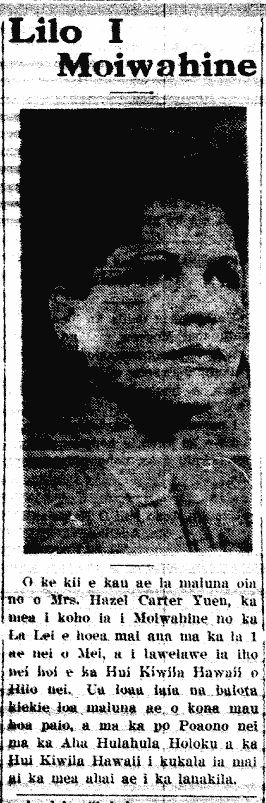
Became Queen

The picture above is of Mrs. Hazel Carter Yuen, the one chosen as Queen for the upcoming Lei Day, the 1st of May, held by the Hawaiian Civic Association [Hui Kiwila Hawaii] of Hilo. She received the most ballots from amongst her running mates, and on the night of this past Saturday at the Holoku Ball of the Hawaiian Civic Association the one who took the win was announced.

(Hoku o Hawaii, 4/9/1941, p. 1)

Lilo i Moiwahine

Ka Hoku o Hawaii, Buke XXXV, Helu 50, Aoao 1. Aperila 9, 1941.

One of many congratulatory messages to the newly elected king, Kalakaua, 1874.

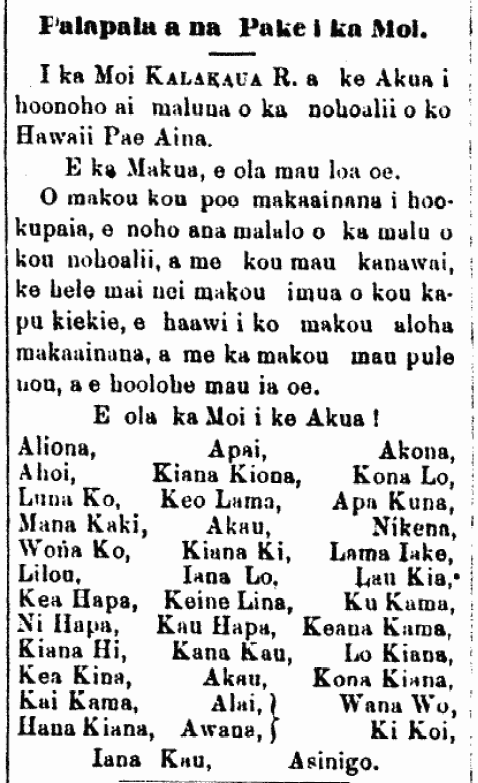
Letter from the Chinese to the King.

To King Kalakaua Rex, whom God has placed on the throne of the Hawaiian Archipelago.

Oh Father, long may you live.

We are your citizens who have been naturalized, living in under the protection of your rule and your laws; we come before your high kapu, to offer you our aloha from your citizens, as well as our prayers for you, and we shall always heed you.

Let the King live Through God!

Aliona, Apai, Akona, Ahoi, Kiana Kiona, Kona Lo, Luna Ko, Keo Lama, Apa Kuna, Mana kaki, Akau, Nikena, Wona Ko, Kiana Ki, Lama iake, Lilou, Iana Lo, Lau Kia, Kea Hapa, Keine Lina, Ku Kama, Ni Hapa, Kau Hapa, Keana Kama, Kiana Hi, Kana Kau, Lo Kiana, Ke Kina, Akau, Kona Kiana, Kai Kama, Alai, Wana Wo, Hana Kiana, Awana, Ki Koi, Iana Kau, Asinigo.

(Kuokoa, 3/21/1874, p. 1)

Palapala a na Pake i ka Moi.

Ka Nupepa Kuokoa, Buke XIII, Helu 12, Aoao 1.

Election season, 1912.

LINEKONA THE REPRESENTATIVE FOR THE WELL-BEING OF HAWAII.

Lincoln is the Morning Star,
The shining lantern,
Appointed by you, O Heavenly Powers,
Assisted by the Trinity.

Rise, O people of Hawaii,
The descendants of the I and the Mahi,
One in heart until victorious,
From Hawaii to Niihau.

Heard across the Islands,
Here is the one who will save the Lahui,
The eagle* will make right,
The Equal Rights of the land.

Let the story be told,
Lincoln the Representative for the Well-Being of Hawaii.

Composed by

George Kelii,

Honolulu, February 29, 1912.

*The eagle is used to represent the United States.

[Back in the day, there were many mele composed to support candidates. This one is for Lincoln Loy McCandless, who is famous for drilling for water here, and thus is also known as Likana or Linekona Eliwai (water driller). He will also be seen referred to as Lina (from Link).]

(Aloha Aina, 3/2/1912, p. 1)

LINEKONA KA ELELE OLA HAWAII.

Ke Aloha Aina, Buke XVI, Helu 9, Aoao 1. Maraki 2, 1912.