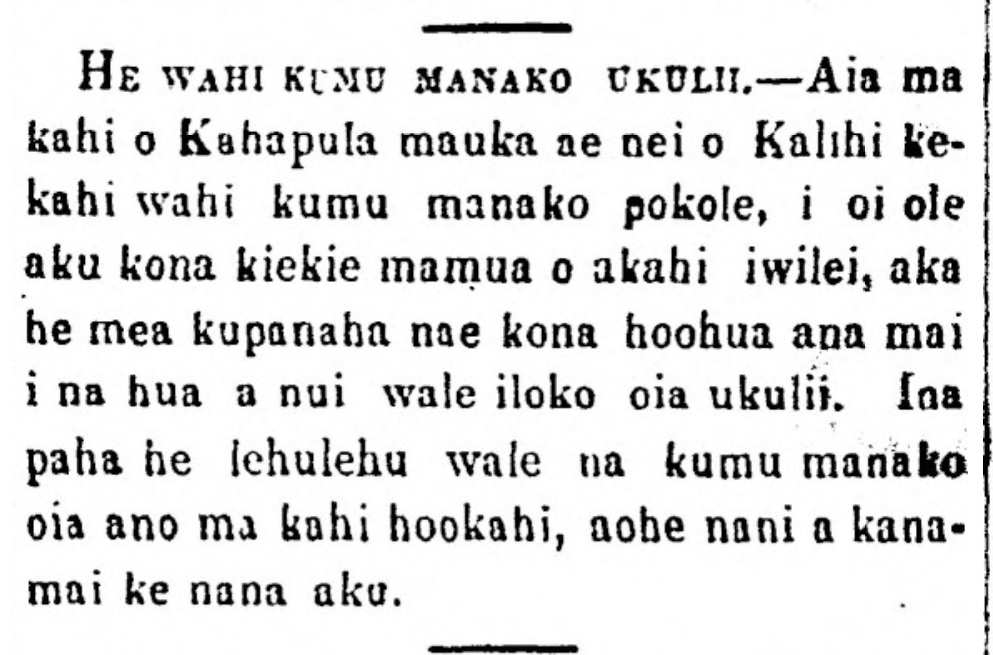
Mini mango trees, 1867.

[Found under: “NU HOU KULOKO”]

A tiny mango tree.–At Kahapula’s1 place in the uplands of Kalihi, there is a short mango tree, its height not more than an iwilei.2 But it is amazing that while it is so tiny, it produces so much fruit. Should there be many of those mango trees in one place, there would be nothing more beautiful to see.

Ka Nupepa Kuokoa, Buke XVII, Helu 11, Aoao 3. Maraki 16, 1867
  1. Kahapula is Fred W. Beckley. ↩︎
  2. Iwilei is the distance from your collarbone to the tip of middle finger when arm is extended. ↩︎

Back from rice to kalo, 1892.

[Found under: “NUHOU KULOKO.”]

The Chinese of Waikiki are starting to turn some rice paddy lands into taro fields, and there will be a lot of poi this next year.

(Hawaii Holomua, 12/12/1892, p. 3)

Hawaii Holomua, Buke III, Helu 117, Aoao 3. Dekemaba 12, 1892.

Kaʻū famine, 1862.

It is said that the people of Kau are soon to be in trouble because of famine. This is because they are all busy collecting pulu (the wool from tree fern), and are not planting taro; therefore they are faced with this problem.

(Hoku o ka Pakipika, 4/10/1862, p. 2)

Ka Hoku o ka Pakipika, Buke I, Helu 29, Aoao 2. Aperila 10, 1862.

Coffee in Keei planted by Princess Likelike, 1878.

Kona Coffee

O Kuokoa Newspaper; Aloha oe:—

Here is something I have seen with my own eyes: a Coffee [Kope] plantation growing in Keei, South Kona.

That Coffee plantation of H. Cooper is perhaps 150 acres large, and the Coffee is growing well, and no disease [kakani] is seen on the Coffee; its leaves are a beautiful green. Continue reading

On rice birds in Punaluu, 1873.

[Found under: “Na Hiohiona o Koolauloa.”]

Pertaining to Punaluu.—This is rice farming lands for Chulan & Co. There is much rice in this land; there is much rice as well amongst the Hawaiians in Waiono, Makana, Puheemiki, Kapano, and Papaakoko; Continue reading

We all know what happened to that old lady who swallowed a fly, 1896.

THAT IS THE GREATEST OF CALAMITIES.

Because of the great many calamities faced by the sugar industry in Hawaii, therefore some people think best thing is for us to import another animal larger than the Mongoose to kill off the Mongoose.

That is a great misconception, but this would cause yet even more calamities. Continue reading

I have come across this obituary a number of times, and each time, I think, “What a name!” 1921.

KING KEONAONA IAPANA OKURA HAS PASSED ON

To the Editor of the Kuokoa Newspaper, Aloha oe:—Please insert  in your pride of the nation, our bundle of tears of sadness, about our beloved who departed this life, so that the family and many friends living from Hawaii, the Island of Keawe all the way to Kauai of Manokalanipo will know. Continue reading

And of course, rice, 1862.

[Found under: “NEWS OF HAWAII NEI.”]

RICE.—We are overjoyed to see that rice is planted by one of our friends, S. Kamakahiki, in Hana, East Maui; there is a lot of grain and it is of good quality; why O Friends, are you dallying on planting this good source of money? We are amazed at the small number of people undertaking the growing of rice in Hana, for this is how it is, according to the letter of S. Kamakahiki, like this:

“I am the only one growing Rice here in Hana; I am harvesting the Rice and storing it at my house; I am filled with joy that I have found this good occupation.”

(Kuokoa, 2/15/1862, p. 2)

Raiki.

Cotton was grown here too, 1863.

Petaining to Cotton.

O Kuokoa Newspaper; Aloha oe:

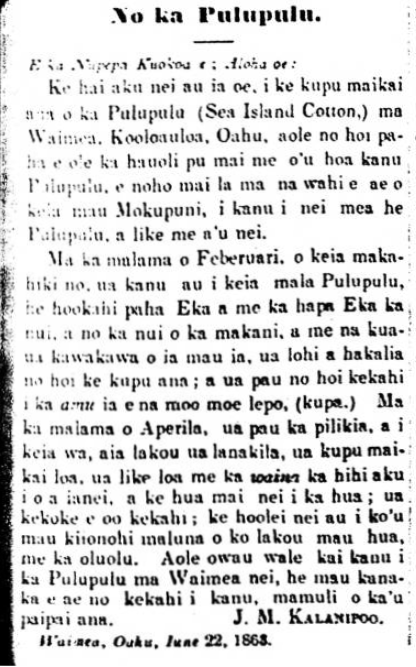
I am reporting to you that the Cotton [Pulupulu] (Sea Island Cotton) is sprouting well in Waimea, Koolauloa, Oahu; you will surely rejoice with my fellow Cotton planters living in other places of these Islands, who planted this thing, Pulupulu, like me.

In the month of February of this very year I planted this Cotton field; it is perhaps an Acre and a half large, and because of the strong wind and the saturating showers of those days, the sprouting was late and slow; and some of it was eaten [amu ia] by army worms [“moo that sleep in the earth”] (kupa). In the month of April, that problem was over, and now, the plants have triumphed; they are growing well; it is like grape vines that are crawling here and there, and the bolls are developing; some are almost mature; I look over their bolls with satisfaction. I am not the only one who planted Cotton here in Waimea, but there are others who planted as well, because of your encouragement.

J. M. Kalanipoo.
Waimea, Oahu, June 22, 1863.

(Kuokoa, 6/27/1863, p. 1)
Kuokoa_6_27_1863_1

Continue reading