Surveying the summit of Haleakala, 1876.

[Found under: “Na Nu Hou Kuloko”]

Shivering in the cold.–On the Saturday of big rain before the 28th of November, heavy raindrops made a clatter atop the tents of the surveyors staying on the summit of Haleakala. They were patient until their books and surveying tools were soaked, then they left the grounds and returned to Makawao, where they arrived alive.
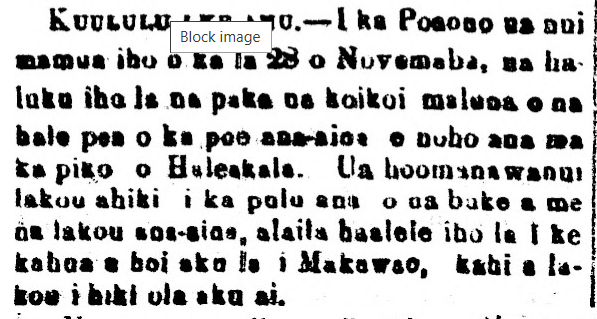
Ka Nupepa Kuokoa, Buke XV, Helu 50, Aoao 2. Dekemaba 9, 1876.

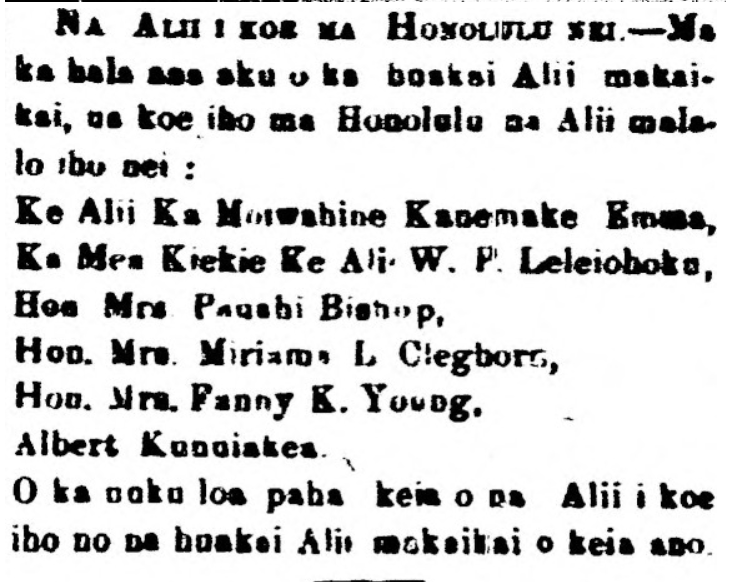
Royal Tour of the Islands, 1874.

[Found under: “Nu Hou Kuloko.”]

The Alii who remain here in Honolulu.–With the departure of the Royal Tour, the remaining Alii here in Honolulu are as follows:

The Alii, The Dowager Queen Emma,

His Highness, the Alii, W. P. Leleiohoku,

The Hon. Mrs. Pauahi Bishop,

The Hon. Mrs. Miriam L. Cleghorn,

The Hon. Mrs. Fanny K. Young,

Albert Kunuiakea.

This is perhaps the fewest Alii remaining from Royal tours of this type.

(Kuokoa, 4/4/1874, p. 3)

Ka Nupepa Kuokoa, BUke XIII, Helu 14, Aoao 3. Aperila 4, 1874.

Honolulu seen through the eyes of a malihini, 1856.

NOT PONO!

I came from the countryside, and stayed a for a bit in Honolulu. I witnessed some things that are not right:

  1. Pigs should not travel in droves on the streets of town.
  2. People should not raise so many dogs. You hardly can walk on the streets without being bitten. It is almost impossible to sleep at night because of the chattering dogs. The town is close to facing a famine because much of the food goes to the dogs.
  3. This is another thing I witnessed that was not right, the leaving of dead animals on the streets. It is better to bury them. [If not] maybe and epidemic will develop.
  4. And another thing, springs should not be left open where people walk.
  5. Kawaiahao Church and the cemetery should not be left so it becomes a place where pigs live. Where are you O Friends of those buried there? It would seem that you would get together and rebuild the wall that has fallen and is left gaping.

(Hae Hawaii, 9/3/1856, p. 107)

Ka Hae Hawaii, Buke 1, Helu 27, Aoao 107. Sepetemaba 3, 1856.

The return of Emma Aima Nawahi, 1920.

SHE IS RETURNING

This coming Friday, the Matsonia will stop in Hilo nei, and aboard that Californian Steamship returns Mrs. Aima Nawahi and her family, after spending several months in the State of California. The readers of the Hoku have been blessed by the kindness of this Hawaiian Matriarch in sending some news of their travels in that famous State of California, and in this issue, some news of this travel is published. Continue reading

Queen Kapiolani on Kauai, 1877.

THE QUEEN AT HAENA.

O Lahui Hawaii; Aloha oe:—

While I was in the village of my dear home, enjoying the breaking of the Kahoaloha wave, gazing at the green leaves of the Hinahina of Makana, and the good ways of my dear loving blossom Esther Kanani [Esetera Kanani] who believes in introducing friends to live while doing the good works of God. Continue reading

Kauai people call the Kuokoa a rag, 1893.

FROM KAUAI.

Kahikina Kelekona—Here I am in the district of Hanalei now, and I am travelling around the storied places [wahi pana] of this famous lands.

The newspapers greatly subscribed to are the Hawaii Holomua and the Oiaio. There are very few who subscribe to the Kuokoa here. You hear the kanaka saying those words that we are accustomed to, that the Kuokoa is a rag; kanaka are not pleased with it. I saw and heard first hand the them saying so.

Continue reading

Description of Hawaii Island, 1867.

TRAVELLING ON HAWAII.

Makawao, September 10, 1867.

O Alaula—Aloha to you:—I want to tell you of some things pertaining to my travels on Hawaii. On the 6th of August, we boarded the Kilauea to sail to Hawaii. It was a fine day; we sailed that day and night.

We stopped in Kealakekua.

At nine o’clock that next day we landed at the cape of Kaawaloa. We had many  thoughts when we saw that place famous in the old days. We entered the house of a chiefess, Mrs. L. K. Pratt, my schoolmate in days past. We shared aloha; we at oranges [alani] and melon [ipu], and smelled the wind of Kaawaloa, and we all boarded the steamship. Continue reading