A mele for Grover Cleveland, 1894.

KA HOOLA O KA KAHUI [sic] HAWAII

He ohohia nui loa
Nou e Kalivalana
Peresidena oikelakela
Kaulana me ke kiekie
O ka puuwai hao kila
O ka naauao lua ole
Pookela oe o ka nani
O ka manao akea
No ka ninau lahui
O ka Pae Aina Hawaii
Kau olelo hooholo
E hoi o Liliuokalani
Ma Kona Noho Kalaunu
O ke Aupuni Moi
Mai a Kamehameha mai
Piha olioli na moku
Ia oe e Kalivalana
Hauoli na puuwai
O ka Lahui Hawaii
I ke aloha kamahao
O Amerika Huiia
Lohea he leo aloha
Mai Wasinetona mai
Lanakila oikelakela
Ka Aoao Demokarata
Haneri a oi aku
Na kakoo o Hawaii
Puhi i na Pi Gi
Na hoohui aina
Ua haule na ikaika
A ka poe lehelehe wale
E ka Lahui Hawaii
E i ae hoi ka Hoola
Ke kuokoa mau loa
No Hawaii Aina
Lahui me ka Moi
E o e Kalivalana
I kou inoa hiwahiwa
“Ka Wiwo ole o na Wiwo ole
Ka makuakane o Hawaii
Ka Puuhonua o ka Pakipika
E noho ana i ka puuwai
O ka Lahui Hawaii.”

W. L. Kaleiakalahui.

[THE SAVIOR OF THE HAWAIIAN PEOPLE

There is great delight
For you O Cleveland
The greatest President
Famous and exalted
With heart of steel
An intelligence second to none
You are in the heights of splendor
With open mind
On the question of the people
Of the Hawaiian Archipelago
Your decision
To return Liliuokalani
To Her Throne
Of the Monarchy
From Kamehameha
The islands are filled with joy
For you O Cleveland
Hearts are happy
Of the Hawaiian People
With wonderful love
Of the United States of America
A voice of aloha has been heard
From Washington
Great Victory
The Democratic Party
Hundred or more
Were the supporters of Hawaii
Blown away were the Provisional Government
The annexationists
The powerful have fallen
The people who are all mouth
O Hawaiian Nation
The Savior says
Let there be never-ending independence
For the Land of Hawaii
The People and the Sovereign
Answer O Cleveland
Your precious name song
“The Fearless one amongst Fearless ones
The father of Hawaii
The Refuge of the Pacific
Living in the hearts
Of the Hawaiian People.”

W. L. Kaleiakalahui.

The attitude of the Hawaiian nation towards Grover Cleveland on the most part was and is (as seen recently) much different than towards his successor, William McKinley.]

(Nupepa Aloha Aina, 3/17/1894, p. 3)

KA HOOLA O KA KAHUI HAWAII

Nupepa Aloha Aina, Buke I, Helu 11, Aoao 3. Maraki 17, 1894.

Mele found everywhere in the Hawaiian-Language Newspapers, 1912.

[From: “KA LA NUI O NA LIMAHANA MA KEAUHOU, HAWAII.”]

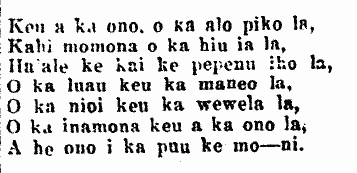
Keu a ka ono, o ka alo piko la,
Kahi momona o ka hiu ia la,
Ha’ale ke kai ke pepenu iho la,
O ka luau keu ka maneo la,
O ka nioi keu ka wewela la,
O ka ina mona keu a ka ono la,
A he ono i ka puu ke mo—ni.

[This mele excerpt is included in an article on a Labor Day celebration which took place in Keauhou, Kona, Hawaii. The writer of the article, Harry Haanio, says that it is a famous song composed by his older brother, who lives in Koloa, Hawaii Island, famous for the iliili hanau, the rocks that give birth.

Would this be what inspired Bina Mossman to compose her famous mele, “He Ono”? There are many, many old oli and mele which get altered and added to in later years. There are countless beautiful poetic pieces in the Hawaiian-Language Newspapers. Composers of today might consider looking within its pages for their own inspiration!]

(Kuokoa, 9/13/1912, p. 5)

Keu a ka ono, o ka alo piko la...

Ka Nupepa Kuokoa, Buke XLVIII, Helu 37, Aoao 5. Sepatemaba 13, 1912.

Poe’s “The Raven” in Hawaiian! 1871.

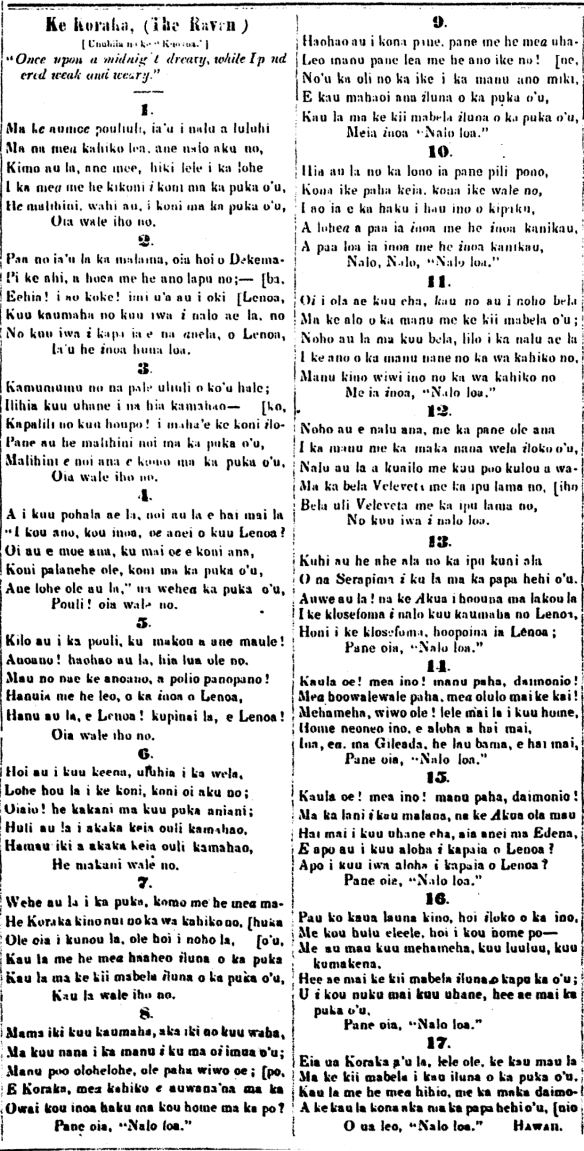
Ke Koraka, (The Raven)

[Translated for the “Kuokoa.”]

“Once upon a midnight dreary, while I pondered weak and weary.”

1.

Ma ke aumoe pouliuli, ia’u i nalu a luluhi
Ma na mea kahiko loa, ane nalo aku no,
Kimo au la, ane moe, hikilele i ka lohe
I ka mea me he kikoni i koni ma ka puka o’u,
He malihini wahi au, i koni ma ka puka o’u,
Oia wale iho no.

2.

Paa no ia’u la ka malama, oia hoi o Dekemaba,
Pi ke ahi, a hoea me he ano lapu no;—
Eehia! i ao koke? imi u’a au i oki
Kuu kaumaha no kuu iwa i nalo ae la, no Lenoa,
No kuu iwa i kapa ia e na anela, o Lenoa,
Ia’u he inoa huna loa.

3.

Kamumumu no na pale uliuli o ko’u hale;
Ilihia kuu uhane i na hia kamahao—
Kapalili no kuu houpo! i maha’e ke koni iloko,
Pane au he malihini nei ma ka puka o’u,
Malihini e noi ana e komo ma ka puka o’u,
Oia wale iho no.

4.

A i kuu pohala ae la, noi au la e hai mai la
“I kou ano, kou inoa, oe anei o kuu Lenoa?
Oi au e moe ana, ku mai oe e koni ana,
Koni palanehe ole, koni ma ka puka o’u,
Aue lohe ole au la,” ua wehea ka puka o’u,
Pouli! oia wale no.

5.

Kilo au i ka pouli, ku makou a ane maule!
Anoano! haohao au la, hia lua ole no.
Mau no nae ke anoano, a polio panopano!
Hanuia me he leo, o ka inoa o Lenoa,
Hanu au la, e Lenoa! kupinai la, e Lenoa!
Oia wale iho no.

6.

Hoi au i kuu keena, uluhia i ka wela,
Lohe hou la i ke koni, koni oi aku no;
Oiaio! he kakani mau kuu puka aniani;
Huli au la i akaka keia ouli kamahao,
Hamau iki a akaka keia ouli kamahao,
He makani wale no.

7.

Wehe au la i ka puka, komo me he mea mahuka
He Koraka kino nui no ka wa kahiko no.
Ole oia i kunou la, ole hoi i noho la,
Kau la me he mea haaheo iluna o ka puka o’u,
Kau la ma ke kii mabela iluna o ka puka o’u,
Kau la wale iho no.

8.

Mama iki kuu kaumaha, aka iki no kuu waha,
Ma kuu nana i ka manu i ku ma oi imua o’u;
Manu poo olohelohe, ole paha wiwo oe;
E Koraka, mea kahiko e auwana’na ma ka po,
Owai kou inoa haku ma kou home ma ka po?
Pane oia, “Nalo loa.”

9.

Haohao i kona pane, pane me he mea uhane,
Leo manu pane lea me he ano ike no!
No’u ka oli no ka ike i ka manu ano miki,
E kau mahaoi ana iluna o ka puka o’u,
Kau la ma ke kii mabela iluna o ka puka o’u,
Meia inoa “Nalo loa.”

10.

Hia au la no ka lono ia pane pili pono,
Kona ike paha keia, kona ike wale no,
I ao ia e ka haku i hau ino o kipaku,
A lohea a paa ia inoa me he inoa kanikau,
A paa loa ia inoa me he inoa kanikau,
Nalo, Nalo, “Nalo loa.”

11.

Oi i ola ae kuu eha, kau no au i noho bela
Ma ke alo o ka manu me ke kii mabela o’u;
Noho au la ma kuu bela, lilo i ka nalu ae la
I ke ano o ka manu nane no ka wa kahiko no
Manu kino wiwi ino no ka wa kahiko no
Me ia inoa, “Nalo loa.”

12.

Noho au e nalu ana, me ka pane ole ana
I ka manu me ka maka nana wela iloko o’u,
Nalu au la a kuailo me kuu poo kulou a waiho
Ma ka bela Veleveta me ka ipu lama no,
Bela uli Veleveta me ka ipu lama no,
No kuu iwa i nalo loa.

13.

Kuhi au he ahe ala no ka ipu kuai ala
O na Serapima i ku la ma ka papa hehi o’u.
Auwe au la! na ke Akua i hoouna ma lakou la
I ke klosefoma i nalo kuu kaumaha no Lenoa,
Honi i ke klosefoma, hoopoina ia Lenoa;
Pane oia, “Nalu loa.”

14.

Kaula oe! mea ino! manu paha, daimonio!
Mea hoowalewale paha, mea olulo mai ke kai!
Mehameha, wiwo ole! lele mai la i kuu home,
Home neoneo ino, e aloha a hai mai,
Ina, ea. ma Gileada, he lau bama, e hai mai,
Pane oia, “Nalo loa.”

15.

Kaula oe! mea ino! manu paha, daimonio!
Ma ka lani i kau maluna, na ke Akua ola mau
Hai mai i kuu uhane eha, aia anei ma Edena,
E apo au i kuu aloha i kapaia o Lenoa?
Apo i kuu iwa aloha i kapaia o Lenoa?
Pane oia, “Nalo loa.”

16.

Pau ko kaua launa kino, hoi iloko o ka ino,
Me kuu hulu eleele, hoi i kou home pono—
Me au mau kuu mehameha, kuu luuluu, kuu kumakena.
Hee ae mai ke kii mabela iluna o ka puka o’u;
U i kou nuku mai kuu uhane, hee ae mai ka puka o’u,
Pane oia, “Nalo loa.”

17.

Eia ua Koraka a’u la, lele ole, ke kau mau la
Ma ke kii mabela i kau iluna o ka puka o’u.
Kau la me he mea hihiu, me ka maka daimonio
A ke kau la kona aka ma ka papa hehi o’u,
O ua leo, “Nalo loa.”

Hawaii.

[This is one of many translated poems and stories found in the Hawaiian-Language Newspapers. Maybe translators of today might look at these for ideas on traditional ways stories were translated from other languages for a Hawaiian-speaking audience.

The person who translated Edgar Allan Poe’s “The Raven” also translated many hymns as well. For some reason “Ke Koraka” is reprinted two issues later on Feberuari 25, 1862, p. 4. For some reason, this page unfortunately is not available online.]

(Kuokoa, 2/11/1871, p. 1)
Ke Koraka, (The Raven)

Ka Nupepa Kuokoa, Buke X, Helu 6, Aoao 1. Feberuari 11, 1871.
More on the Queen’s 75th birthday, 1913.

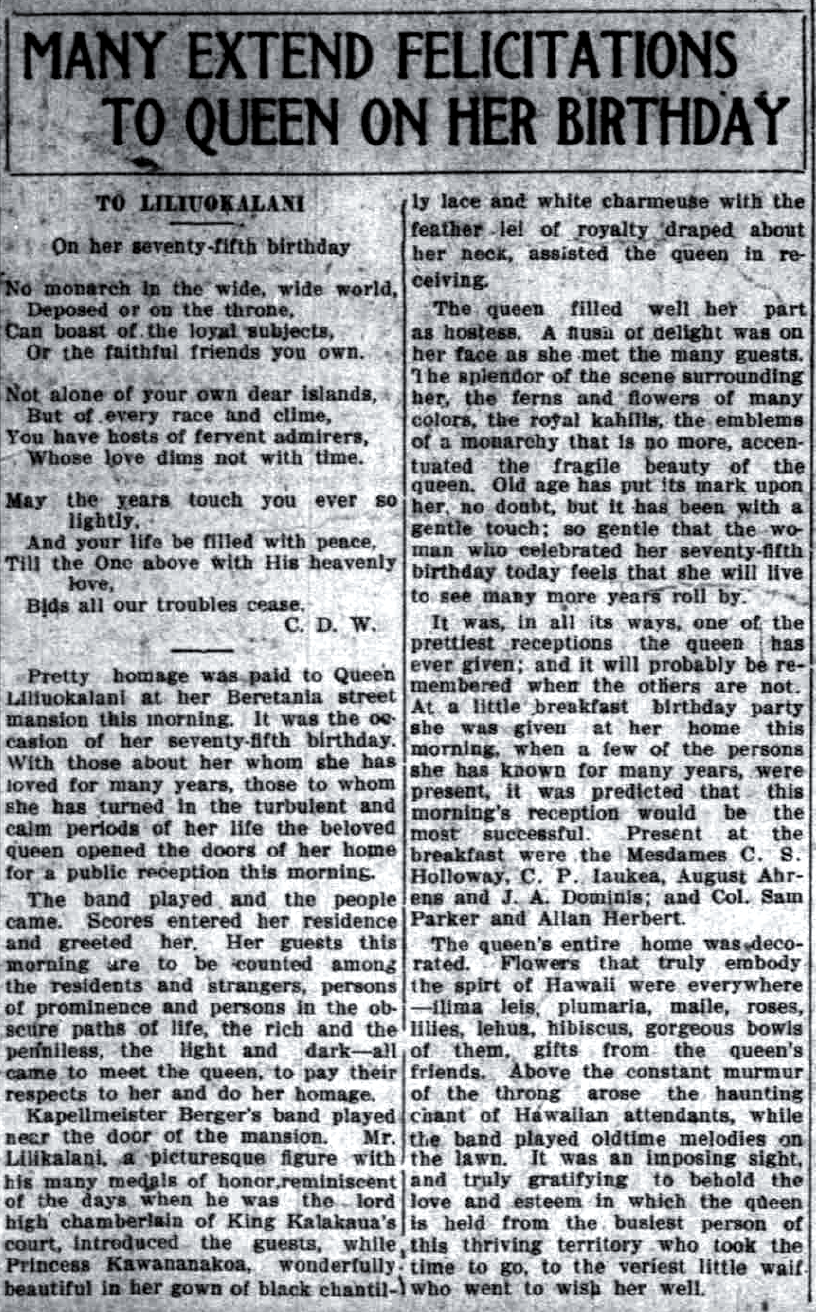
MANY EXTEND FELICITATIONS TO QUEEN ON HER BIRTHDAY

TO LILIUOKALANI

On her seventy-fifth birthday

No monarch in the wide, wide world,
Deposed or on the throne,
Can boast of the loyal subjects,
Or the faithful friends you own.

Not alone of your own dear islands,
But of every race and clime,
You have hosts of fervent admirers,
Whose love dims not with time.

May the years touch you ever so lightly,
And your life be filled with peace,
Till the One above with His heavenly love,
Bids all our troubles cease.

C. D. W.

Pretty homage was paid to Queen Liliuokalani at her Beretania street mansion this morning. It was the occasion of her seventy-fifth birthday. With those about her whom she has loved for many years, those to whom she has turned in the turbulent and calm periods of her life the beloved queen opened the doors of her home for a public reception this morning.

The band played and the people came. Scores entered her residence and greeted her. Her guests this morning are to be counted among the residents and strangers, persons of prominence and persons in the obscure paths of life, the rich and the penniless, the light and dark—all came to meet the queen, to pay their respects to her and do her homage.

Kapellmeister Berger’s band played near the door of the mansion. Mr. Lilikalani, a pictureque figure with his many medals of honor reminiscent of the days when he was the lord high chamberlain of King Kalakaua’s court, introduced the guests, while Princess Kawananakoa, wonderfully beautiful in her gown of black chantilly lace and white charmeuse with the feather lei of royalty draped about her neck, assisted the queen in receiving.

The queen filled well her part as hostess. A flush of delight was on her face as she met the many guests. The splendor of the scene surrounding her, the ferns and flowers of many colors, the royal kahilis, the emblems of a monarchy that is no more, accentuated the fragile beauty of the queen. Old age has put its mark upon her, no doubt, but it has been with a gentle touch; so gentle that the woman who celebrated her seventy-fifth birthday today feels that she will live to see many more years roll by.

It was, in all its ways, one of the prettiest receptions the queen has ever given; and it will probably be remembered when the others are not. At a little breakfast birthday party she was given at her home this morning, when a few of the persons she has known for many years, were present, it was predicted that this morning’s reception would be the most successful. Present at the breakfast were the Mesdames C. S. Holloway, C. P. Iaukea, August Ahrens and J. A. Dominis; and Col. Sam Parker and Allan Herbert.

The queen’s entire home was decorated. Flowers that truly embody the spirit of Hawaii were everywhere—ilima leis, plumaria, maile, roses, lilies, lehua, hibiscus, gorgeous bowls of them, gifts from the queen’s friends. Above the constant murmur of the throng arose the haunting chant of Hawaiian attendants, while the band played oldtime melodies on the lawn. It was an imposing sight, and truly gratifying to behold the love and esteem in which the queen is held from the busiest person of this thriving territory who took the time to go, to the veriest little waif who went to wish her well.

(Honolulu Star-Bulletin, 9/2/1913, p. 1)

MANY EXTEND FELICITATIONS TO QUEEN ON HER BIRTHDAY

Honolulu Star-Bulletin, Volume XXI, Number 6679, Page 1. September 2, 1913.

Patriotic mele in English, 1893.

As Israel in ancient times sat weeping by the waters of Babylon listening to the plaintive songs which arose from their singers, so sits Hawaii in grief and mourning to-day and to Her our bard sings:

I had a dream, I saw a vision pass before me,
Long ages past arose in swift array,
Adown the stream of time my fleeting fancy bore me
From age to age unto the present day,
Far o’er the southern sea I saw brave ships a-sailing
From isle to isle, till at Hawaii’s shore
They touched, and soon with joy the natives came, them hailing
With pious awe, incarnate Gods of yore,
From all the land they flocked with speed to see the stranger,
Adoring gave their gifts both rich and rare,
But time brought fuller knowledge, knowledge brought its dangers
And Captain Cook’s life paid the forfeit there.
And down the stream still visions came a-floating;
Vancouver came unto this race so brave;
Restored the friendship Cook had lost; while noting
That Britain ne’er would hold them as her slave.
Still swept the vision on with flight so speedy;
One ship alone this time comes into view—
America’s gift unto these islands needy,
Peace, love, goodwill—and Christianity too.
Right lovingly was welcomed each new teacher,
The people flocked to hear good news so true,
That more and more it seemed to every preacher,
The harvest plenteous, but the laborers few.
And time flew by on wings. The isles grew fair, and fairer;
One Briton thought to seize them for his land,
But Britain’s Admiral, our independence bearer,
Restored the flag midst praise from every hand,
The years passed by. Through all the land there rose the steeple—
The preacher controlled all with kindly hand;
Give land and constitution to your people!
(O King! Give heed!) and God will bless your land.
Year followed year. Changed Kings and constitution.
The stranger increased: took mortgages on land:
Kept Hawaii’s daughters, sisters, wives in prostitution:
Spread poverty and vice around on ev’ry hand.
Still years rolled on. With sugar now grown wealthy,
The foreign Christians lifts his eye around,
And says: “For me no doubt the climate is most healthy,
“Tho’ poor and dying Hawaii’s native sons are found.
“Some seventy years ago we gave this land the Bible
“And tried to teach them then its use,
“(To say we’ve showed them poor examples is no libel)
“And fair exchange ‘t will be to cook their goose.
“Their cries for right and justice soon we’ll stifle:
“Take for ourselves this Paradise on earth.
“If they object, we’ll each one tap our rifle,
“And call for help upon our land of birth.
“Unfit to rule with all these years of training—
“(We’ll spread the lie around on every hand,)
“You’ll see they’ll let us do it, uncomplaining,
“For they have got our Bible, and so we’ll take their land.”
At this a noise awoke me, and in wonder
I saw the very instance of my dream.
Hawaii’s Queen and Natives were put under
To bolster up their money-getting scheme
And now forth from them goes across the waters
One last appeal for Justice and for Right.
Preserving peace, Hawaii’s gen’rous sons and daughters,
Before God’s throne on high, in prayer unite:
“Great God! the Judge of All! The records thou art keeping!
“Look down in mercy on our sad estate!
“Be kind unto us! Hear our voice of weeping!
“Till thou restore, grant us in peace to wait.
“And thou, great nation! home of truth and bravery!
“Freedom’s defender! we pray thee us O, hear!
“Restore our Queen and us; now, as in slavery,
“Held by usurper’s armed fear.
“Restore our rights and help us to maintain them!
“O let our prayer be crowned with success!
“Our conduct and your friendship will retain them,
“The God of nations will for ever bless.”

[This mele was probably composed by Kahikina Kelekona, J. G. M. Sheldon.

The image taken from the microfilm is hard to make out at the bottom. Hopefully there will be funding found to have the Hawaiian-Language Newspapers be unbound and rescanned clearly. How can you get to all the pearls stored in the newspapers if you can’t make out the words?]

(Hawaii Holomua, puka pule, 1/28/1893, p. 4)

As Israel in ancient times...

Hawaii Holomua (Puka Pule), Buke III, Helu 5, Aoao 4. Ianuari 28, 1893.

Sweet Emalia and “Moku o Keawe” redux, 1907.

A Lei of Patriotism.

The Lehua Garland of Hilo, Hawaii Rises in Triumph—What is that in the Newspaper, Sweet Waiakahone.

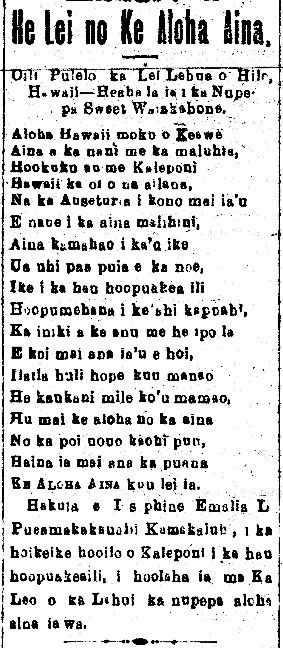
Aloha Hawaii moku o Keawe
Aina a ka nani me ka maluhia,
Hookuku au me Kaleponi
Hawaii ka oi o na ailana,
Na ka Auseturia i kono mai ia’u
E naue i ka aina malihini,
Aina kamahao i ka’u ike
Ua uhi paa puia e ka noe,
Ike i ka hau hoopuakea ili
Hoopumehana i ke ahi kapuahi,
Ka iniki a ke anu me he ipo la
E koi mai ana ia’u e hoi,
Ilaila huli hope kuu manao
He kaukani mile ko’u mamao,
Hu mai ke aloha no ka aina
No ka poi uouo kaohi puu,
Haina ia mai ana ka puana
Ke Aloha Aina kuu lei ia.

Composed by Iosephine Emalia L. Pueamakakaualii Kamakaluhi, at the California winter exhibition in the skin-whitening snow, published in Ka Leo o ka Lahui, the patriotic newspaper of the time.

[Sweet Emalia and her song of aloha aina which is still so famous today!]

(Aloha Aina, 10/26/1907, p. 8)

He Lei no Ke Aloha Aina.

Ke Aloha AIna, Buke XII, Helu 43, Aoao 8. Okatoba 26, 1907.

More mele and coverage of the Waimea cowboys, 1908.

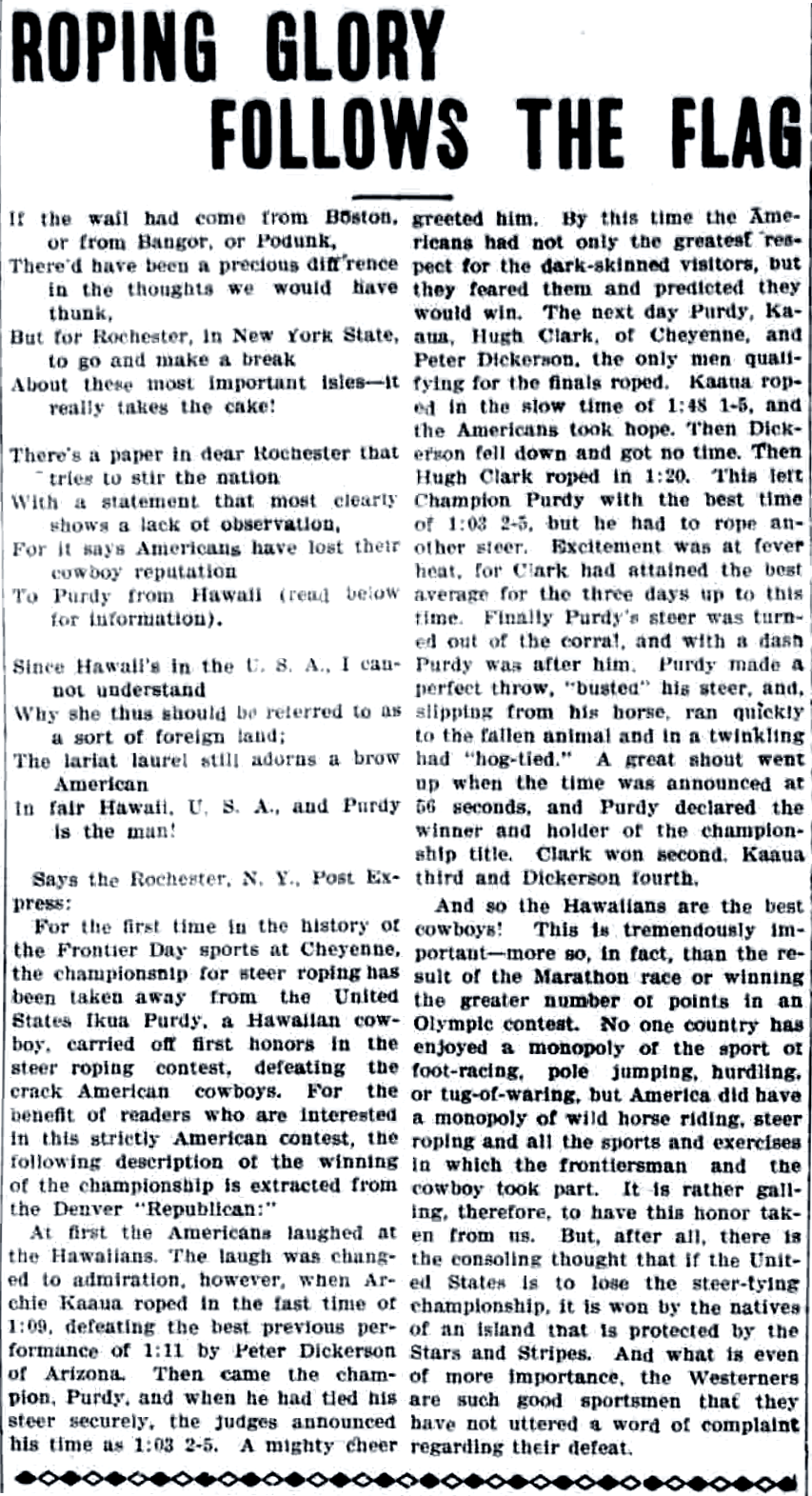
ROPING GLORY FOLLOWS THE FLAG

If the wail had come from Boston, or from Bangor, or Podunk,
There’d have been a precious diff’rence in the thoughts we would have thunk,
But for Rochester, in New York State, to go and make a break
About these most important isles—it really takes the cake!

There’s a paper in dear Rochester that tries to stir the nation
With a statement that most clearly shows a lack of observation,
For it says Americans have lost their cowboy reputation
To Purdy from Hawaii (read below for information).

Since Hawaii’s in the U. S. A., I cannot understand
Why she thus should be referred to as a sort of foreign land;
The lariat laurel still adorns a brow American
In fair Hawaii, U. S. A., and Purdy is the man!

Says the Rochester, N. Y., Post Express:

For the first time in the history of the Frontier Day sports at Cheyenne, the championship for steer roping has been taken away from the United States Ikua Purdy, a Hawaiian cowboy, carried off first honors in the steer roping contest, defeating the crack American cowboys. For the benefit of readers who are interested in this strictly American contest, the following description of the winning of the championship is extracted from the Denver “Republican:”

At first the Americans laughed at the Hawaiians. The laugh was changed to admiration, however, when Archie Kaaua roped in the fast time of 1:09, defeating the best previous performance of 1:11 by Peter Dickerson of Arizona. Then came the champion, Purdy, and when he had tied his steer securely, the judges announced his time as 1:03 2-5. A mighty cheer greeted him. By this time the Americans had not only the greates respect for the dark-skinned visitors, but they feared them and predicted they would win. The next day Purdy, Kaaua, Hugh Clark, of Cheyenne, and Peter Dickerson, the only men qualifying for the finals roped. Kaaua roped in the slow time of 1:48 1-5, and the Americans took hope. Then Dickerson fell down and got no time. Then Hugh Clark roped in 1:20. This left Champion Purdy with the best time of 1:03 2-5, but he had to rope another steer. Excitement was at fever heat, for Clark had attained the best average for the three days up to this time. Finally Purdy’s steer was turned out of the corral, and with a dash Purdy was after him. Purdy made a perfect throw, “busted” his steer, and, slipping from his horse, ran quickly to the fallen animal and in a twinkling had “hog-tied.” A great shout went up when the time was announced at 56 seconds, and Purdy declared the winner and holder of the championship title. Clark won second, Kaaua third and Dickerson fourth.

And so the Hawaiians are the best cowboys! This is tremendously important—more so, in fact, than the result of the Marathon race or winning the greater number of points in an Olympic contest. No one country has enjoyed a monopoly of the sport of foot-racing, pole jumping, hurdling, or tug-of-waring, but America did have a monopoly of wild horse riding, steer roping and all the sports and exercises in which the frontiersman and the cowboy took part. It is rather galling, therefore, to have this honor taken from us. But, after all, there is the consoling thought that if the United States is to lose the steer-tying championship, it is won by the natives of an island that is protected by the Stars and Stripes. And what is even of more importance, the Westerners are such good sportsmen that they have not uttered a word of complaint regarding their defeat.

(Hawaiian Star, 9/23/1908, p. 6)

ROPING GLORY FOLLOWS THE FLAG

The Hawaiian Star, Volume XVI, Number 5143, Page 6. September 23, 1908.

Another English mele for Ikua Purdy folks, 1908.

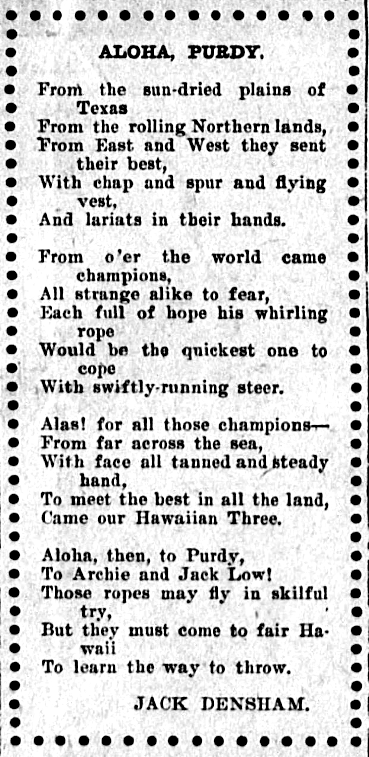
ALOHA, PURDY.

From the sun-dried plains of Texas
From the rolling Northern lands,
From East and West they sent their best,
With chap and spur and flying vest,
And lariats in their hands.

From o’er the world came champions,
All strange alike to fear,
Each full of hope his whirling rope
Would be the quickest one to cope
With swiftly-running steer.

Alas! for all those champions—
From far across the sea,
With face all tanned and steady hand,
To meet the best in all the land,
Came our Hawaiian Three.

Aloha, then, to Purdy,
To Archie and Jack Low!
Those ropes may fly in skillful try,
But they must come to fair Hawaii
To learn the way to throw.

JACK DENSHAM.

(Hawaiian Gazette, 8/25/1908, p. 3)

ALOHA, PURDY.

Hawaiian Gazette, Volume LI, Number 68, Page 3. August 25, 1908.

Mele and more for Ikua Purdy and the lads …in English, 1908.

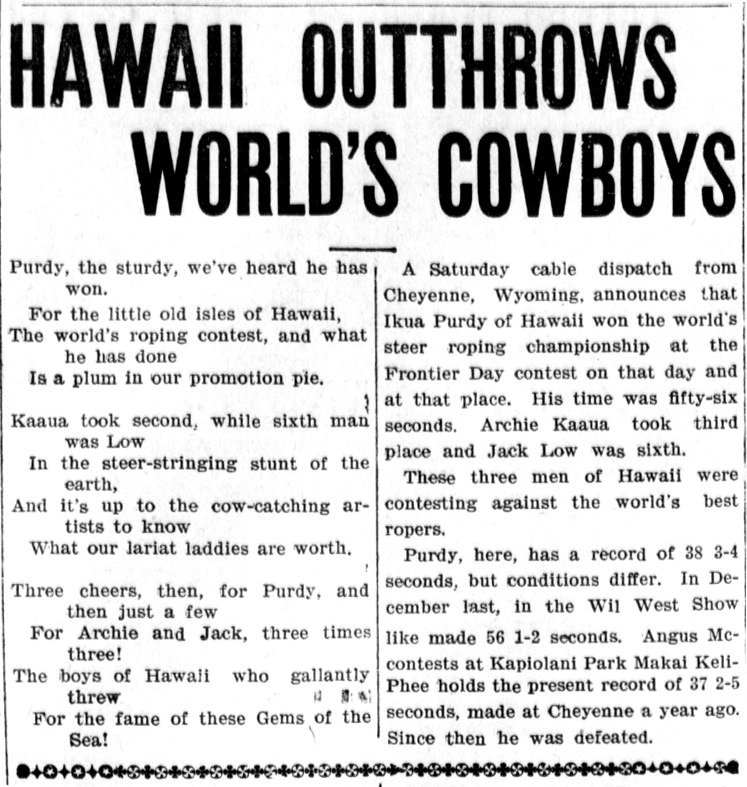
HAWAII OUTTHROWS WORLD’S COWBOYS

Purdy, the sturdy, we’ve heard he has won.
For the little old isles of Hawaii,
The world’s roping contest, and what he has done
Is a plum in our promotion pie.

Kaaua took second, while sixth man was Low
In the steer-stringing stunt of the earth,
And it’s up to the cow-catching artists to know
What our lariat laddies are worth.

Three cheers, then, for Purdy, and then just a few
For Archie and Jack, three times three!
The boys of Hawaii who gallantly threw
For the fame of these Gems of the Sea!

A Saturday cable dispatch from Cheyenne, Wyoming, announces that Ikua Purdy of Hawaii won the world’s steer roping championship at the Frontier Day contest on that day and at that place. His time was fifty-six seconds. Archie Kaaua took third place and Jack Low was sixth.

These three men of Hawaii were contesting against the world’s best ropers.

Purdy, here, has a record of 38 3-4 seconds, but conditions differ. In December last, in the Wild West Show [contests at Kapiolani Park Makai Keliilike made 56 1-2 seconds. Angus McPhee holds the present record of 37 2-5 seconds, made at Cheyenne a year ago. Since then he was defeated.

(Hawaiian Star, 8/28/1908, p. 6)

HAWAII OUTTHROWS WORLD'S COWBOYS

Hawaiian Star, Volume XVI, Number 5117, Page 6. August 24, 1908.

More on the famous paniolo of Waimea, 1908.

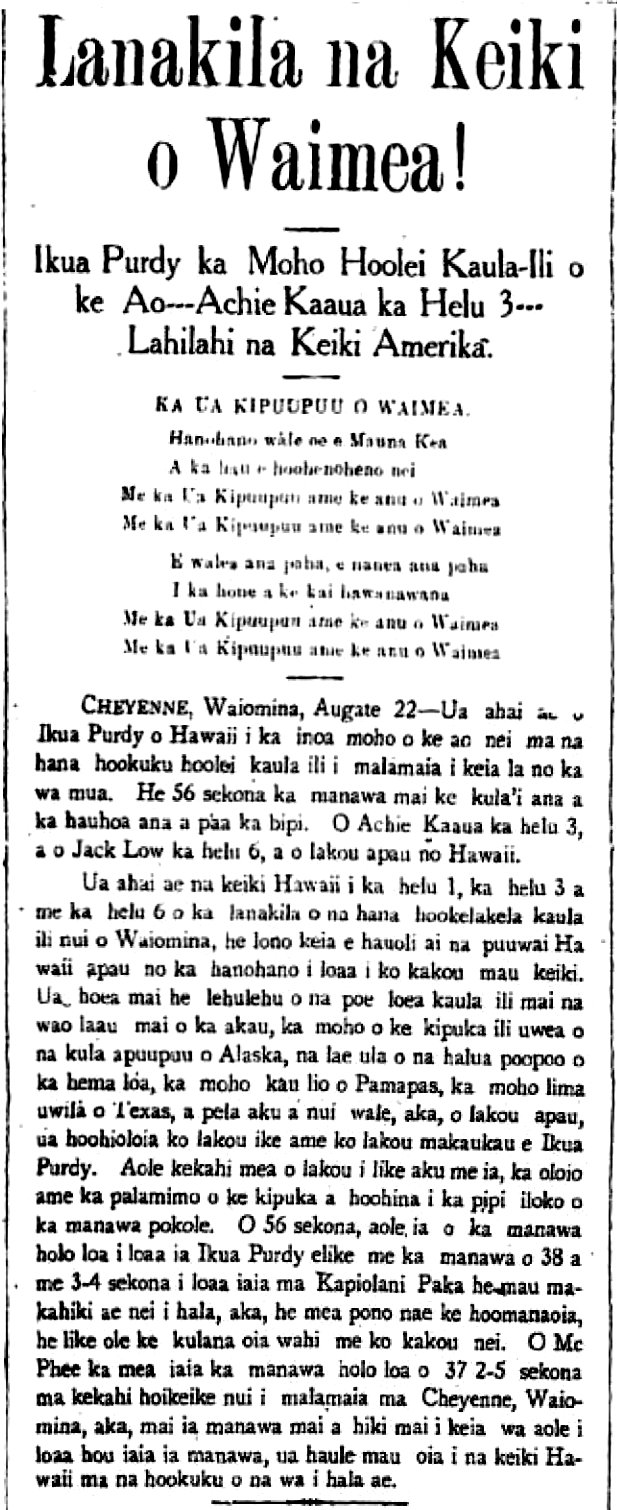
The Boys of Waimea are Victorious!

Ikua Purdy is the Champion Roper of the World—Archie Kaaua took 3rd—the American Boys are Weak¹.

KA UA KIPUUPUU O WAIMEA.

Hanohano wale no o Mauna Kea
A ka hau e hoohenoheno nei
Me ka Ua Kipuupuu ame ke anu o Waimea

E walea ana paha, e nanea ana paha
I ka hone a ke kai hawanawana
Me ka Ua Kipuupuu ame ke anu o Waimea

CHEYENNE, Wyoming, August 22—Ikua Purdy of Hawaii took the name of champion of the world in the roping contest held today for the first time. It took 56 seconds from the release of the steer until it was tied fast. Archie Kaaua [Achie Kaaua] took 3rd, and Jack Low took 6th, and they are all from Hawaii.

The Hawaiian boys took 1st, 3rd, and 6th places in the great contest of Wyoming; this is news which all Hawaiian hearts can be happy about, for the honor garnered by our boys. Many expert ropers showed up, from the forests of the north, the champion of the wire lasso of the rugged plains of Alaska, the experts from the furrowed lands of the far south, the champion rider of the Pampas, the lightning-handed champion of Texas, and so many more; however, all of their knowledge and preparation was overcome by Ikua Purdy. Not one of them was his match, with his swift and skilled lassoing and felling of the steer in short time. 56 seconds was not the fastest time made by Ikua Purdy like the 38 3/4 seconds he achieved at Kapiolani Park some years earlier, however, it should be kept in mind that the conditions there are not the same as ours. McPhee is the one with the fastest time, 37 2/5 seconds gotten at a big contest held in Cheyenne, Wyoming, but from that time to now, he did not make that time again; he was constantly defeated by the Hawaiian boys in contests after that.

THE KIPUUPUU RAIN OF WAIMEA.

Glorious is Mauna Kea
Graced with snow
With the Kipuupuu Rain and the cold of Waimea

Relaxing at ease
At the soft whispering sea
With the Kipuupuu Rain and the cold of Waimea

¹I’m not sure if “Lahilahi” here is referring to the American boys being “deflated”…

(Kuokoa Home Rula, 8/28/1908, p. 1)

Lanakila na Keiki o Waimea!

Kuokoa Home Rula, Buke VI, Helu 35, Aoao 1. Augate 28, 1908.