Napua Stevens back home, 1938.

CAME BACK HOME

The picture above is a picture of that kamaaina girl of Hilo nei, Miss Harriet Napua Stevens, formerly of Hilo and who is now staying in Honolulu and heard nightly at the Young Hotel [Hokele Iana] singing with the Band of Giggi Royce [Gigi Royce] of Honolulu. Continue reading

Royal Hawaiian Band headed to America, 1906.

THE ROYAL HAWAIIAN BAND OF THE COUNTY OF OAHU.

The picture below is of the Royal Hawaiian Band [Bana Alii Hawaii], famous here in the Hawaiian Archipelago, but there will be a small change, that being, this band will head to America in the month of June, and will stay there during the months of July and August, and will have two lady singers, which will be the entire band as is desired. Continue reading

Joseph Nawahi, born on this day in 1842, was not only a patritot, but a beautiful singer to boot, 1875.

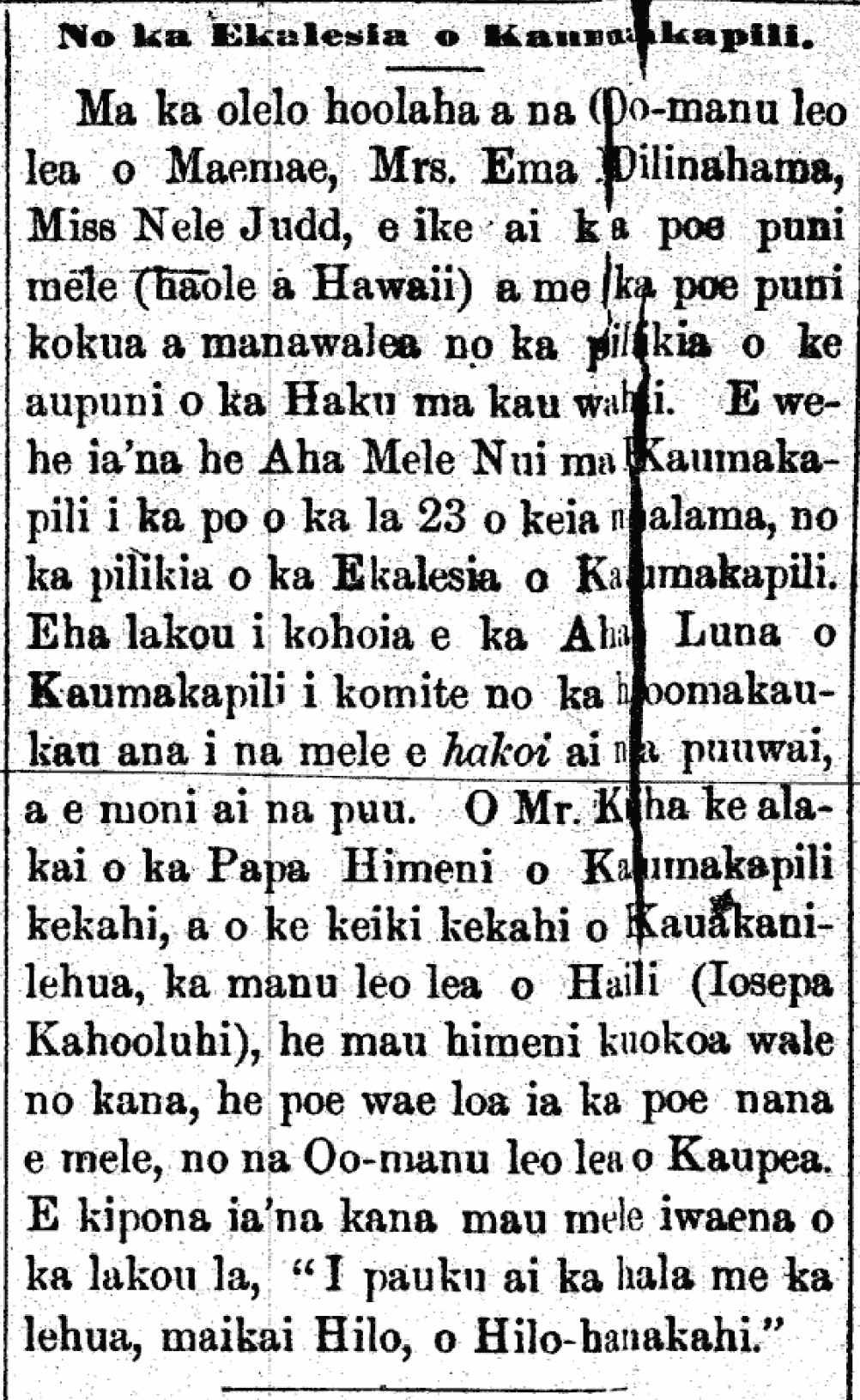
Relating to Kaumakapili Church.

In the announcement of the sweet-voiced Oo birds of Maemae, Mrs. Emma Dillingham [Ema Dilinahama] and Miss Nelly Judd [Nele Judd], those who love music (both English and Hawaiian) as well as those who love helping and donating to the troubled kingdom of the Lord in some way. There will be held a Grand Concert at Kaumakapili on the night of the 23rd of this month, for the difficulties of Kaumakapili Church. There are four chosen by the Leadership of Kaumakapili as a committee to prepare mele to excite the heart and to whet the appetite. Mr. Kiha, the leader of the Kaumakapili Choir is one of them, and the son of the Kanilehua rain, the sweet-voiced bird of Haili (Joseph Kahooluhi) is another, who will only be singing solos; those singing were chosen carefully from amongst the beautiful-voiced Oo birds of Kaupea. His songs will be mixed in amongst theirs, “So that the hala will be sectioned in with the lehua; wonderful is Hilo, Hilo Hanakahi.”

[We all know that Joseph Kahooluhi Nawahiokalaniopuu was one of the great patriots of all times, and we even know about his fine painting skills, but did you know that he composed mele and that he had a sweet singing voice? The newspapers are like treasure boxes filled with all sorts of pearls.]

(Lahui Hawaii, 12/16/1875, p. 2)

No ka Ekalesia o Kaumakapili.

Ka Lahui Hawaii, Buke I, Helu 51, Aoao 2. Dekemaba 16, 1875.

New organ being assembled at Kawaiahao Church, 1901.

Organ of Kawaiahao.

The new Organ of the Church has arrived, and if you go inside, you will see all sorts of small parts of this organ strewn here and there of the church. It is being assembled as quickly as possible by those working on it. There are hundreds of small parts to be put together until the large organ is complete. Because the church is being taken up by this activity, the church activities will take place in the room below.

[This is just one of a number of new organs that Kawaiahao received throughout the years!]

(Kuokoa, 7/12/1901, p. 4)

Ka Ogana o Kawaiahao.

Ka Nupepa Kuokoa, Buke XXXIX, Helu 28, Aoao 4. Iulai 12, 1901.

Christmas at Iolani Palace, 1920.

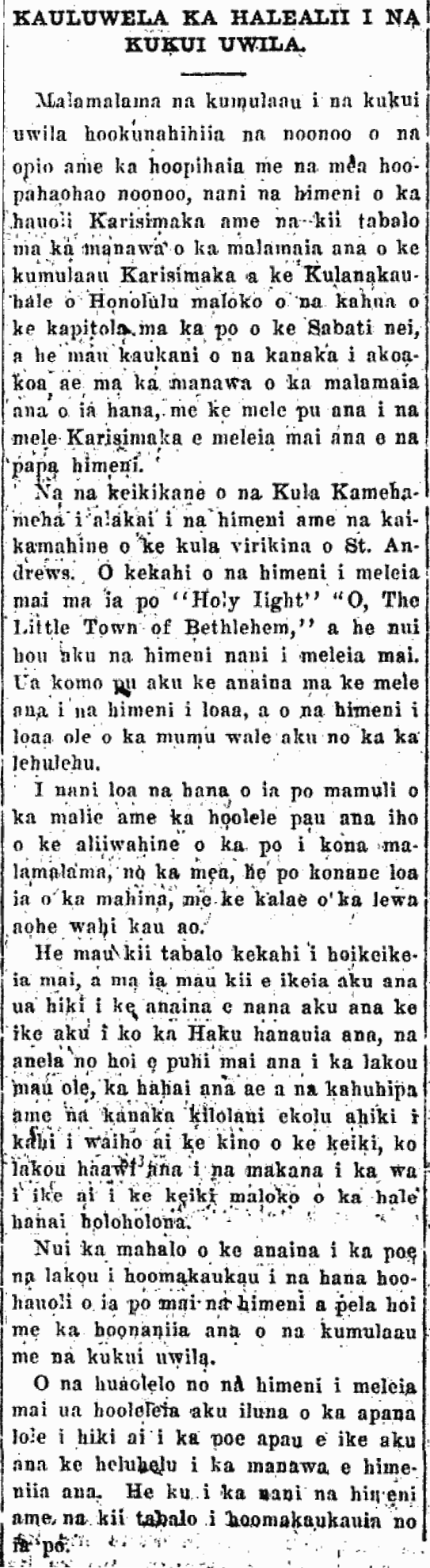
THE PALACE IS AGLOW WITH ELECTRIC LIGHTS.

The trees were bright with electric lights and the minds of the children were amazed, filled with wonder; the singing of Christmas joy and the skits were beautiful as the Christmas tree of the City of Honolulu was lit on the grounds of the capital this past Sunday; and there were thousands of people gathered while the event was held, while they sang along to Christmas carols being sung by choral groups.

The boys of the Kamehameha Schools led the singing along with the girls of the St. Andrews Priory School. Some of the songs sung that night were “Holy Light,” “O, The Little Town of Bethlehem,” a many other beautiful songs were sung. The crowd joined in the singing of the songs they knew, and when they did not know the words, they were silent.

The activities that night were wonderful because of the peace and because the queen of the night shone down her light, being this was a bright moonlit night, with a clear sky an no clouds.

There were skits performed as well, and in these performances to be seen, the crowd could watch the birth of the Lord, the angels blowing their trumpets, the following of the shepherds and the three magi to where the child lay, and their giving of gifts when they saw the child in the manger.

The audience was very appreciative of those who put on the joyous festivities that night, from the singing and so forth to the decorating of the trees with lights.

The words of the songs sung were projected onto a section of cloth so that everyone who could see could read it while the songs were being sung. The singing and the skits that were prepared for that night were wonderful.

(Kuokoa, 12/31/1920, p. 2)

KAULUWELA KA HALEALII I NA KUKUI UWILA.

Ka Nupepa Kuokoa, Buke LVIII, Helu 53, Aoao 2. Dekemaba 31, 1920.

Columbia Records in Hawaii, 1911.

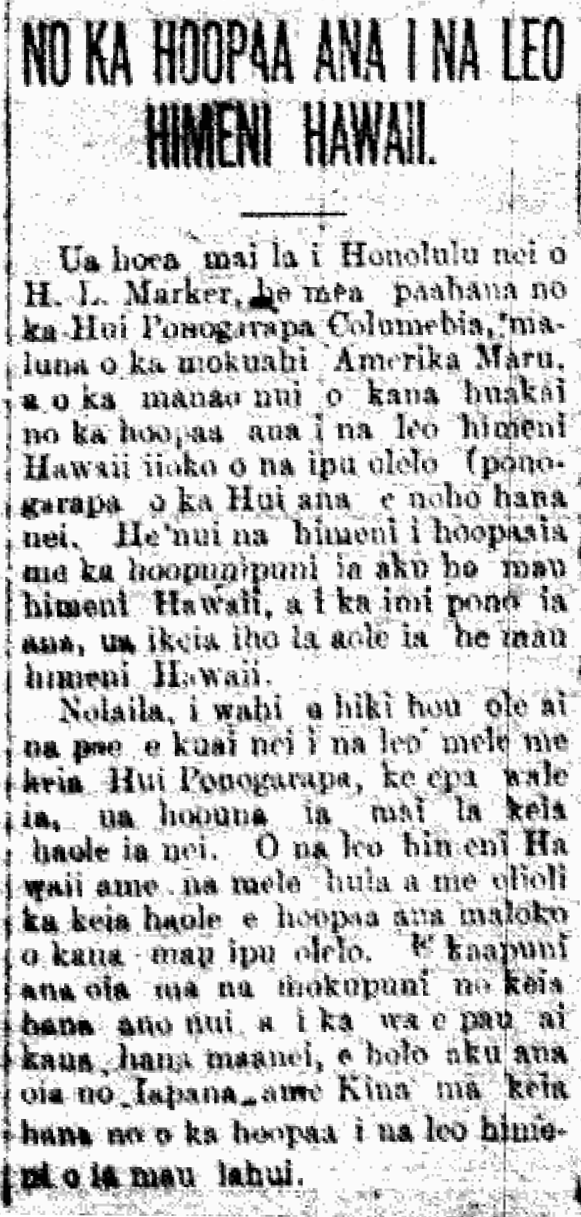
TO RECORD HAWAIIAN SINGING.

H. L. Marker, an employee of the Columbia Phonograph Company, arrived aboard the steamship Amerika Maru, and the main reason for his trip is to record Hawaiian singing in a horn [ipu leo] of the Company for which he works. There have been many a fake recording of Hawaiian songs, and after a close check, it was found that they weren’t Hawaiian songs.

Therefore, so as no more people purchasing music from this Phonograph Company will be deceived, that haole was sent here. Hawaiian songs and hula songs and chanting is what this haole will be recording in his horns. He will be travelling around the islands to accomplish this great effort, and when his work here is done, he will be going to Japan and China to do this job of recording songs of those people.

(Aloha Aina, 6/24/1911, p. 1)

NO KA HOOPAA ANA I NA LEO HIMENI HAWAII.

Ke Aloha Aina, Buke XVI, Helu 25, Aoao 1. Iune 24, 1911.

James B. Pakele reports from San Francisco, 1894.

Behold California, a Land of Cold.¹

J. U. Kawainui,

Aloha oe,

Here I am in California in good health. This is a very cold land, but there is always something new, there is no night here; the nights are like days.

These past few days, I have almost travelled all around the town; I went to visit the sugar refinery of the Millionaire², the place where they build warships, the place where money is minted, and the place where the soldiers drill (the Pressido [Presidio]).

I was at the Cliff House this past Thursday, it is a place that many visitors travel to, I saw the animals of the sea, but that place was very cold. After that, I went to the New City Hall and I spent almost a day visiting the various offices; it is a large structure perhaps eight times the size of Iolani Palace.

There are many poor people here with no place to sleep, and there are also many rich people.

PERTAINING TO THE GREAT EXHIBITION.

I went into the different exhibition halls of the Fair, so astonishing to see; there were all kinds of beautiful things.

I was in Alameda County, a large building, and within it, there was every variety of fruit.

Arizona Indian Building is the exhibition hall of the Indians [Ilikini]. There I saw their way of dancing; their dress is fine, but their dancing isn’t great.

I went into the building of hand crafts and saw the making of the clothes that we wear and so forth, and the exhibition hall of all kinds of animals. This week, one of the handlers was killed, mauled by a lion; the reason for this was the the lights went out when the handler was sweeping inside, at which point it jumped and tore at him. I saw the blood and the suit which is placed out as a display in the pen; today there was a service over his dead body. All the people in the fair attended the funeral, the Hawaiian youths sang in Hawaiian, “In Jesus’ Hands” [“Ma ko Iesu mau lima.”] .

The most highly attended thing is the display of Kilauea in Hawaii; the haole men and women are very taken by Hawaiian things, but above all is the hula kui; all the time is filled with hula kui.

There are two bands constantly playing in the Park, but they aren’t good like the Hawaiian boys; I am always being asked by many people if I will be attending the college that John Wilson³ is attending; I have a letter urging me to go there (Stanford University).

James B. Pakele.

San Francisco, February 17, 1894.

¹”Ike ia Kaleponi he Aina Anu” hearkens back to the mele “E Nihi ka Hele”.

²Spreckels Sugar Company of Claus Spreckels, known here as the Ona Miliona [Millionaire].

³See more on John Henry Wilson in Men of Hawaii.

[For related articles and information, see the previous posts, and the posts soon to come as well! Oh… and coincidentally, i noticed i recently posted James B. Pakele’s death announcement from 1913. He died at Queen’s Hospital on January 30.]

(Kuokoa, 3/3/1894, p. 1)

Ike ia Kaleponi he Aina Anu.

Ka Nupepa Kuokoa, Buke XXXIII, Helu 9, Aoao 1. Maraki 3, 1894.

Ninipo Hoonipo Song in Australia, 1927.

AMUSEMENTS

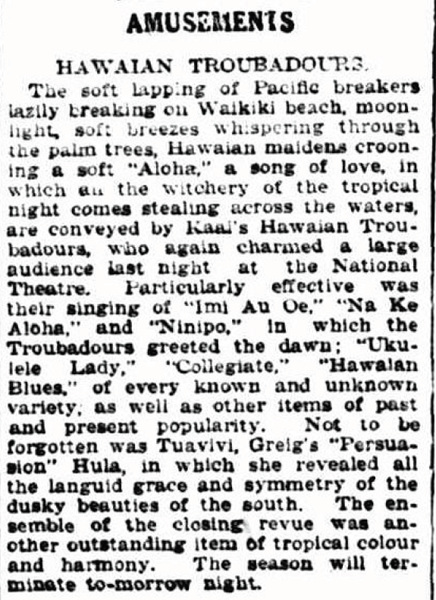
THE HAWAIIAN TROUBADOURS. The soft lapping of Pacific breakers lazily breaking on Waikiki beach, moon light, soft breezes whispering through the palm trees, Hawaian maidens crooning a soft “Aloha,” a song of love, in which all the witchery of the tropical night comes stealing across the waters, are conveyed by Kaai’s Hawaian Troubadours, who again charmed a large audience last night at the National Theatre. Particularly effective was their singing of “Imi Au Oe,”¹ “Na Ke Aloha,” and “Ninipo,” In which the Troubadours greeted the dawn; “Ukulele Lady,” “Collegiate,” “Hawaian Blues.” of every known and unknown variety; as well as other items of past and present popularity. Not to be forgotten was Tuavivi, Greig’s “Persuasion” Hula, in which she revealed all the languid grace and symmetry of the dusky beauties of the south. The ensemble of the closing revue was another outstanding item of tropical colour and harmony. The season will terminate to-morrow night.

[Earlier, i posted Liliuokalani’s “Ninipo Hoonipo Song”, and strangely enough, i ran across this reference to it being sung all the way in Australia in 1928!]

¹”Imi Au Ia Oe”

(Examiner, 4/22/1927, p. 6)

AMUSEMENTS.

The Examiner, Volume LXXXV, Number 95, Page 6. April 22, 1927.

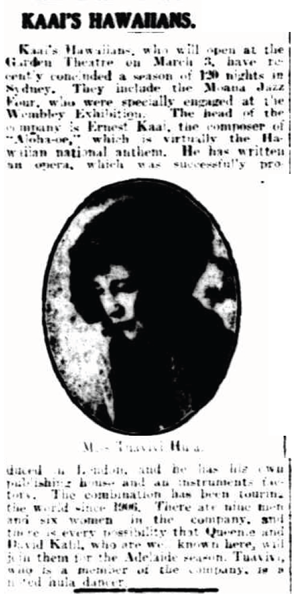
“Kaai’s Hawaiians” on TROVE, 1928.

KAAI’S HAWAIIANS.

Kaaiʻs Hawaiians, who will open at the Garden Theatre on March 3, have recently concluded a season of 120 nights in Sydney. They include the Moana Jazz Four, who were specially engaged at the Wembley Exhibition. The head of the company is Ernest Kaai, the composer of   “Aloha oe,” which is virtally the Hawaiiian national anthem. He has written and opera, which was successfully pro…

Miss Tuavivi Greig

…duced in London, and he has his own publishing house and an intsruments factory. The combination has been touring the world since 1906. There are nine men   and six women in the company, and there is every possibility that Queenie and   David Kaili, who are we know here, will join them for the Adelaide season. Tuavivi,   who is a member of the company, is a noted hula dancer.

[This comes from an Adelaide, South Australia newspaper, found on the National Library of Australia webside, TROVE. It seems unclear newspaper images is not something limited to Hawaii nei. However, at least the text on that site is correctable.]

(Advertiser, 2/23/1923, p. 11)

KAAI'S HAWAIIANS.

The Advertiser, Volume LXX, Number 21645, Page 11. February 23, 1928.

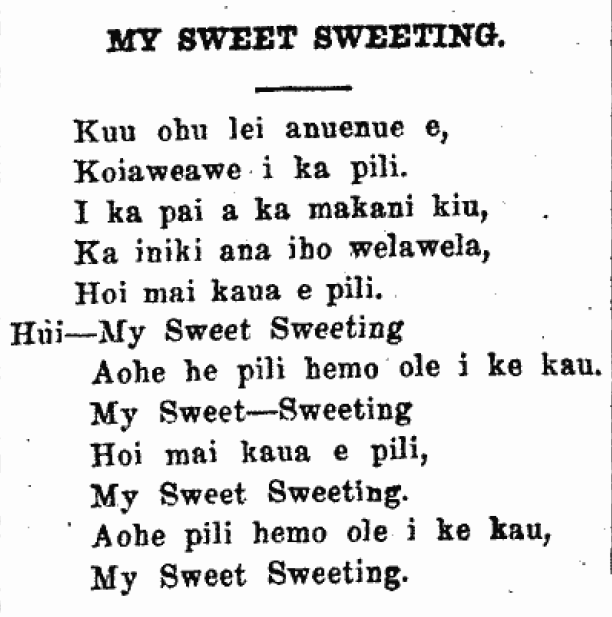
My Sweet Sweeting, 1908.

MY SWEET SWEETING.

Kuu ohu lei anuenue e,
Koiaweawe i ka pili.
I ka pai a ka makani kiu,
Ka iniki ana iho welawela,
Hoi mai kaua e pili.

Hui—My Sweet Sweeting
Aohe he pili hemo ole i ke kau.
My Sweet—Sweeting
Hoi mai kaua e pili,
My Sweet Sweeting.
Aohe pili hemo ole i ke kau,
My Sweet Sweeting.

[Mele are just waiting to be found again in the newspapers!]

(Kuokoa, 9/18/1908, p. 5)

MY SWEET SWEETING.

Ka Nupepa Kuokoa, Buke XLIII, Helu 38, Aoao 5. Sepatemaba 18, 1908.