Kawaihau Orchestra and Glee Club in SF. 1905.

HAWAIIAN MUSICIANS HEARD IN EXCELLENT PROGRAMME

Kawaiahau Orchestra and Glee Club Delights Large Audience With Singing and Playing.

The Kawaiahau Orchestra and Glee Club of Honolulu gave a delightful musicale yesterday afternoon and eveing at Lyric Hall before a large and highly pleased audience. The numbers, both vocal and instrumental, were admirably interpreted and encores were frequent.

The programme was given in the following order:

March, “Marine Band”; solo and chorus, “Kawaiahau” (Kealakai), Keoni Eluene; duet, “Ka Lai Opua” (Malie), Messrs. Kimo and Eluene; flute and solo, “Always” (Bowen), Major Mekia Kealakao [Kealakai]; bass solo, selected, James Kamakani; solo and chorus, “Akahi” (Princess Like Like [Likelike]), James Kulolia; tenor solo, “Kapilina” (Liliu), Kimo Ko; saxophone solo, “Kalai Pohina” (Nape), David Nape; solo, “Malu Ike Ao” (Kalima), Keoni Eluene; waltz, “Hawaiian Melodies” ; hula songs (Manoa); song and chorus, “Aloha Oe” (Queen Liliu), Hawaii Ponoi.

[Because of its location, The San Francisco Call had much Hawaii coverage.]

(San Francisco Call, 10/7/1905, p. 16)
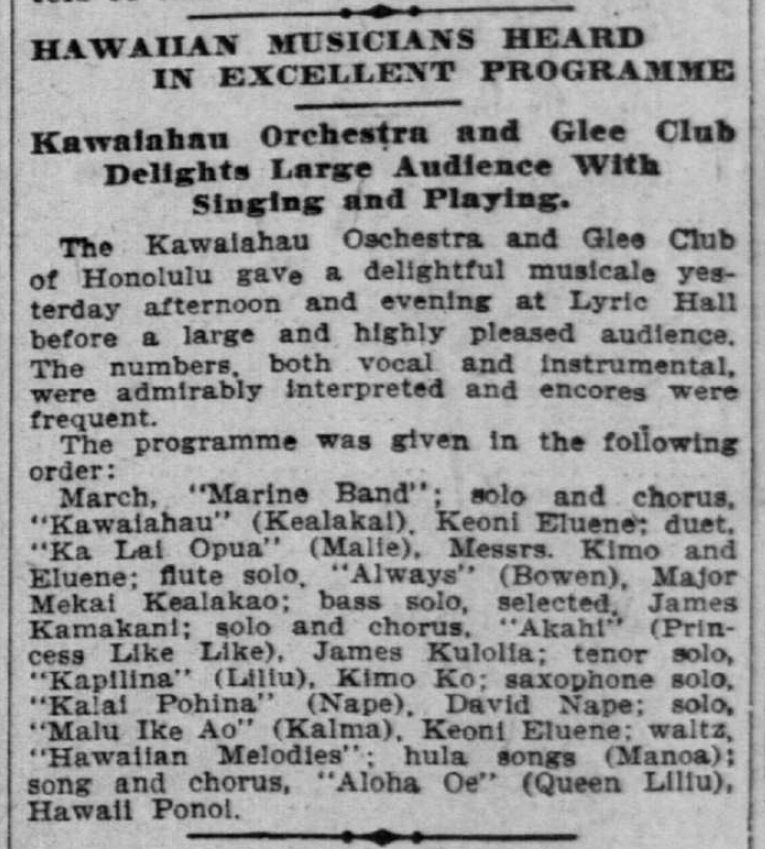
HAWAIIAN MUSICIANS HEARD IN EXCELLENT PROGRAMME

The San Francisco Call, Volume XCVIII, Number 129, Page 16. October 7, 1905.
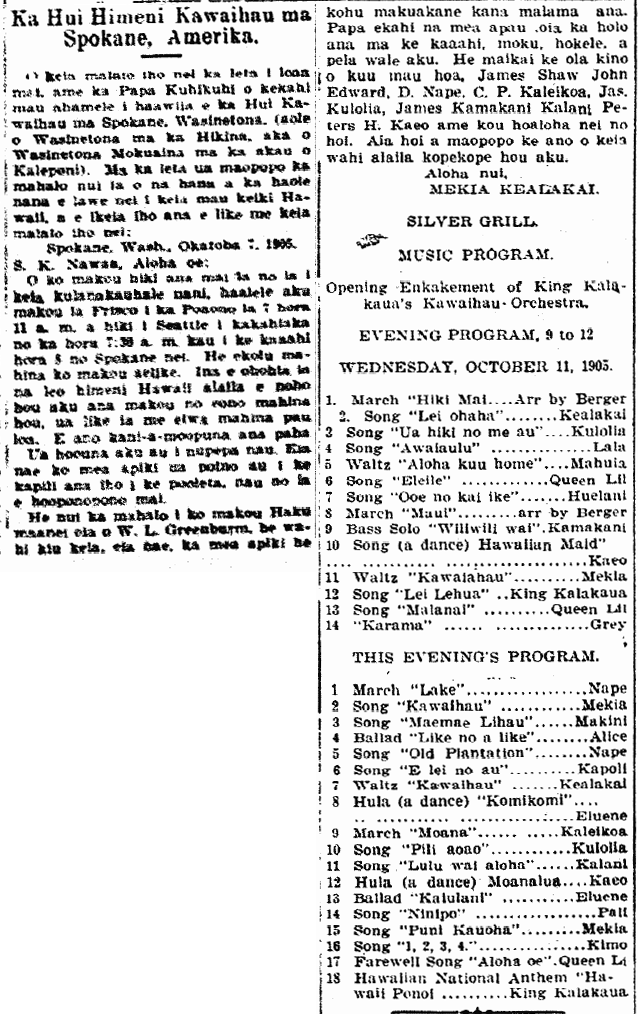
Kawaihau Glee Club performs in Washington State. 1905.

The Kawaihau Glee Club in Spokane, America.

Here below is a letter received as well as a program from some performances given by the Kawaihau Glee Club at Spokane, Washington (not Washington in the East, but Washington State to the North of California). It is apparent from the letter that the actions of that haole taking these Hawaiian boys around is much appreciated, and this is seen as below:

Spokane, Wash., October 7, 1905.

S. K. Nawaa, Aloha to you:

We’ve arrived in this beautiful town, we left Frisco on Saturday the 7th [?] at 11 a. m. and got to Seattle in the morning, at 7:30 a. m. boarded the 8 o’clock train for Spokane. Our contract is for 3 months. If they are taken by the sound of Hawaiian music, we will stay on for another 6 months, which would make 9 months total. Perhaps we will be like old grandparents by then.
I have sent a newspaper to you. But here is the thing, I had problems with the postage, so you will have to take care of it.
We really are thankful for our Boss here, W. L. Greenburn [?], he is an investigator. The one problem is that he treats us as if he is our father. Everything is first class, from the train, to the boat, to the hotel, and so forth. My friends, James Shaw, John Edward [Edwards?], D. Nape [David Nape], C. P. Kaleikoa, James Kulolia, James Kamakani, Kalani Peters, H. Kaeo and me, your friend as well, we are all in good health. As soon as I get acclimated to how it is here, I will write again.
Much Aloha,
Mekia Kealakai.

SILVER GRILL
MUSIC PROGRAM
Opening Enkakement of King Kalakau’s Kawaihau Orchestra.
EVENING PROGRAM, 9 to 12

WEDNESDAY, OCTOBER 11, 1905.

1 March “Hiki Mai” Arr by Berger
2 Song “Lei ohaha” Kealakai
3 Song “Ua hiki no me au” Kulolia
4 Song “Awaiaulu” Lala
5 Waltz “Aloha kuu home” Mahuia
6 Song “Eleile” Queen Lil
7 Song “Ooe no kai ike” Huelani
8 March “Maui” arr by Berger
9 Bass Solo “Wiliwili wai” Kamakani
10 Song (a dance) Hawaiian Maid” Kaeo
11 Waltz “Kawaiahau” Mekia
12 Song “Lei Lehua” King Kalakaua
13 Song “Malanai” Queen Lil
14 “Karama” Grey

THIS EVENING’S PROGRAM.

1 March “Lake” Nape
2 Song “Kawaihau” Mekia
3 Song “Maemae Lihau” Makini
4 Ballad “Like no a like” Alice
5 Song “Old Plantation” Nape
6 Song “E lei no au” Kapoli
7 Waltz “Kawaihau” Kealakai
8 Hula (a dance) “Komikomi” Eluene
9 March “Moana” Kaleikoa
10 Song “Pili aoao” Kulolia
11 Song “Lulu wai aloha” Kalani
12 Hula (a dance) Moanalua Kaeo
13 Ballad “Kaiulani” Eluene
14 Song “Ninipo” Pali
15 Song “Puni Kauoha” Mekia
16 Song “1, 2, 3, 4.” Kimo
17 Farewell Song “Aloha oe” Queen Li
18 Hawaiian National Anthem “Hawaii Ponoi King Kalakaua

[I am assuming that they copied the program as it was printed out in Washington…]

(Kuokoa, 11/3/1905, p. 5)

Ka Hui Himeni Kawaihau ma Spokane, Amerika.

Ka Nupepa Kuokoa, Buke XLIII, Helu 44, Aoao 5. Novemaba 3, 1905.

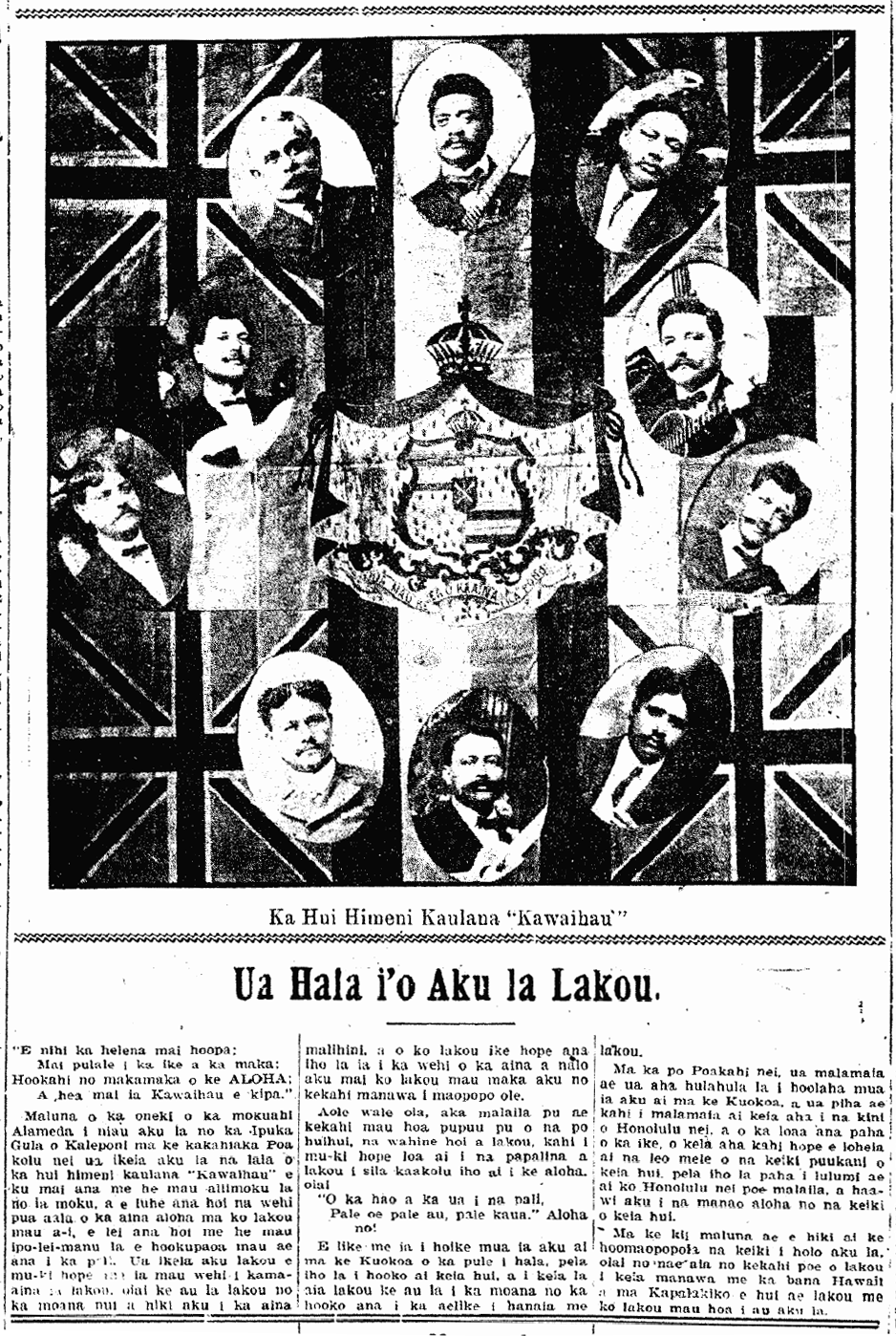
Kawaihau Glee Club off to San Francisco. 1905.

The Famous Singing Group “Kawaihau”

They Left for Afar.

“E nihi ka helena mai hoopa; [Tread carefully, don’t touch;]
Mai pulale i ka ike a ka maka [Don’t get excited by what the eye sees:]
Hookahi no makamaka o ke ALOHA [There is but one companion, that is ALOHA];
A hea mai ia Kawaihau e kipa. [Calling out to Kawaihau to come visit.]”¹

Aboard the deck of the steamship Alameda that moved swiftly on to the Golden Gate of California on the morning of Wednesday was seen the members of the famed singing group “Kawaihau” standing like officers of the ship while garlands of fragrant flowers of the beloved land hung about their necks; they wore the lei like a beloved sweetheart ever imbuing fragrance in their bosom. They were seen inhaling for the last time the adornment familiar to them as they were leaving for the great sea headed for foreign lands; and they were seeing for the last time the verdure of the land which disappeared from their eyes for who knows how long.

Not just them, but also there were the companions to curl up together in the cold nights—their wives, there to kiss their cheeks for the last time, which they sealed threefold with love, as

“O ka hao a ka ua i na pali [The assault of the rain in the cliffs]
Pale oe, pale au, pale kaua.” Aloha no! [I fend off, you fend off, we both fend off.”² Aloha!]

Just as reported earlier in the Kuokoa of last week, so did this group carry out, and today they are travelling over the ocean to fulfill the contract made with them.

This past Monday that dance advertised earlier in the Kuokoa was held, and the venue where the event took place was filled with the multitudes of Honolulu; perhaps they knew that this gathering would be the last they’d hear the singing of the performers of this group, and that is probably why Honolulu’s people thronged there and gave their aloha to the boys of the band.

In the picture above, you can see the boys who went, although some of them are currently with the Hawaiian Band in San Francisco and will meet up with their companions who left.

¹Play on the chorus of Kalakaua’s “E Nihi ka Hele.”
²Anyone know what mele this might come from?

[This is who played at that huge wedding celebration in Pauoa attended by Kaiulani in 1898 (the articles posted yesterday)]

(Nupepa Kuokoa, 9/22/1905, p. 1)

Ua Hala i'o Aku la Lakou

Ka Nupepa Kuokoa, Buke XLIII, Helu 38, Aoao 1. Sepatemaba 22, 1905.

More “Alika”! 1893.

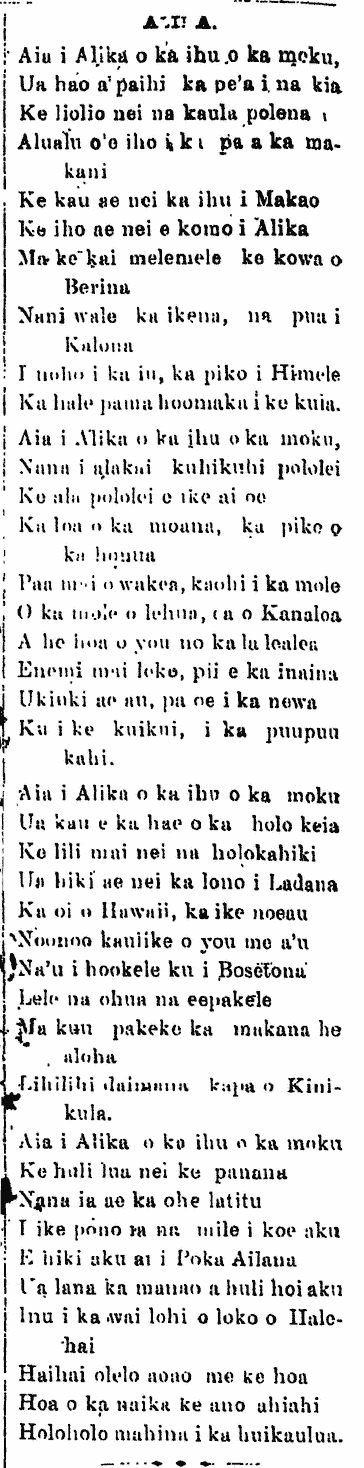
ALIKA.

Aia i Alika o ka ihu o ka moku,

Ua hao a paihi ka pe’a i na kia

Ke liolio nei na kaula polena

Alualu ole iho i ka pa a ka makani

Ke kau ae nei ka ihu i Makao

Ke iho ae nei e komo i Alika

Ma ke kai melemele ke kowa o Berina

Nani wale ka ikena, na pua i Kalona

I noho i ka iu, ka piko i Himele

Ka hale pama hoomaka i ke kuia.

Aia i Alika o ka ihu o ka moku,

Nana i alakai kuhikuhi pololei

Ke ala pololei e ike ai oe

Ka loa o ka moana, ka piko o ka honua

Paa mai [?] o wakea, kaohi i ka mole

O ka mole o lehua, oa [?] o Kanaloa

A he hoa o you no ka la lealea

Enemi mai loko, pii e ka inaina

Ukiuki ae au, pa oe i ka newa

Ku i ke kuikui, i ka puupuu kahi.

Aia i Alika o ka ihu o ka moku,

Ua kau e ka hae o ka holo keia

Ke lili mai nei na holokahiki

Ua hiki ae nei ka lono i Ladana

Ka oi o Hawaii, ka ike noeau

Noonoo kaulike o you me a’u

Na’u i hookele ku i Bosetona

Lele na ohua na eepakele [eepakeke]

Ma kuu pakeke ka makana he aloha

Lihilihi daimana kapa o Kinikula.

Aia i Alika o ka ihu o ka moku,

Ke huli lua nei ke panana

Nana ia ae ka ohe latitu

I ike pono ia na mile i koe aku

E hiki aku ai i Poka Ailana

Ua lana ka manao a huli hoi aku

Inu i ka wai lohi o loko o Halehai

Haihai olelo aoao me ke hoa

Hoa o ka naika ke ano ahiahi

Holoholo mahina i ka huikaulua.

[It is interesting how this might be divided into 4 stanzas of 10 lines, each beginning with “Aia i Alika o ka ihu o ka moku”. I wonder if it was sung differently than today. The Hawaiian-Language Newspapers are filled with mele: those we are familiar with today (often full of variations), as well at those that have been lost (temporarily) over time!]

(Lei Momi, 7/1/1893, p. 4)

ALIKA

Ka Lei Momi, Buke I, Helu 9, Aoao 4. Iulai 1, 1893.

“Alika” variant, 1898.

ALIKA SONG.

1st

Ma ke kai Melemele

Ke kowa a o Berina

O ka hale lau Pama

A o make i ke kula.

Hui: Aia i Alika

E ka ihu o ka moku

Ua hao a paihi

Na pe’a i ka makani

Ke liuliu nei

Na kaula likini

Alualu ole iho

Ka pe’a i ka makani.

2nd

A oi kau aku

Ka newa i ko piko

Kaa e ka huila

Niniu i ka makani.

[Here is a variant of a mele still popular to this day! I wonder if it was sung to the same tune as we hear it sung now…]

(Loea Kalaiaina, 1/31/1898, p. 1)

ALIKA SONG

Ka Loea Kalaiaina, Buke II, Helu 5, Aoao 1. Ianuari 31, 1898.

More Hawaiians playing music afar, 1908.

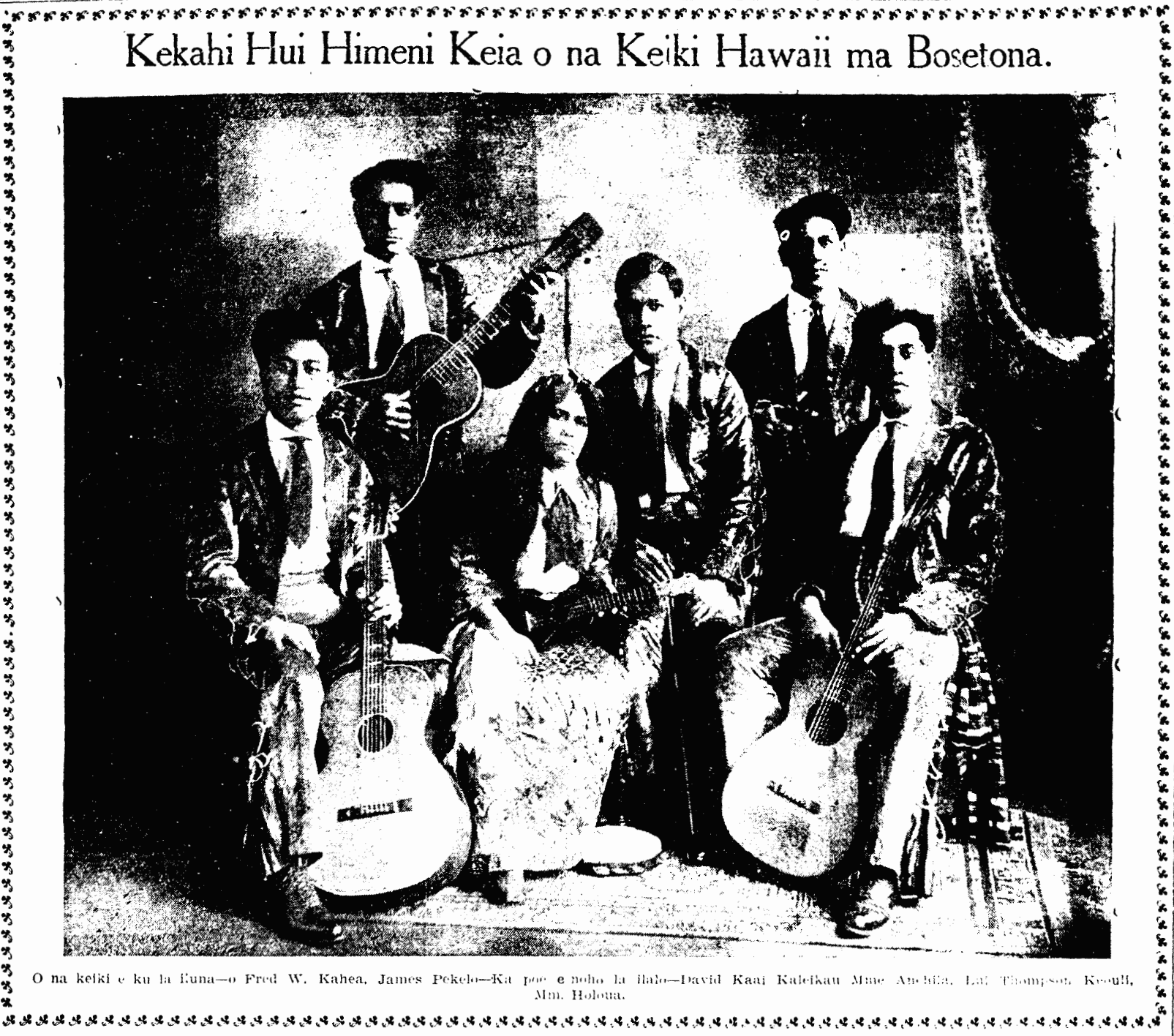
This is a Singing Group of Hawaiian Youths in Boston.

The ones standing–Fred W. Kahea, James Pekelo. Those sitting–David Kaai Kaleikau [Kaleikoa], Madame Anehila [Hobron], Lui Thompson Keouli, Monsieur [William] Holoua

[Plus check out this awesome brochure from the same time put up by the University of Iowa! The Honolulu Students from the Hawaiian Islands. Sometimes the internet is such a good thing!]

(Kuokoa 2/7/1908, p. 6)

Kekahi Hui Himeni Keia o na Keiki Hawaii ma Bosetona.

Ka Nupepa Kuokoa, Buke XLIII, Helu 6, Aoao 6. Feberuari 7, 1908.

More music—Ernest Kaai, 1906.

ERNEST KAAI LEFT ON HIS MUSICAL TOUR OF KAUAI.

Last evening, Professor Ernest Kaai of the town of Honolulu nei left for the island of Kauai along with his fellow musicians to hold concerts in the places where they will visit, and they will not be left without being welcomed by the people of Kauai.

Travelling along with him are Mrs. Nane [Nani] Alapai, the singer of the Royal Hawaiian Band; Miss Keala; Mr. Holokahiki; and John Noble, Jr., a youth skilled on the flute [hoopiopio?]. They number five in total, and they are members of that band that is moving quickly through the places they visit.

After arriving on Kauai, Lihue is the first port where they stop, and it is there that they will hold their first concert tomorrow. After that, their tour will go all the way to Koloa where they will have a concert on the coming Monday, the 6th.

Then their musical tour will move on to Eleele, where they will have a musical assembly on the next Tuesday, the 7th. From there they will arrive at Waimea, and they will open another concert on Tuesday [Wednesday] the 8th. And then onto Makaweli where they will have another concert on the next day, the 9th.

Ernest Kaai and his band mates will spend a number of days on Kauai, and when they reach Makaweli, and hold a concert there on the day shown, it is then that they will know where their tour will move to next.

On this tour, Professor Kaai has time to give benefit concerts for good causes if it will be beneficial, but this all depends on the scheduling.

Mr. Kaai is a young Hawaiian that is well known in this town among the Hawaiians and among the haole that love playing music, for the regular job of that young man is teaching music. There are many haole women and haole men and Hawaiians as well who were taught by him and graduated in music.

[If this post looks familiar to some of you, it is because I posted it some time ago on the old Hoolaupai Facebook page. I found that it is not easy to find anything on that page, so started the blog at http://nupepa-hawaii.com, where it is a whole lot easier to find posts! So I will be on occasion reposting articles so that they will be findable in one location. They will all be under the category “Repost”.]

(Kuokoa, 8/3/1906, p. 8)

UA HALA AKU O ERNEST KAAI I KE KAAHELE HIMENI NO KAUAI.

Ka Nupepa Kuokoa, Buke XLV, Helu 31, Aoao 8. Augate 3, 1906.

Kaena Song (Kuu Lei Momi), 1913

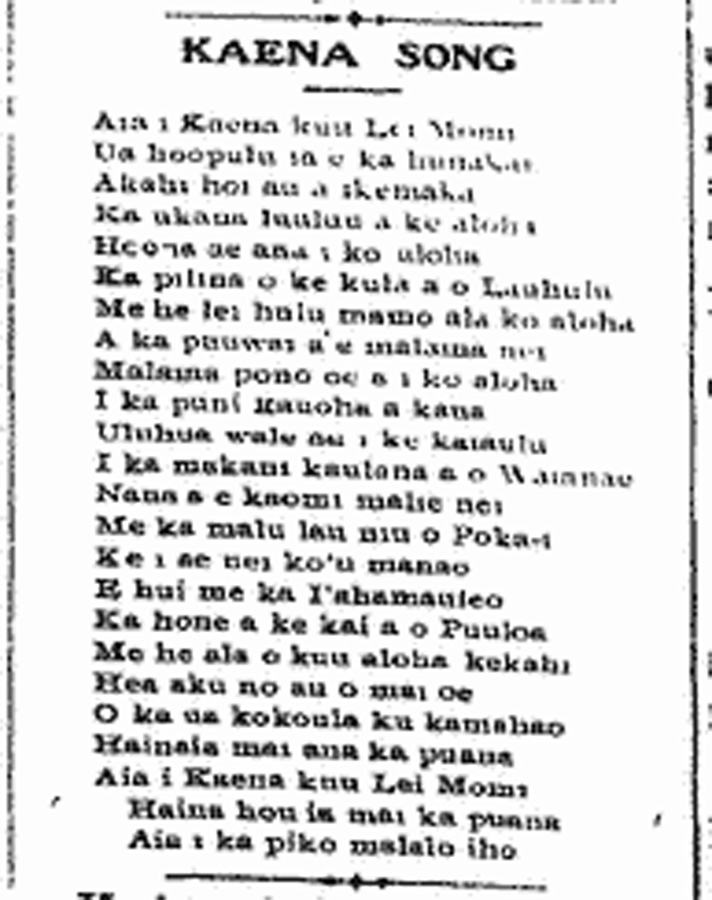
KAENA SONG

Aia i Kaena kuu Lei Momi

Ua hoopulu ia e ka hunakai

Akahi hoi au a ikemaka

Ka ukana luuluu a ke aloha

Hoona ae ana i ko aloha

Ka pilina o ke kula a o Lauhulu

Me he lei hulu mamo ala ko aloha

A ka puuwai a e malama nei

Malama pono oe a i ko aloha

I ka puni kauoha a kaua

Uluhua wale au i ke kaiaulu

I ka makani kaulana a o Waianae

Nana a e kaomi malie nei

Me ka malu lau niu o Poka-i

Ke i ae nei ko’u manao

E hui me ka I’ahamauleo

Ka hone a ke kai a o Puuloa

Me he ala o kuu aloha kekahi

Hea aku no au o mai oe

O ka ua kokoula ku kamahao

Hainaia mai ana ka puana

Aia i Kaena kuu Lei Momi

Haina hou ia mai ka puana

Aia i ka piko malalo iho

[Versions of familiar mele like this one (attributed to Samuel K. Halstead), and many others not heard today, are found all over the newspapers! There is so much that the haku mele of today can learn from them, if they would just look back…]

[A large portion of the digital images for this paper are illegible, and hopefully they will be reshot before it is too late.]

(Holomua, 12/20/1913, p. 4)

KAENA SONG

Ka Holomua, Buke I, Helu 12, Aoao 4. Dekemaba 20, 1913.