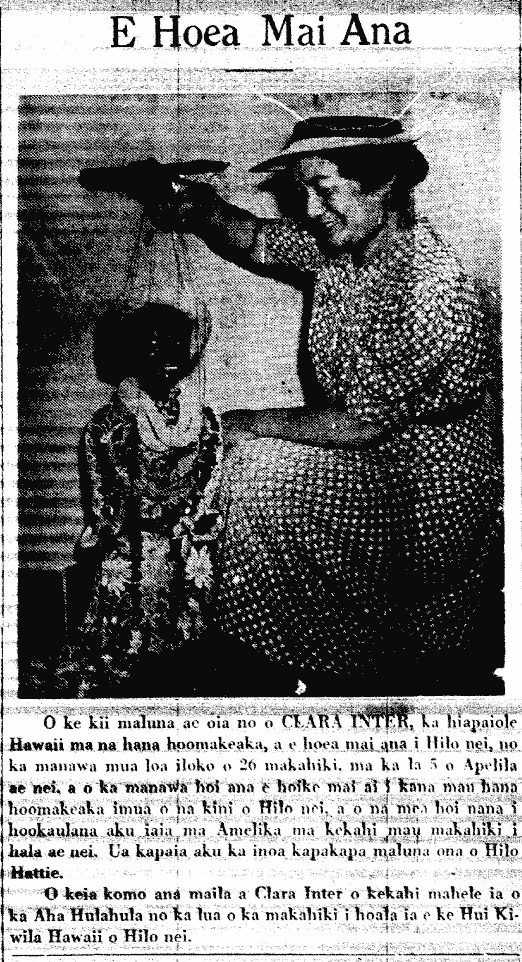
Hilo Hattie on her way to Hilo, 1941.

On Her Way

The picture above is of CLARA INTER, the Hawaiian champion of comedy, and she is coming to Hilo nei, for the first time in 26 years, on the 5th of this coming April; and this is when she will be showing her humor before the people of Hilo, and what she was made famous for in America some years ago. She is nicknamed Hilo Hattie.

Clara Inter is part of a Dance [Holoku Ball] put on for the second year by the Hawaiian Civic Club of Hilo [Hui Kiwila Hawaii o Hilo].

(Hoku o Hawaii, 3/26/1941, p. 1)

E Hoea Mai Ana

Ka Hoku o Hawaii, Volume XXXV, Number 48, Aoao 1. Maraki 26, 1941.

Iolani Palace open to the public, 1938.

The Crown Room of Iolani Palace Opened

This is the only Crown Room in the United States of America, and it is a reminder of the days when it was under the rule of the kings and queens of Hawaii nei. The appearance of the crown room these days is like that of the times of the monarchs.

This past week, the crown room of the Iolani Palace was opened once again, and it was opened to the public; Governor Poindexter and Secretary Hite [of the Citizens’ Council] opened the doors of that crown room. There were many who arrived there for the opening.

Amongst the chants [na olioli ame na kanaenae] of the ancient Hawaiians, there were eyes misted with tears with memories of the days of the monarchy, and there was also the sweet sound of the Royal Hawaiian Band [Bana Hawaii]; there were hundreds of people lined up in the only crown room in all the United States. This tour was led by Mrs. Eugenia Reis, moi of the Daughters and Sons of Hawaiian Warriors, and in attendance were the members of her association and seven other Hawaiian associations. Continue reading

Words of praise for C. R. Bishop on today, his birthday, 1896.

MEMORIALS.

….¹

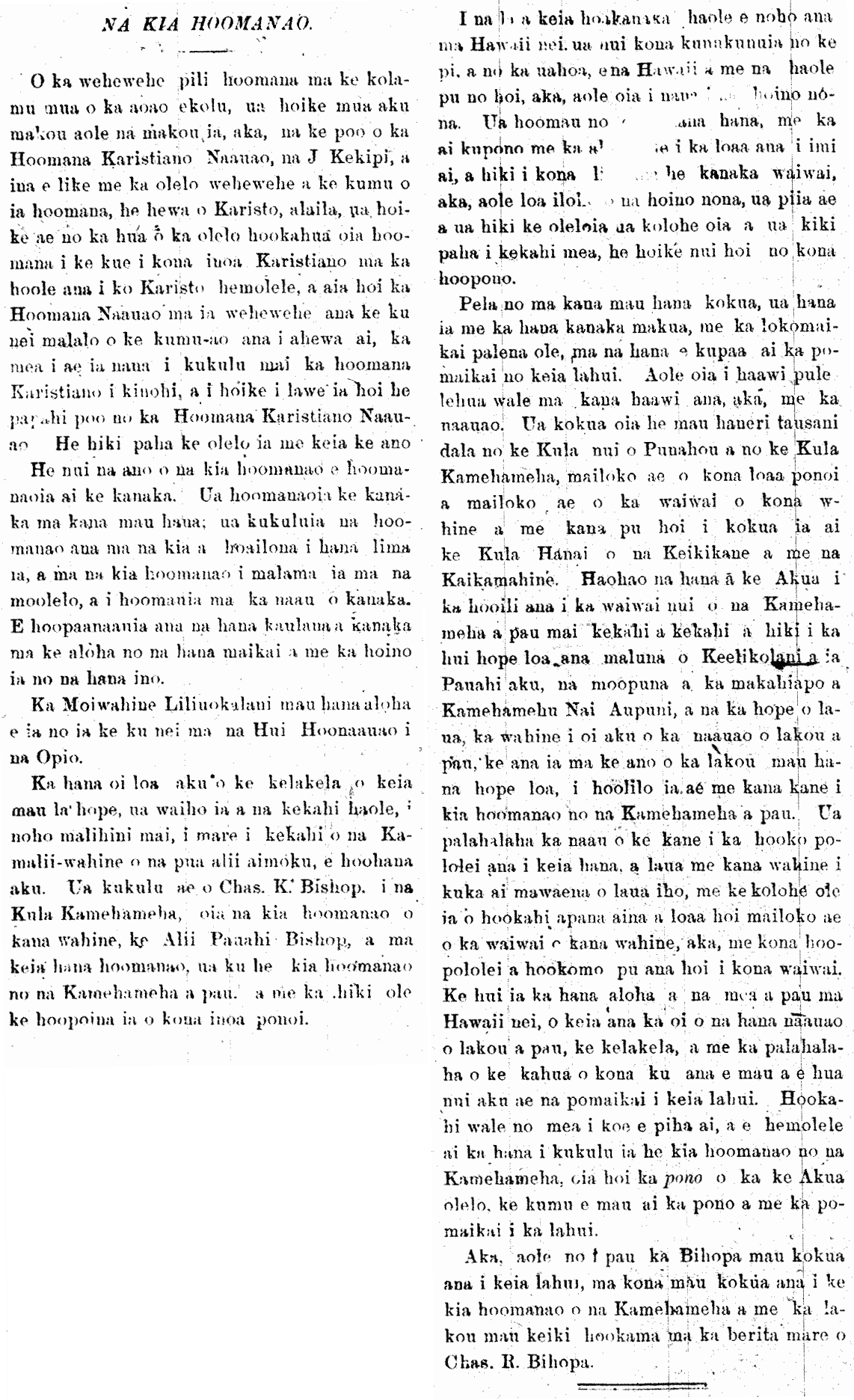
There are many kinds of memorials [kia hoomanao] to remember people by. A person is remembered for his deeds, in memorials built as pillars and monuments, in reminiscences, and preserved in the hearts of the many. Famous deeds of people are remembered with aloha for the good, and with scorn for the bad.

Queen Liliuokalani’s beloved efforts stand today as the Hui Hoonaauao i na Opio [Liliuokalani Educational Society].

The epitome of great deeds of these past days was done by a haole who lived here as a malihini and married one of the Princesses amongst the royal youth. Charles R. Bishop built the Kamehameha Schools, the memorial for his wife, the Alii Pauahi Bishop; and by this act of commemoration, a memorial now stands for all of the Kamehamehas, and it is impossible to forget their name.

 In the days when this haole friend was living here in Hawaii, he was often criticized for his stinginess and defiance by Hawaiian and haole alike, but he paid no care to this criticism. He continued with his work, ate healthily, [illegible digital image], until he was a rich man; but in all the criticism for him, there is no way that it could be said that he was a scoundrel or that he cheated someone; and this says a lot for his uprighteousness.

Likewise with his charity work, he acted with maturity and kindness without end in his steadfast support for the benefit of this lahui. In giving, he was not frivolous in his giving, but gave wisely. He donated hundreds of thousands of dollars to the Punahou College and to the Kamehameha Schools, from his own estate and from that of his wife’s; and from his own, also benefited were the Boarding School for  Boys and Girls. How wondrous is God in his passing down the great entire wealth of the Kamehamehas from one to another until it all came down to Keelikolani and then to Pauahi, the grandchildren of the first born of Kamehameha Nai Aupuni; and it was the last of the two, the one most knowledgeable of them all, as measured by their final deeds, which she created with her husband as a memorial for all of the Kamehamehas. This man was of a great mind in his carrying out meticulously this work which he and his wife discussed between themselves, without misappropriating a single parcel of land included in the estate of his wife, but instead he was conscientious and included his own estate. When put together with all the other beloved deeds by everyone in Hawaii nei, this is measured as the most wise of them all, the height and breadth of its foundation will go on and bear forth much benefits for this lahui. There is but yet one thing to complete and to perfect the building of this memorial to the Kamehamehas, that being the righteousness of God’s words, the basis upon which the good and the blessings of the lahui will continue.

But Bishop’s help for our people is not done in his continued assistance to the memorial to the Kamehamehas and their foster children [keiki hookama] in the covenant of marriage of Charles R. Bishop.

¹The first paragraph was left out because it was somewhat irrelevant to this particular post, and was commentary on J. Kekipi and the Christian Science [Hoomana Karistiano Naauao] faith.

(Oiaio, 2/21/1896, p. 2)

NA KIA HOOMANAO.

Ka Oiaio Puka La, Buke I, Helu 37, Aoao 2. Feberuari 21, 1896.

150 years ago—The beginnings of the Kaahumanu Society, 1864.

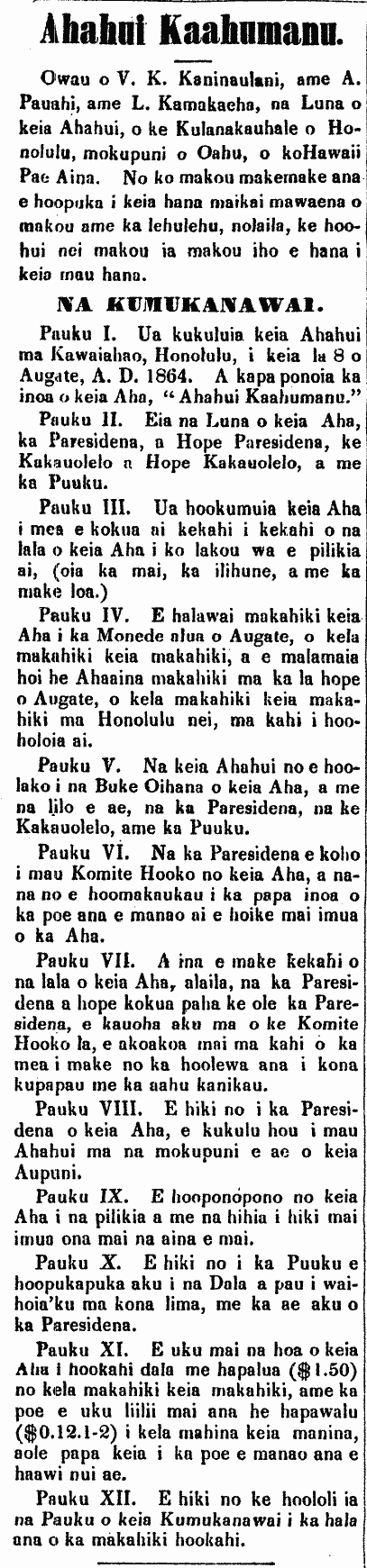
Ahahui Kaahumanu.

I am V. K. Kaninaulani, along with A. Pauahi,¹ and L. Kamakaeha, are the Officers of this Association, of the Town of Honolulu, Island of Oahu, of the Hawaiian Archipelago. Because of our desire to announce this fine endeavor amongst ourselves and the people, we come together to undertake these tasks.

CONSTITUTION.

Clause I. This Association was established at Kawaiahao, Honolulu, on this day the 8th of August, 1864. This Association is officially called, “Ahahui Kaahumanu.”

Clause II. The Officers of this Association are the President, the Vice President, the Secretary, the Vice Secretary, and the Treasurer.

Clause III. This Association was established to assist each other member of this Association when they are in need (in sickness, poverty, and death)

Clause IV. The yearly meeting of this Association will be on the second Monday of August of each year, and a yearly Banquet will be held on the last day of August every year in Honolulu nei, at the location designated.

Clause V. The Association will supply Record Books [Buke Oihana] of the Association, as well as any other expenses for the President, Secretary, and the Treasurer.

Clause VI. The President will select Executive Committees for this Association, and they will prepare lists of names of those who want to present themselves before the Association.

Clause VII. Should a member of this Association die, then the President or if not the President, then a representative will order by Executive Committee to gather in mourning attire at the place of the deceased for the funeral over her body.

Clause VIII. The President of this Association is empowered to establish other Associations on the other islands of this Nation.

Clause IX. The Association shall resolve all problems and difficulties brought before it from other lands.

Clause X. The Treasurer may expend all funds at her disposal with the approval of the President.

Clause XI. Members of this Association shall pay a dollar and a half ($1.50) yearly, or installments of an eighth ($0.12.1-2) every month; it is not prohibited to give more.

Clause XII. Clauses of this Constitution may be changed after one year.

¹Pauahi is often referred to as A. Pauahi. [Would there be anyone who knows what that initial stands for?]

(Kuokoa, 8/20/1864, p. 4)
Ahahui Kaahumanu.

Ka Nupepa Kuokoa, Buke III, Helu 34, Aoao 4. Augate 20, 1864.

Daughters of Hawaii celebrate 90th birthday of Elizabeth Kekaaniau, 1924.

ANNOUNCEMENT.

Daughters of Hawaii.

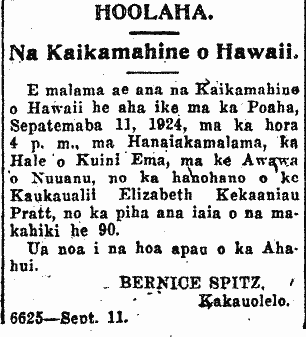
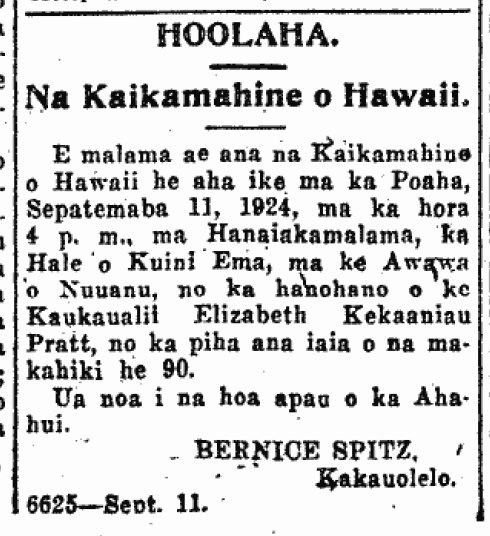
The Daughters of Hawaii will hold a reception on Thursday, September 11, 1924, at 4 p. m., at Hanaiakamalama, the Home of Queen Emma, in Nuuanu Valley, to honor the Kaukaualii Elizabeth Kekaaniau Pratt, for her 90th birthday.

Open to all members of the Association.

BERNICE SPITZ.

Secretary.

(Kuokoa, 9/11/1924, p. 6)

HOOLAHA.

Ka Nupepa Kuokoa, Buke LXIII, Helu 37, Aoao 6. Sepatemaba 11, 1924.

Beginning of the Daughters of Hawaii, 1903.

DAUGHTERS OF HAWAII.

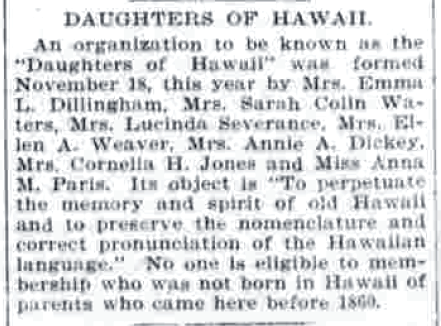
An organization to be known as the “Daughters of Hawaii” was formed November 18, this year by Mrs. Emma L. Dillingham, Mrs. Sarah Collin Waters, Mrs. Lucinda Severance, Mrs. Ellen A. Weaver, Mrs. Annie A. Dickey, Mrs. Cornelia H. Jones and Miss Anna M. Paris. Its object is “To perpetuate the memory and spirit of old Hawaii and to preserve the nomenclature and correct pronunciation of the Hawaiian language.” No one is eligible to membership who was not born in Hawaii of parents who came here before 1869.

[I had a nice time at Queen Emma Summer Palace yesterday. They have a new exhibit called “Kiakahi,” dealing with the Queen’s travels abroad. Here is one of the first articles mentioning the Daughters of Hawaii found in the English newspapers. There are many more interesting accounts which can be found at http://chroniclingamerica.loc.gov/ and by choosing Hawaii as the state and using the search term “Daughters of Hawaii” (in quotations).]

(Hawaiian Star, 12/7/1903, p. 7)

DAUGHTERS OF HAWAII.

The Hawaiian Star, Volume XI, Number 3654, Page 7. December 7, 1903.

A public event at Hanaiakamalama, 2013.

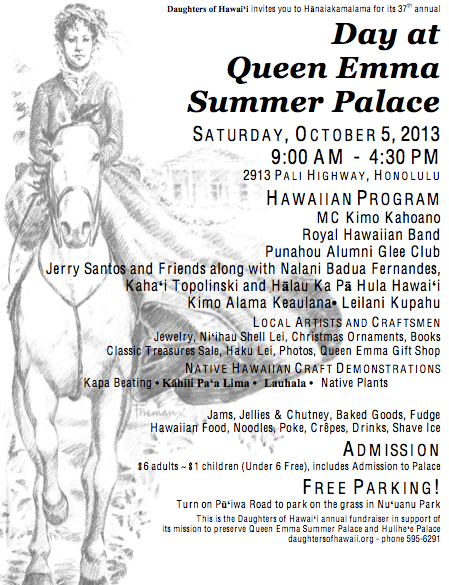
Day at Queen Emma Summer Palace

Although the party held 89 years ago was only open to the members of the Daughters of Hawaii, the event this Saturday, October 5, 2013, is open to one and all. Queen Emma Summer Palace is under the care of the Daughters of Hawaii. It seems like it will be a great event with proceeds going to the organization. Let’s give them support for their care of this historic home of Ke Alii Kaleleonalani as well as Hulihee Palace in Kona!!

Check out our various posts on the Daughters of Hawaii!]

Day at Queen Emma Summer Palace

Day at Queen Emma Summer Palace

Daughters of Hawaii and Hanaiakamalama, 1924.

ANNOUNCEMENT.

Na Kaikamahine o Hawaii.

The Daughters of Hawaii will hold a social, this Thursday, September 11, 1924, at 4 p. m., at Hanaiakamalama, the Home of Queen Emma, in Nuuanu Valley, to honor the honorable Kaukaualii Elizabeth Kekaaniau Pratt, for her 90th birthday.

This is open to all the member of the Association.

BERNICE SPITZ,

Secretary.

(Kuokoa, 9/11/1924, p. 6)

HOOLAHA. Na Kaikamahine o Hawaii.

Ka Nupepa Kuokoa, Buke LXIII, Helu 37, Aoao 6. Sepatemaba 11, 1924.

More on the Wahiawa “healing stones,” 1927.

THE SUPERNATURAL ROCKS WILL BE LEFT IN THEIR PLACE.

At the meeting of the Daughters of Hawaii last week Wednesday in the Home of Queen Emma Kaleleonalani in Nuuanu, the association decided not to move the “Healing Stones” from where the two stand in Wahiawa; they made no decision to perhaps not move them for a time between three and six months and after that time, to take up again the question of those rocks.

When ayes and nays were asked for per the request explained earlier by Mrs. Julie Judd Swanzy and added to with small changes made by Mrs. F. A. Potter, there were three members who were opposed to the changes.

The decision by the association agreed upon that day, was in accordance with the decision by the President of the Board of Health, F. E. Trotter, that there would be no action upon on the matter of the rocks and that they’d be left where they stand now without being moved. With this decision by the Daughters of Hawaii, the ones who have responsibility over the rocks, dashed was the hope and request of 400 citizens of Wahiawa made to this association in a petition to remove the rocks from Wahiawa.

Another subject considered and decided upon by the association was this: there shall be no monuments built upon heiau. At that meeting, announced were pledges of $588, and cash donations of $1712, and funds of $341.72 for the restoration of that palace in Kailua, Kona, Hawaii [Hulihee].

Because of the rumor that the enthusiasm over the healing powers of the rocks are dwindling, which was known because less people go to worship the stones and because of less donations, this is the reason for the postponement by the association on action to be taken in regard to the rocks, with their belief that perhaps in a short few months the craze of the people over worshiping them will decrease drastically.

At that meeting of the association, there were many letters read by the President, Mrs. Swanzy, in front of the members gathered there, from different people dealing with the stones.

One of these letters was a petition by 400 people of Wahiawa asking to remove these rocks from there; three of the people who signed their names to the document asked that their names not be publicized and to take out their names from the list; there was a letter against the moving of the rocks to the Bishop Museum, where the stones would just be a “Collection” there; in another letter, it was asked to move the rocks to an area near the new road in Koko Head.

Mrs. Charles Clark asked to return these stones to the grounds of Kukaniloko; her idea was opposed by the majority of the members for the reason that the ancient history of these stones have nothing to do with the history dealing with the alii born at Kukaniloko, and therefore, it is not right to move them there. The rocks were moved to Kukaniloko at the order of Galbraith, because he thought they might be broken up where they stood beneath the stream.  The association does not want to return the stones there; they have been something much cared for by the Filipinos and others, and other stones of Kukaniloko have been cracked because of candles placed upon them, and the grounds are full of rotting fruits and flowers; and seeing those things which marred the beauty of the area was why they were moved to where they stand now. Those stones will not be considered again for return to Kukaniloko.

As for the $3000 in the bank, it is from donations made by people who went to worship the stones, but the association has not agreed to take a cent of the money, but it will instead be appropriated for use for works benefiting the people of Wahiawa.

(Kuokoa, 11/24/1927, p. 4)

E WAIHOIA ANA NO NA POHAKU KUPUA MA KO LAUA WAHI.

Ka Nupepa Kuokoa, Buke LXVI, Helu 52, Aoao 4. Novemaba 24, 1927.

Lei o Kaahumanu, 1916.

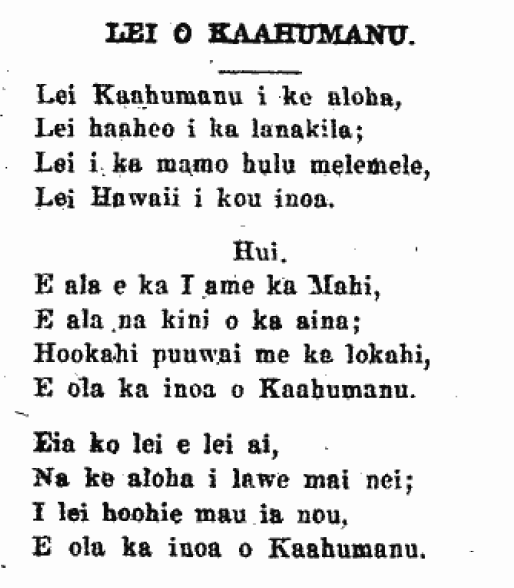
LEI O KAAHUMANU.

Lei Kaahumanu i ke aloha,
Lei haaheo i ka lanakila;
Lei i ka mamo hulu melemele,
Lei Hawaii i kou inoa.

Hui:

E ala e ka I ame ka Mahi,
E ala na kini o ka aina;
Hookahi puuwai me ka lokahi,
E ola ka inoa o Kaahumanu.

Eia ko lei e lei ai,
Na ke aloha i lawe mai nei;
I lei hoohie mau ia nou,
E ola ka inoa o Kaahumanu.

LEI OF KAAHUMANU.

Kaahumanu is adorned with a lei of aloha,
A proud lei in victory;
Adorned with the yellow-feathered mamo,
Hawaii is adorned by your name.

Chorus:

Rise, O I and Mahi,
Rise, O People of the land;
With one heart and in unity,
May the name of Kaahumanu live.

Here is the lei for you to wear,
Carried here by aloha;
It is an ever distinguished lei for you,
May the name of Kaahumanu live.

(Kuokoa, 12/29/1916, p. 2)

LEI O KAAHUMANU.

Ka Nupepa Kuokoa, Buke LIV, Helu 52, Aoao 2. Dekemaba 29, 1916.