Missionary Manuel Antone, aka Manuela Pukiki, 1866

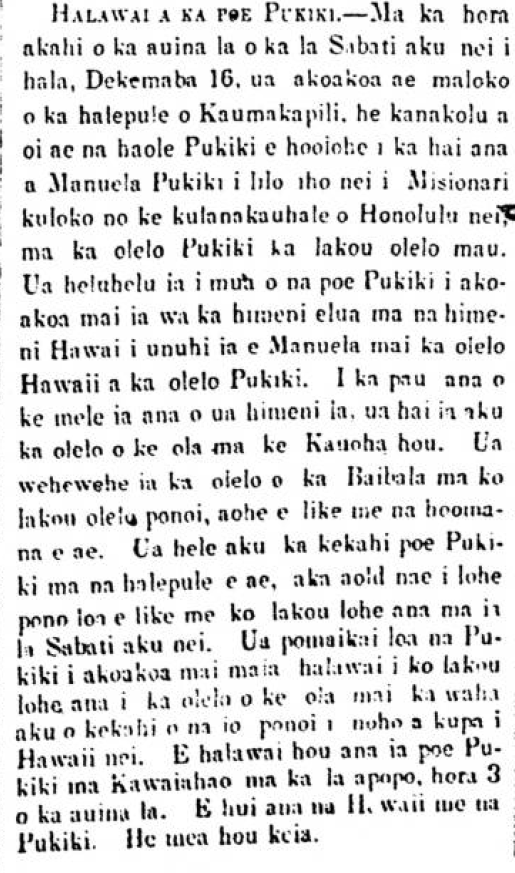
Meeting of the Portuguese.–At one in the afternoon of this past Sunday, December 16, thirty or more haole Pukiki gathered in Kaumakapili Church to hear the talk of Manuela Pukiki who just became a local missionary for the town of Honolulu. They generally speak in Portuguese. Read before the Portuguese gathered at that time were two hymns translated by Manuela from Hawaiian to Portuguese. When the hymns were done being sung, the word of life was told from the New Testament. The words of the Bible were explained to them in their own language, not like the other religions. Some of the Portuguese have gone to other churches, but they did not listen carefully like the did this past Sunday. The Portuguese who got together at that gathering were blessed to have heard the words of life from the mouth of one of their own flesh who have lived until familiar with Hawaii nei. The Portuguese will meet again at Kawaiahao tomorrow at 3 in the afternoon. The Hawaiians and the Portuguese are meeting together. This is something new.

(Kuokoa, 12/22/1866, p. 3)
Ka Nupepa Kuokoa, Buke V, Helu 51, Aoao 3. Dekemaba 22, 1866

Daughter of the Bishop of Honolulu Baptized, 1865

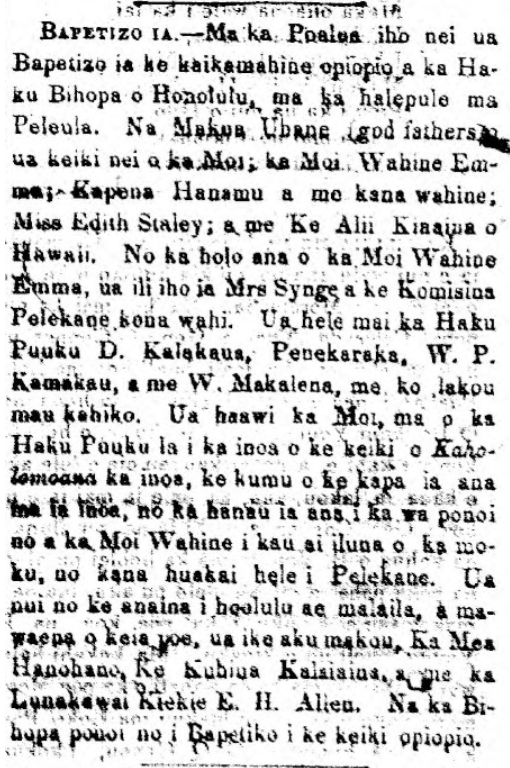
Baptized.–This past Tuesday, the young daughter of the Lord Bishop [Staley] of Honolulu was baptized at the church at Peleula. The god parents of the child are the King, Queen Emma, Captain Hanham [Kapena Hanamu], and his wife; Miss Edith Staley; and the Governess of Hawaii [Keelikolani]. Because Queen Emma was travelling, her part was assumed by the wife of the British Commissioner, Mrs. Synge. The Lord Chamberlain D. Kalakaua, Penekaraka [Prendergast], W. P. Kamakau, and W. Makalena attended in their finery. The King, through the Lord Chamberlain gave the child the name Kaholomoana. The reason she was given that name, because she was born at the exact time the Queen boarded the ship to go on her trip to Britain. There was a large crowd gathered there, and among them we saw His Excellency the Minister of the Interior [Hutchison], and Lord Chancellor E. H. Allen. The Bishop himself baptized the young child.

(Au Okoa, 6/19/1865, p. 2)

Ke Au Okoa, Buke I, Helu 9, Aoao 2. Iune 19, 1865.

Rev. William Hoapili Kaauwai

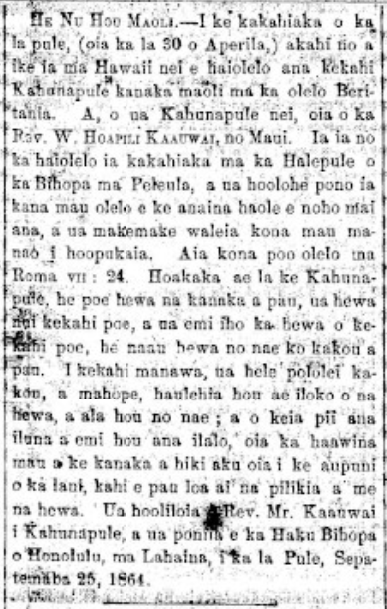
Real News–On Sunday morning (that being the 30th of April), there was seen here in Hawaii nei for the first time, a Hawaiian reverend preaching in English. And that reverend is Rev. W. Hoapili Kaauwai, from Maui. While he was preaching on that morning at the Anglican Church at Peleula, the haole congregation there was listening carefully, and the ideas he expressed were greatly appreciated. His topic was from Romans VII:24. The reverend clarified that all people are sinners; some are very sinful while other are less; but we all have sinful hearts. Sometimes we go straight, and thereafter we fall into sin, yet we rise up again; and this getting up and falling back down is something all people do until they reach the nation of heaven, where all troubles and sins are no more. Rev. Mr. Kaauwai became a reverend, and he was ordained by the Lord Bishop of Honolulu [Thomas Nettleship Staley], at Lahaina, on Sunday, September 25, 1864.

[This William Hoapili Kaauwai wrote a lengthy autobiography of his travels around the world. “Ka Moolelo no ka Makaikai ana a Puni ka Honua, i Kakauia e William Hoapili Kaauwai.” It appears in the Kuokoa from 8/29/1868 and abruptly stops on 1/9/1869. On 1/30/1869, in the article, “He mau olelo hoakaka,” explained is that Kaauwai returned to Wailuku with promises to continue writing from there.]

(Au Okoa, 5/8/1865, p. 3)

Ke Au Okoa, Buke I, Helu 3, Aoao 3. Mei 8, 1865.

Death of Doreka Kaholua, aka Doreka Opunui, 1869.

Found under: “NU HOU KULOKO.: Oahu.”

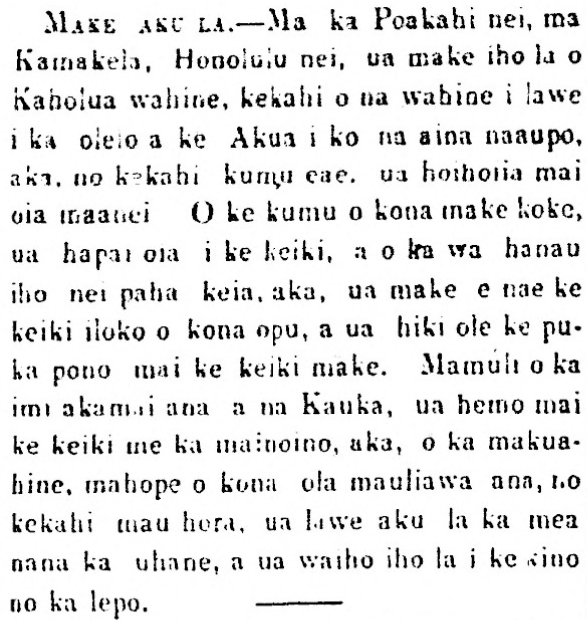
Died.–This past Monday, at Kamakela, here in Honolulu, Kaholua wahine, one of the women who took the word of God to the ignorant lands, but for other reasons she was returned here. The cause of her quick death was that she was pregnant, and perhaps it was while she was giving birth, the baby died within her belly, and the dead baby could not come out. Because the doctors’ skillful attempts, the child was expelled disfigured, but as for the mother, after she gasped for life for some hours, the one who belongs the soul took hit away, and left the body behind for the earth.

(Kuokoa, 9/18/1869, p. 3)

Ka Nupepa Kuokoa, Buke VIII, Helu 38, Aoao 3. Sepatemaba 18, 1869.

Another account:

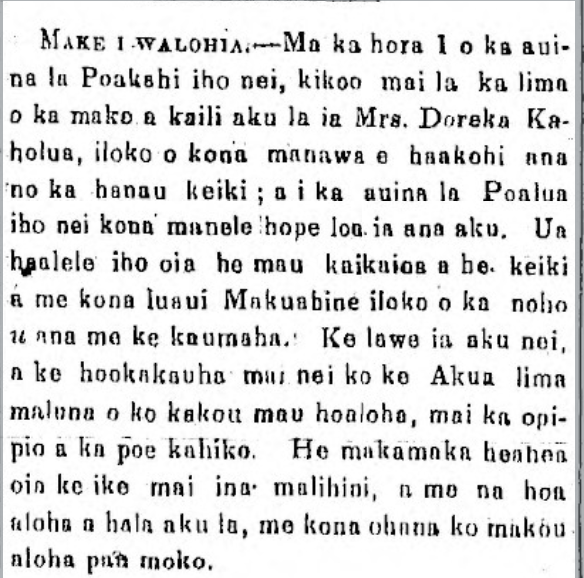
A Sorrowful Death.–At 1 o’clock in the afternoon, this past Monday, the hand of death reached out and snatched Mrs. Doreka Kaholua while she was bearing down giving birth; and on Tuesday afternoon she was carried away for all times. She left behind a number of younger siblings and a child, and her birth mother who grieve for her. God’s hand stretches out above our friends, from the young to the old. She was a welcoming host, should she see a stranger or friends, until she passed. With her family goes our sympathy.

(Au Okoa, 9/16/1869, p. 2)

Ke Au Okoa, Buke V, Helu 22, Aoao 2. Sepatemaba 16, 1869.

Did you see Bishop Museum’s He Aupuni Palapala blog the other week about Hawaiians in the Marshall Islands? See more about the Daniela and Doreka Opunui. Click here.

What should and should not be printed in the newspapers, 1864.

South Kona, Hawaii
12 of December, 1864.

Rev. L. H. Gulick; Aloha oe:–

At the meeting of church leaders here in South Kona, on the 9th of this month, I was selected as the Committee to write to you about some opinions decided upon by that assembly, pertaining to the newspaper you are thinking to publish. And here are those opinions:

First. They discussed with much consideration words that are appropriate to publish in the Kuokoa Newspaper, and those that are improper. And they believe it is not proper to publish Hawaiian mele in the newspaper. They believe that by publishing mele in the newspaper, it will lead the young ones of the lahui toward its old ways. Being that some mele published in Whitney’s Kuokoa ; the extremities of this nation have much delight in those mele, and they are memorized by the youth; just like this mele:

“O Kilauea no ke aloha,
O ka ihu lolilua i ka ale.”

Kilauea is beloved,
Its prow unstable on the billows.”

And so forth, and there are many mele of that nature.

Second. The Assembly believes it is improper to publish certain local news of Hawaii nei, such at this. People start to hula on Kauai, and someone there sees this and announces it in the newspaper. That announcement to them is something inappropriate to print in the newspaper. It will give people living on the other islands the idea to imitate this behavior.

But they consider it is proper to print in the newspapers should hula practitioners from this location or that location be punished under the law.

Third. The Assembly believes that fighting words and filth should not be constantly printed in the newspaper–That is what they decided to report to you through me.

Aloha olua,
J. W. Kupakee, Committee.

(Kuokoa, 12/24/1864, p. 5)

Ka Nupepa Kuokoa, Buke III, Helu 52, Aoao 5. Dekemaba 24, 1864.

[Found under: “KA MOOLELO O NA KAMEHAMEHA. Na S. M. Kamakau.”]

The year 1828 was famous for Kaahumanu going to Hawaii and retrieving Lilinoe on Mauna Kea, who was an ancient woman; a thousand and more years she was left on the mountain of Mauna Kea, according to her sworn statement. It was said that Lilinoe remained with body unspoiled, her hair remained affixed and had not fallen out. And should you want to see her descendants, they can be found by way of Huanuiikalailai; she became a kupuna of the alii, and came forth was Umiokalani, the son of Keawenuiaumi and Hoopiliahoe. But it was stated that Lilinoe was not found by Kaahumanu and that she was hidden away. Liloa, Lonoikamakahiki, Kauhoa, and Lole are the only ones who were found by Kaahumanu at Waipio, and they were brought to Kaawaloa. The alii in Hale o Keawe were from the ancestral chiefs to Kalaniopuu and Kiwalao. Hale o Keawe was filled with the bones of the alii, they were arranged and secured in kaai. They were taken to Kaawaloa and a majority of them were burned in fire. That is a very wicked example in Boti’s mind.

Here is another, Kaikioewa was indebt to Mikapalani [William French], that being the haole trader; the other alii were greatly indebted to him, but in his transactions he was a haole who was beyond reproach. The sandalwood that was thrown away by some haole traders were purchased by Mr. French, and therefore he was also called by the name Hapuku because of he indiscriminately gathered [hapuku] the white sandalwood as well as the very small branches, and he was relied upon by the alii and greatly liked; therefore, the alii were much indebted to him. Kaikioewa was one who was indebted, and because he had no sandalwood to pay his debt, therefore Kaikioewa paid his debt with the land of Kawalo [Kewalo] and Kulaokahua which went to Mr. French. So Mr. French prepared to build wooden structures at Kulaokahua adjacent to Waikiki where the Olohe sank.

(Kuokoa, 6/13/1868, p. 1)

Ka Nupepa Kuokoa, Buke VII, Helu 24, Aoao 1. Iune 13, 1868.

Death of Panio French, 1880.

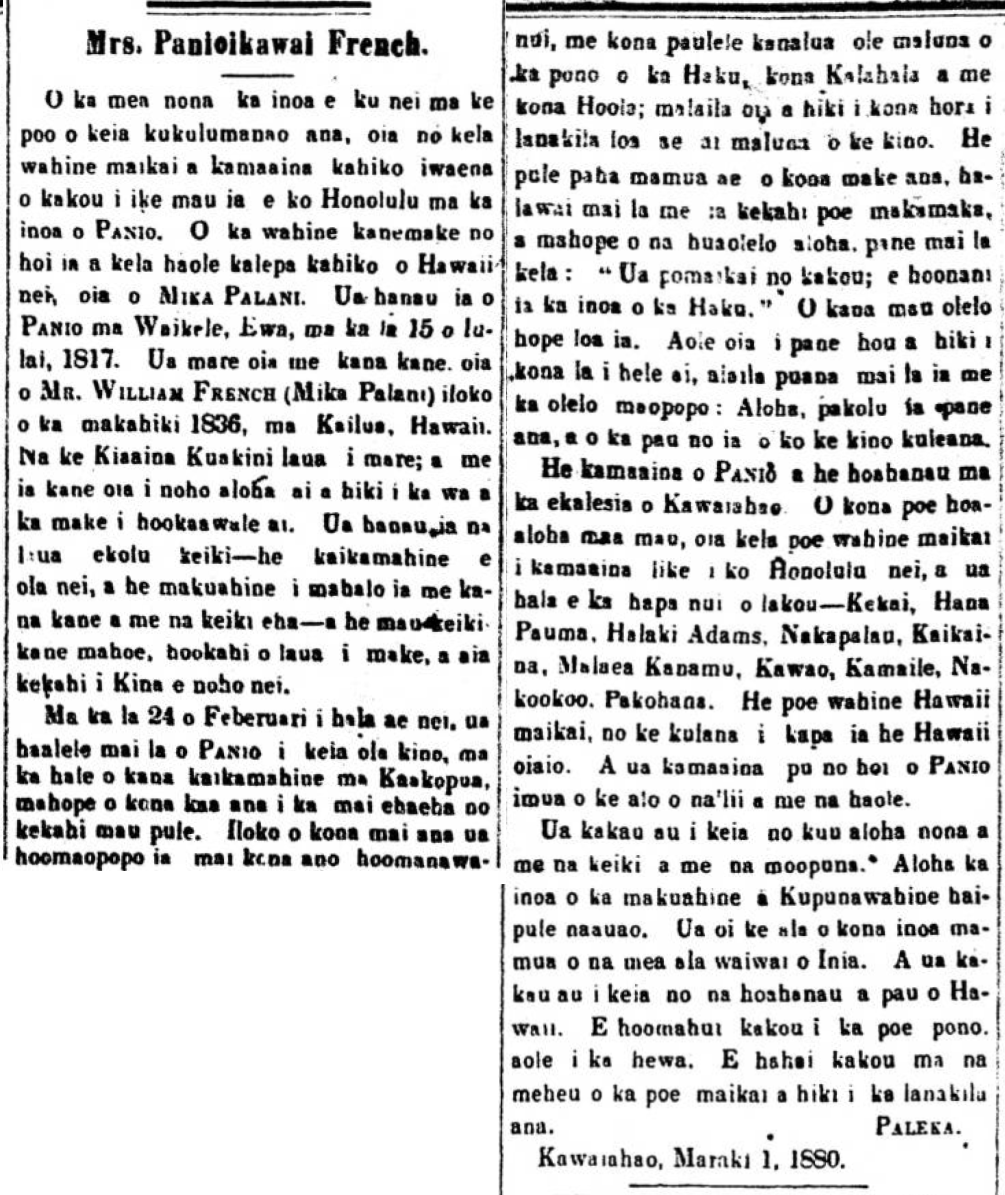
Mrs. Panioikawai French.

The one whose name appears at the title of this essay, is that fine woman and old time familiar one amongst us who was always known by Honolulu’s people by the name of Panio. She was the widow of that old haole trader of Hawaii nei, that is Mika Palani. Panio was born in Waikele, Ewa, on the 15th of July 1817. She was married to her husband, Mr. William French (Mika Palani) in the year 1836 at Kailua, Hawaii. Governor Kuakini was the one who married the two; and she lived together with her husband until death separated them. They had three children–and a daughter survives today; she is a mother who is respected along with her husband and their four children–there are twin boys, one who has died, and the other lives in China.

On this past 24th of February, Panio left this bodily life, at the residence of her daughter at Kaakopua, after being confined with a painful sickness for several weeks. While sick, her patient nature was apparent, along with her unwavering faith in the righteousness of the Lord, her Savior and her Salvation; and there she remained until her hour in which she was victorious over her body. There perhaps was a prayer before her death; met with her were some friends, and after words of aloha, she responded: “We are blessed; praised be the name of the Lord.” Those were her very last words. She did not say anymore until the day she left, when she said clearly: “Aloha,” three times and her bodyʻs function was over.

Panio was a familiar and a brethren of Kawaiahao Church. Her constant friends were the fine women who were also kamaaina to the people of Honolulu, and most of them have passed on–Kekai, Hana Pauma, Halaki Adams, Nakapalau, Kaikaina, Malaea Kanamu, Kawao, Kamaile, Nakookoo, Pakohana. They are fine Hawaiian women of the stature referred to as a true Hawaiian. Panio was also a kamaaina in the presence of the alii as well as the haole.

I wrote this down because of my aloha for her and her children and grandchildren. Aloha for that mother and grandmother of devout heart. Her name is more perfumed than the costly perfumes of India. And I write this for all of the brethren of Hawaii. Let us emulate the righteous and not the sinful. Let us follow the footsteps of the good until we overcome.

Paleka.
Kawaiahao, March 1, 1880.

(Kuokoa, 3/6/1880, p. 4)

Ka Nupepa Kuokoa, Buke XIX, Helu 10, Aoao 4. Maraki 6, 1880.

Hawaiian Language in 1918.

Is It Right to Neglect Our Mother Tongue?

To the Editor of the Kuokoa Newspaper; Aloha oe:–I ask of your graciousness in allowing me to clarify my thoughts on the title that appears above; I believe this title will become something that will motivate some of our people to also submit their thoughts [to be published] on that topic, that being: “Is it right to neglect our mother tongue?”

I bring up that question in regard to the Hawaiian language, the mother tongue of this lahui, because I see with these passing days, it is as if it is actually true, that there is no desire or wish within us to perpetuate our language to the very last generation of Hawaiians.

Continue reading

John Wind enrolls into Wailuku Theological School, 1866.

[Found under: “HUNAHUNA MEA HOU O HAWAII NEI.”]

A foreigner learning to become a pastor.—In a letter secretly received by one of us, the writer said that an Indian enrolled in the Wailuku Theological School, and that he is a stranger. His name is Ioane Makani. We have admiration for the great desire of this stranger to gain knowledge of the occupation of a pastor, and it would appear that he will most definitely return to teach his Indian People who live wild in the forests of America.

[John Wind is reported to have attended Royal School. And from there it seems he was admitted to the preparatory department of Oahu College, as per a PCA 8/26/1858, p. 2 article.]

(Kuokoa, 7/7/1866, p. 2)

Ka Nupepa Kuokoa, Buke V, Helu 27, Aoao 2. Iulai 7, 1866.

Kamehameha Day, a Hundred Years Ago, 1922.

The Day of the Nation Conqueror, Kamehameha I.

This coming Sunday, the 11th of June, is Kamehameha Day. This day is regularly celebrated as the birthday of the Nation Conqueror Kamehameha I here in Hawaii. And this regular celebration is what we will do this year.

It is a usual thing for all the Hawaiian associations to hold a memorial service for the one for whom this important holiday is, on the Sunday preceding the 11th of June. But this year that day falls on a Sunday, so it is appropriate that the memorial activities be carried out with sincerity and maturity by us this year.

Continue reading