25th Annual Kamehameha Schools Luau, 1912.

KAMEHAMEHA STUDENTS AT LUAU

For the twenty-fifth time, the Kamehameha Schools held a luau on the night of last Saturday, and a great number of Kamehameha Schools graduates: boys with their wives, and so too girls with their husbands; and it was a time for the old people to get acquainted with the new, and a time to rejoice, and to listen to the speeches prepared, and the main thing was the feasting on tables weighted down with foods prepared by the students of the school.

In attendance were the teachers of the schools, some of the trustees, and a few invited malihini; they ate heartily, and there was leftover for those who prepared it [?], and everyone went home at the proper time with pleasant thoughts on what was seen that night.

After stomachs [ka lua o ka inaina] were filled, everyone enjoyed some songs from the boys of Kamehameha, and also from the girls, and the Honolulu band, then the speeches of the night were heard.

From the school, President Horne gave the first speech, that is, he gave his thanks for the gathering of the students on that night, which was something that the school was happy about, that the students of Kamehameha always come back to see the school which educated them.

According to him, in learning from the students how they are living, that being not going into debt; each of them are have still gone in debt; they are indebted to the Kamehameha School, and the benevolence of Bernice Bishop, the one who founded this school.

Following him, Faxon Bishop was called, and he explained the falsity of what he heard about the lack of advancement of those who graduated from the school.

There have been many things which he has heard about the children of Kamehameha after they leave the school, and to put an end to his misconceptions, he instructed the principal, Mr. Horne, to supply him with the roster of all students who graduated from the school, along with their occupations; and when he saw the list, he exclaimed about the falsehood of all that he had heard.

From amongst the 261 students who graduated from the school, he separated them into their current occupations, along with those deceased and those whose occupations are not known. These are the students of Kamehameha by their different occupations which benefits their lives as well as that of their families.

From within the great number of children who graduated, 63 of them are working in skilled labor; 50 are in secretarial, bookkeeping, or office work; 20 have deceased; 18 are in the teaching profession; 17 farmers; 10 in singing; 9 in the postal service; 7 with the street cars; 7 in the police force; 6 of them are ranked deputy sheriff; 6 are architects [kahakii]; 6 at the custom house [kukeawa]; 4 in roadwork; 3 in the army or navy; 3 drivers; 2 in law school; 2 newspaper editors; 2 stevedores; 2 in the board of health; 2 are day laborers [limahana hana la]; 2 are ticket agents; 1 is the head of the jail; 1 undertaker; 1 bank employee; 1 pastor; 1 lighthouse keeper; 1 head of a store; 1 at Kalihi Camp; and as for those whose occupations are unknown, there are 4.

By this list of occupations of the children, he said that there is absolutely no school known which have graduates that have progressed in this manner, which contradicts the truth of what he heard.

At the close of his speech, one of the old graduates of the school was called up, Deputy Sheriff Oscar Cox of Waialua, and it was he that instructed the trustees that they also should look after the welfare of all of the students of Kamehameha who graduate.

There are two major points he spoke of on that night pertaining to the progress of the school, that being the trustees acceptance of the importance of paying heed to the longevity of the tenure of the teachers within the school, and to not have them just stay for a short period and return to America, followed by the arrival of new teachers; that just leads to the the children not having a unified education. The other point was the importance of paying attention to the children when they leave the school.

He encouraged the youths living in this town now to return to and to live in the country, for according to him, there are many jobs in the sugar plantations, and should there be boys going back to Waialua, he believes he will be able to assist them in finding proper work by talking with the people in the sugar plantations.

He pointed out to the board of trustees that there is much land all over, and should the trustees care for the well being of the youths of Kamehameha, then it is of great importance that they give out those many acres of land to those youths going into farming, raising livestock, or other endeavors that will benefit them, along with granting them a sum of money for their use; and in that way, according to him, if there was this assistance, he would leave his government position and start working where he would gain an independent livelihood, and he would be able to care for and educate his children.

There was much appreciation for the Mr. Cox’s speech amongst his fellow schoolmates, as they continued to clap, however the thoughts of the trustees have yet to be seen.

From what was said about the luau that was held, it was a party leaving everyone gratified.

[A hundred years later, as Kamehameha Schools is celebrating its 125th year anniversary, this is something perhaps to look back to and to think about today and tomorrow…]

(Kuokoa 6/14/1912, p. 4)

NA HAUMANA KAMEHAMEHA MA KA PAINA LUAU

Ka Nupepa Kuokoa, Buke XLVIII, Helu 24, Aoao 4. Iune 14, 1912.
More on the weekly Lahainaluna newspaper, “Ko Lahainaluna Ponoi.” 1874.

[Found under the title: “O ka mikiala hana” (Prompt work)]

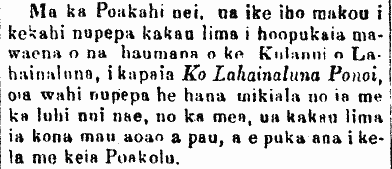
This Monday we saw a handwritten newspaper published amongst the students of the Lahainaluna College, called Ko Lahainaluna Ponoi; that paper is done promptly but with much effort, for each page is handwritten and it is published every Wednesday.

(Kuokoa, 9/12/1874, p. 3)

Ma ka Poakahi nei,...
Ka Nupepa Kuokoa, Buke XIII, Helu 37, Aoao 3. Sepatemaba 12, 1874.

Bishop Alfred Willis Leaves for Tonga, 1902.

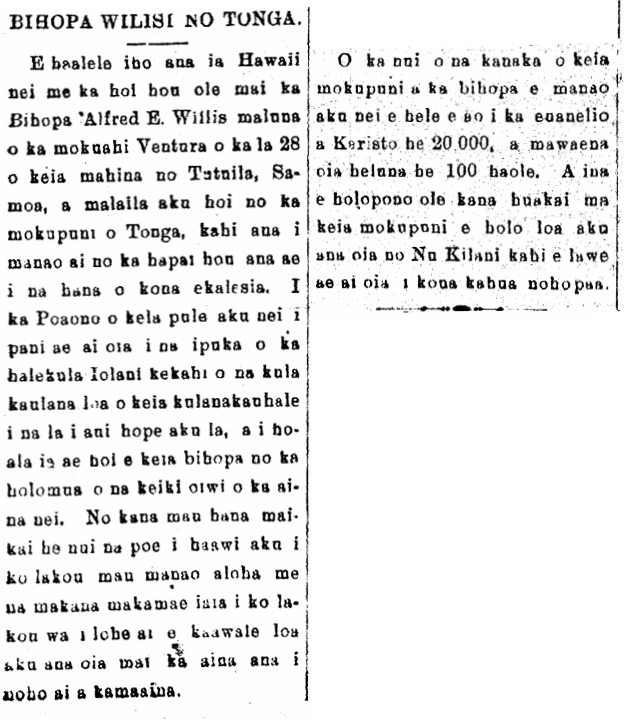
BISHOP WILLIS TO TONGA.

Bishop Alfred E. Willis is leaving Hawaii, and not returning, aboard the steamship Ventura on the 28th of this month for Tutuila, Samoa, and from there for the island of Tonga, where he intends to take up the work of his church. Last Saturday he closed the doors of Iolani School, one of the very well known schools of this town in days gone by,  and it was established by this bishop for the advancement of the native children of this land. For his good works, there were many people gave their expressions of aloha and precious gifts to him when they heard that he will forever leave this land that he became a local to.

The population of the people of this island on which the bishop is intending to go teach the word of Christ to is 20,000; and with this number, 100 are haole. And should this trek to this island does not go well, he will continue on to New Zealand where he will put down roots.

(Aloha Aina, 5/24/1902, p. 4)

BIHOPA WILISI NO TONGA.

Ke Aloha Aina, Buke VIII, Helu 21, Aoao 4. Mei 24, 1902.

Laying of the cornerstone of Liliuokalani School, 1912.

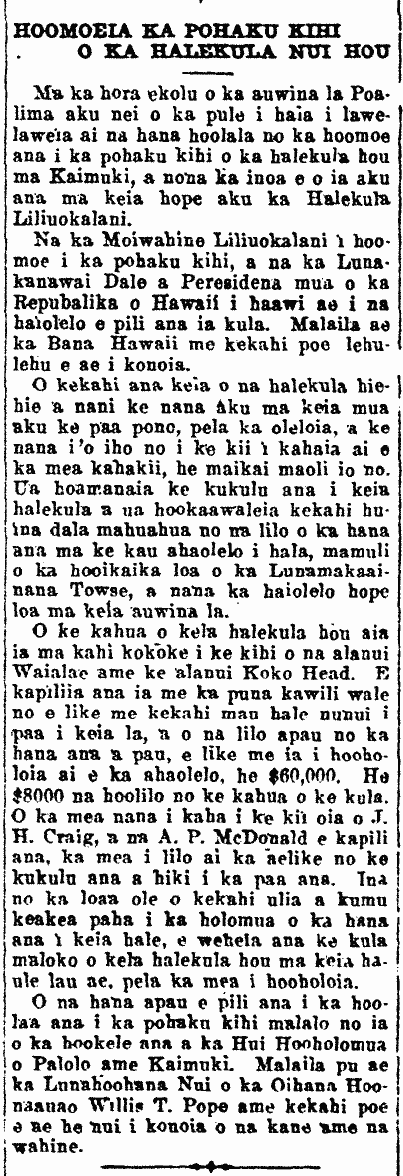
The Cornerstone of the New Great School is Laid.

At three o’clock on the afternoon of last Friday (4/12/1912), a ceremony was conducted to lay the cornerstone of the new school house in Kaimuki, that will be called hereafter, Liliuokalani School.

Queen Liliuokalani laid the cornerstone, and Legislator Dole, and former President of the Republic of Hawaii gave a speech about the school. The Hawaiian Band was there along with many invited guests.

When it is completed, this will be one of the most distinguished and beautiful schools, according to what is being said. And when you look at the artist’s rendering, it is indeed splendid. Authorization for building and funds were set aside in the previous session of the Legislature, through the efforts of Legislator Towse, and it was he that gave the final speech that afternoon.

The grounds of this school is near the corner of Waialae and Koko Head. It is being constructed of cement, like many of the great buildings being built these days. And the entire costs will be, as decided by the legislature, $60,000. $8000 was spent to purchase the land. The artist who drew the rendering was J. H. Craig. A. P. McDonald is the one doing the constructing; he received the contract to build the school to completion. Should there be no accidents or hinderances to the progress, the school will be unveiled this coming fall, as per what was decided.

Everything concerning the dedication of the cornerstone fell under the Improvement Club of Palolo and Kaimuki. Present also the head of the DOE, Willis T. Pope, as well as many men and women invited to attend.

[Although sadly this school has been closed, I hear there will be a 100th year celebration of the laying of the cornerstone to be held on the Queen Liliuokalani School grounds, on the 12th of April, with gates opening at 3:00 p. m.

See also from Chronicling America these related articles in English:

Evening Bulletin, 4/13/1912, p. 11,

Hawaiian Gazette, 4/16/1912, p. 7.

And about the actual opening of the school:

Hawaiian Gazette, 10/15/1912, p. 7.]

(Kuokoa, 4/19/1912, p. 6)

HOOMOEIA KA POHAKU KIHI O KA HALEKULA NUI HOU.

Ka Nupepa Kuokoa, Buke XLVIII, Helu 16, Aoao 6. Aperila 19, 1912.

Entrance exams for Kamehameha Schools, 1941.

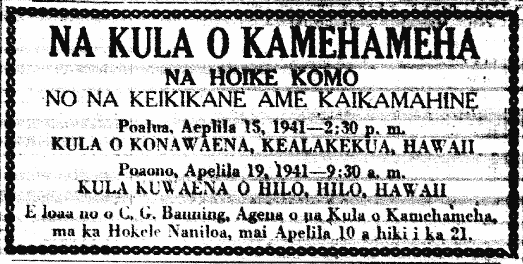
KAMEHAMEHA SCHOOLS

ENTRANCE EXAMS

FOR BOYS AND GIRLS

Tuesday, April 15, 1941—2:30 p. m.

KONAWAENA SCHOOL, KEALAKEKUA, HAWAII.

Saturday, April 19, 1941—9:30 a. m.

HILO INTERMEDIATE SCHOOL, HILO, HAWAII

C. G. Banning, Agent for the Kamehameha Schools will be available at the Naniloa Hotel from April 10 until the 21st.

(Hoku o Hawaii, 4/9/1941, p. 2)

NA KULA O KAMEHAMEHA

Ka Hoku o Hawaii, Buke XXXV, Helu 50, Aoao 2. Aperila 9, 1941.

More news out of Lahainaluna, 1874.

[Found under: “Local News”]

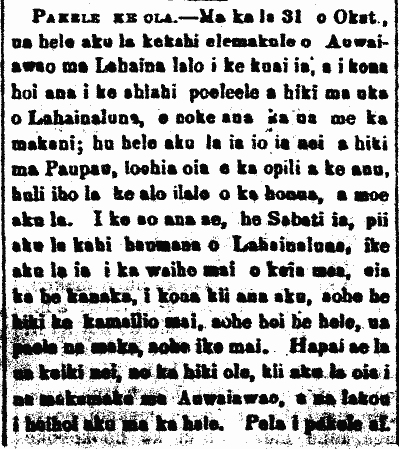
Life is saved.—On the 31st of Oct., an old man from Auwaiawao went to Lahainalalo to go shop, and when he was returning in the evening, it was dark and he reached Lahainaluna; the rain kept falling and the wind kept blowing; the old man wandered here and there until Paupau, and he was numbed with cold and fell face down to the ground and slept. In the morning, it was a Sunday, a student from Lahainaluna was walking up and spotted this thing, come to find out it was a man; when he went to fetch him, the man couldn’t speak, or walk, his eyes were blackened and he couldn’t see. The boy went to carry him, but because he couldn’t, he went to get friends from Auwaiawao, and they carried the man back to his home. That is how he survived.

(Kuokoa, 12/5/1874, p. 2)

Pakele ke ola.

Ka Nupepa Kuokoa, Buke XIII, Helu 49, Aoao 2. Dekemaba 5, 1874.

Newspapers coming out of Lahainaluna School! 1874.

[Found under: “Local News”]

We’ve heard that there are three handwritten newspapers put out by the students of Lahainaluna, named: “Lahainaluna Ponoi,” [Lahainaluna’s Own], “Ka Hoku Kakahiaka,” [The Morning Star], and “Ka Nupepa lawe i na nu hou” [The Newspaper bringing the news]. We offer our praise to the editors of those newspapers, as well as to the entire school.

[It would be a great find if someone had a copy/copies of these newspapers lying around!!]

(Kuokoa 12/5/1874, p. 2)

Ua lohe mai makou...

Ka Nupepa Kuokoa, Buke XIII, Helu 49, Aoao 2. Dekemaba 5, 1874.

Lahainaluna School news, 1867.

Items from Lahainaluna College.

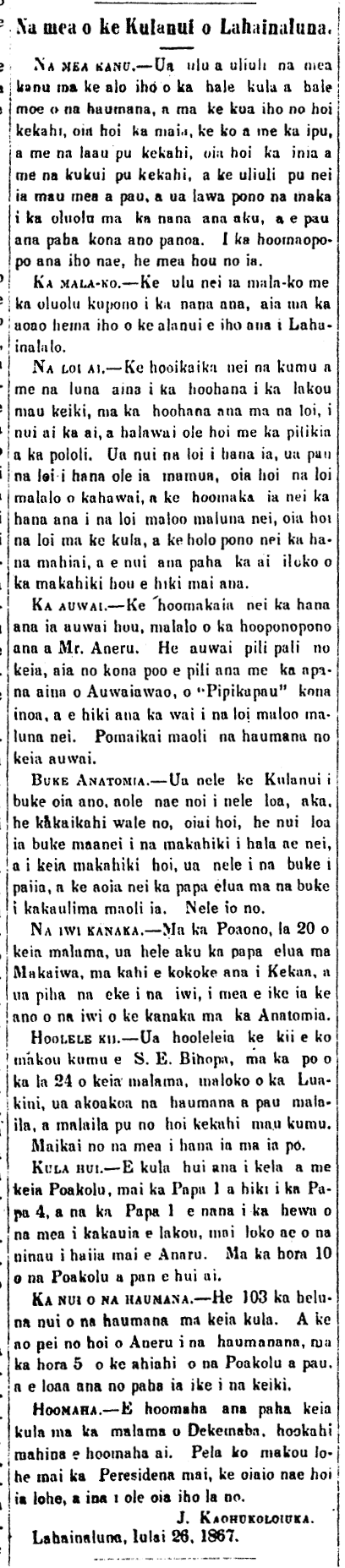
Crops.—The plants are thriving in front of the school house and the student’s dormitory, as well as in the back; those being: bananas, gourds, and trees as well, such as the pride of India, and kukui, which are all also thriving; it is very pleasant to look at, and the barrenness will perhaps be no more. But this is a considerably new thing.

The sugar cane patch.—The cane patch seems to be growing well, it is on the left side of the road going down to Lahainalalo.

The taro patches.—The teachers and land supervisors are putting effort into working the students in the patches to increase food so that they will not face problems with hunger. The patches being worked are large, and the loi that were not used before are being worked, those being the ones below the river, and the ones above it are starting to be worked (the ones at the school), and the farming is going well, and the taro production will perhaps increase in this upcoming year.

The canal.—The new auwai is being started under the direction of Mr. Andrews. This auwai runs next to the pali, and it’s source is in the district of Auwaiawao; it is called “Pipikapau” and the water will reach the dry patches here above. The students will be truly blessed by this auwai.

The anatomy book (“Anatomia”).—The College is lacking a volume of this type, but it is not totally without, there are a few; although there were a great many in the past years, this year, they are without the printed book, and the second class is being taught from a handwritten book. They are terribly lacking.

Human bones.—On Saturday, the 20th of this month, the second class went to Makaiwa, close to Kekaa, and bags were filled with bones so that they could see the kinds of bones as in Anatomia.

Lantern slides.—Pictures were projected by our instructor, S. E. Bishop, on the night of the 24th of this month in the Church; all the students gathered together, and also there were some of the teachers.
The activities that night were fine.

Joint school.—Every Wednesday, all the grades join together, from the 1st class to the 4th, and the 1st class checks the mistakes in what is written by the other classes in response to the questions given by Andrews. They join together at 10 o’clock on every Wednesday.

The enrollment.—There are 103 students at this school. And Andrews teaches the students at 5 o’clock in the evening every Wednesday, and perhaps the children are acquiring this knowledge.

Break.—The school might go on vacation during the month of December, for a month. This is what we hear from the President, whether it be true or not.

J. Kaohukoloiuka.
Lahainaluna, July 26, 1867.

(Kuokoa, 8/3/1867, p. 3)

Na mea o ke Kulanui o Lahainaluna.

Ka Nupepa Kuokoa, Buke VI, Helu 31, Aoao 3. Augate 3, 1867.

Aliiolani School ad, 1907.

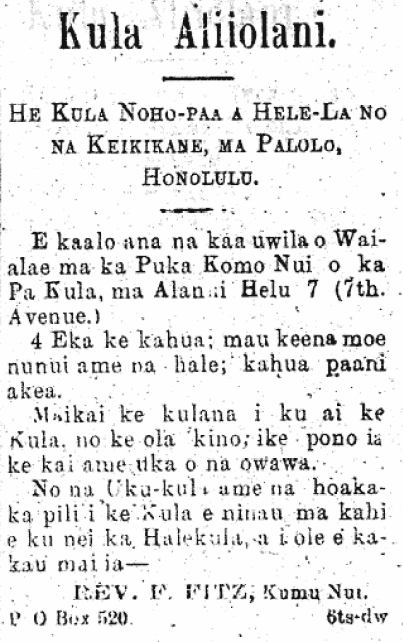
Aliiolani School.

A Boarding and Day School for Boys, in Palolo, Honolulu.

Street cars of Waialae pass by the Front Entrace of the Campus, on 7th Avenue (Alanui Helu 7).

Campus of 4 acres; spacious dorm rooms and buildings; large playground.

The area where the school sits is good for the health; the ocean and the upland valleys are clearly visible.

For Tuition and details about the School, inquire at where the Schoolhouse stands, or write to—

REV. F. FITZ, Head Instructor.

P. O. Box 52o.

(Na’i Aupuni, 1/4/1907, p. 3)

Kula Aliiolani.

Ka Na'i Aupuni, Buke III, Helu 4, Aoao 3. Ianuari 4, 1907.