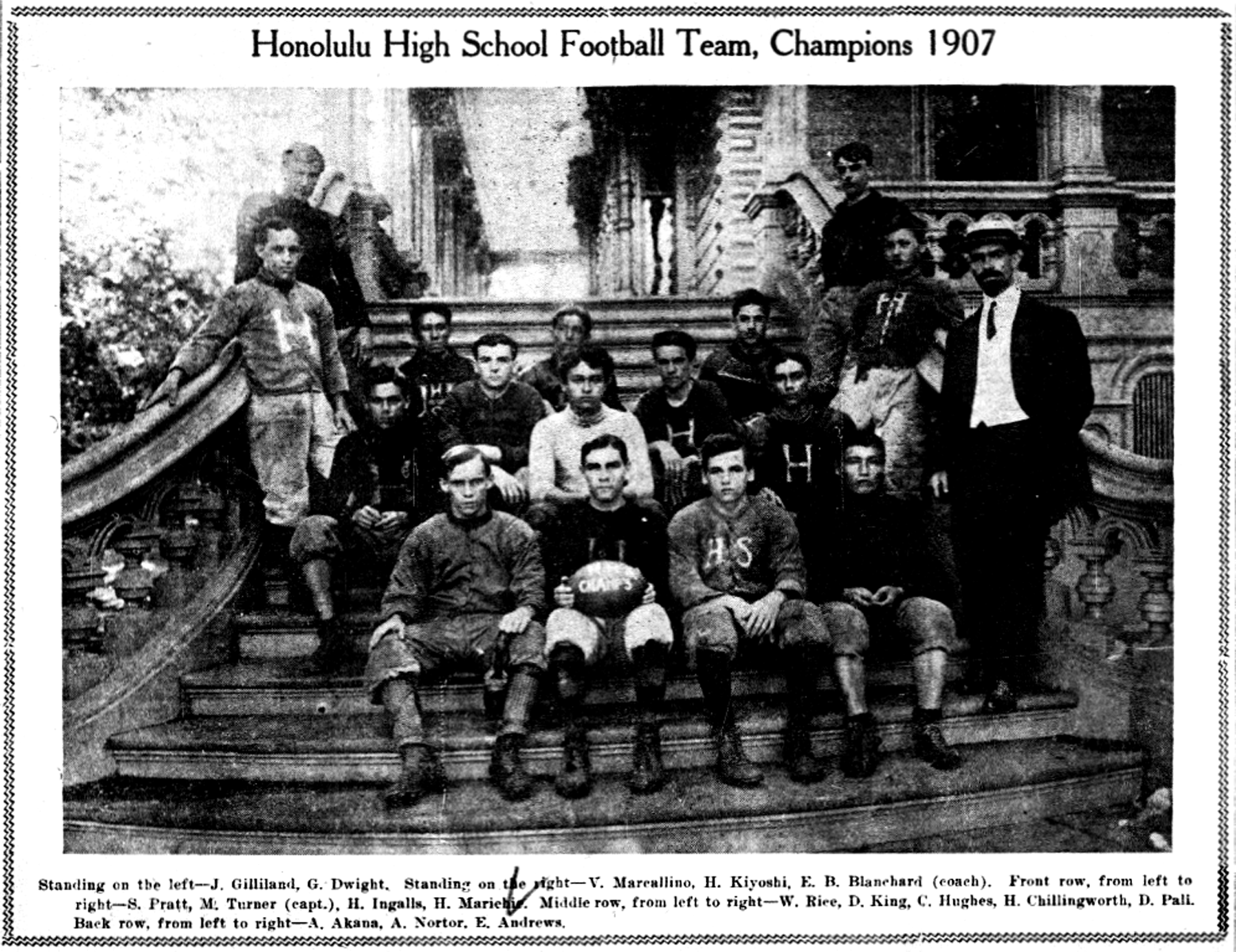
THE FOOTBALL TEAM OF THE HONOLULU HIGH SCHOOL.
(Kuokoa, 1/4/1907, p. 7)
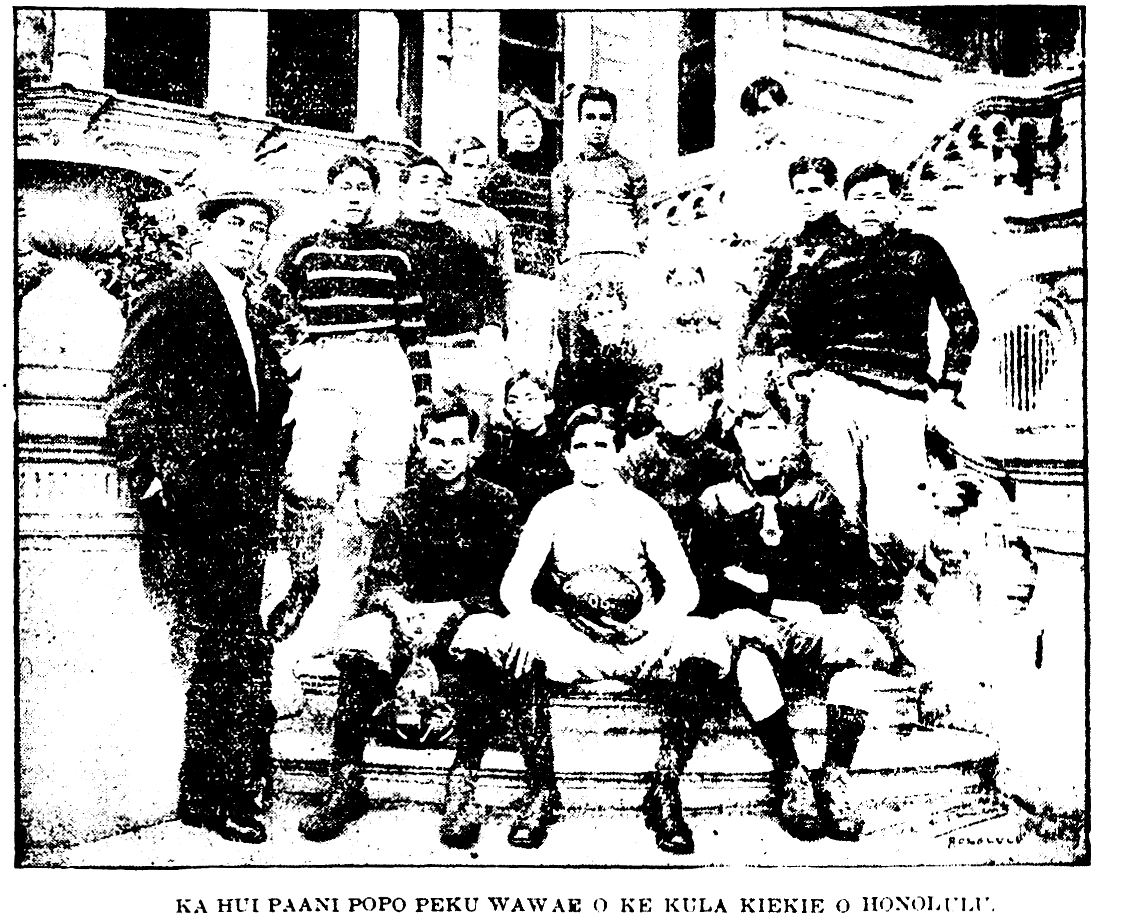
Ka Nupepa Kuokoa, Buke XLVI, Helu 1, Aoao 7. Ianuari 4, 1907.
(Kuokoa, 1/4/1907, p. 7)
Ka Nupepa Kuokoa, Buke XLVI, Helu 1, Aoao 7. Ianuari 4, 1907.
Standing on the left—J. Gilliland, G. Dwight. Standing on the right—V. Marcallino, H. Kiyoshi, E. B. Blanchard (coach). Front row, from left to right—S. Pratt, M. Turner (capt.), H. Ingalls, H. Marichie. Middle row, from left to right—W. Rice, D. King, C. Hughes, H. Chillingworth, D. Pali. Back row, fro left to right—A. Akana, A. Nortor, E. Andrews.
[The Honolulu High School would go on to become what we know today as McKinley High School.]
(Sunday Advertiser, 12/8/1907, p. 7)
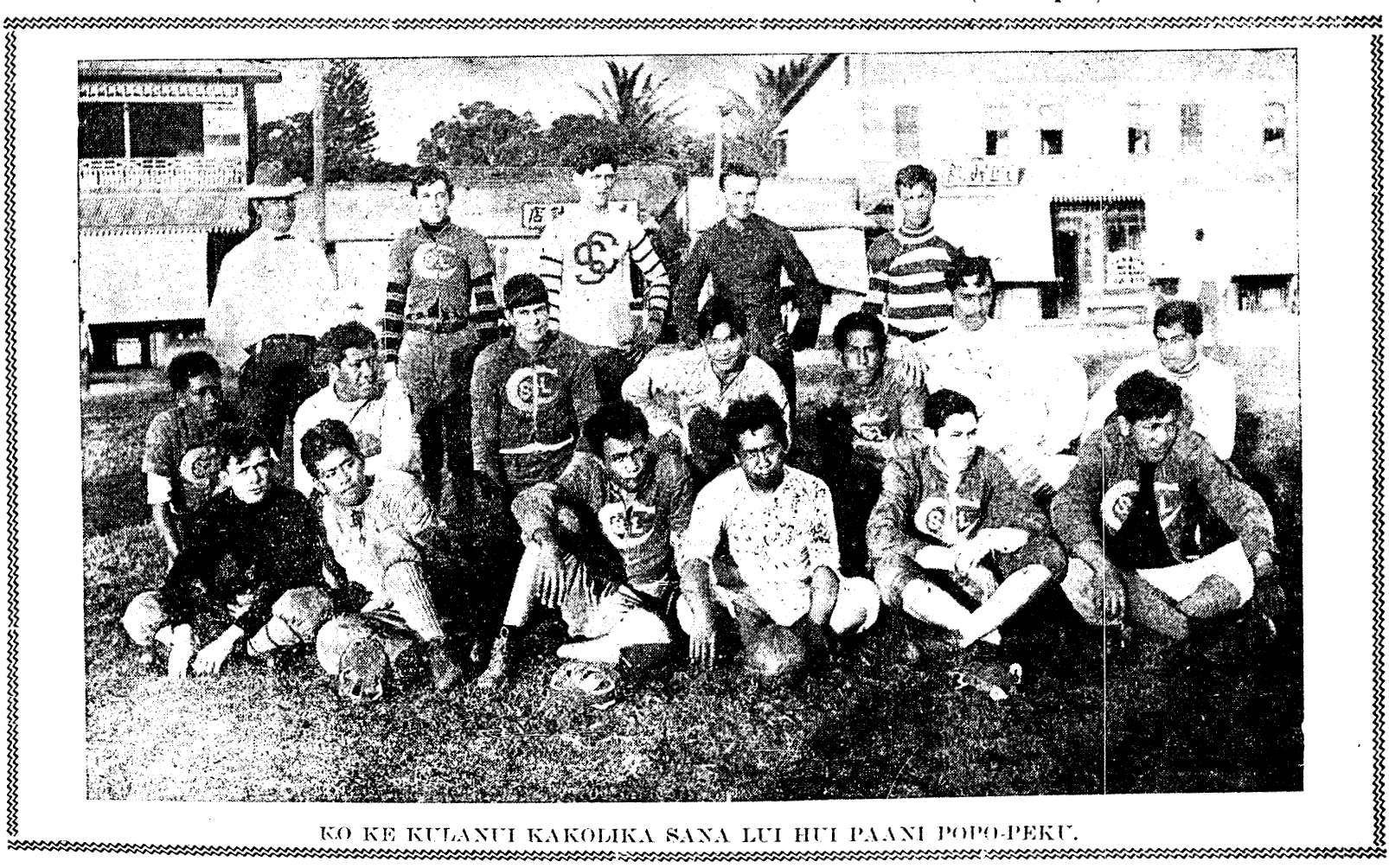
Sunday Advertiser, Volume V, Number 258, Page 7. December 8, 1907.
[Here is a very random football image from 110 years ago of Saint Louis High School’s football team. This picture is for some reason much clearer than the usual digitized newspaper image.]
(Kuokoa, 10/5/1905, p. 4)
Ka Nupepa Kuokoa, Buke XLIII, Helu 42, Aoao 4. Okatoba 5, 1905.
Hanalei School Items Show a Continued Interest is Still Kept Up in Our National Sport
Many Entries Enlivens The Contest S. E. Lucas, Opticians, Will Arrive on The Kinau Tomorrow
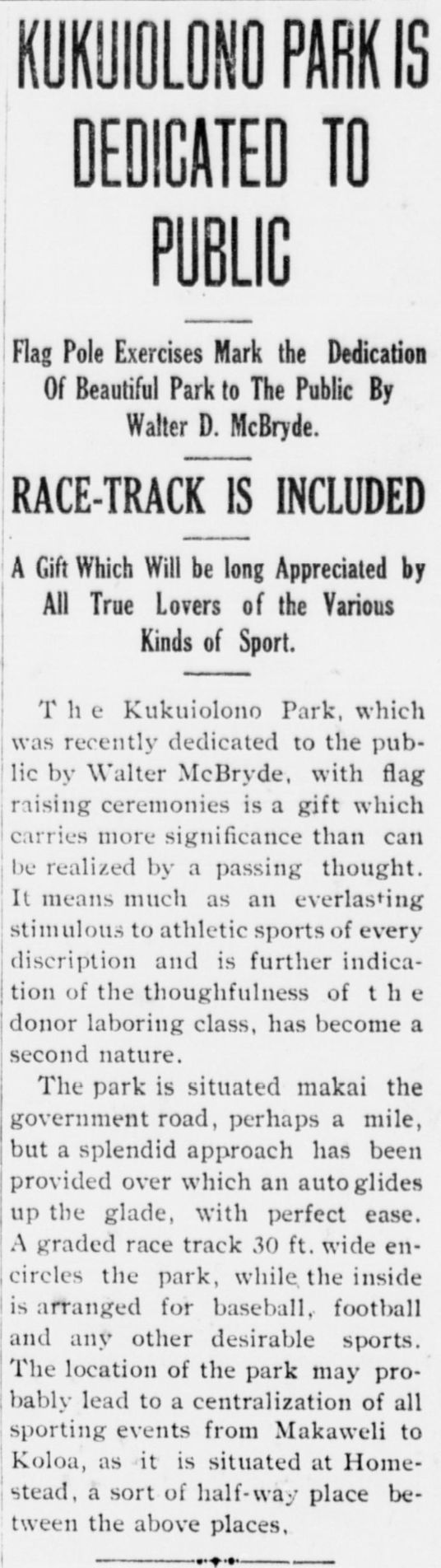
November third will be a big day at the Kukuiolono Park, the new McBryde Park. The occasion will be the celebration of the Mikado’s birthday anniversary and the amusements arranged for the day include horse racing, sulky racing, bicycle and foot racing, as well as various other athletic sports. Continue reading
Flag Pole Exercises Mark the Dedication Of Beautiful Park to The Public By Walter D. McBryde.
A Gift Which Will be long Appreciated by All True Lovers of the Various Kinds of Sport.
The Kukuiolono Park, which was recently dedicated to the public by Walter McBryde, with flag raising ceremonies is a gift which carries more significance than can be realized by a passing thought. It means much as an everlasting stimulous to athletic sports of every discription and is further indication of the thoughtfulness of the donor laboring class, has become a second nature.
The park is situated makai the government road, perhaps a mile, but a splendid approach has been provided over which an auto glides up the glade, with perfect ease. A graded race track 30 ft. wide encircles the park, while the inside is arranged for baseball, football and any other desirable sports. The location of the park may probably lead to a centralization of all sporting events from Makaweli to Koloa, as it is situated at Homestead, a sort of half-way place between the above places.
(Garden Island, 10/31/1911, p. 1)
The Garden Island, Volume 8, Number 43, Page 1. October 31, 1911.
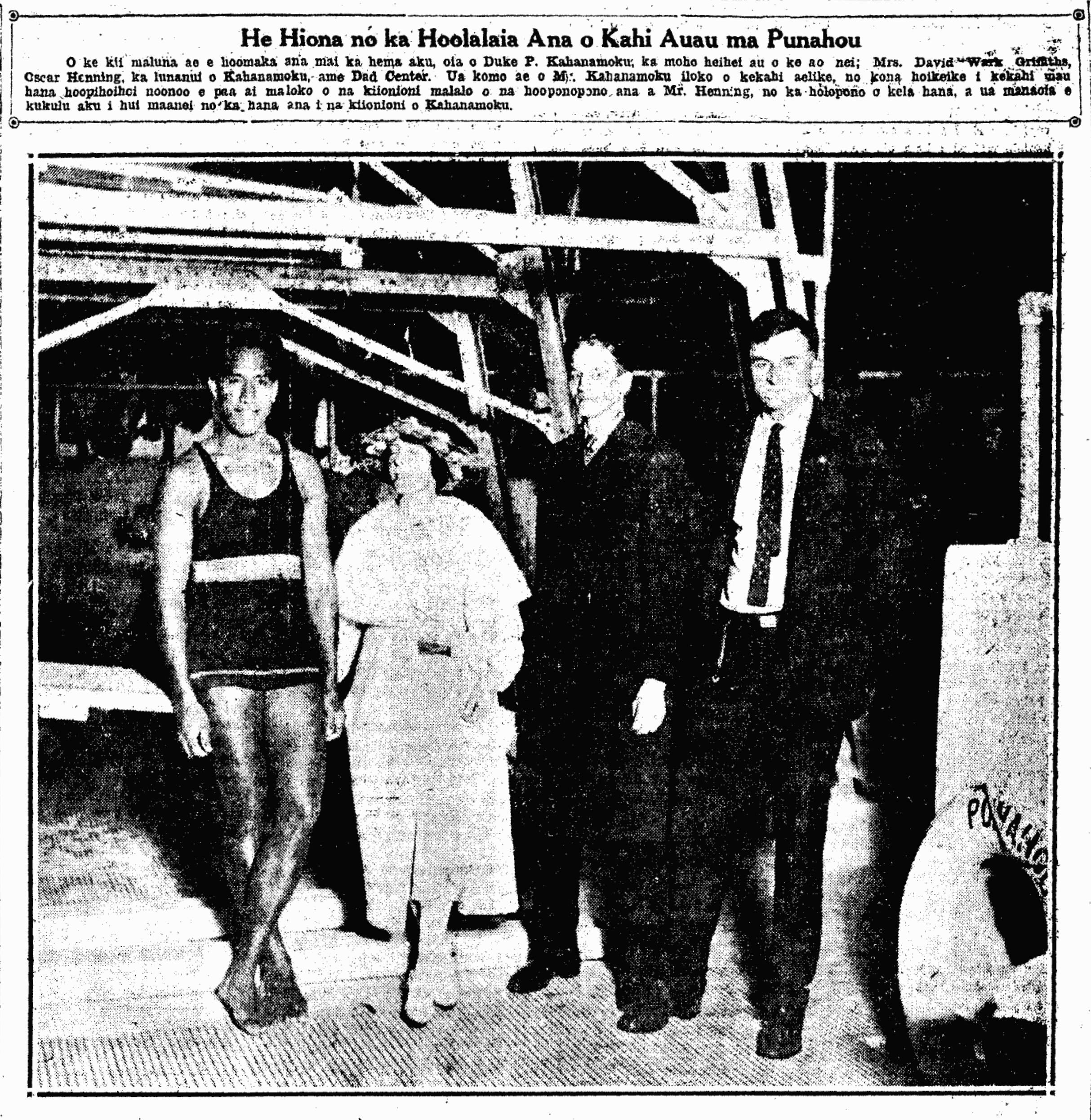
The picture above [below], beginning from the left is of Duke P. Kahanamoku, the world champion swimmer, Mrs. David Wark Griffith, Oscar Henning, the manager of Kahanamoku, and Dad Center. Mr. Kahanamoku entered into a contract for him to perform some astonishing feats to be made into a movie under the direction of Mr. Henning for the success of that endeavor, and it is believed that a company will be started here to produce Kahanamoku’s movies.
(Kuokoa, 2/10/1922, p. 5)
Ka Nupepa Kuokoa, Buke LXI, Helu 6, Aoao 5. Feberuari 10, 1922.
KRG
The Butts
Bull’s Eye.
The Losers.
Scorer.
Bicycle Race.
Horse Race.
DRAWN BY JOHN K. WAIAMAU.
(Hawaiian Gazette, 6/17/1904, p. 5)

Hawaiian Gazette, Volume XXXIX, Number 49, Page 5. June 17, 1904.
Big Troupe of Wrestles Arrives on Tenyo Maru—Matches Begin Saturday
Headed by Tachiyama, mightiest wrestler of all Japan, a troupe of 54 of the greatest mat artists of Dai Nippon arrived this morning on the T. K. K. liner Tenyo Maru. They have come to Honolulu for a series of performances, beginning on Saturday night at Athletic park.
Tremendous big fellows, mighty of girth and of limb, are these Japanese wrestlers, and as they lined the deck of the Tenyo Maru this morning they attracted the immediate attention of the thousands of Japanese and others who had assembled at the dock. The picturesque dress of the Nipponese wrestler—silken over-kimono, a sort of under-garment falling below the knees, girdle, and above all the peculiar headdress—make the athletes conspicuous anywhere, and they are still more conspicuous because of their size, far greater than that of the ordinary Japanese.
The wrestlers will be in Hawaii for several weeks. The arrangements for the series of matches at Athletic park are nearly complete. The matches start at 7 o’clock on Saturday night, and a number of local Japanese athletes are anxious to match skill and brawn against the famed champions from the empire.
This morning and informal committee of Japanese went out to the Tenyo Maru to receive the wrestlers. Arthur K. Ozawa, who has been somewhat in charge of the advance arrangements here, and several Japanese newspapermen met the steamer off port. At the dock to receive their comrades were W. Uchiumi and K. Yamanishi, who arrived here on May 22 as advance agents for the troupe. Uchimi is a retired wrestler and will probably act as referee at some of the matches.
The wrestlers will be matched somewhat according to weight and previous records. Tachiyama is billed to appear every night. He has been the undisputed champion of Japan since he won the title in a series of desperate matches with contenders for the crown left by Hitachiyama, an old veteran who was declared to be the greatest of all Japan’s champions.
Tachiyama has amassed a fortune estimated at half a million dollars during his career. He is a big, good-natured man, standing about six feet three inches and weighing in the neighborhood of 315 pounds. He is said to be quick in spite of his enormous size. Many of these wrestlers seem to be mountains of flesh, which is an advantage at the Japanese style of wrestling in short, furious bouts much like two bulls locking horns.
Spectators at Athletic park recently have noticed a high skeleton tower of wood being erected in deep center field and wondered what the structure was for. This is put up to observe and old custom in Japanese wrestling circles. Early in the morning on the day when matches are to take place, a gong is beaten for a half hour to an hour by a herald who announces the matches.
Champion Wrestler of All Japan Here With Comrades
Tachiyama (“Mountain of Swords”), who is the premier mat artist of Japan, will appear nightly at the local matches.
(Honolulu Star-Bulletin, 7/9/1914, p. 9)

Honolulu Star-Bulletin, Volume XXII, Number 6940, Page 9. July 9, 1914.
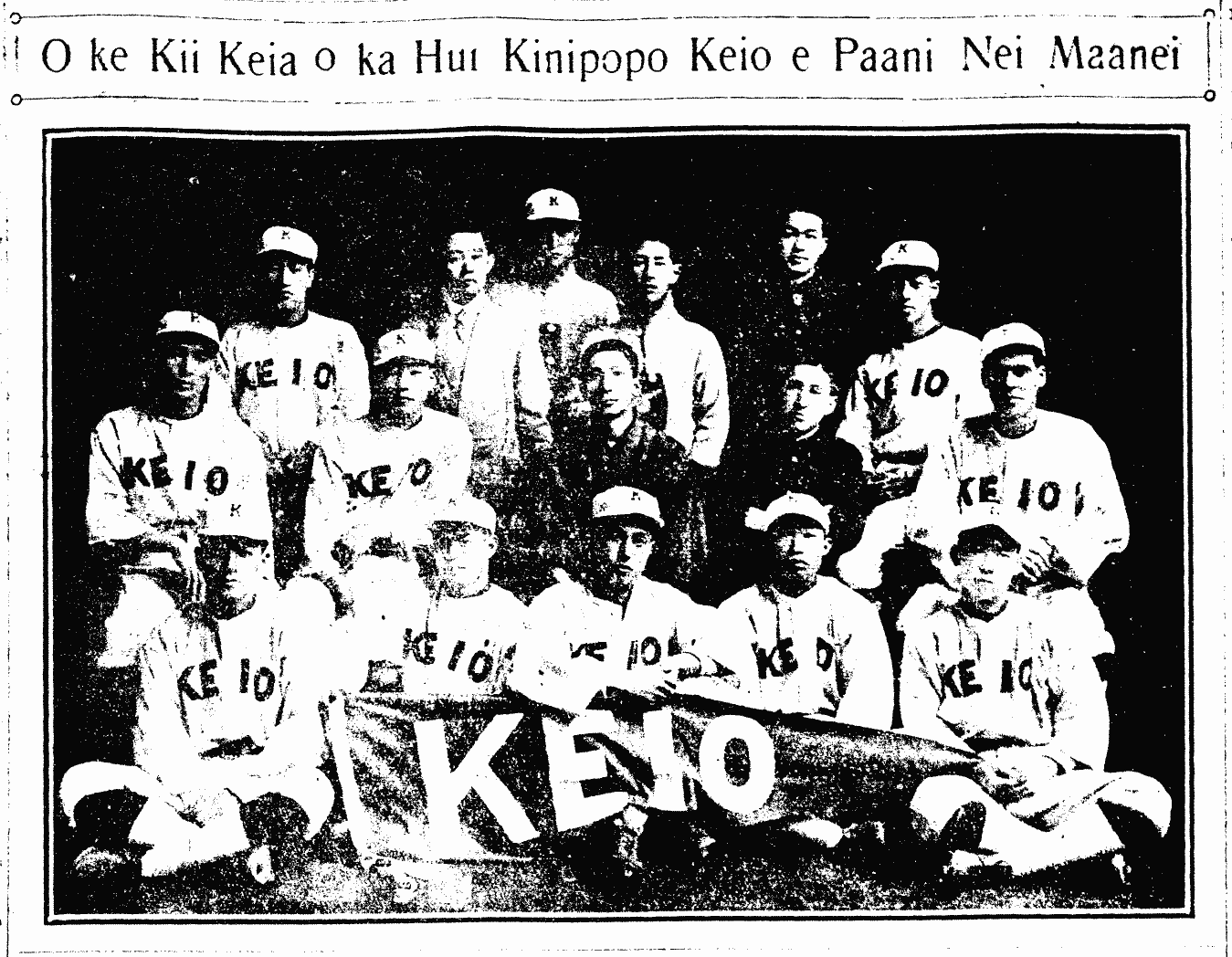
[This baseball team from Keio University in Japan came to Hawaii a number of times in the early 1900s.]
(Kuokoa, 5/29/1914, p. 5)
Ka Nupepa Kuokoa, Buke LII, Helu 22, Aoao 5. Mei 29, 1914.
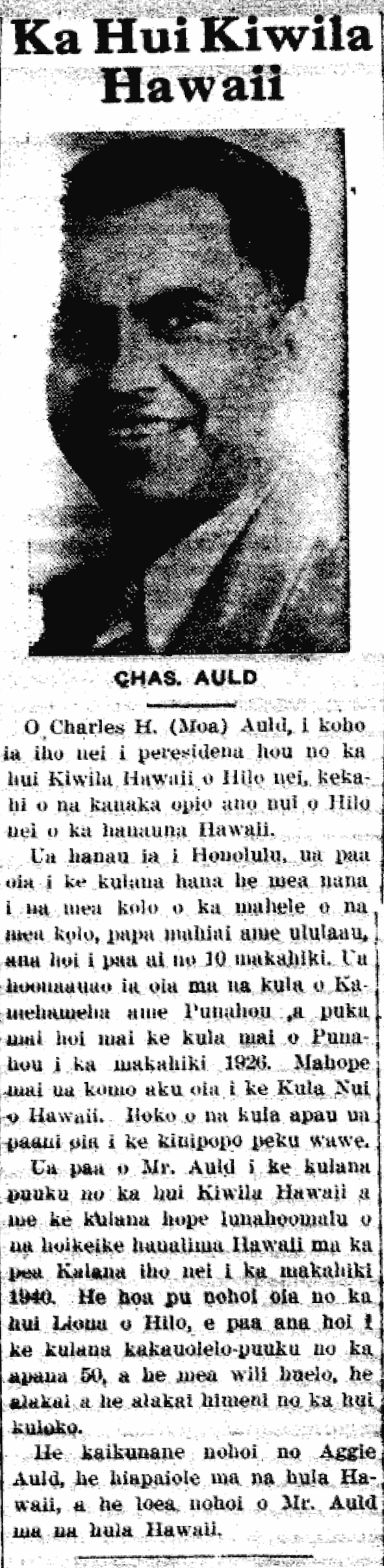
CHAS. AULD
Charles H. (Moa) Auld has been chosen as the new president of the Hawaiian Civic Club [hui Kiwila Hawaii] of Hilo nei, one of the important youths here in Hilo of Hawaiian ancestry.
He was born in Honolulu, and was employed as an inspector of insects in the insects division of the department of agriculture and forestry [papa mahiai ame ululaau], in which he was employed for 10 years. He was educated at the Kamehameha Schools and at Punahou, and he graduated from Punahou in 1926. Thereafter he attended the University of Hawaii. In each of these schools he played football [kinipopo peku wawae].
He is a brother also of Aggie Auld, and expert in Hawaiian hula, and Mr. Auld himself is adept at it as well.
(Hoku o Hawaii, 3/19/1941, p. 1)
Ka Hoku o Hawaii, Volume XXXV, Number 47, Aoao 1. Malaki 19, 1941.
 nupepa