Voice from the past, 1924.

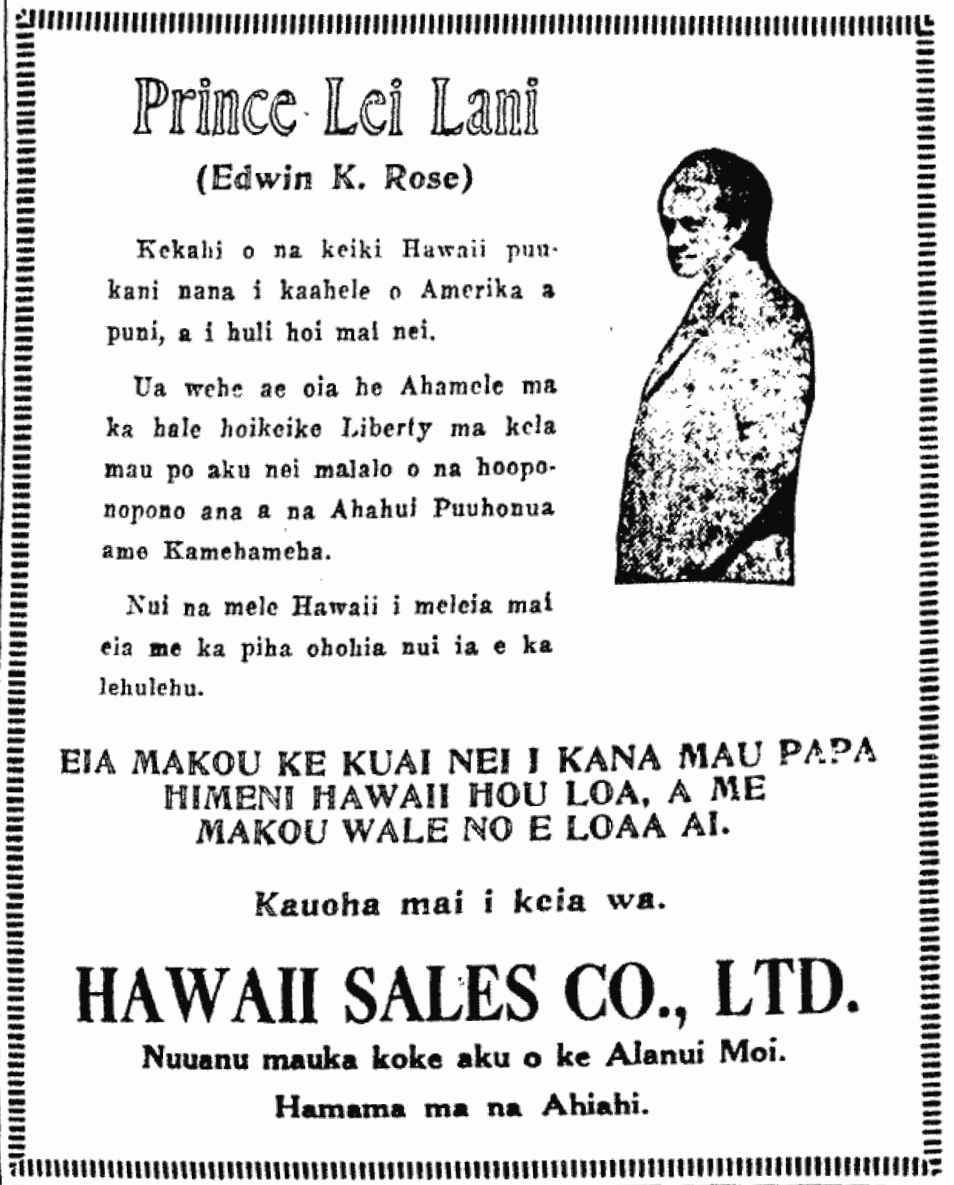
Prince Lei Lani

(Edwin K. Rose)

One of the Hawaiian singers who is touring all over America, and returned home.

He held a Concert at the Liberty Theater the other night organized by the Hawaiian Protective Association [Ahahui Puuhonua] and the Royal Order of Kamehameha [Ahahui Kamehameha].

There were many Hawaiian songs sung by him which were highly acclaimed by the crowd.

WE ARE SELLING HIS BRAND NEW HAWAIIAN RECORDS, AND WE ARE THE ONLY ONES WHO HAVE THEM.

Put in your orders now.

HAWAII SALES CO., LTD.

Nuuanu mauka near King Street.

Open in the Evenings.

(Kuokoa, 4/10/1926, p. 6)

Prince Lei Lani

Ka Nupepa Kuokoa, Buke LXIII, Helu 15, Aoao 6. Aperila 10, 1924.

More on Hawaiians performing in lands afar, 1912.

HAWAIIAN YOUTHS SINGING IN AMERICA

There are many Hawaiian youths famous for singing in America that are touring as a band, and they are  bringing the name of tiny Hawaii to the forefront of the whole world; they are greatly admired everywhere they go for their beauty and gentlemanliness, and also for the beauty and excellence of their singing voices; and it is this style of the Hawaiian youths which cause the young fans to chase after them—so unbelievable are the waters of Alekoki.¹

New York, Aug. 12. According to N. K. Bahling, a long-time resident of Honolulu, “The Hawaiian youths are distinguished by their singing; I met up with them living at 209 East 14th Street, they being Mr. and Mrs. David Kalaukoa, Alfred K. Jones, John K. Paaluhi; they are the singing group that went to Europe the other year, to England, Germany and France. While they were there, the people there went “crazy” over hearing the call of the singing kahuli land shells² of Hawaii.

(See page Four)

¹This hearkens back to the opening line from the song “Alekoki” by Lizzie Alohikea, which speaks of the amazing waters of Alekoki, and here is used to describe the craze over the Hawaiian performers: “Aole i piliwi ia, Kahi wai ao Alekoki…”

²Kahuli are the famous land shells of the upland forests which chirp sweetly, often used to describe a melodious singing voice.

(Kuokoa Home Rula, 9/5/1912, p. 2)
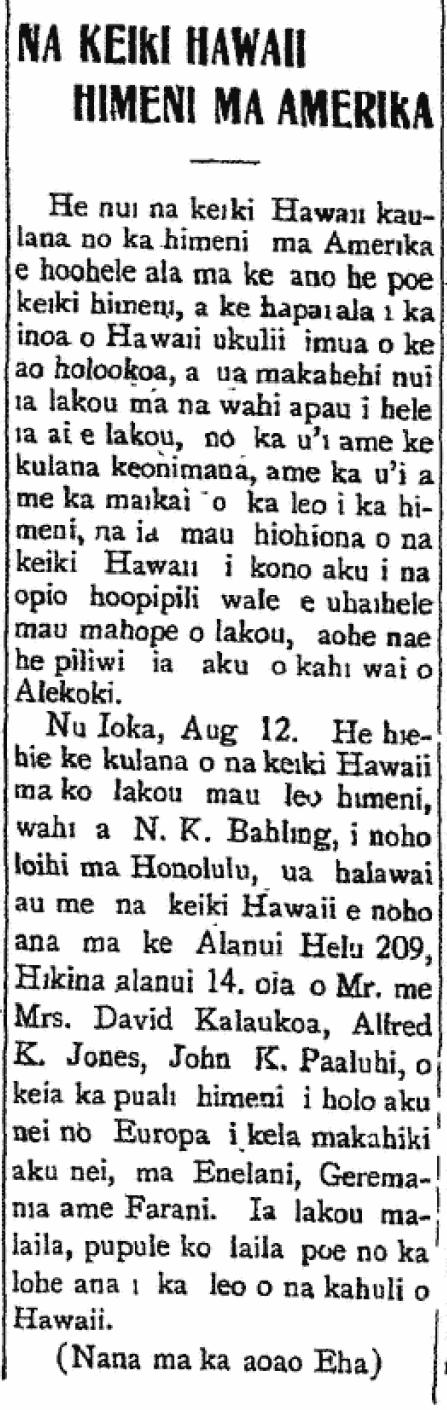
NA KEIKI HAWAII HIMENI MA AMERIKA

Kuokoa Home Rula, Buke X, Helu 36, Aoao 2. Sepatemaba 5, 1912.

Boys of the Hawaiian Singing Groups

(From page Two)

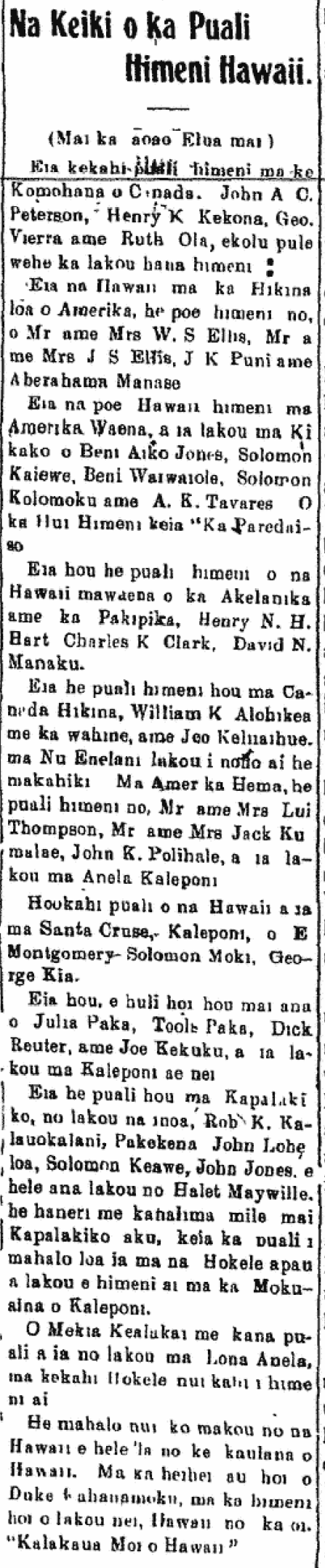
There is a choral group in the West side of Canada. John A. C. Peterson, Henry K. Kekona, George Vierra, and Ruth Ola; their gig will open in three weeks.

These are the Hawaiians on the East Coast of America, they are a group of singers; Mr. and Mrs. W. S. Ellis, Mr. and Mrs. J. S. Ellis, J. K. Puni, and Aberahama [Abraham] Manase.

These are the Hawaiian singers in the Midwest, in Chicago: Beni Aiko Jones, Solomon Kaiewe, Beni Waiwaiole, Solomon Kolomoku, and A. K. Tavares. This is the Singing Group, “Ka Paradaiso [Paradise]”.

Here is another singing group of Hawaiians between the Atlantic and the Pacific: Henry N. H. Hart, Charles K. Clark, David N. Manaku.

Here is a new singing group in Eastern Canada: William K. Alohikea and his wife, and Joe [Joseph] Keliiaihue; they were living in New England for a year. In southern America is also a singing group: Mr. and Mrs. Lui Thompson, Mr. and Mrs. Jack Kumalae, John K. Polihale, and they are in Angel [Los Angeles ?], California.

There is one group of Hawaiians in Santa Cruz, California: E. Montgomery, Solomon Moki, and George Kia.

Also, Julia Paka, Tools Paka, Dick Reuter, and Joe [Joseph] Kekuku are coming back; they are in California.

There is a new singing group in San Francisco whose names are: Rob K. Kalauokalani, Pakekena John Loheloa, Solomon Keawe, and John Jones; they are headed for Halet Maywille [?] which is a hundred and fifty miles from San Francisco; this is the group who was greatly appreciated at every hotel they sang at in California.

Mekia [Major] Kealakai and his group is in Los Angeles, and singing in a huge hotel.

We are greatly appreciative of the Hawaiians who go out to bring fame to Hawaii. In the swimming competition of Duke Kahanamoku, when they sang, Hawaii was the best. “Kalakaua Moi o Hawaii [Kalakaua, King of Hawaii]”.

(Kuokoa Home Rula, 9/5/1912, p. 4)
Na Keiki o ka Puali Himeni Hawaii.

Kuokoa Home Rula, Buke X, Helu 36, Aoao 4. Sepatemaba 5, 1912.

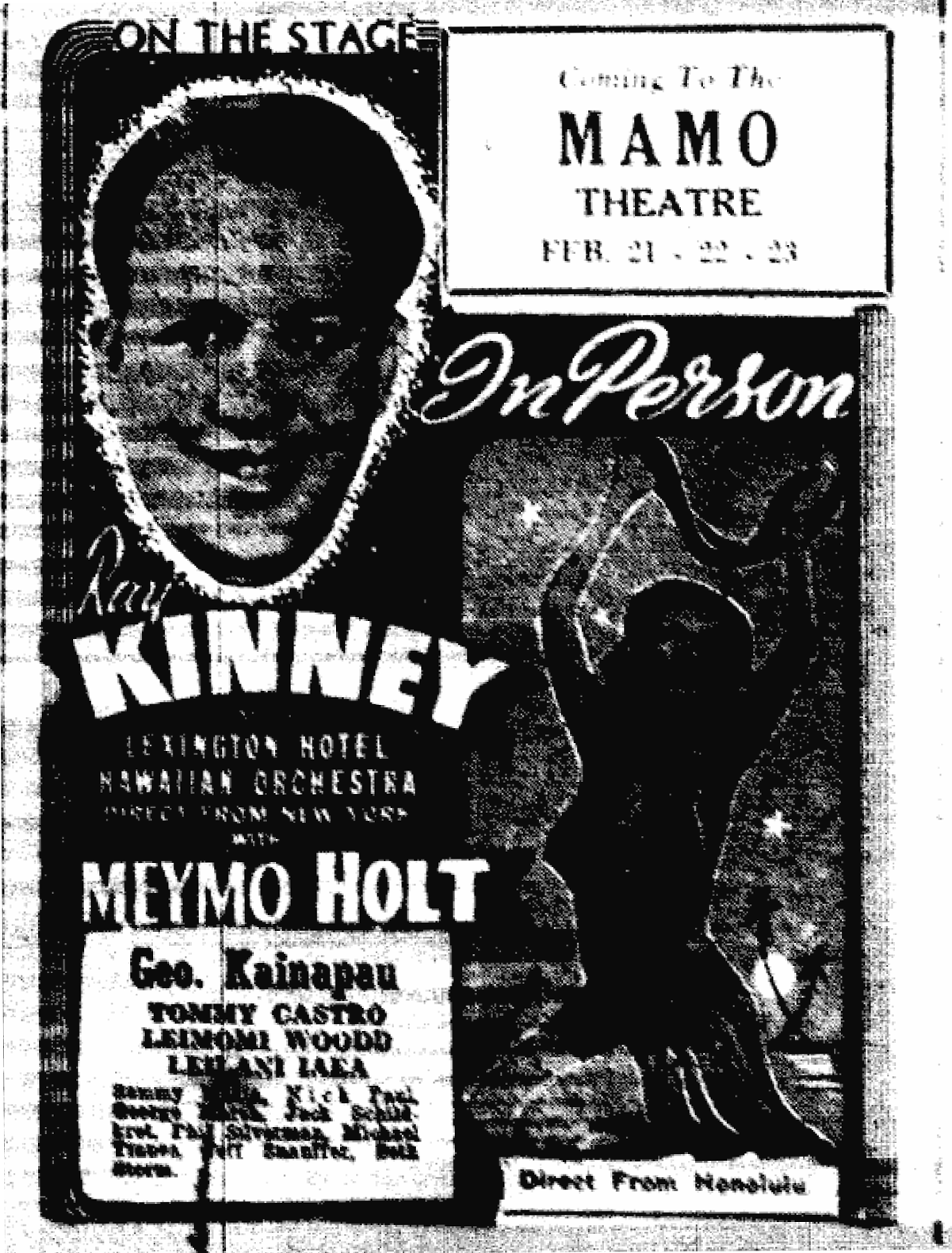
Ray Kinney and group from the Lexington Hotel performing in his hometown, Hilo, 1940.

ON THE STAGE

Coming To The

MAMO

THEATRE

FEB 21 – 22 – 23

In Person

Ray

KINNEY

LEXINGTON HOTEL

HAWAIIAN ORCHESTRA

DIRECT FROM NEW YORK

WITH

MEYMO [Ululani] HOLT

George Kainapau

TOMMY CASTRO

[Lillian] LEIMOMI WOODD

LEILANI IAEA

[illegible group of names]

Direct From Honolulu

[It seems the Senate Honored the entertainers and workers of the Lexington Hotel’s Hawaiian Room on its 75th anniversary just the other month!

There is also going to be a presentation related to this at the Distinctive Women in Hawaiian History Program on Saturday, September 15, 2012)

Unfortunately, the available digital image is as seen below, the actual  newspaper image should probably be much more clear and legible.]

(Hoku o Hawaii, 2/21/1940, p. 4)

ON THE STAGE

Ka Hoku o Hawaii, Volume XXXIV, Number 43, Page 4. Pepeluali 21, 1940.

Paper Lei and Hawaiian foods popular in New York. 1912.

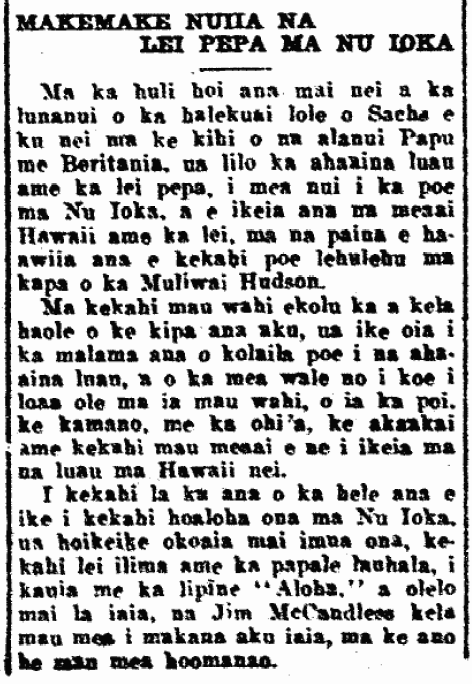
PAPER LEI ARE MUCH SOUGHT AFTER IN NEW YORK.

At the return of the head manager of the clothiers, Sachs, which stands at the corner of Fort and King Streets; [he said,] “Luau and paper lei have become popular with New Yorkers, and Hawaiian foods and lei are seen at parties given by many people on the banks of the Hudson River.

Supposedly at three places that haole went to visit, he saw people holding luau parties, and the only thing missing at those places was poi, salmon, tomatoes, onions and some other foods seen at luau in Hawaii nei.

One day when he went to go see one of his friends in New York, shown before him was an ilima lei and a lauhala hat upon which was a ribbon which read “Aloha,” and he said that they were a gift from Jim McCandless, as a memento.

(Kuokoa, 8/9/1912, p. 6)

MAKEMAKE NUIIA NA LEI PEPA MA NU IOKA

Ka Nupepa Kuokoa, Buke XLVIII, Helu 32, Aoao 6. Augate 9, 1912.

“Beautifying” Waikiki: Have we changed that much in a hundred years? 1912.

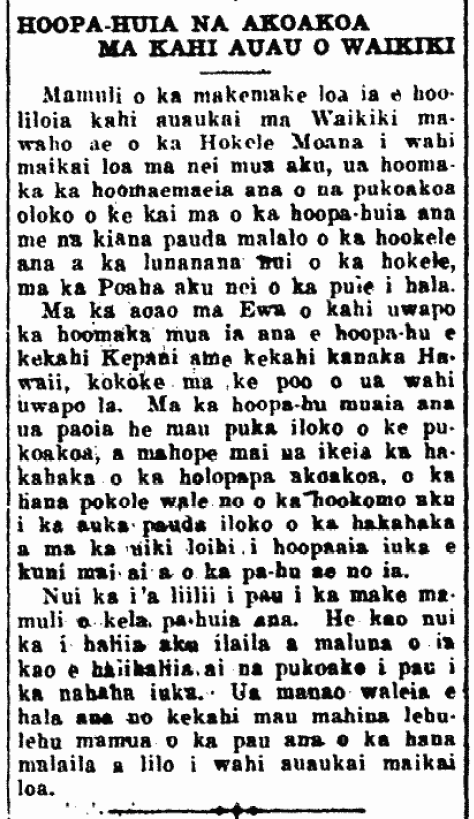
CORAL BLOWN UP AT A SWIMMING SPOT IN WAIKIKI.

Because of a great desire to make the swimming area in Waikiki outside of the Moana Hotel great in the future, they have begun to clear coral from the ocean by blowing it up using giant powder [kiana pauda] under the direction of the general manager of the hotel, on Thursday of last week.

The blasting has begun on the Ewa side of the wharf, by some Japanese and Hawaiians, near the head of that wharf. In the first blasting, holes were dug into the coral, and after, cracks were seen in the coral bed. It was quick work putting in some explosives in the cracks while lighting it using a long fuse held on shore  and then it exploded.

There were many small fishes killed because of the blast. There was a big scow taken there and the coral that was blown off was carried away upon it. It is imagined that it will be several months before the work there will be done and the area will then be a fine bathing spot.

(Kuokoa, 7/26/1912, p. 4)

HOOPA-HUIA NA AKOAKOA MA KAHI AUAU O WAIKIKI

Ka Nupepa Kuokoa, Buke XLVIII, Helu 30, Aoao 4. Iulai 26, 1912.

Hawaiians at the Alaska-Yukon-Pacific Exposition, 1909.

Check out this picture and more from the Hawaii delegation at the 1909 Alaska-Yukon-Pacific Exposition, online at the University of Washington Digital Collections site!

http://content.lib.washington.edu/cdm4/item_viewer.php?CISOROOT=%2Fayp&CISOPTR=538&DMSCALE=100&DMWIDTH=802&DMHEIGHT=623.4296875&DMMODE=viewer&DMFULL=1&DMX=0&DMY=0&DMTEXT=%2520hawaii&DMTHUMB=0&REC=12&DMROTATE=0&x=801&y=314

Hawaiian officials, hostesses, and musicians in front of the Hawaii Building, Alaska Yukon Pacific Exposition, Seattle, August 5, 1909.

How much do we know about how it was back then… 1909.

THE WORLD IS STILL IN THE DARK ABOUT HAWAII.

Although there has been so many stories heard talking about Hawaii and its people and its many wonderful things, in no way has the ignorance of some people in foreign lands about Hawaii been cleared; they assume Hawaii is an uneducated land and that we are cannibals.

On the return of someone who went to visit the fair in Seattle [Alaska-Yukon-Pacific Exposition], he spoke about the arrival of a haole woman who didn’t know about the conditions of Hawaii; and she put before the Hawaiian girls a great number of questions—questions which made it plain that she had no clue about this era of education here in Hawaii.

When she saw a pineapple, she didn’t believe that it was real, because she poked at it with her finger, perhaps thinking that it was just some decoration, or perhaps butter [butter sculpture seems to have been popular at the time].

When she approached the area where the Hawaiian girls were stationed to talk about Hawaii nei as well as to give various performances, she asked one of them:

“Are you all real Hawaiian girls?” she asked while peering at each one of the beautiful Hawaiian girls over her gold-rimmed glasses.

“We are all Hawaiian girls,” she was answered kindly and very politely.

“How long has it been since your arrival here?” She asked next.

“This is our fourth day here,” she was answered again, with a pleasant voice and decorum.

“Your English is quite good. Where did you all learn it?”

“Upon our arrival here, we tried learning this language.”

“Is that so. And where did you all get your clothes?”

“We got it here in Seattle; we purchased it.”

“I thought that maybe you all don’t much wear clothes in the Hawaiian Islands; but you all still are cannibals, right?”

These girls could not endure this any longer after those last words of that malihini woman; they were very well appreciated for their etiquette, pleasantness, and their entire conduct which would receive no criticism from the visitors; however, with this woman, they were asked questions that they could not fathom, and that woman perhaps was close to being railed at were it not for the arrival of Will J. Cooper who advised the woman to go and look at the fish located in a different area.

(Kuokoa, 8/27/1909, p. 6)

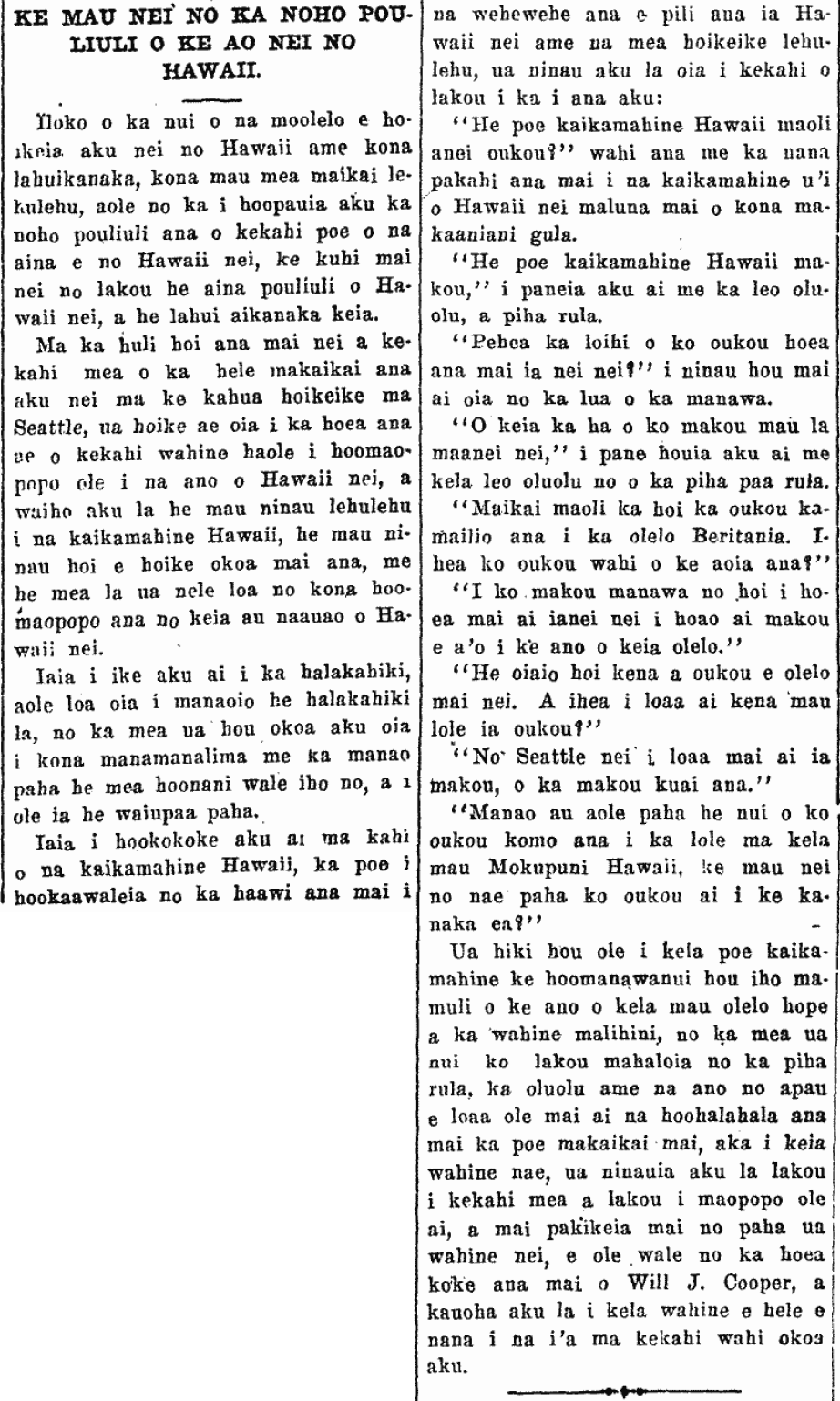
KE MAU NEI NO KA NOHO POULIULI O KE AO NO HAWAII.

Ka Nupepa Kuokoa, Buke XLVI, Helu 35, AoAo 6. Augate 27, 1909.

More Lei Day in Honolulu, 1928.

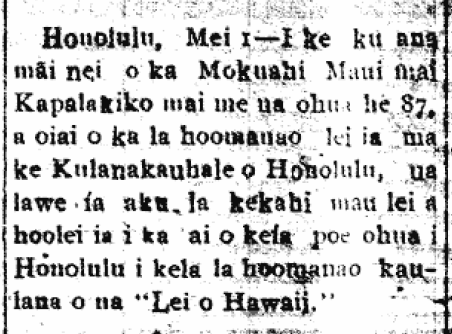
Honolulu, May 1—When the Steamer Maui from San Francisco docked with 87 passengers, and being that it was the day to celebrate lei in the City of Honolulu, lei were brought and the necks of the passengers in Honolulu were adorned with lei, on this famous day to celebrate the Lei of Hawaii.

(Hoku o Hawaii, 5/8/1928, p. 2)

Honolulu, Mei 1...

Ka Hoku o Hawaii, Buke XXI, Helu 48, Aoao 2. Mei 8, 1928.

No matter how drastically some things may change, other things just seem to remain the same? 1912.

TINY PARKS ON KALAKAUA AVENUE

In between Kalakaua Avenue are being placed tiny Parks, fifty feet long by twenty feet wide. These parks are right in front of D. Kalauokalani’s place, and parks of those type are being built until Pawaa, and perhaps all the way until the Moana Hotel. The insides of these tiny parks will be planted with all sorts of flowers to delight the eyes of the travellers when they see them.

These types of parks have been built in the father land [America] and the large countries of the world, and this is perhaps the first to be seen here in Honolulu nei. Maybe it will raise the status of this city, but the strange thing about this type of construction is that the bad conditions of the roads still remain, and that there are others that want the same for their streets; but the response from the government is that there is no money—yet this costly endeavor is being taken care of quickly. So very humorous.

(Kuokoa Home Rula, 3/1/1912, p. 1)

MAU PAKA LIILII MA KALAKAUA AVENUE

Kuokoa Home Rula, Buke X, Helu 9, Aoao 1. Maraki 1, 1912.

Opposition to Hula in West Coast of the U. S., 1916.

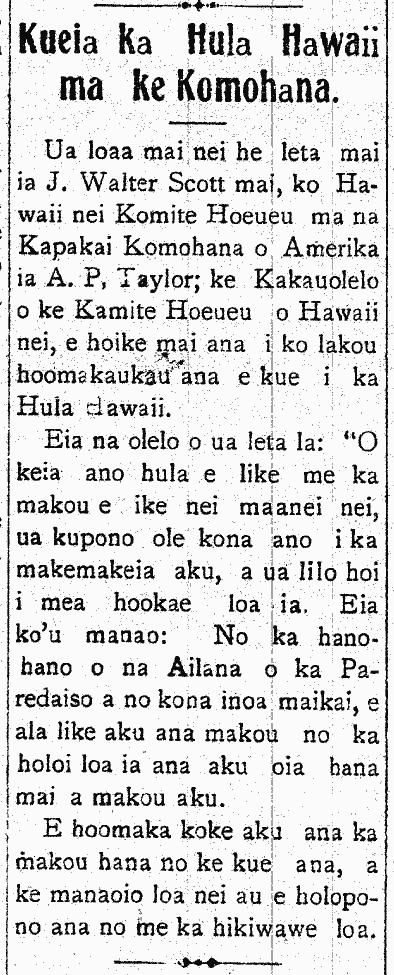
Opposition to Hawaiian Hula in the West.

A. P. Taylor, the Secretary of the Promotion Committee of Hawaii, received a letter from J. Walter Scott, the representative of the Promotion Committee on the West Coast of America, speaking of their preparations to oppose Hawaiian Hula.

Here is what was said in the letter: “The kind of hula that we are witnessing here, it is not according to what is wanted, and is something that has become abhorred. This is what I think: For the honor of the Islands of Paradise, and for its good name, we rise as one to obliterate for good that act from amongst us.

We will begin this opposition immediately, and I trust it will move forward in no time.

(Puuhonua, 9/1/1916, p. 5)

Kueia ka Hula Hawaii ma ke Komohana.

Ka Puuhonua, Buke III, Helu 33, Aoao 5. Sepatemaba 1, 1916.