WRITES LEI DAY SONG
Mrs. Mary Robins, right, who has composed a song, “Lei Day,” which she and her daughter, Mrs. Mattie R. Caminos, sang today at the Bank of Hawaii. Continue reading

Mrs. Mary Robins, right, who has composed a song, “Lei Day,” which she and her daughter, Mrs. Mattie R. Caminos, sang today at the Bank of Hawaii. Continue reading
O Hae Hawaii:—Aloha oe:
A friend of ours has died on the 1st of Mei, 1860; that is Abela Kekamakahi, someone loved by everyone.
This is why he died; he had a distended stomach [opu ohao], which he had for four months. He was treated by a haole man, and received comfort, thereafter he relapsed, and a Hawaiian kahuna appeared named Keahilele, and with his treatment, his body received no comfort. Continue reading
Mrs. Ellen Akana who won the $25 Lei Day prize for the most beautiful entry by a lei seller. The lei was made of violets, roses and baby’s breath with maiden hair.
(Star-Bulletin, 5/7/1928, p. 5)
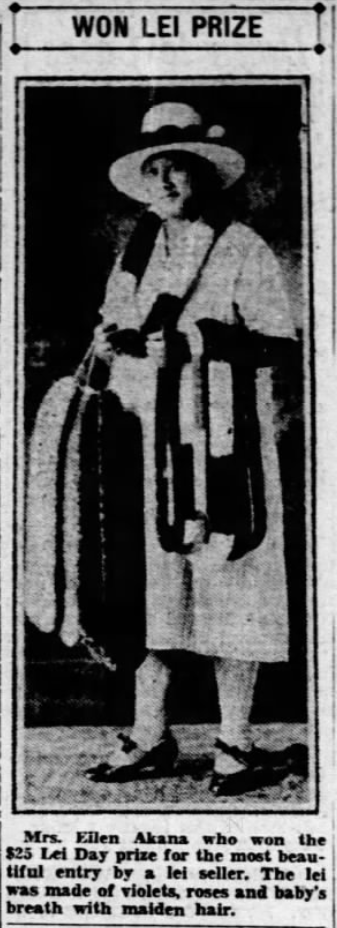
Honolulu Star-Bulletin, Volume XXXV, Number 11,338, Page 5. May 7, 1928.
MARGARET DE LA CRUZ, whose cheerful smile is familiar to all who visit the docs on streamer days, is representative of the typical Hawaii lei woman.
(Advertiser, 5/1/1928, p. 1)
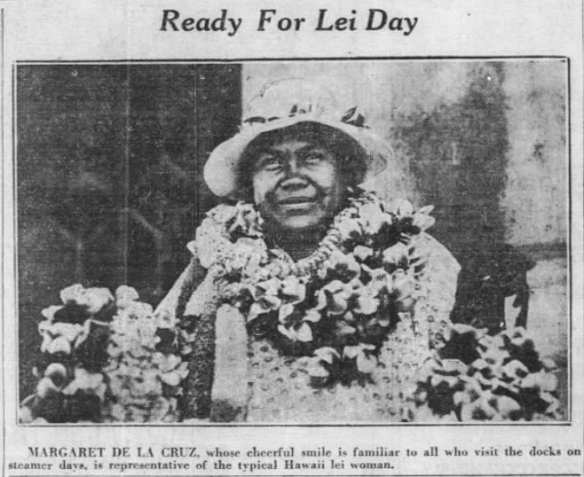
Honolulu Advertiser, 70th Year, Number 14,793, Page 1. May 1, 1928.
MRS. MARY ROBBINS, the composer of “Honolulu Harbor,” the latest hit of popular Hawaiian melody, sang her own composition on the first annual Lei day of Honolulu at Bank of Hawaii on May 1. Continue reading
O Hawaii Ponoi Newspaper, aloha kaua. Please permit me to place my light parcel in an open space of your columns so that our friends may see, from the rising of the sun to the setting of the sun. Continue reading
Doctor for the leprosy patients.—D. Kaiuokalani of Leleo, Honolulu, presented a letter asking the Board of Health [Papa Ola] to permit him to go and treat the leprosy patients. Continue reading
Pertaining to Kalawao. This past Tuesday, some people with leprosy [mai pake] were sent again to Kalawao, Continue reading
—On the 30th of April another case occurred near Hanalei, Kauai, which, though it did not result in murder, shows that the natives are rapidly progressing in all the attendant arts of civilization. A colored man of Wainiha, named William Hodges, and a married man, Continue reading
Attempt at Strangling.—We learn that on the 30th ult., at Wainiha, Kauai, a colored man, named William Hodges, narrowly escaped being strangled by having had a lasso put around his head, while asleep, by parties operating from outside the house, assisted by some one of the inmates. Investigation of the parties is now being held.
(Polynesian, 5/10/1862, p. 3)
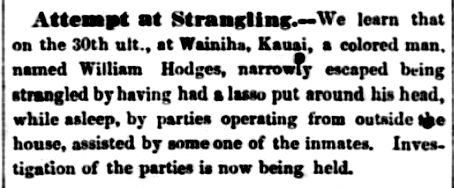
Polynesian, Volume XIX, Number 2, Page 3. May 10, 1862.
 nupepa