HAWAIIAN HULA IN PHILADELPHIA, AMERICA
At a party given in Philadelphia some weeks ago, according to news received, the thing that was most delightful was the Hawaiian hula portion. Continue reading
At a party given in Philadelphia some weeks ago, according to news received, the thing that was most delightful was the Hawaiian hula portion. Continue reading
By A. K. POEPOE
(This is the second article by Mr. Poepoe, a Normal school instructor, telling of Hawaiian tone production methods.)
A story obtained from Kona, Hawaii, and recorded by the late Dr. Emerson, mentioning one of the methods used for the training of the chanters conveys to me several fundamental principles vital to vocal art, that aid in verifying the distinct tone focus and timbre in the Hawaiian voice.
“It refers to a little pool of shallow water in the rocks by the sea at Kailua, Hawaii, where the sun was reflected late every afternoon for a considerable interval. This and similar pools were called ‘poho na’u,’ poho, meaning both a depression in the surface and to blow gently. These pools were great swimming centers in olden times. Continue reading
By A. K. POEPOE
With the advent of various mechanical music devices in the homes and public places, foreign tone qualities are being heard and are gradually replacing the distinct Hawaiian tones, so noticeable in Hawaiian songs. I feel it my duty to call the attention of the Hawaiian singers and lovers of Hawaiian vocal art to the fact that the peculiar Hawaiian tone quality that made Hawaii famous has a distinct focus in the vocal organs.
I feel that unless we distinguish the placement of our tones with its characteristics, and our phonetic system, in the vocal organs, from those we hear, the future generations will sing Hawaiian compositions, Hawaiian words, Hawaiian interpretation, with a foreign tone quality.
In written music we have artificial means of preserving the music by musical notations, whereas, in vocal singing we have to depend upon sensations felt in the vocal organs. Continue reading
A he ohohia nui no Keoni Waika
Ka elele hiwahiwa a ka lahui
Hui like mai kakou
E koho me ka lokahi.
Hookahi mea nui i anoi ia
O ka pono kaulike o ka lehulehu
Mai Hawaii o Keawe
A Kauai o Mano. Continue reading
(HULA)
Auhea wale oe ke ala
E maalo nei i kuu maka
Ua kuhi au aia la me oe
O kuu lei ahihi i ka uka
A heaha la hoi keia
A ka nui manu ae wa nei
Me he la e i mai ana
Ilaila pu aku kaua Continue reading
I Maui au a huli hoi mai,
Loheia mai ana ua meahou,
Ma ka leka au a i ike iho ai,
Na hana hakuepa a ka lokoino;
Owau ka i lawe olelo ia,
He kahuna lapaau hoopunipuni,
O ko’u Makua lani maluna,
O ko’u mua ia ma ka’u hana.
O Kona mana piha ko’u aahu,
O Kana olelo ka’u ai ia,
Ka Uhane Hemolele ko’u Alakai,
A kuu kino a e haaheo nei. Continue reading
Hawaiian Music.—It is something to hear of Hawaiians, who but a few years ago, as a nation, possessed no other songs but the semi-barbarous Meles of their ancestors, and no other music than the montonous “ah—ah,——o—oo—u—uu,” of former years,—it is something pleasingly new to have to note the appearance of a neatly lithographed sheet of music for sale in the bookstore, both the words and music of which were composed by a Hawaiian lady. The title describes the sentiments expressed in the composition—”He Mele Lahui Hawaii,” or, in English, “A Hawaiian National Hymn.” The words are not rhyme, but read smoothly, with the euphony characteristic of the Hawaiian tongue, and the music is very sweet, the first few bars resembling those of the popular song of “Hazel Dell.” When sung by a full choir of natives, many of whom, male and female, have well managed voices of peculiar sweetness of tone, the “National Hymn,” expressing as it does both piety and patriotism, cannot fail to become popular. The lithography is very creditably done at Newcomb & Co’s book-bindery. We subjoin a translations of the words:
Almighty Father, bend thine ear,
And list the nation’s prayer,
That lowly bows before thy throne,
And seeks thy fostering care.
Grant thy peace throughout the land,
O’er each sunny sea-girt isle;
Keep the nation’s life, O Lord,
And upon our Sovereign smile. Continue reading
Pertaining to the Queen.—Queen Emma has returned from her tour of Wailuku on this past Tuesday evening of May, and it was at 8 o’clock that she reached here in Lahaina. She was accompanied by the distinguished ones of the valley shade [ka malu hekuawa], and she returned with her attendants who went along, His Ex. P. Nahaolelua, Col. D. Kalakaua, Hon. P. Y. Kekuaokalani, Hon. A. M. Kahalewai and Mrs. Kalakaua.
Exhibit of paintings.—This past Thursday night, there was a great exhibit of illustrations at the School of the English Mission; there were many portraits shown that night, all of Hawaii’s Alii; and we admired all of the paintings, and they were done with skill; in attendance as well was the Queen.
A Party.—On the evening of Thursday, Reverend G. Mason held a party to honor the Queen, and those who were instructed, and everything carried out at the party was gracious, and the tables were laden with things of all sorts, and we ate until satiated, and a most was leftover. Continue reading
I am a candidate running for the position of supervisor in the Democratic party. I am Portuguese by birth, but I was born in Kohala, Hawaii, therefore, I am Hawaiian, without anyone denying this; I have many children in Hawaii who live here as their homeland and will lie in my dear land that I love.
I am a laborer, and work for the good of the laborers at all times, and thereby for the public, without regard for that but for equality.
Give your ballots for me this coming Saturday. I am your son, O Hawaii, to be proud of. Grant me an olive branch of aloha.
(Aloha Aina, 5/25/1917, p. 2)
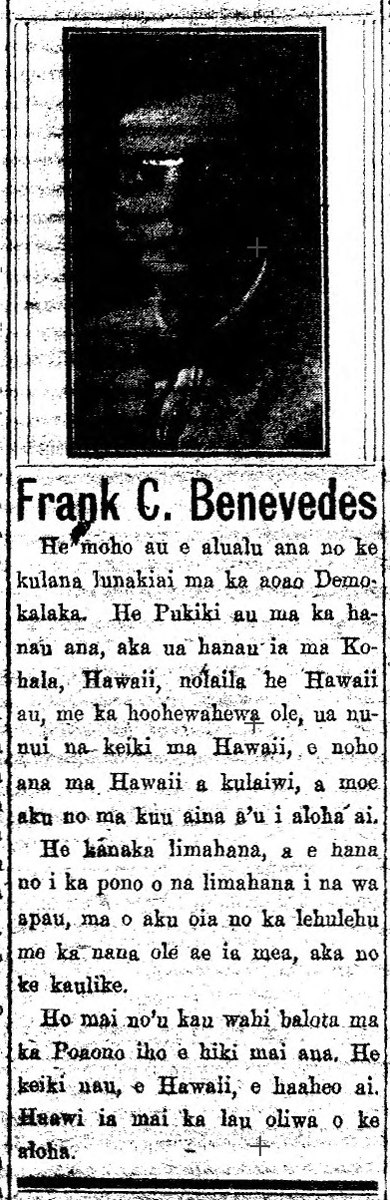
Ke Aloha Aina, Buke XXII, Helu 21, Aoao 2. Mei 25, 1917.
Candidate for Sheriff.
As I announce my candidacy for Sheriff on the Republican Ballot in the upcoming Election Season, I would like to make clear that I stand on the platform of good, and should I be elected, I will carry out all things so that everyone will be pleased. I ask humbly for your support.
(Puuhonua o na Hawaii, 5/25/1917, p. 4)
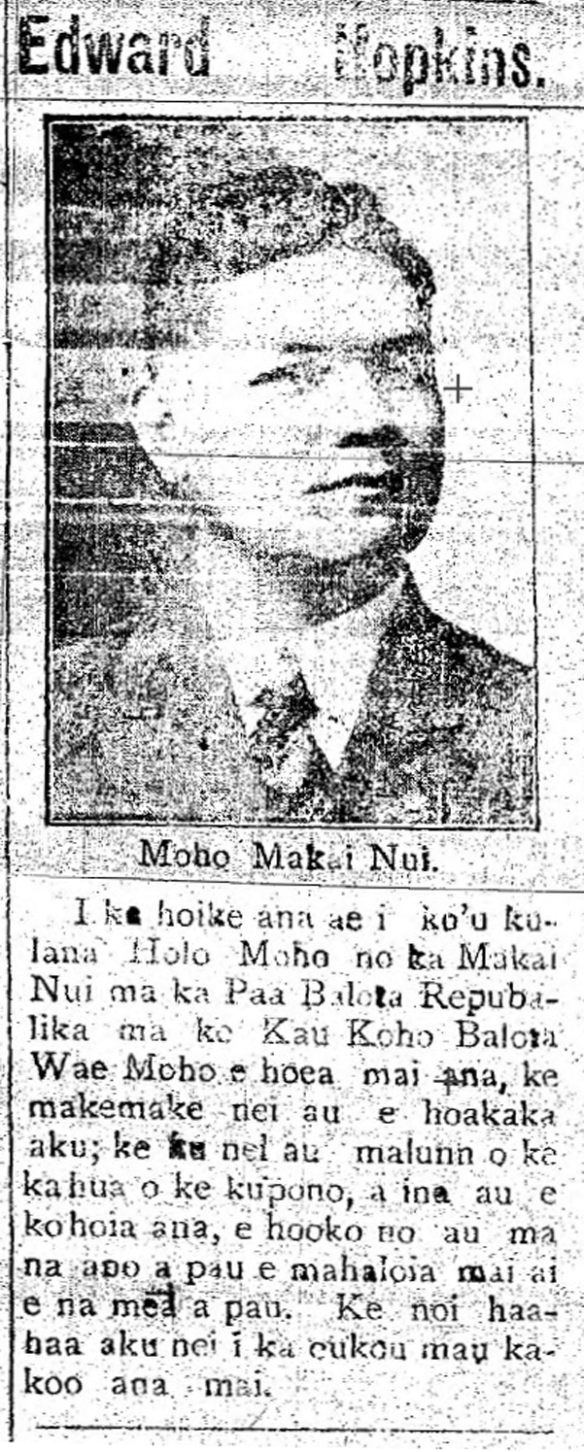
Ka Puuhonua o na Hawaii, Buke IV, Helu 21, Aoao 4. Mei 25, 1917.
 nupepa