Hilo’s Palace Theatre, 1925.

THE PALACE THEATRE

The astonishingly beautiful Theatre was just completed, and it was dedicated [hoau ia] in the evening of this past Monday, and a great crowd filled this very first opening.

A Hawaiian established this beautiful building here in Hilo, and it can accommodate 813 guests. It is divided up into various sections, and there are proper seats located everywhere, and the moviegoers at all times will sit in true comfort. Continue reading

Who is Mary? 1915.

A Letter From California.

San Diego, Jan. 4, 1915.

My Dear Papa:

How are you? I have a few minutes to write some short lines to you that I believe will make you happy.

 We arrived here in the evening of the 27th of December, 1914, and we are now at the Fair proper, in the area that features Hawaii. Our trip here was fine except for the first day after leaving home. Oh my how sick I was, with continuous nausea! But after that, it was a beautiful voyage by the seafaring steed, the “Sierra.”

We landed in San Francisco in the afternoon of Christmas day, and went touring about for two hours, then we boarded the steamship “Congress” for San Pedro, and spent the night there. We went into the movie houses and went to Long Beach to see the swimming beaches. We are all doing well, and the nights are pretty cold.

The Fair¹ opened on the night before the new year, and it is progressing nicely. I haven’t had time to go and see my cousins because I am always busy with work, and cannot just leave without permission.

O Papa, I can’t write a long letter, because I have only a little time; with hope that you are doing well, and I am happy to hear from you.

Goodbye, dear Papa, with much aloha.

Your daughter,

MARY.

¹This is a reference to the Panama-California Exposition.

(Aloha Aina, 1/23/1915, p. 1)

Ke Aloha Aina, Buke XIX, Helu 69, Aoao 1. Ianuari 23, 1915.

Ke Aloha Aina, Buke XIX, Helu 69, Aoao 1. Ianuari 23, 1915.

More on the wax cylinder of Kalakaua, 1891.

A VOICE FROM THE DEAD.

Just before the last call of the reaper whose powerful scythe severed the connections of King Kalakaua with mundane matters, His Majesty was visited by Mr. Louis Glass, agent of the Edison Phonograph Co., and by request spoke into a cylinder of the machine. His Majesty spoke the following, as an experimental trial, having intended, when in better health to speak more at length. The Editor of the Paradise of the Pacific obtained the following carefully prepared translation of His Majesty’s words, the rendition being made by Mr. James I Dowsett, Jr., of Honolulu, at his request:

“Aloha kaua—Aloha kaua. Ke hoi nei no paha makou ma keia hope aku i Hawaii, i Honolulu. A ilaila oe e hai aku ai oe i ka lehulehu i kau mea e lohe ai ianei.”

[Translation.]

“We greet each other—We greet each other. We will very likely hereafter go to Hawaii, to Honolulu. There you will tell my people, what you have heard me say Here.”

(Paradise of the Pacific, 2/1891, p. 2)

A VOICE FROM THE DEAD.

Paradise of the Pacific, Volume IV, Number 2. February 1891.


Report of Kalakaua’s death from the “San Francisco Chronicle,” 1891.

KALAKAUA DEAD

Last Hours of the Hawaiian Monarch.

Solemn Scenes at the Royal Bedside.

The Succession and the Political Situation.

Sketches of the Dead Sovereign and of the Heirs to the Throne.

Kalakaua I., King of the Hawaiian Islands, is dead. He expired at 2:33 o’clock yesterday afternoon in his room at the Palace Hotel, where for three days he had lain unconscious on his bed. Surrounding him at the moment of his death were Col. Macfarlane, the King’s Chamberlain; Col. Hoapili Baker, His Majesty’s Equerry-in-waiting; Hawaiian Consul McKinley, Admiral Brown, U. S. N. Rev. J. Sanders Reed, Rev. F. H. Church and a number of personal friends of the King. Immediately after the death, Admiral Brown notified the Secretary of the Navy of that fact, Mayor Sanderson was also notified, and he called a meeting of the Supervisors for 9 o’clock this morning to consider proper action in the matter. The remains were embalmed and this afternoon they will be removed to the mortuary chapel of Trinity Church, where they will be guarded by a detail of United States soldiers.

At the Deathbed.

The Scenes in the Chamber of the Dying Monarch.

It was a pitiful and most impressive scene. The dying monarch lay gasping upon his bed, his emaciated body heaving convulsively with each of his labored respirations. At the bedside stood two ministers of the Gospel, physicians of the body had given way when they had come to the sad conclusion that Kalakaua was beyond mortal aid. Seated at the head of the bed, clasping the left hand of his King was Col. Baker, Kalakaua’s Aid-de-camp, whose strong frame was bent with sorrow, and who with great difficulty kept back the flood of tears which trembled in his eyes. Bending over from the right side was Col. Macfarlane, Chamberlain of the King. The suspense of the last few days had almost prostrated him, and his face bore traces of weeping. Crouched upon the floor against the wall near the bedside were the King’s valet Kahikina, an Hawaiian youth, and Kalua, a young girl from the Gilbert islands, who had been a most devoted servant to Kalakaua. They formed part of his suite on his arrival here.

Only a light coverlet of rich brown design covered the body of the King. In his struggles to throw off the firm reaper who was gradually pressing more heavily upon him, Kalakaua had thrust his arms out upon the bed. During the forenoon his faithful servant Kalua, in an endeavor to make the King as comfortable as possible, had placed beneath his chin a wide soft scarf of blue silk. There it remained until the death, seeming as it rose and fell upon the bright red undershirt to be symbolical of the wavering between this and the great beyond of the spirit of the stricken King.

Kalakaua was possessed of great vitality, and to the last he resisted the destroyer with a persistence which excited the wonder of the medical men, who knew that the King’s time had come. Though for three days past he had been unconscious and life had apparently been kept in him merely by the stimulants applied internally through natural channels or hypodermically, his constitution seemed determined to keep the spirit with the trembling body. Even after the physicians had relinquished all hope and, knowing that he must die, had ceased to apply stimulants, he continued to struggle on.

During the morning Drs. Woods, Watts, Sanger and Taylor were in attendance.

They consulted and announced that in their opinion the King would not live more than a few hours. He had then been unconscious for nearly forty hours, with the exception of one brief moment in the early morning, when he recognized Admiral Brown and spoke to Colonel Baker saying:

“Well, I am a very sick man.” Continue reading

More “last words” of King Kalakaua, 1891.

[Found under: “NU HOU HAWAII.”]

These are the very last words of King Kalakaua at the colony of Kalaupapa before he left Hawaii nei for California: “You all are good, and gracious; your dwellings are good and so are all things; however as for those who practice sorcery [poe anaana], have them go elsewhere.”  S. L. Hulipono.

(Kuokoa, 6/13/1891, p. 3)

Eia ka olelo hope loa...

Ka Nupepa Kuokoa, Buke XXX, Helu 24, Aoao 3. Iune 13, 1891.

Last words of the King, 1891.

Kalakaua’s Last Words Preserved by Phonograph.

Outside the little circle of immediate friends and attendants upon the late King Kalakaua who were admitted into the sick chamber it is not known that for the ten days prior to the monarch’s death an Edison phonograph stood near the bedside. Many who saw the instrument daily never suspected its character or use, and during the excitable days preceeding the King’s death, during which every nerve was taxed to its greatest tension, the innocent-looking little machine reposed in its shaded corner unnoticed and unobserved by all except the King’s chamberlain and his secretary. Continue reading

Kukuiolono Park opens, Nov. 3, 1911.

BIG DAY IS ON FOR NOVEMBER 3. IN PARK

Hanalei School Items Show a Continued Interest is Still Kept Up in Our National Sport

C. MASER WINS THE FIRST PRIZE

Many Entries Enlivens The Contest S. E. Lucas, Opticians, Will Arrive on The Kinau Tomorrow

November third will be a big day at the Kukuiolono Park, the new McBryde Park. The occasion will be the celebration of the Mikado’s birthday anniversary and the amusements arranged for the day include horse racing, sulky racing, bicycle and foot racing, as well as various other athletic sports. Continue reading

Kukuiolono Park dedicated, 1911.

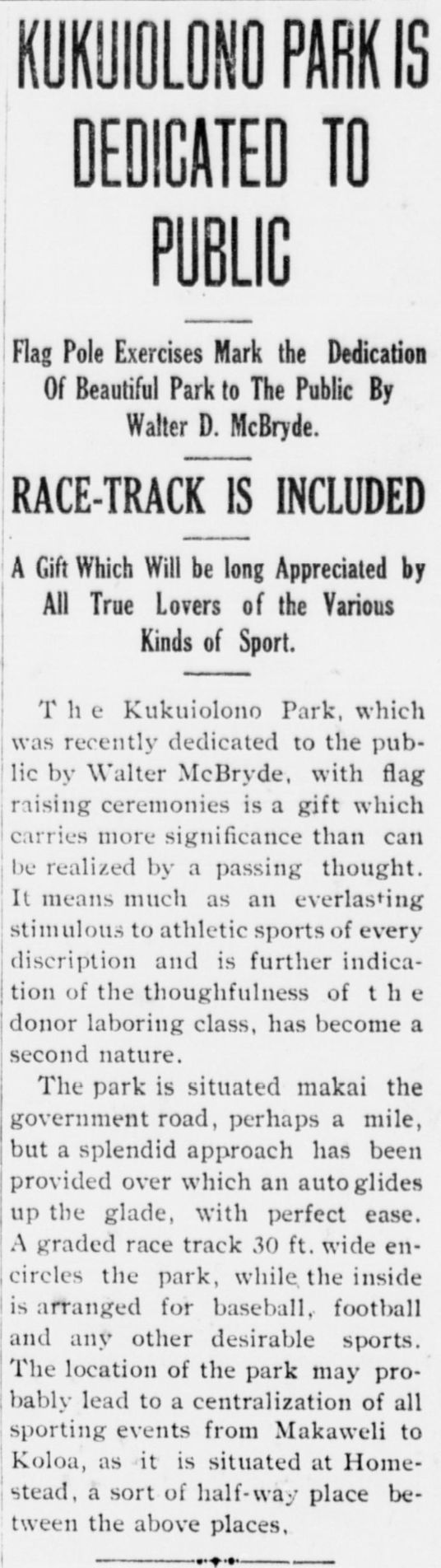
KUKUIOLONO PARK IS DEDICATED TO PUBLIC

Flag Pole Exercises Mark the Dedication Of Beautiful Park to The Public By Walter D. McBryde.

RACE TRACK IS INCLUDED

A Gift Which Will be long Appreciated by All True Lovers of the Various Kinds of Sport.

The Kukuiolono Park, which was recently dedicated to the public by Walter McBryde, with flag raising ceremonies is a gift which carries more significance than can be realized by a passing thought. It means much as an everlasting stimulous to athletic sports of every discription and is further indication of the thoughtfulness of the donor laboring class, has become a second nature.

The park is situated makai the government road, perhaps a mile, but a splendid approach has been provided over which an auto glides up the glade, with perfect ease. A graded race track 30 ft. wide encircles the park, while the inside is arranged for baseball, football and any other desirable sports. The location of the park may probably lead to a centralization of all sporting events from Makaweli to Koloa, as it is situated at Homestead, a sort of half-way place between the above places.

(Garden Island, 10/31/1911, p. 1)

KUKUIOLONO PARK IS DEDICATED TO PUBLIC

The Garden Island, Volume 8, Number 43, Page 1. October 31, 1911.

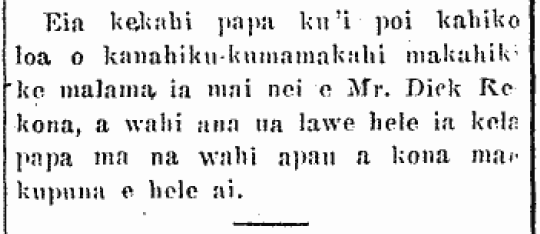
Walter McBryde purchases Kukuiolono, 1907.

[Found under: “COMMERCIAL NEWS By Daniel Logan”]

LAND MATTERS.

All of the interests of the estate of the late L. Ahlo in the rice industry were bought at auction sale on Monday by Jas. F. Morgan, trustee, and have since been incorporated under the name of Kaneohe Rice Mill Co., Ltd., with a capital of $50,000, the incorporators being Arnim Haneburg, W. Pfotenhauer, Geo. Rodiek, August Humburg and P. Bartels.

An agreement of sale has been made by the government with Walter McBryde for the mountain lot of Kukuiolono, in the Kalaheo tract, Kauai. The price is $894, one-tenth deposited on signing of papers, and the purchaser agrees to plant 3000 trees every year for ten years on the land. At the end of that period he is to receive a deed of the lot. The purpose of the agreement is stated to be conservation of the forest and of its water resources.

…..

(Sunday Advertiser, 1/13/1907, p. 4)

LAND MATTERS.

Sunday Advertiser, Volume V, Number 211, Page 4. January 13, 1907.

Sale of Kukuiolono lands, 1906.

GOVERNMENT LANDS ANNOUNCEMENT.

ANNOUNCING THE SALE OF SOME GOVERNMENT LANDS KNOWN AS THE “KUKUIOLONO LOT,” KALAHEO, KAUAI.

At 12 o’clock noon, on Monday, January 7, 1907, at the front of the Judiciary Building [Hale Hookolokolo] of Honolulu, there will be a public auction under the provisions of Section 17, Part IV, Land Act, 1895. (Section 276, Revised Laws of Hawaii.), the above premises consisting of 178.2 acres of mountain pastoral land. Continue reading