Even more deaths from Kalawao, 1887.

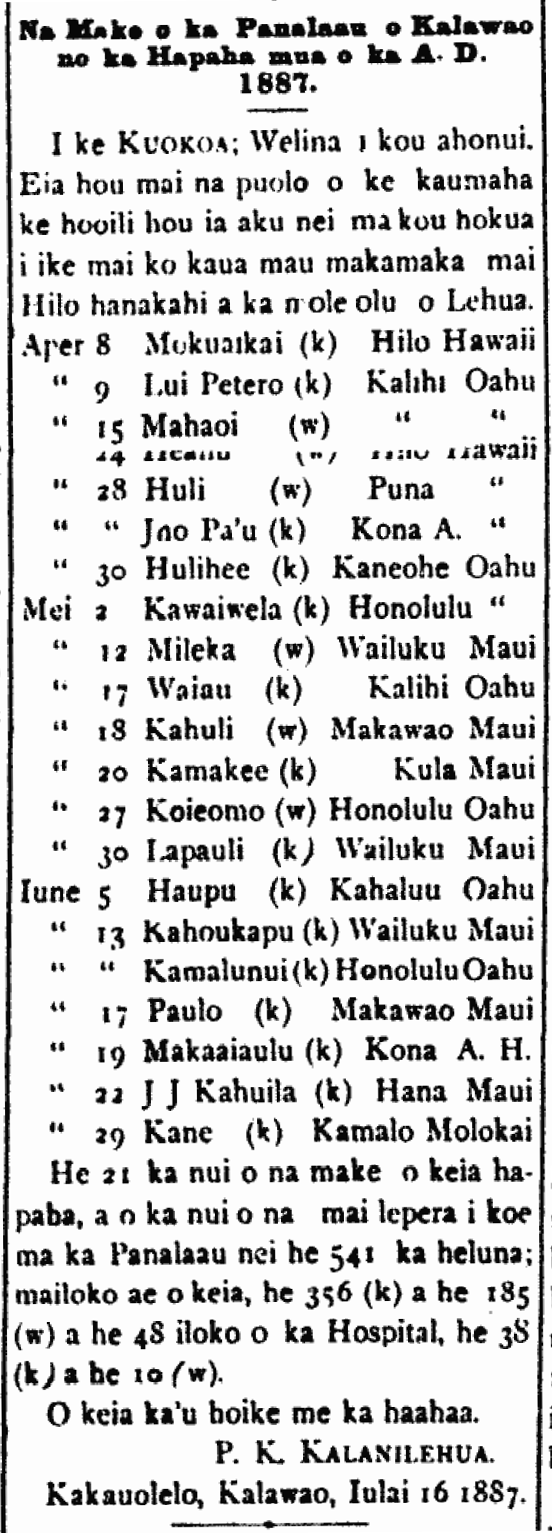
Deaths in the Colony of Kalawao for the first Quarter of the year 1887 A. D.

To the Kuokoa; Salutations to your patience. Here again is a sad delivery to be loaded upon your shoulders so that our friends from Hilo Hanakahi all the way until the pleasant base of Lehua [the whole archipelago] may see.

Apr. 8 Mokuaikai (m) Hilo, Hawaii

” 9 Lui Petero (m) Kalihi, Oahu

” Mahaoi (f) ” “

” 24 Heanu (f) Hilo, Hawaii¹

” 28 John Pa’u (m) North Kona, “

” 30 Hulihee (m) Kaneohe, Oahu

May 2 Kawaiwela (m) Honolulu, “

” 12 Mileka (f) Wailuku, Maui

” 17 Waiau (m) Kalihi, Oahu

” 18 Kahuli (f) Makawao, Maui

” 20 Kamakee (m) Kula, Maui

” 27 Koieomo (f) Honolulu, Oahu

” 30 Lapauli (m) Wailuku, Maui

June 5 Haupu (m) Kahaluu, Oahu

” 13 Kahoukapu (m) Wailuku, Maui

” ” Kamalunui (m) Honolulu, Oahu

” 17 Paulo (m) Makawao, Maui

” 19 Makaaiaulu (m) North Kona, Hawaii

” 22 J. J. Kahuila (m) Hana, Maui

” 29 Kane (m) Kamalo, Molokai

There were 21 who died this quarter, and the number of remaining leprosy patients here in the Colony is 541; from within this number, 356 are male, and 185 are female; and 48 are in the Hospital of which 38 are male and 10 female.

This is my report with humility.

P. K. Kalanilehua.

Secretary, Kalawao, July 16, 1887.

¹ This line is folded under and can’t be seen clearly. There are many pages of newspaper images like this, and this is just another reason that the newspapers have to be unbound and flattened out so that they can be shot clearly.

(Kuokoa, 7/23/1887, p. 4)
Na Make o ka Panalaau o Kalawao no ka Hapaha mua o ka A. D. 1887.

Ka Nupepa Kuokoa, Buke XXVI, Helu 30, Aoao 4. Iulai 23, 1887.
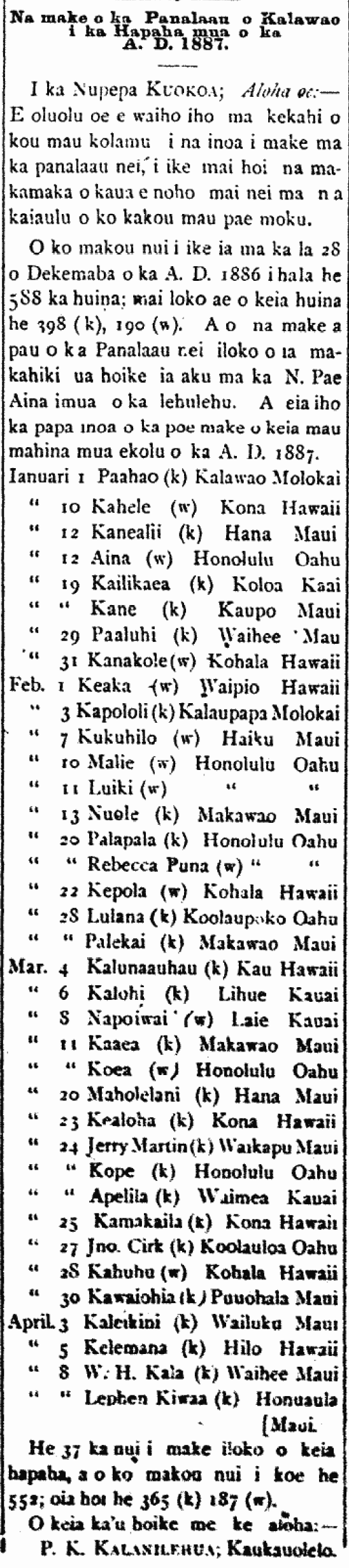
More deaths in Kalawao, 1887.

The deaths in the Colony of Kalawao in the first Quarter of the year 1887 A. D.

To the Kuokoa Newspaper; Aloha oe:—Please put in one of your columns the names of those who died in this colony, so that our friends living in the neighborhoods of our archipelago may see.

The numbers of us known on the 28th of December of the past year 1886 A. D. were 588 total; of this, 398 were males and 190 were females. And the total deaths in this Colony during that year were shown before the public in the Newspaper Pae Aina [Ko Hawaii Pae Aina]. And here below is the list of people who died in the first three months of 1887 A. D.

January 1, Paahao (m) Kalawao, Molokai

” 10, Kahele (f) Kona, Hawaii

” 12 Kanealii (m) Hana, Maui

” 12 Aina (f) Honolulu, Oahu

” 19 Kailikaea (m) Koloa, Kauai

” ” Kane (m) Kaupo, Maui

” 29 Paaluhi (m) Waihee, Maui

” 31 Kanakole (f) Kohala, Hawaii

Feb. 1 Keaka (f) Waipio, Hawaii

” 3 Kapololi (m) Kalaupapa, Molokai

” 7 Kukuhilo (f) Haiku, Maui

” 10 Malie (f) Honolulu, Oahu

” 11 Luiki (f) ” “

” 13 Nuole (m) Makawao, Maui

” 20 Palapala (m) Honolulu, Oahu

” ” Rebecca Puna (f) ” “

” 22 Kepola (f) Kohala, Hawaii

” 28 Lulana (m) Koolaupoko, Oahu

” ” Palekai (m) Makawao, Maui

Mar. 4 Kalunaauhau (m) Kau, Hawaii

” 6 Kalohi (m) Lihue, Kauai

” 8 Napoiwai (f) Laie, Kauai

” 11 Kaaea (m) Makawao, Maui

” ” Koea (f) Honolulu, Oahu

” 20 Maholelani (m) Hana, Maui

” 23 Kealoha (m) Kona, Hawaii

” 24 Jerry Martin (m) Waikapu, Maui

” ” Kope (m) Honolulu, Oahu

” ” Apelila (m) Waimea, Kauai

” 25 Kamakaila (m) Kona, Hawaii

” 27 John Cirk (m) Koolauloa, Oahu

” 28 Kahuhu (f) Kohala, Hawaii

” 30 Kawaiohia (m) Puuohala, Maui

April 3 Kaleikini (m) Wailuku, Maui

” 5 Kelemana (m) Hilo, Hawaii

” 8 W. H. Kala (m) Waihee, Maui

” ” Lephen Kiwaa (m) Honuaula, Maui.

There were 37 deaths in this quarter, and the number of us remaining are 552; that being 365 males and 187 females.

This is my report, with aloha:—

P. K. Kalanilehua; Secretary.

(Kuokoa, 5/14/1887, p. 3)

Na make o ka Panalaau o Kalawao i ka Hapaha mua o ka A. D. 1887.

Ka Nupepa Kuokoa, Buke XXVI, Helu 20, Aoao 3. Mei 14, 1887.

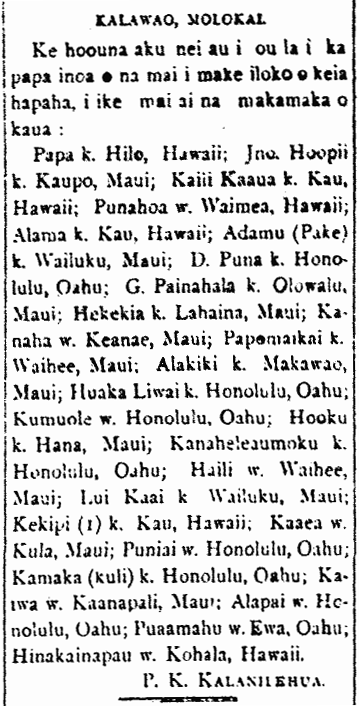
Patients at Kalawao who passed on. 1887.

[Found under: “Correspondences from Our Friends.”]

KALAWAO, MOLOKAI.

I am sending you the list of names of the patients who died this quarter; let our friends see this:

Papa (m.) Hilo, Hawaii; John Hoopii (m.) Kaupo, Maui; Kaiii Kaaua (m.) Kau, Hawaii; Punahoa (f.) Waimea, Hawaii; Alama (m.) Kau, Hawaii; Adamu (Chinese m.) Wailuku, Maui; D. Puna (m.) Honolulu, Oahu; G. Painahala (m.) Olowalu, Maui; Hekekia (m.) Lahaina, Maui; Kanaha (f.) Keanae, Maui; Papomaikai (m.) Waihee, Maui; Alakiki (m.) Makawao, Maui; Huaka Liwai (m.) Honolulu, Oahu; Kumuole (f.) Honolulu, Oahu; Hooku (m.) Hana, Maui; Kanaheleaumoku (m.) Honolulu, Oahu; Haili (f.) Waihee, Maui; Lui Kaai (m.) Wailuku, Maui; Kekipi 1 (m.) Kau, Hawaii; Kaaea (f.) Kula, Maui; Puniai (f.) Honolulu, Oahu; Kamaka (deaf m.) Honolulu, Oahu; Kaiwa (f.) Kaanapali, Maui; Alapai (f.) Honolulu, Oahu; Puaamahu (f.) Ewa, Oahu; Hinakainapau (f.) Kohala, Hawaii.

P. K. Kalanilehua.

(Kuokoa, 11/5/1887, p. 4)

KALAWAO, MOLOKAI.

Ka Nupepa Kuokoa, Buke XXVI, Helu 45, Aoao 4. Novemaba 5, 1887.

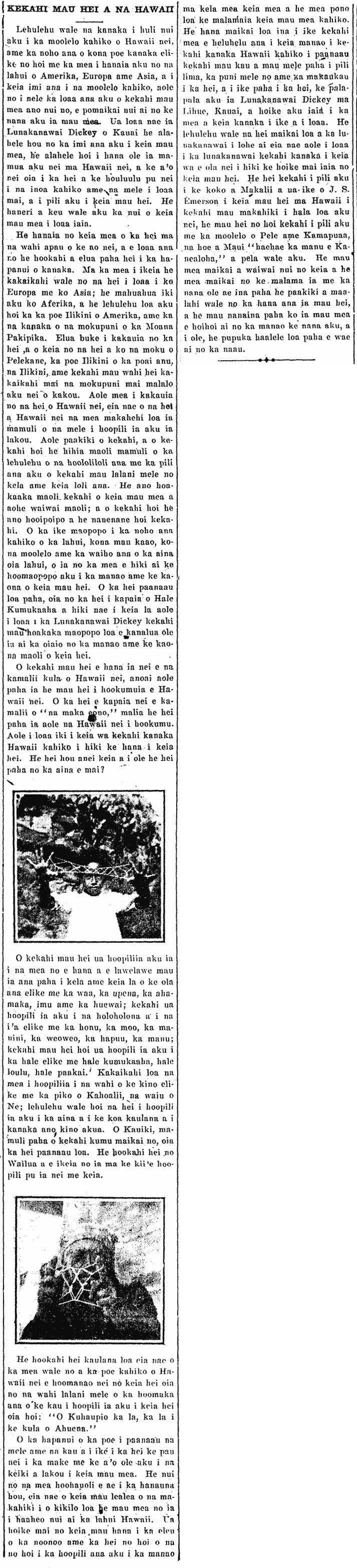
Hei, cat’s cradle, Hawaiian style, 1916.

Some String Figures of Hawaii

There are many people studying the history of Hawaii nei and the lifestyle of its people, like what has been done with America, Europe and Asia. And through this studying of history, there has not been a lack of new information which brings benefits by its study. However Judge [Lyle Alexander] Dickey has come up with a new path to this study, not utilized before in Hawaii nei. He is learning string figures, and is collecting the old names and the mele that go with these string figures. He now has about a hundred or more of them.

String figures is something done all over the world. And most people know one or two. From what is known, there is not much of them in Europe and Asia; there are a bit more in Africa; and there is a lot with the Indians of America and the people of the islands of the Pacific. There are two books on string figures of the islands of Britain, the Indians of the Arctic, the Indians, and a few from the islands to the south of us. There is nothing written on the hei of Hawaii nei, even if Hawaii’s figures are most wonderful for the mele which accompany them. Some are not difficult, however some are very problematic because of the many transformations, with different lines of mele going along with each change. Some are very humorous without value, while some are for wooing, while others are riddles. Knowing the way of life of the people, its tales, its history, and the lay of its lands—this is the means of understanding the meanings and kaona (underlying meanings) of these hei. Perhaps the most widely memorized figure is called Hale Kumukaaha. However to this day, Judge Dickey has not gained clarity as to the true meaning and kaona of this hei.

Some figures done by the school children of Hawaii are perhaps not originating in Hawaii nei. The hei called “six eyes” is probably not from here [the first image]. Not a single old Hawaiian can make this figure. Maybe it is a new figure or maybe one from outside of Hawaii.

Some of the hei are associated with daily life, like the canoe, the net, the hammock, the imu, and the water gourd. Some are associated with animals and fish, like the turtle, the mo’o, the manini, the aweoweo, the hapuu, and the bird. Some hei are associated with the house like the kumukaaha structure, the loulu structure, and the paakai structure. There are a very little hei pertaining to body parts, like the piko of Kahoalii and the breasts of Ne. There are many dealing with land and famous fishing shrines as well as men with god-like bodies. Kauiki, for probably a good reason is the most widely known figure. One hei is for Wailua and it is seen in the attached illustration.

There is one famous hei, but it is only known by the oldsters of Hawaii nei, of which is accompanied by the chant starting with: “O Kuhaupio ka la, ka la i ke kula o Ahuena.”

A majority of the people who have the song or chant memorized along with the figures, have died without teaching them to their children. There are so many other things that entertain the new generation, but this entertainment of times long ago is something that the Hawaiian people are proud of. This skill shows intelligence in making the figures and associating it to this thing or that, and it is important that this ancient knowledge be kept. It would be good if someone reading this knows of some old Hawaiian who has a chant or mele memorized close at hand, one who is fond of mele and versed in string figures, or one who knows string figures, that he should Judge Dickey in Lihue, Kauai and tell him of what this person knows. There are many different hei of which the judge has heard, however, he has not found someone now living who can show them to him. There is one that is associated with the net of Makalii that J. S. Emerson saw in Hawaii many years ago; there are also some associated with the story of Pele and Kamapuaa, the paddle o Maui, “haehae ka manu e Kanealoha,” and so forth. These are great and very valuable, and it is important that they be preserved without regard to its simplicity or difficulty. And it is perhaps something that will bring joy when witnessing it being done, or perhaps something exceedingly appalling to consider.

(Kuokoa, 6/9/1916, p. 3)

KEKAHI MAU HEI A NA HAWAII

Ka Nupepa Kuokoa, Buke LIV, Helu 23, Aoao 3. Iune 9, 1913.

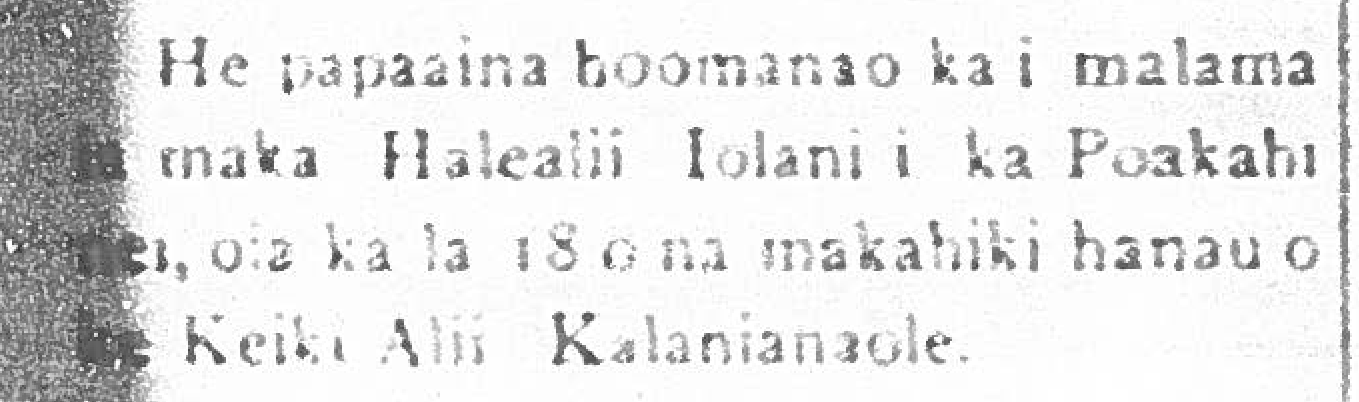
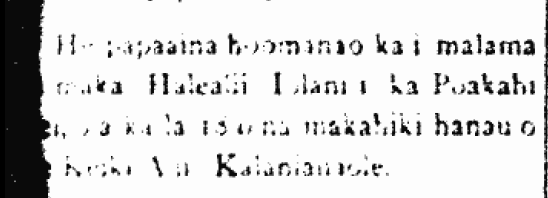
Prince Kuhio’s 17th birthday celebration redux—a little clearer, but still… 1888.

[Found under: “This and That.”]

A celebratory feast was held at Iolani Palace this past Monday; that was the 18th¹ birthday of Prince Kalanianaole.

[Compare this to the previous post. This  image was taken directly from the microfilm. At least the text, although barely, is legible. Many times even the microfilms are unclear. The Hawaiian-Language Newspapers deserve to be reshot clearly—the countless people who wrote in the Hawaiian-Language Newspapers deserve to have their words read and heard as they intended.]

The black to the left of the article is a shadow that was caused because the newspaper is bound tightly like a book, and when that page is shot, the left of the page curves down and falls in a valley. That is why although the binding of the issues allowed them to survive intact to today, it is not good for shooting images. The papers need to be first unbound and laid out flat so we can get as clear an image as possible.]

¹If Kuhio was born on March 26, 1871, he would have been 17 years old then.

(Kuokoa, 3/31/1888, p. 3)

He papaaina hoomanao ka i malama...

Ka Nupepa Kuokoa, Buke XXVIII, Helu 13, Aoao 3. Maraki 31, 1888.

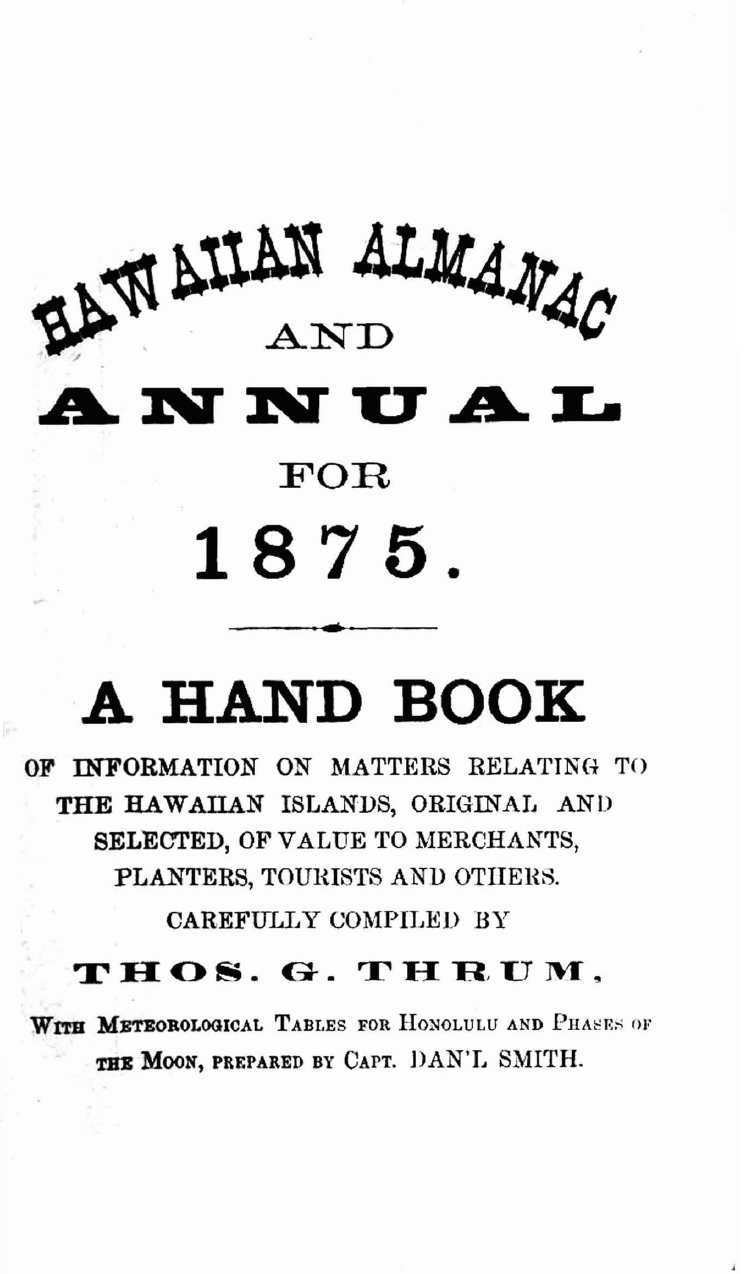
Statistics galore and useful information, 1875–1947.

If you haven’t heard of Thrum’s Hawaiian Almanac and Annual, check this out! And if you didn’t know that it is available online, here it is. This long running yearly publication contains a wide range of general information all in one place, and it can come in handy. Mahalo to the good folks at Hamilton Library’s Hawaiian Collection (5th floor) for putting up this helpful page!

About Thrum’s and About This Guide

HAWAIIAN ALMANAC AND ANNUAL FOR 1875.

First page of the first “Hawaiian Almanac and Annual”.

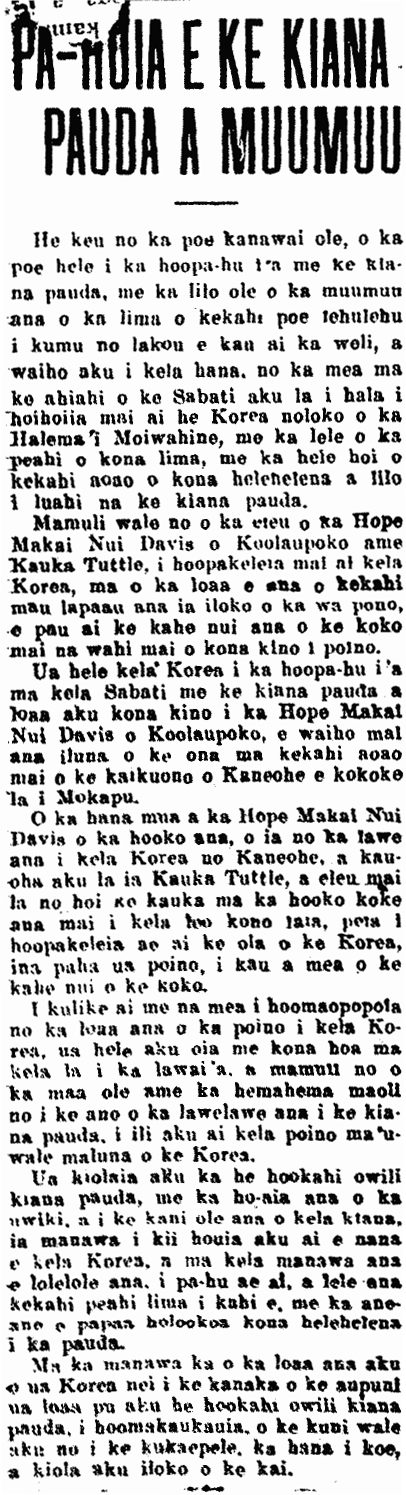
A “fishing” accident, 1913.

MAIMED FROM AN EXPLOSION OF GIANT POWDER

How reckless are the lawless, those who fish by setting off giant powder [kiana pauda] without fear resulting from the many people whose hands were maimed and without stopping this activity; because this past Sunday, a Korean was brought to the Queen’s Hospital with his hand blown off and a side of his face falling victim to the giant powder.

It was only because of the quick action taken by Deputy Sheriff [Hope Makai Nui] Davis of Koolaupoko and Dr. Tuttle that that Korean was saved by stopping the heavy bleeding from his injuries earlier in proper time.

That Korean went that Sunday to blast fish with giant power and his body was found by Deputy Sheriff Davis of Koolaupoko, he was lying on the sand on the side of Kaneohe Bay near Mokapu.

The first thing Deputy Sheriff Davis did was to bring that Korean to Kaneohe, and called for Dr. Tuttle; he hurried in answering to the call, and that is how the Korean’s life was spared; he was would have been in trouble because of the tremendous amount of bleeding.

According to what is understood about how that Korean received his injuries: he went with a friend that day to fish, and because he was not accustomed to and very inept at handling giant powder, that is how this senseless tragedy befell him.

A twist of giant powder was thrown after lighting the fuse, and because it did not go off, that Korean went to grab it and check it out, and while he was handling it, it exploded, and his had flew off, and almost his whole face was burnt by the powder.

When the government man found the Korean, found also was a twist of giant powder ready to ignite and throw into the ocean.

[Notice how the dash in the first word of the title, “pa-huia” signifies that the syllable after the dash is lengthened, and also how the passive “ia” is as usual, not set off—today therefore it would be written “pahū ʻia”

(Kuokoa, 3/21/1913, p. 1)

PA-HUIA E KE KIANA PAUDA A MUUMUU

Ka Nupepa Kuokoa, Buke VL, Helu 12, Aoao 1. Maraki 21, 1913.

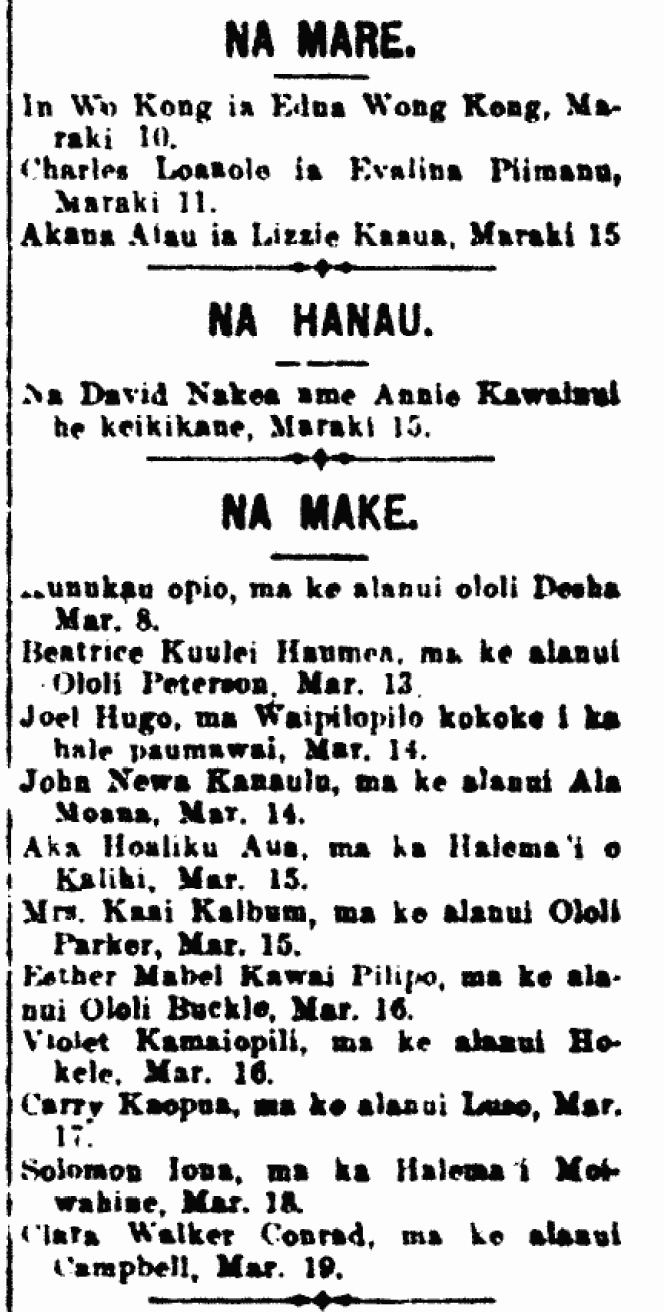
Vital Statistics, 1913.

MARRIAGES.

In Wo Kong to Edna Wong Kong, March 10.
Charles Loaaole to Evalina Piimanu, March 11.
Akana Aiau to Lizzie Kaaua, March 15.

BIRTHS.

To David Nakea and Annie Kawainui, a son, March 15.

DEATHS.

Kunukau opio, on Desha Lane, Mar. 8.
Beatrice Kuulei Haumea, on Peterson Lane, Mar. 13.
Joel Hugo at Waipilopilo, near the water pump station [hale paumawai], Mar. 14.
John Newa Kanaulu, on Ala Moana Boulevard, Mar. 14.
Aka Hoaliku Aua, at the Kalihi Hospital, Mar. 15.
Mrs. Kaai Kalbum, on Parker Lane, Mar. 15.
Esther Mabel Kawai Pilipo, on Buckle Lane, Mar. 16.
Violet Kamaiopili, on Hotel Street, Mar. 16.
Carry Kaopua, on Luso Street, Mar. 17.
Solomon Iona, at Queen’s Hospital, Mar. 18.
Clara Walker Conrad, on Campbell Avenue, Mar. 19.

(Kuokoa, 3/21/1913, p. 8)

NA MARE. / NA HANAU. / NA MAKE.

Ka Nupepa Kuokoa, Buke VL, Helu 12, Aoao 8. Maraki 21, 1913.

The passing of Kaimi Nakapaahu, 1920.

KAIMI NAKAPAAHU.

KAIMI NAKAPAAHU, MY DEAR BROTHER, HAS GONE.

Mr. Solomon Hanohano, Editor of the Kuokoa, Aloha oe:—May your patient heart welcome these tears of love for my dearly beloved brother who has left his wife and their beloved lei, a daughter, as well as his brothers and sisters in great sadness for him.

The supportive bond within has been severed, we are heavyhearted to inform the many friends and companions of my beloved brother who passed, from the Kumukahi where the sun rises to the setting of the sun at the pleasant base of Lehua.

Aloha, much aloha for my brother who has gone afar; no more shall we see your face, you are gone forever.

My shock was immense at hearing the sad news, told to me, his sister, that my beloved brother had passed.

We did not witness his last breath; he carried alone his illness, and it is his death that revealed this to us, and we were beset with sadness and regret, we who were of the same womb [pupuu hookahi], as well as his companion, his wife, and the neck lei of my brother’s that he was to wear until grown [his daughter], we grieve for him in this world of much suffering.

He was born of the loins of Mr. and Mrs. Luka Nakapaahu, our parents, on June 22, 1884, at Waimea, Kauai; and died at Hilo Hospital on the 28th of February.

He was employed by the inter-island ferry as a sailor, with the thought that then he’d be able to see the famous land of Hilo, but here the life breathe of my beloved brother was taken away and he was returning as a corpse to his birth land of our ancestors and parents who went before him to the other side.

Aloha, aloha for the body of my beloved brother who has gone afar, travelling alone on your billows, O Alenuihaha, and arriving at the land of the Kukalahale rains [Oahu], being kept at Mr. Williams’ place; and then once again carried by the Kinau by which I brought the body of my beloved brother atop the shifting billows of Kaieie; no more will you moisten his young face with your sea spray for all times.

My brother and I arrived at Nawiliwili on the 12th of March, and we remained patiently aboard the Kinau until the most of the passengers disembarked, leaving just me and my brother, and when the freight was done with for that place where our kupuna lived, [?? pau na mili ana ia holo aku o kauanoe o Koloa, kahi i wahi,] for it was perhaps not known that I had an important delivery, and with tears, the ship went on to and stopped at Makaweli, and when the freight there was taken care of, i thought of seeing my elder siblings and our younger siblings waiting for me bringing back our beloved brother; the Kinau entered Waimea at 5 in the evening, and made way for the sands of Luhi; how sad, Kaimi Nakapaahu will no longer tread on your soft sands, O Waiula and Waikea; he will no more swim in those wondrous waters of the land.

We were let off; waiting patiently for us were his wife and child, along with our older siblings and our younger ones.

We reached the house, he was laid out, and we saw his face and were struck with much aloha and regret; on the following 13th, his funeral was carried out by Mr. H. M. Nawai, and we took his body and put it to rest by the side of our beloved father; and the words of the Great Book came to pass: man’s life is vapor that appears and vanishes.

We give our thanks to the inter-island ferry [moku holo piliaina]  for agreeing to return the body of my beloved brother who has gone afar, to his land of birth to lie with our father.

Aloha, aloha my brother who has travelled alone on your two seas, O Hawaii.

We give thanks to everyone who came and stayed up with our beloved one the whole night, as well as those at the grave of our beloved who acted with loving hearts.

I will conclude here; it is God who bring solace to our never ending aloha, as well as for his wife who is left without, and their child who is without a father.

Me, with grief, his beloved sister,

KANIO NAKAPAAHU.

[Another example of how Hawaiian-Language Newspapers provide information not found anywhere else—From what i can tell, the only information about Kaimi Nakapaahu is based off of “The Cole-Jensen Collection : Oral genealogies and genealogical information collected from the Polynesian peoples and from the Pacific Islands.” in Utah. Here however in the announcement by his sister, we have a personal account, with much more added information, not to mention a picture!

I am certain that the picture in the original newspaper is much clearer, and this is yet another reason to have the Hawaiian-Language Newspapers scanned clearly!]

(Kuokoa, 4/2/1920, p. 3)

KAIMI NAKAPAAHU, KUU KAIKUNANE ALOHA, UA HALA.

Ka Nupepa Kuokoa, Buke LVIII, Helu 13, Aoao 3. Aperila 2, 1920.